Do Other States Honor Colorado Registration?
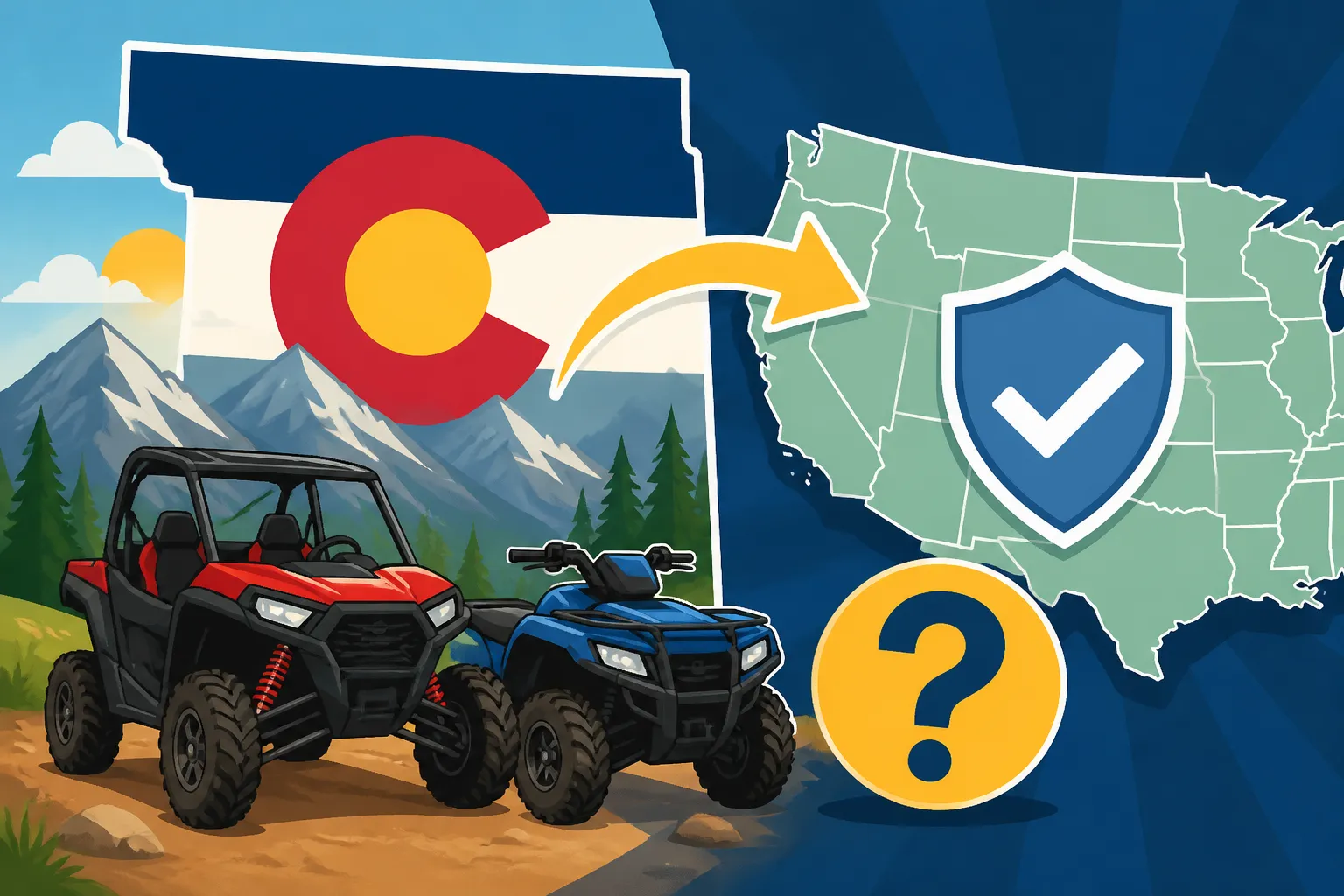
A Colorado OHV registration does not automatically give you permission to ride in every other state. The destination may recognize it, require a separate nonresident permit, or apply different rules depending on where you ride. The key is to distinguish registration from a riding permit and from a street-legal plate, then check the rules for your machine and destination before you travel.
The Short Answer: Sometimes, but Do Not Assume
Other states set their own requirements for off-highway vehicles. A Colorado registration may help show that your machine is properly registered in Colorado, but it is not a universal pass for out-of-state trails, public lands, or roads. Whether it satisfies a destination state’s requirements depends on that state’s current rules and the land manager’s requirements.
Some jurisdictions may accept an out-of-state registration or permit as an exemption from buying a local permit. Others may require visitors to purchase a nonresident OHV permit even if their machine is registered at home. Some places may have no separate permit requirement for a particular riding area, but still enforce rules about access, equipment, age, or operating behavior.
The practical answer is: check the rules where you plan to ride, not just the paperwork you have at home. Reciprocity can be limited. It may apply only to certain classes of vehicles, certain public lands, or particular permit programs. A rule for state trails might not apply on federal land, a county road, or a privately managed recreation area.
Colorado’s own system is useful context. Colorado registration is administered for OHV use in Colorado; it is not the same thing as a street-legal license plate. For an overview of what the state registration covers, see Colorado Parks and Wildlife OHV Registration Explained. If you are trying to understand how home-state paperwork and local permission differ, Colorado OHV Permit Reciprocity With Other States is also relevant—but the destination’s rules still control your trip.
| What you have | What it generally shows | What it does not automatically provide |
|---|---|---|
| Colorado OHV registration and decal | The machine has Colorado OHV registration for the applicable period | Permission to ride everywhere outside Colorado |
| A permit from another state | Authorization under the conditions set by that permit program | Access to closed routes or exemption from other rules |
| A road-legal plate | Registration for road use under the issuing jurisdiction’s rules | Automatic permission to use every OHV trail or riding area |
| A title or bill of sale | Evidence related to ownership | A riding permit or authorization to use public land |
Think of reciprocity as a possible shortcut in a specific program, not as a general agreement that makes Colorado paperwork valid everywhere. Even if another state recognizes your Colorado registration, that recognition may not waive local rules for a particular trail network or public land unit.
Registration, Permit, and Plate Are Different Things
People often use “registration” and “permit” as if they mean the same thing. In practice, they can serve different purposes. Understanding those differences can prevent a frustrating surprise at a trailhead.
Colorado OHV registration
Colorado OHV registration is tied to the state’s OHV program and is represented by registration documents and a decal. It is not equivalent to a road license plate. It also does not automatically authorize riding on private land without permission or on a route closed to motorized use.
Registration details can change with the registration period, and documents may have different uses depending on where and how you ride. For Colorado-specific questions about what belongs with a machine, see Do You Carry Paperwork on the Trail?. For the distinction between ownership documents and state registration, Do You Need Both a Title and a Registration in Colorado? can help clarify the separate roles.
A destination-state permit
A destination may require its own OHV permit for visitors, even when the machine is registered in Colorado. Such a permit may be required for a particular state trail system, riding area, or class of vehicle. It may also be limited to a defined period or route network.
A permit is not a substitute for checking access. A valid permit does not make a closed trail open, turn private property into public access, or override seasonal closures. Nor does it necessarily satisfy separate land-manager requirements. If your trip includes more than one jurisdiction, check each one independently.
A road-legal plate
A plate issued for road use is different from Colorado OHV registration. A machine that is plated in one state may still face restrictions in another state, especially when it is being used on public roads or OHV routes. The destination may have rules about the vehicle’s classification, equipment, operator qualifications, and which roads or trails it may use.
Do not assume that a machine’s plate settles the OHV permit question either. Some places have separate requirements for plated vehicles using designated OHV areas. For Colorado examples of this distinction, see Colorado Rules for Out-of-State Street-Legal Machines and Colorado Permits for Plated Jeeps. They illustrate why a plate and an OHV permit should be treated as separate questions rather than interchangeable documents.
Ownership paperwork
A title, bill of sale, or other proof of ownership can be important if an agency asks about the machine. But these documents do not normally serve as riding authorization by themselves. Keep ownership paperwork separate in your thinking from registration, permits, and road-use documents.
How to Check Reciprocity Before You Travel
A few minutes of checking before departure can prevent a wasted trip or an avoidable citation. Start with the exact place you plan to ride, rather than searching only for general information about the state.
-
Name the destination precisely. Write down the state, trail system or recreation area, and the managing agency if you know it. A state may have different requirements for its own trails, federal land, county roads, and private recreation areas.
-
Identify your machine’s status. Note whether it has Colorado OHV registration, a road-legal plate, or both. Include its vehicle type—such as an ATV, UTV, or dirt bike—because rules and exemptions may differ by class.
-
Find the destination’s official permit and registration rules. Look for instructions aimed at nonresident riders. Check whether an out-of-state registration is accepted, whether an additional permit is required, and whether any exemption applies to your machine. If the language is unclear, contact the agency or land manager responsible for the riding area.
-
Check the exact land and route rules. A permit may cover one riding area but not another. Confirm that your intended routes are open to your type and width of machine, and check seasonal closures, access restrictions, and any local operating requirements.
-
Verify what documents and decals to carry or display. Requirements may involve proof of registration, a permit, a decal, or other paperwork. Ask where a decal must be placed and whether digital documents are accepted in the field. Do not assume a photo on your phone will replace a required physical document.
-
Check the permit’s dates and coverage. Confirm that it will be valid for the dates you will ride and covers the locations on your itinerary. If you are crossing into another state or changing land managers, repeat the check for the next jurisdiction.
-
Keep confirmation with your trip records. Save the official page or written response that explains the requirement, along with purchase confirmation for any permit. Keep the required physical items accessible, too; a saved page is useful context, not a substitute for a permit if one is required.
Colorado riders planning to cross a state line may also find Riding a Colorado Machine in Another State useful for thinking through the move from home-state paperwork to destination rules. If you are coming the other way, Out-of-State Machines on Colorado Trails covers the reverse situation. The same principle applies: a machine’s home registration and the destination’s ride authorization are separate checks.
Common Trip Situations and What to Do
Your Colorado-registered ATV is going to another state’s trail system
Start by checking the trail system’s nonresident requirements. Do not rely on a general statement that the state “recognizes” Colorado registration unless it clearly applies to your vehicle and the specific area. Ask whether recognition means you are exempt from buying a local permit, or whether your Colorado registration is simply accepted as proof of home registration while a local permit is still required.
Also check whether the trail system has vehicle-size limits or other access conditions. A permit does not guarantee that every route is suitable or open to every machine. If you are riding with friends who have different vehicle types, check the rules for each vehicle rather than assuming one answer covers the group.
Your machine has a plate as well as Colorado OHV registration
Having both documents can make the situation more complicated, not less. Determine which status the destination uses to classify the machine on the route you want to ride. A plate may matter for road use, while a separate permit may apply to an OHV area. The machine’s road-use status in Colorado does not necessarily determine how another state treats it.
Check whether the destination distinguishes between plated and unplated machines, and whether the plate must be issued by the state where the machine is registered or meet other conditions. If the route includes public roads, verify road access separately from trail access.
You are riding on federal land outside Colorado
Federal land does not mean one simple set of OHV permit rules. The relevant land manager and the specific area can determine which permits, stickers, or documents are needed. A state’s registration or permit may be recognized in one place and not in another. Confirm the requirements with the office responsible for the land and check the area’s route designations and closures.
Do not rely only on a map app or a friend’s description of a route. Verify that motorized use is allowed on the route and that your vehicle class is permitted. Route status, seasonal gates, and local restrictions can matter as much as the registration question.
You are only passing through
A short ride or a brief stop does not necessarily create an exception. If you plan to ride at a staging area, trail, or public riding area along the way, check the rules for that location. If the machine stays on a trailer and is not operated, that is a different situation from unloading and riding—but do not infer that a particular permit rule applies without checking.
If your route crosses a public road while riding, road-use rules may apply even when the destination is an OHV trail. Confirm the permitted crossing or connection, rather than assuming a trail permit makes the entire route legal.
You are visiting Colorado on another state’s registration
Reciprocity also matters in the other direction. An out-of-state registration does not automatically establish that a machine may be used on every Colorado trail or riding area. Colorado has its own permit and access requirements, and a road-legal plate does not necessarily replace an OHV permit where one is required. For a Colorado-specific overview, see Colorado Non-Resident OHV Permit Explained.
That is why travelers should confirm requirements in both directions. A Colorado decal may not be enough for a trip elsewhere, and another state’s registration may not be enough for a ride in Colorado. The destination’s current rules are the deciding factor.
What to Carry and What to Confirm at the Trailhead
Before unloading, match your paperwork to the trip. Carry the registration documents required for your machine, any destination permit, and proof that the permit applies to the area and dates you are using. If the agency requires a physical decal or display, make sure it is attached as directed. A purchase receipt alone may not satisfy a display requirement.
Keep a record of the route and the authority that manages it. This can be especially useful when a ride crosses state, county, or land-management boundaries. A route may switch from a designated trail to a road or another agency’s land without an obvious change in scenery. Check signs and posted closure information as you go, and turn around if the route is closed or the rules do not match your machine.
If officials or staff ask about your documents, be prepared to show what you have and explain which area you are riding. Avoid arguing from a general reciprocity claim; if the rule is uncertain, ask the agency before the trip. The safest planning assumption is that a Colorado registration proves Colorado status, while the destination decides whether that status is enough for its own riding requirements.
Disclaimer
This article is for general informational purposes only and does not constitute professional advice. Laws, prices and regulations vary by location and change over time. Consult a qualified professional for guidance on your specific situation.