Fines for Riding Without a Colorado Permit
Riding without the required Colorado OHV registration or permit can lead to a citation, but the exact consequence depends on what you were riding, where you were riding, and which rule was involved. The key is to work out which document applies before heading out—and what to do if an officer says yours is missing.
Which Colorado permit or registration applies
Colorado’s OHV rules distinguish between registration for many Colorado machines and a permit for machines registered elsewhere. The terms are sometimes used loosely, but buying the wrong one can leave you exposed to a citation.
For a Colorado-owned ATV, dirt bike, or many side-by-sides used on public land, the relevant requirement is generally Colorado OHV registration. A machine registered in another state generally needs a Colorado nonresident OHV permit when it is used where Colorado requires one. A regular vehicle plate is not automatically a substitute for an OHV permit on a route where that permit is required.
The rule can also depend on the place and the vehicle. A street-legal Jeep, truck, or plated side-by-side may be subject to OHV permit rules when it enters a designated OHV area or trail. Do not assume that road registration alone answers the question; check Why Plated Vehicles Still Need a Colorado Permit and confirm the requirement for the specific route.
| Your situation | Document to check | Why it matters |
|---|---|---|
| Colorado machine used on public land | Colorado OHV registration | Registration is generally the relevant credential for Colorado OHVs |
| Machine registered in another state | Colorado nonresident OHV permit | A home-state registration or permit may not satisfy Colorado’s requirement |
| Plated, street-legal vehicle entering an OHV trail or area | Colorado OHV permit rules for that route | A license plate may not replace an OHV permit |
| Machine used only on private property | Whether the property and use qualify for an exemption | Public-land requirements may not apply, but other rules can still matter |
| Rental or borrowed machine | What the owner or rental provider has supplied | Do not assume someone else’s paperwork covers the machine or route |
If you are visiting from out of state, Which Colorado Permit an Out-of-State Rider Buys explains the basic choice. For a wider overview of the registration system, see Colorado Parks and Wildlife OHV Registration Explained. Colorado permit rules can change, and access requirements may differ by land manager, so verify the current rules before your trip.
A valid registration or permit does not give you permission to ride anywhere. The route still needs to be open to your vehicle type, and you must follow signs, closures, and local restrictions. Colorado Permit Rules on Public Land is useful for separating the permit question from the question of where riding is allowed.
What can happen if you ride without one
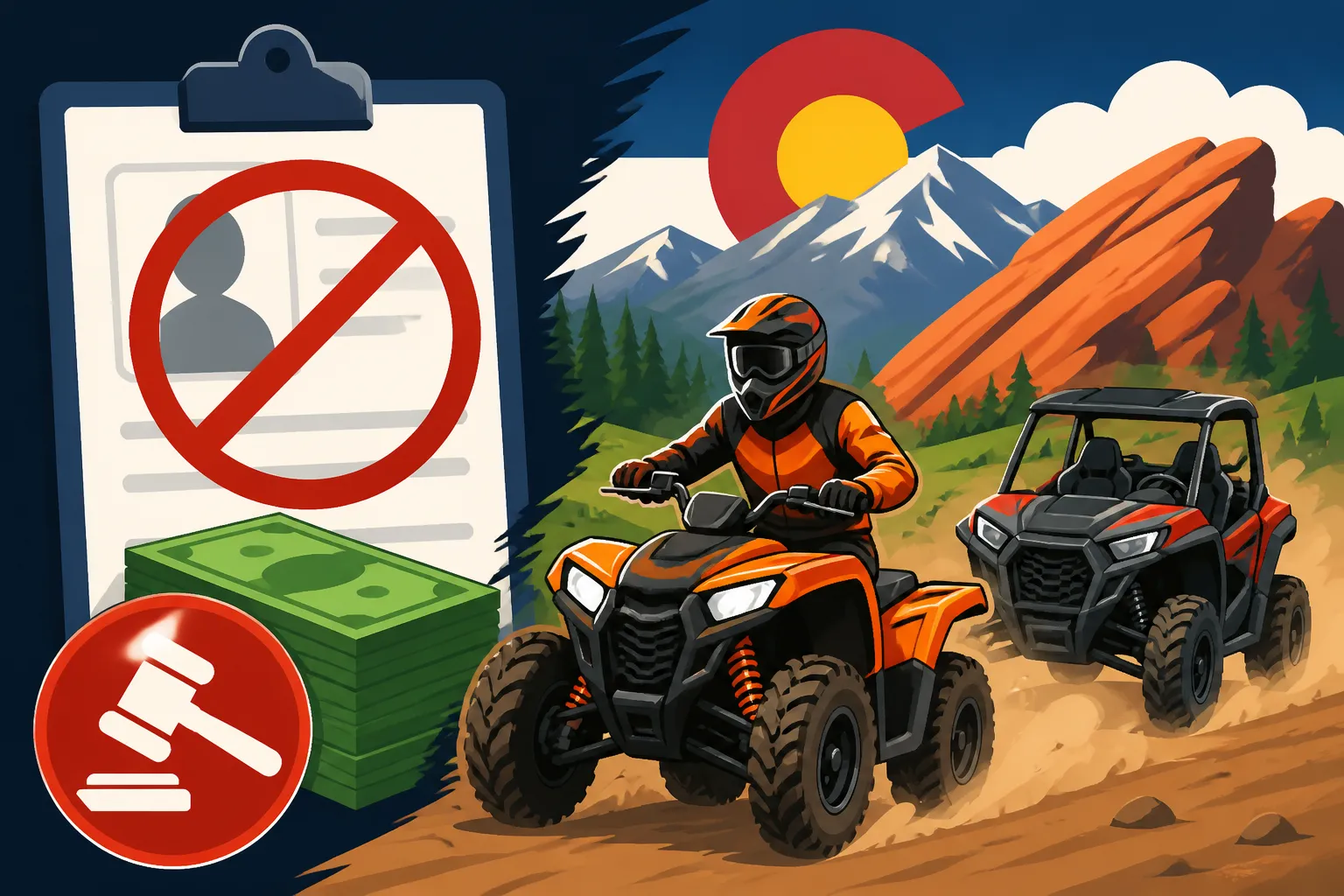
If you are riding in a place where a Colorado registration or permit is required and cannot show that you have the right one, an officer may issue a citation. The citation can require you to respond or pay through the process stated on the paperwork. Depending on the circumstances, additional court costs or other consequences may apply. The amount and process are not safe to guess: they can depend on the specific violation, the issuing authority, and current rules.
A missing permit is not necessarily the only issue an officer may address. For example, riding on a closed route, leaving a designated trail, entering private property without permission, or violating a separate equipment or road-use rule can create additional violations. Those are distinct from simply lacking the required OHV credential, and a permit would not make the underlying conduct legal.
A stop may also take time while an officer checks the machine, its identification, and the paperwork. If you cannot establish that you have the required credential, you may need to stop riding until the issue is resolved. Do not count on being allowed to buy a permit at the trailhead and continue without consequence; the officer decides how to handle the situation under the applicable rules.
The practical risk is not limited to the fine. A citation can disrupt a trip, create follow-up paperwork, and complicate later interactions if other violations are involved. The best approach is to settle the permit question before unloading the machine, especially when your route crosses public land, an OHV trail network, or roads with separate local rules.
There is no useful universal answer to “How much is the fine?” without knowing the exact citation and current schedule. Check the official information from the issuing agency or court for the actual amount, response deadline, and available options. If the ticket lists a violation you do not understand, use the statute or regulation cited on the paperwork rather than relying on a general online summary.
Why riders get cited, and how to avoid the problem
Most permit-related problems begin with an assumption: that a home-state sticker works in Colorado, that a license plate replaces an OHV permit, or that a machine kept on private property never needs documentation. Some assumptions may be right for a particular situation, but they are not reliable substitutes for checking the rules tied to the machine and route.
Confirm the machine’s status before the trip
Identify whether the machine is Colorado-registered, registered in another state, or plated for road use. Then check which Colorado credential applies to that status. If the machine belongs to someone else or is rented, ask what paperwork is provided and whether it covers the Colorado use you have planned. A rental agreement is not proof that the required permit is current.
For a multi-machine trip, check each vehicle separately. One rider’s permit does not automatically resolve the paperwork for another machine. Keep the registration card or permit information available in the way the issuing agency requires, and make sure the decal or other proof is displayed as directed. Instructions may differ by credential and vehicle type, so follow the current placement guidance rather than copying another rider’s setup.
Check the exact route and land manager
A county road, a Forest Service road, a designated OHV trail, and a private road are not interchangeable. A route can cross different jurisdictions, and a local closure or access restriction can apply even if your registration is valid. Look at current maps, posted signs, and official closure information before setting out. For a relevant land-use issue, Colorado Trails Closed to Motorized Use explains why route status matters separately from paperwork.
Also check whether your trip involves a state park, event, or other area with additional access conditions. An OHV permit may satisfy one requirement while leaving another pass, permission, or event authorization outstanding. If you are unsure whether a private-land exemption applies, do not extend it to nearby public routes; see Do You Need a Permit on Private Colorado Land?.
Keep evidence easy to reach
Carry or store the required paperwork so you can produce it during a stop. Confirm that the details match the machine and that the registration or permit has not expired. For a Colorado registration, Colorado OHV Registration Year Runs April to March can help you understand the registration period, while When a Colorado OHV Registration Expires focuses on checking expiration. If a document is missing or the record appears wrong, resolve that before riding rather than hoping an officer can sort it out trailside.
A few minutes of checking can prevent a confusing encounter:
- Identify the machine’s registration and plate status.
- Confirm the Colorado credential required for that machine and route.
- Check that the credential is current and associated with the correct machine.
- Verify route access, closures, and any additional land-manager requirements.
- Carry the required proof and follow the decal-display instructions.
If you are stopped, remain calm, follow lawful instructions, and provide the paperwork you have. If you believe the citation is incorrect, note the location, the route, the machine details, and what the officer said. Keep the citation and any relevant registration or permit records. Do not argue roadside about the legal interpretation; use the response process printed on the citation. Appealing an OHV Citation covers the next steps if you decide to challenge it.
If you receive a citation
Read the citation carefully before paying or taking other action. It should identify the alleged violation and explain how to respond. Pay particular attention to any deadline, required appearance, or instructions for contacting the issuing agency or court. Missing a response deadline can create a separate problem, so confirm the process with the authority named on the paperwork.
Check whether the allegation is specifically about lacking a Colorado permit or registration, or whether it includes another alleged violation. If several issues are listed, address each one. A permit purchased after a stop may help you comply going forward, but it does not necessarily cancel a citation for riding without one earlier.
Gather records that relate to the alleged violation: proof of registration or permit, purchase confirmation, machine details, and information about where and when you were riding. If you believe the document was valid, check that it applied to the correct machine, was current on the date of the stop, and covered the type of use involved. If there is a genuine error, follow the official correction or appeal procedure rather than relying on an informal conversation.
For a disputed or serious citation, a qualified attorney can explain the consequences and options under the rule cited. Do not assume that every OHV ticket has the same fine, deadline, or appeal process. Use the citation and the current instructions from the issuing authority as the source for those details.
The simplest way to avoid a permit citation is to match the right credential to the machine, verify the route, and carry proof before riding. A valid permit is only one part of a lawful trip, but it is a part you can usually check before leaving home.
Disclaimer
This article is for general informational purposes only and does not constitute professional advice. Laws, prices and regulations vary by location and change over time. Consult a qualified professional for guidance on your specific situation.