Youth Riders at an Open Riding Area
Taking a child to a Colorado open riding area raises two separate questions: whether the rider may use that kind of terrain and whether the machine fits their ability. The answer can change when a route enters a public road or a site has its own restrictions. Here’s how to separate statewide rules from area-specific requirements and plan a safer ride.
What Colorado’s youth rules mean at an open riding area
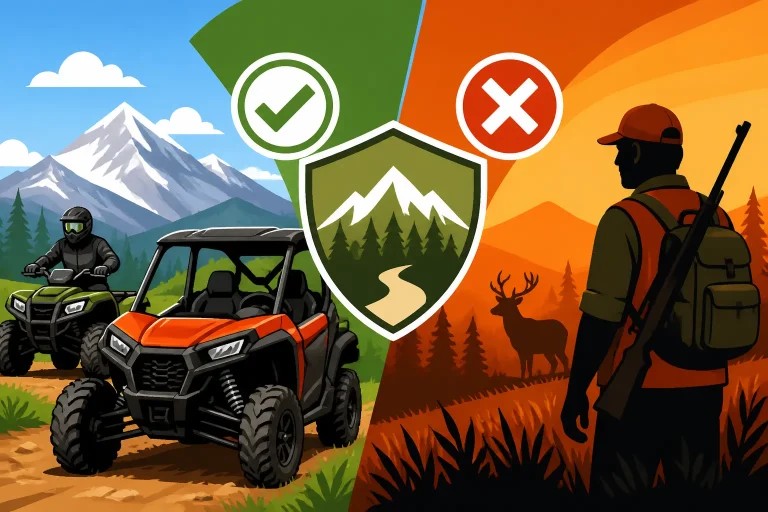
An open riding area is land where off-highway vehicle use is allowed, subject to the land manager’s rules. It is not automatically the same as a road open to OHVs. That distinction matters because Colorado’s age rules for riding on certain public roads should not be treated as a blanket minimum age for every off-road trail or riding area.
Colorado’s age-ten rule concerns operating an OHV on a public road that has been opened to OHVs. A child who is too young to operate on that road may still be able to ride in an area away from public roads, depending on the land manager’s requirements and other applicable rules. If an open riding area includes road sections, check those separately before the trip. Colorado’s Age Ten Rule for Riding an Opened Road explains the road-specific distinction.
There is no good reason to assume that the word “open” means “no restrictions.” A recreation area may have limits on vehicle type, width, route, season, or rider conduct. Some routes within a larger area may be closed, and a signed route can have different rules from nearby terrain. Check the current map and notices for the specific site, then stay on routes open to the youth rider’s machine.
It also helps to separate three kinds of requirements:
- State rules: These may cover items such as permits, road use, equipment, and youth operation.
- Land-manager rules: The agency or property manager may set additional access limits, closures, and operating conditions.
- Safe riding practice: Close adult supervision, a suitable machine, and conservative route choices are prudent even when a rule does not spell out every detail.
For the road-specific age and supervision requirements, see Colorado Supervision Rules for Riders 10 to 16 and Riders Under 10 on Colorado Public Roads. Do not use those road rules as a substitute for checking what applies at an off-road riding area.
Check the site before you load the machines
Identify the actual riding area and the routes you plan to use, rather than relying on a broad description such as “open land.” Confirm that the area allows your kind of vehicle, whether it is an ATV, dirt bike, or side-by-side. Look for posted restrictions on youth riders and any conditions attached to a route.
If the ride could leave the designated riding area or connect to a county road, stop and check that segment’s rules. A route that appears to continue naturally may cross into land with different access rules. Where the rules are unclear, choose a route with clear authorization instead of treating an uncertain connection as permission.
For riding on private land, obtain permission from the landowner and follow any conditions they set. Public-land access and private-land permission are not interchangeable. Written Permission Before Riding Private Land covers the permission question in more detail.
Choose a machine the young rider can control
A machine that is technically available to a child is not necessarily a good match. The rider needs to understand the controls, reach them comfortably, and operate the vehicle without depending on an adult to correct every mistake. Age alone cannot show whether a young rider is ready for a particular machine or trail.
Before a ride, consider the child’s size, coordination, attention, experience, and ability to follow directions. Look at the machine’s owner’s manual and safety labels for the manufacturer’s age guidance. Those recommendations are important, but they do not replace Colorado rules or a riding area’s restrictions.
Do not choose solely by engine size or by the child’s willingness to try a larger vehicle. A more powerful machine can accelerate quickly, carry more speed into a turn, and be harder to manage on uneven ground. A machine that is too large may also make it difficult for a rider to reach the controls or respond promptly.
| What to check | Signs the machine may fit | Reasons to choose a smaller or different machine |
|---|---|---|
| Reach and control | Rider can reach and use the controls comfortably | Rider stretches, shifts awkwardly, or cannot operate controls reliably |
| Starting and stopping | Rider can start, stop, and maintain a controlled pace | Rider struggles to stop smoothly or mistakes the controls |
| Turning and terrain | Rider can make controlled turns on suitable ground | Rider loses control on turns, slopes, or loose surfaces |
| Rider position | Rider can sit in the intended position and keep a stable posture | Rider slides, reaches, or cannot stay positioned securely |
| Vehicle capacity | Machine is designed for the intended rider and load | Rider or passenger exceeds the machine’s intended use or seating |
For an ATV, confirm that the vehicle is designed for one rider if it has a single seat. Do not carry a passenger on a single-rider quad. For a side-by-side, use only designated seats and make sure each rider can sit properly and use the restraint system. A child who is too small to fit the seat and restraint as intended should not be carried just because there is an open space.
If a child is new to riding, begin on level, open ground where the adult can explain the controls and observe the rider closely. Practice stopping, turning, and slowing down before moving onto a longer route. Increase difficulty gradually; a young rider who can manage a flat practice area may still need help judging loose gravel, ruts, steep grades, or narrow trails.
For machine-size considerations, see Youth Machine Size Rules Colorado Parents Ask About and Engine Size Limits for Colorado Riders Under 16. These topics can help frame the choice, but check the actual machine’s manual and the riding area’s rules rather than treating a general size chart as a legal authorization.
Supervision should match the terrain
Close supervision is a practical safety measure for youth riders, even where an off-road area does not impose the same age rule as a road. Keep the adult close enough to see the rider and intervene if needed. A distant adult following behind a group may not be able to help quickly when a child gets into trouble.
Set simple boundaries before riding: where the child may go, what to do if they lose sight of the group, and when to stop. Agree on signals and regrouping points. On a narrow or busy route, keep the youth rider in a position where the adult can monitor them without blocking other riders or creating a hazard.
Choose terrain that leaves room for mistakes. Avoid routes where a small error could send a rider down a steep slope, into a drop-off, or into oncoming traffic. A child’s first ride is not the time to test the limits of a machine or attempt a difficult route because other riders are doing it.
Permits, equipment, and a pre-ride check
Youth riders do not remove the machine’s permit or registration obligations. Before operating on public land, confirm what authorization is required for the machine and who must obtain it. A Colorado resident’s machine may require Colorado OHV registration; an out-of-state visitor may need a Colorado nonresident OHV permit. The details can depend on the machine, the rider’s circumstances, and where it will be used.
Do not assume that a registration or sticker from another state automatically satisfies Colorado’s requirements. Reciprocity is a specific question, not something to infer from a machine having an out-of-state plate or decal. Check Colorado OHV Permit Reciprocity With Other States and Colorado Non-Resident OHV Permit Explained if you are visiting with an out-of-state machine.
A permit attached to the machine is also not a substitute for checking where that machine may operate. Confirm the rules for the open riding area, carry or keep accessible any required documentation, and make sure the permit or registration is valid for the planned use. For help identifying the authorization for your situation, see Which Colorado Permit an Out-of-State Rider Buys.
Protective gear and a quick mechanical check matter just as much as the paperwork. Youth riders should have a properly fitted helmet and suitable eye protection, along with clothing that covers exposed skin and footwear that stays secure on the vehicle. Check current Colorado requirements for helmets and eye protection, especially when riding with passengers or on a route that includes a road. A helmet that shifts, pinches, or blocks vision is not a good fit.
Before leaving the staging area:
- Confirm access. Check current area notices, maps, seasonal closures, and route restrictions. Make sure the selected route suits the vehicle and the youth rider.
- Confirm the permit or registration. Verify that the machine has the required Colorado authorization for the location and type of use.
- Inspect the machine. Check brakes, throttle, tires, steering, lights where needed, and any required safety equipment. For a side-by-side, check restraints and doors or nets if fitted.
- Fit protective gear. Check the helmet fit and fastening, eye protection, gloves, sturdy footwear, and layers suited to the weather.
- Explain the plan. Tell the young rider where the group is going, what signals to use, and what to do if separated or if the machine stops.
- Start conservatively. Use a suitable practice area and check the rider’s control before continuing to more demanding terrain.
Colorado conditions can change quickly, and an open area may have weather, dust, traffic, or rough ground that makes a route harder than it looks on a map. Be ready to turn around. If the rider is tired, anxious, or no longer responding reliably to instructions, stop the ride rather than pushing on to the planned destination.
A small amount of preparation can make the day smoother. Put the required paperwork and basic supplies where an adult can reach them, and avoid overloading a child’s machine or side-by-side. If shopping for youth protective gear, Amazon may be one place to compare available sizes, but check fit and applicable safety markings in person or against the product details before relying on any item.
The safest planning rule is straightforward: verify the location’s access rules, separate off-road riding from public-road operation, choose a machine the child can control, and supervise closely. If any part of the route or age requirement is uncertain, confirm it with the land manager before unloading.
Disclaimer
This article is for general informational purposes only and does not constitute professional advice. Laws, prices and regulations vary by location and change over time. Consult a qualified professional for guidance on your specific situation.