Ranger Checkpoints at Trailheads
A ranger stop at a Colorado trailhead can be routine, but it is easier to handle when you know which permit applies and can show it without rummaging through your gear. The main complication is that Colorado registration, a nonresident OHV permit and a street-legal plate are not interchangeable. Here’s what to expect and how to prepare.
Why Rangers Check OHVs at Trailheads
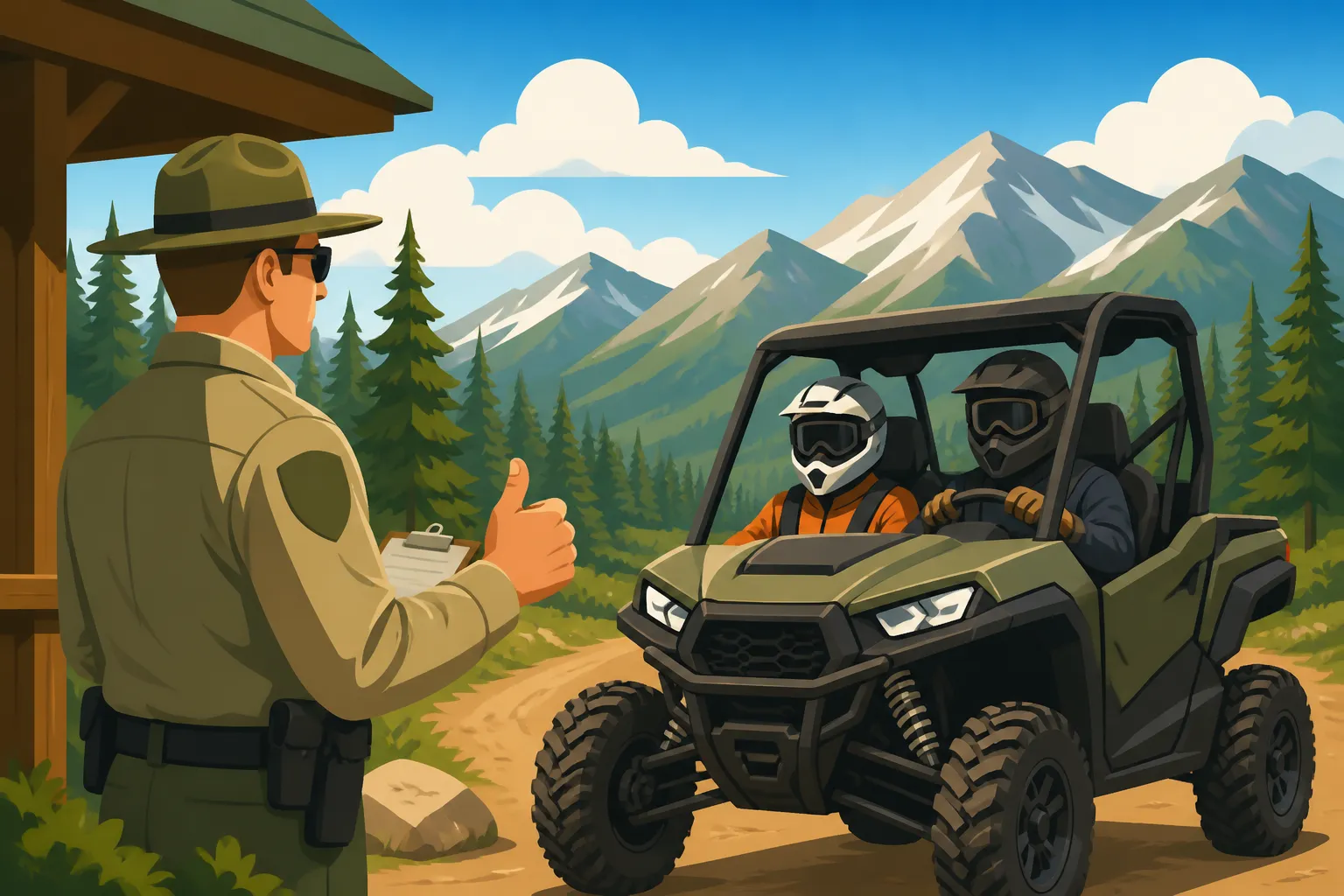
Trailhead checks are generally about confirming that riders and machines are following the rules for the place they are entering. An officer may check permits or registration, ask where you are headed, or look for signs that a machine is being used on a route where it is allowed. A check does not necessarily mean anyone has reported a problem.
The officer may be from Colorado Parks and Wildlife, a federal land agency or another law enforcement agency with jurisdiction in the area. The agency and the rules that apply can depend on whether you are at a state-managed site, on federal land, or using a county or town route. A permit that covers one kind of access does not automatically authorize travel everywhere nearby. Confirm route access and closures before setting out; Colorado Permit Rules on Public Land and Colorado Trails Closed to Motorized Use are useful starting points.
A check may happen as riders arrive, leave, or pass through a staging area. Some trailheads have no checkpoint at all. Enforcement can also happen on a route rather than at its entrance, so seeing no officer at the start is not evidence that a permit or other requirement does not apply.
Officers may check whether the required Colorado document is current and displayed as directed, and whether the machine appears to match the document. They may ask about the machine’s registration or permit status and, where relevant, request proof of ownership or other paperwork. Depending on the route and type of vehicle, equipment and operator requirements may also matter.
A checkpoint is not a substitute for checking the rules yourself. The fact that a machine was allowed through does not necessarily mean every road, trail or nearby town is open to it. Route rules can change at a boundary, and local ordinances may apply on streets that connect public-land routes. See Finding Your Colorado County’s OHV Ordinance and Which Colorado Roads Allow OHVs when your trip includes public roads.
What to Have Ready Before You Ride
The right document depends on who owns or operates the machine, how it is classified, and where it will be ridden. Colorado residents and visitors should not assume they need the same registration or permit. An out-of-state sticker or registration may not satisfy Colorado’s requirements for riding an OHV on public land. Check Which Colorado Permit an Out-of-State Rider Buys before traveling.
| Rider or machine situation | What to confirm before the trip | A common point of confusion |
|---|---|---|
| Colorado resident using an OHV on public land | Whether the machine has the required Colorado registration and whether its identifying information matches | A registration document and a title serve different purposes |
| Visitor bringing an OHV from another state | Whether a Colorado nonresident permit is required and how it must be displayed | An out-of-state registration does not automatically mean Colorado requirements are met |
| Street-legal vehicle entering an OHV area | Whether the vehicle needs a Colorado permit for that specific use and location | A plate does not automatically settle every trail-access question |
| Rented machine | Which permits and documents the rental provider supplies, and what the renter must carry or display | Do not assume a rental contract covers every route or permit |
| Machine on private property only | Whether the ride will remain entirely on private land and whether any public route is involved | Joining a public road or trail may change what applies |
For a Colorado-registered machine, keep the registration information available and check that the displayed decal or other required marking is in place. For a nonresident OHV, read the permit instructions carefully before the ride. A purchase confirmation or receipt may help explain your situation, but do not assume it replaces a required permit display. Colorado Non-Resident OHV Permit Explained covers the visitor permit in more detail, and Where to Put a Non-Resident Permit addresses display.
A title is evidence of ownership; it is not the same thing as permission to ride on a public route. Likewise, a bill of sale can help document a purchase but does not by itself authorize public-land use. If you have recently bought a machine or are carrying one with incomplete records, review Colorado OHV Title Versus CPW Registration and Proof of Ownership for a Colorado OHV before leaving home.
Keep documents protected from water and easy to reach. A secure pouch or folder in the tow vehicle can help keep paperwork together, while the permit or decal itself should stay attached to the machine as instructed. If you use a phone to store copies, treat them as a backup rather than a guaranteed replacement for a document or display the rules require. Cell service may be unreliable, and a screen can be difficult to access with gloves or in poor weather.
Before driving to the trailhead, check the permit’s validity and the route’s current access status. A permit can be valid while a trail is closed, and an open trail does not remove permit obligations. For visitors, Colorado OHV Permit Reciprocity With Other States explains why a permit or registration from home should not be assumed to carry over. If your vehicle has a plate, check the separate rules for plated machines, including Why Plated Vehicles Still Need a Colorado Permit.
How to Handle a Check
Stay calm, stop where directed, and give the officer room to approach safely. Turn off the machine if asked or if doing so is needed to communicate safely. Keep your hands visible and avoid reaching abruptly into a bag, vehicle or storage compartment. If a document is packed away, say where it is and ask before retrieving it.
Answer questions clearly and stick to what you know. If you are unsure whether a permit applies to a particular vehicle, do not guess or argue from an assumption that another state’s paperwork is enough. Show the documents you have and ask what requirement the officer believes applies. If you disagree with a citation or direction, it is generally more useful to document the details and follow the stated process for challenging it than to escalate the conversation at the trailhead.
A practical routine is:
- Confirm the machine’s classification and the route you plan to ride.
- Check current permit, registration, display and access requirements with the relevant agency.
- Make sure documents and permit markings are present, readable and consistent with the machine.
- Keep the documents accessible, and check that every rider in the group knows where they are.
- Follow instructions during a stop, then make a note of the location, agency and issue if you need to clarify a requirement later.
If a permit appears to be missing or a record does not match the machine, do not assume an officer can resolve it at the trailhead. Ask what official source or office can confirm the next step. If the issue concerns a nonresident permit, start with Colorado Permit Vendors and License Agents or Buying a Colorado OHV Permit Online. For a registration problem, use the appropriate Colorado registration channel rather than treating a receipt, another state’s decal or a title as an automatic substitute.
Avoiding Problems on a Mixed-Route Trip
A trip that starts on a public-land trail may also include county roads, town streets, private land or a route managed by another agency. Each segment can have its own restrictions. Check the complete route instead of relying on a trailhead sign or a permit alone. A machine allowed on an OHV trail may not be allowed on a connecting road, and a street-legal vehicle may still face permit rules in an OHV area. Colorado Rules for Out-of-State Street-Legal Machines and Colorado Permit Rules for a Licensed Side-by-Side can help frame those distinctions.
Group rides need a little extra preparation. Do not assume that one rider’s permit covers every machine. Check requirements for each vehicle, including a borrowed or rented machine, and make sure the operator knows the route restrictions. For visitors using their own machines, Colorado Permits for a Second Machine may help clarify whether each machine needs separate documentation. Riders borrowing someone else’s OHV can also review Permits for a Borrowed Machine.
Keep current access information handy, especially when a route crosses agency or county boundaries. Closures, seasonal restrictions and local rules can affect a ride even if your permit is in order. If an officer points out a restriction, ask which route or rule is at issue and record the details once it is safe to do so. That information can help you correct the problem and avoid repeating it on another part of the trip.
The simplest checkpoint preparation is a correctly permitted machine, required markings displayed as instructed, and paperwork you can find quickly. Just as important, know where you are going: a Colorado permit is not a blanket pass for every road or trail, and another state’s registration may not replace a Colorado requirement.
Disclaimer
This article is for general informational purposes only and does not constitute professional advice. Laws, prices and regulations vary by location and change over time. Consult a qualified professional for guidance on your specific situation.