Taking a Colorado Machine to Utah
Taking a Colorado ATV or UTV to Utah raises a practical question: does its Colorado registration let you ride there, or do you need another permit? The answer depends on how the machine is registered, whether it is street-legal, and where you plan to ride. Sort out those details before towing so you can focus on route access and trail rules.
Does Colorado registration work in Utah?
In general, a valid Colorado OHV registration is the credential to check first when taking a Colorado-registered ATV or UTV to Utah. Utah has rules for recognizing out-of-state OHV registrations, and Colorado is a state whose registration may qualify under reciprocity. That can mean you do not need to buy a separate Utah nonresident permit for a machine with current, valid Colorado registration.
Treat that as a starting point, not a blanket exemption. Reciprocity applies to the machine’s registration status, not simply to the fact that it came from Colorado. The type of credential matters, and Utah’s current rules may distinguish among OHVs, street-legal vehicles, and machines from states with different registration systems. Confirm the requirement with Utah’s official OHV authority before you leave, especially if your machine has an unusual registration or plate.
| Your machine’s situation | What to check before riding in Utah |
|---|---|
| Current Colorado OHV registration | Confirm Utah recognizes the registration for your machine type, and bring proof |
| Colorado registration has expired | Renew it or confirm whether Utah requires a nonresident permit |
| Machine has only a Colorado nonresident permit | Do not assume that permit counts as Colorado registration for Utah reciprocity |
| Machine is registered for street use | Check both road legality and the rules for OHV routes and public land |
| Machine has no valid registration | Ask Utah whether a nonresident OHV permit is required before operating it |
| You plan to ride on private land | Get the landowner’s permission and check whether other requirements apply |
The key distinction is between registration and a permit. Colorado residents typically register their OHVs through Colorado Parks and Wildlife. Colorado also has a nonresident permit for certain machines used in Colorado. Those are separate credentials serving different purposes. A Colorado nonresident permit is not automatically proof that an OHV is registered in Colorado, and it should not be treated as a Utah permit. For a fuller explanation of the Colorado side, see Colorado Parks and Wildlife OHV Registration Explained and Colorado OHV Permit Reciprocity With Other States.
A registration sticker alone may not answer every question at a trailhead. Keep the registration card or other proof of current registration with you, and make sure the vehicle identification number on the paperwork matches the machine. A photo of the registration can be a useful backup, but do not rely on a photo if an official rule requires a physical document. Check what Utah accepts before your trip.
If you are unsure which Colorado credential you have, look at the paperwork rather than guessing from the decal. If the machine has a Colorado OHV registration, it is different from a nonresident permit issued for riding in Colorado. If the record is expired, the sticker is damaged, or the owner’s name does not match the paperwork, resolve that before crossing state lines. Riding a Colorado Machine in Another State covers the broader issue of carrying Colorado credentials across state borders.
What to verify before you leave Colorado
The easiest way to avoid a permit problem is to check the documents and the Utah requirement together. Do this before loading up, when there is still time to renew a registration, request a replacement, or buy a required permit.
- Identify the machine’s credential. Check whether it has current Colorado OHV registration, a Colorado nonresident permit, a street-use plate, or no current credential. These are not interchangeable.
- Match the paperwork to the machine. Compare the VIN on the registration document with the VIN on the ATV or UTV. Look for errors in the owner’s name, registration status, and expiration information.
- Confirm Utah’s reciprocity rule for that category. Ask whether a Colorado registration covers your particular kind of machine and intended use. If the machine is not covered, ask whether Utah requires a nonresident permit and how to obtain it.
- Ask what proof to carry. Find out whether Utah expects a registration card, an on-machine decal, a permit, or a combination. Keep the required proof accessible while riding.
- Check access rules for your specific route. A valid registration does not authorize riding on every road or trail. Confirm that your route is open to motorized use and allows your machine’s width and type.
- Check the rules for everyone riding. Age limits, supervision, helmets, passenger rules, and safety requirements can differ by activity and location. Do not assume Colorado rules apply in Utah.
- Recheck shortly before departure. Requirements, closures, and local access conditions can change. Use current official information rather than a saved note from an earlier trip.
If your Colorado paperwork is missing, fix that before traveling. A Colorado replacement process may solve a lost or damaged registration document, but a replacement decal or card is not the same as getting a Utah permit. See Replacing a Lost Colorado OHV Registration if the issue is with your Colorado record.
Registration also does not prove that you own the machine. If you recently bought the ATV or UTV, keep purchase and ownership paperwork available in case the registration record has not yet been updated. For a used machine, Proof of Ownership for a Colorado OHV explains why keeping those records matters.
A Colorado-plated machine needs a separate check. A plate may establish that the vehicle is registered for road use, but it does not automatically mean it can travel on every Utah road or trail. Verify that its road registration is valid for the trip and check whether Utah requires an additional OHV credential for the kind of public-land riding you plan to do. Colorado’s own rules distinguish OHV permits from street-use registration; Colorado Rules for Out-of-State Street-Legal Machines is useful background, but Utah’s rules govern once you are there.
Registration does not grant trail access
A current Colorado registration may address the permit question, but it does not make every Utah route legal. Public land is managed by different agencies, and access can vary by road, trail, season, vehicle width, and land designation. A map that shows a road does not necessarily show that the route is open to your machine.
Before choosing a route, check the current motorized-use map or route information for the land manager responsible for that area. Look for vehicle-width limits, seasonal closures, restrictions on connecting roads, and any rules about staging or parking. Confirm that the route is open to motorized vehicles; hiking and mountain-bike trails are not ATV or UTV routes just because they appear on the same map.
Use local signs as well as maps. A closed gate, closure notice, or sign limiting vehicle type can override an old route file or an online description. If signs or maps seem inconsistent, stop and check with the land manager rather than riding through and sorting it out later. A permit or registration does not protect you from a citation for entering a closed area or leaving a designated route.
Machine dimensions deserve special attention if you are taking a side-by-side. Some routes permit motorcycles and smaller ATVs but not wider UTVs. Measure the vehicle at its widest point, including accessories that affect width, and compare that measurement with the posted limit. Do not rely on what another rider says they drove there; access rules can differ between nearby routes.
Road use is another separate question. An OHV registration is not the same as a license plate that makes a machine street-legal. If you plan to ride on a public road, verify that the road allows your type of vehicle and that the machine meets the applicable equipment and registration requirements. A short connection on a map is still a road segment with its own rules. For the Colorado side of this distinction, see Do You Need Both a Title and a Registration in Colorado?.
Private property has its own limits. Get clear permission from the landowner before riding, and ask which areas and routes are included. Permission to cross a property does not necessarily give permission to use neighboring public land or a road. If a trip combines private land and public routes, check each part separately.
For route planning, a current paper map can help when phone service drops out. If you buy a map online, including through Amazon, check that it covers the right riding area and is current enough to show relevant access information; still compare it with official closure notices before setting out. Carrying a map is a backup, not a substitute for checking the current route designation.
Prepare the machine and plan for the ride
A smooth border crossing is only one part of a good trip. Utah riding conditions, vehicle requirements, and local access rules can differ from what you are used to in Colorado. Prepare for the route you intend to ride, not just the drive to the trailhead.
Carry the registration document and any required permit where you can reach it without unloading the machine. Keep a copy of your ownership paperwork and insurance details separately. If you are towing the ATV or UTV, secure the documents in the tow vehicle and have a backup copy available. Confirm that the VIN and registration details are readable; a faded sticker can create avoidable questions.
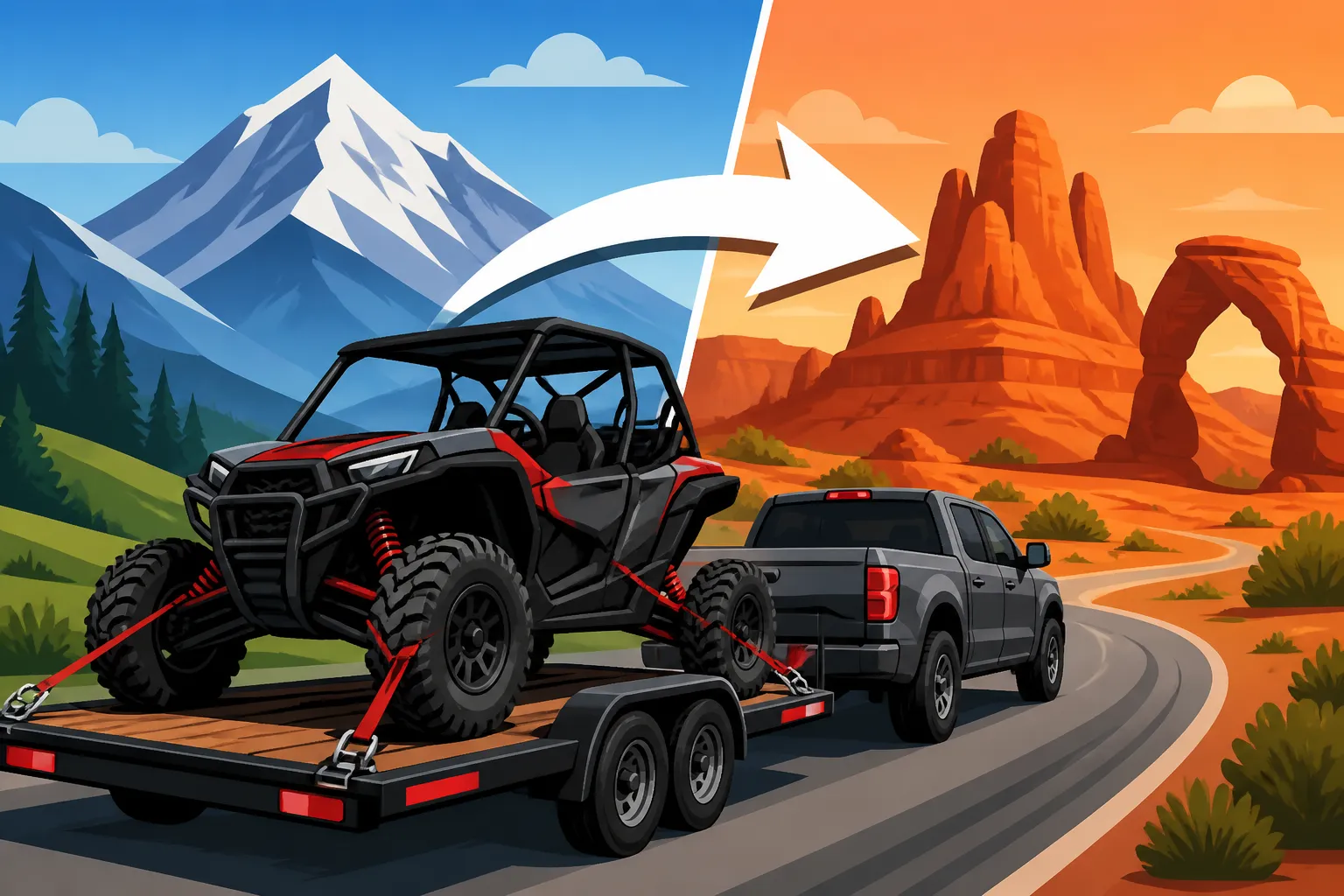
Inspect the vehicle before loading. Check tires, brakes, steering, lights, throttle return, and fuel or battery condition. Look over tie-down points and straps as well. A machine that has sat through a Colorado winter may need more than a quick start before it is ready for a long day on unfamiliar terrain. For hauling advice, Strapping a Machine Down for a Mountain Pass covers the transport side of the trip.
Bring safety equipment that fits the planned ride and current local rules. That can include helmets, eye protection, water, appropriate clothing, a first-aid kit, and basic recovery supplies. A route that looks short on a map can take much longer than expected, especially when it includes rough terrain, slow traffic, or limited cell service. Tell someone where you are going and when you expect to return.
Do not assume a vehicle’s equipment is acceptable everywhere because it passed a check in Colorado. Confirm whether Utah requires a spark arrester, particular lighting, a sound-control device, or other equipment for the land or route you will use. Requirements can depend on the place and type of riding, so verify them for the actual destination.
Finally, save contact details and route information before leaving reliable service. Download maps for offline use, but keep the official source and date of your route check in mind. If a closure appears at the trailhead, follow it even if your downloaded map shows the route as open. Conditions and closures can change faster than printed or saved maps.
A practical rule is to answer three questions before every ride: Is the machine properly registered or permitted for Utah? Is the exact route open to this vehicle? Do the riders and machine meet the requirements for that route? When all three answers are clear, you can head out with much less uncertainty.
Disclaimer
This article is for general informational purposes only and does not constitute professional advice. Laws, prices and regulations vary by location and change over time. Consult a qualified professional for guidance on your specific situation.