Taking a Colorado Machine to Wyoming
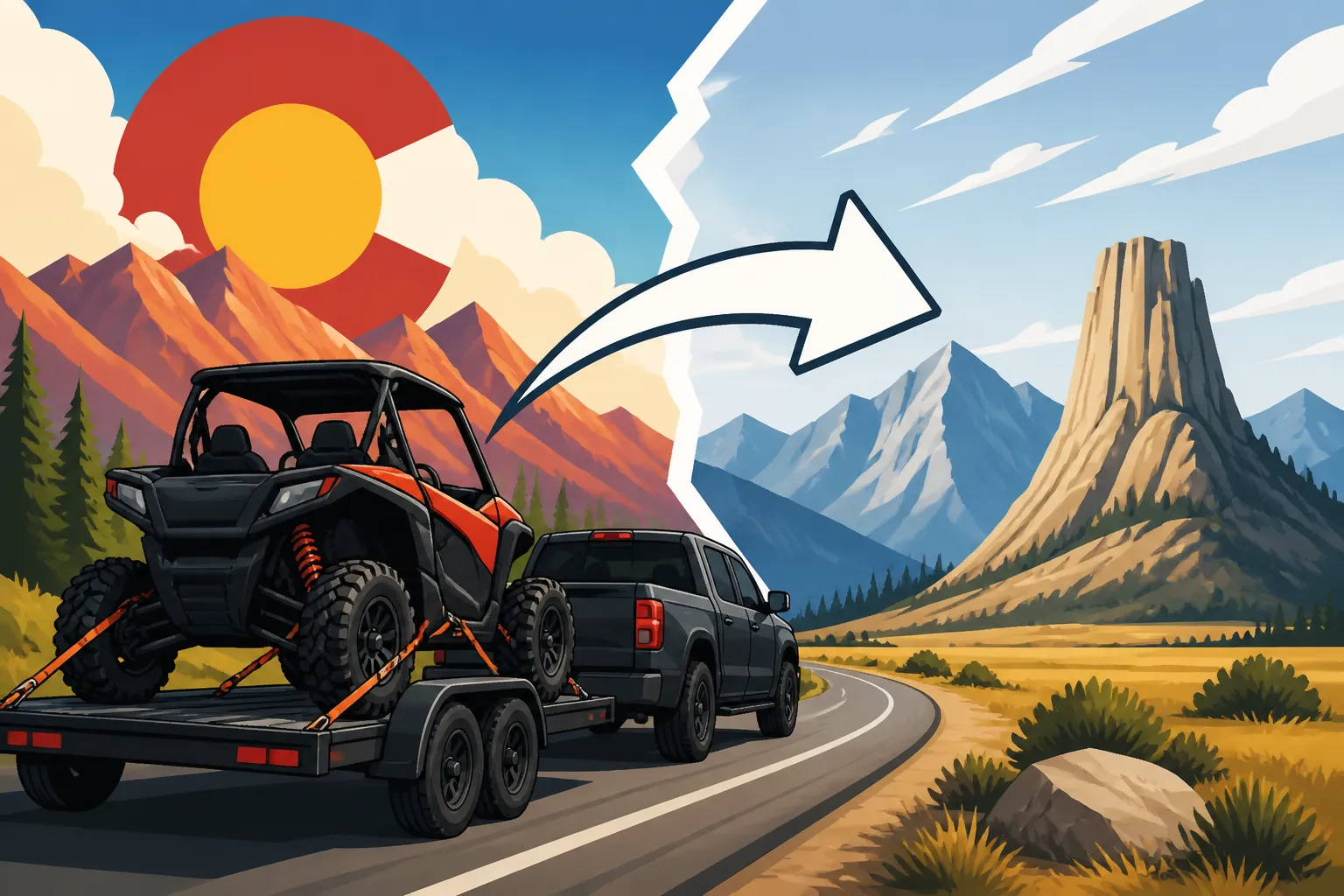
Taking a Colorado ATV or UTV to Wyoming raises two separate questions: whether the machine’s Colorado registration is recognized and whether you may ride the route you have planned. A Colorado sticker or plate does not automatically grant access to every Wyoming trail or road. Check the machine’s status, land-manager rules, and local road permissions before unloading.
Does Colorado Registration Work in Wyoming?
Wyoming’s off-highway vehicle requirements can depend on the vehicle’s type, where you intend to ride, and whether it is currently registered in another state. A Colorado OHV registration is not a universal permit for Wyoming, but it may matter when determining whether you need an additional Wyoming permit or registration.
The practical distinction is between proof that the machine is registered in Colorado and permission to ride a particular place in Wyoming. Even if Wyoming recognizes the Colorado registration for a particular purpose, that does not open a closed trail, authorize road travel, or replace rules set by a land manager.
Before traveling, confirm the current nonresident requirements with Wyoming’s official OHV information. Ask about your exact vehicle and how it is registered in Colorado. An ATV with a Colorado OHV registration sticker may be treated differently from a UTV with a standard road-use registration or a machine that has no current registration. Do not assume that a dealer’s paperwork, a bill of sale, or an out-of-state plate answers every permit question.
If Wyoming requires an additional permit for your machine, find out where to obtain it and what proof you must carry. Check whether the permit must be displayed on the vehicle, kept with you, or both. Rules and procedures can change, so confirm them before you leave rather than relying on a past trip or a rider’s recollection.
| Your machine’s status | What to verify before riding in Wyoming |
|---|---|
| Colorado OHV registration | Whether Wyoming recognizes that registration for your vehicle and planned use, or requires a separate nonresident permit |
| Standard Colorado road registration and plate | Whether the machine’s road status and equipment meet the rules for the specific Wyoming road |
| No current registration | Whether the machine needs Wyoming registration or a permit before it can be used on public land |
| Rental or borrowed machine | Who is responsible for permits, what documents travel with it, and which routes the owner allows |
| Machine used only on private property | Whether the landowner’s permission and the property’s rules cover the planned riding |
For an overview of how different states handle registration, see Colorado OHV Permit Reciprocity With Other States. For the Colorado side of the distinction between a permit and registration, Colorado Non-Resident OHV Permit Explained covers the terminology and process for visitors riding in Colorado. Reciprocity is not a promise that every state accepts every type of document in the same way.
Check the paperwork that matches the vehicle
Gather the documents that show what the machine is and how it is registered. Depending on your situation, that may include the Colorado registration card, current decal information, title or ownership paperwork, and any road-use registration documents. Keep the machine’s VIN accessible and make sure the number on the vehicle matches the paperwork.
If you bought the ATV or UTV recently, check that the registration is current and that the ownership documents are in order. A bill of sale may help explain how you acquired a machine, but it should not be treated as a substitute for a required registration or permit. The same caution applies to a borrowed machine: have the owner confirm its status and provide the documents you may need.
Registration Does Not Decide Where You Can Ride
A machine can be properly registered and still be prohibited from a route. Wyoming riding areas may include land managed by different agencies, county roads, municipal streets, and private property. Each can have its own access rules, seasonal closures, vehicle-width limits, or operating conditions.
On public land, use the official route information for the specific area. A road or trail shown on a consumer map is not necessarily open to motorized use. Check the current Motor Vehicle Use Map for Forest Service land, and consult the relevant land manager’s rules for other public areas. For background on reading route designations, see Reading a Colorado Motor Vehicle Use Map; the same careful approach applies when planning in another state. Colorado Rules on Forest Service Roads and Colorado OHV Rules on BLM Roads also explain why the land manager and route designation matter.
Do not rely only on a GPS line, a social media post, or a trail app’s general route layer. Those tools can help with navigation, but they may not show a recent closure or convey the legal status of a route. Check the official map and notices for the area you plan to ride, including any restrictions on machine width, season, or direction of travel.
Roads and streets require a separate check
A Colorado plate does not automatically make an ATV or UTV legal on Wyoming roads. Nor does a Colorado rule that allows a particular road connection carry over the state line. Road use can depend on the road’s classification, local authorization, vehicle equipment, registration, and the rules of the town or county.
Before planning a road segment, identify the exact road and confirm that the responsible authority allows your machine on it. Ask about connecting roads as well as the main route: a trail may reach a road that is closed to OHVs, or a legal road segment may end before the next trailhead. Do not assume that a road is open simply because it is unpaved or commonly used by off-road vehicles.
If the machine has a standard road plate, verify that its registration and equipment are valid for Wyoming use. If it has only a Colorado OHV sticker, do not treat that sticker as a road plate. For the broader distinction between road access and vehicle status in Colorado, see Colorado Rules for Out-of-State Street-Legal Machines. The specific Wyoming road and local rules still need to be checked separately.
Plan the Border Crossing and Riding Area
A smooth trip starts by deciding which land you will ride, not just which town you will reach. Choose your staging area and intended routes, then confirm the rules for every jurisdiction along the way. A trip that crosses a state line may involve a mix of federal land, state land, county roads, private property, or town streets, and permissions do not automatically transfer between them.
Use this process before loading the machine:
- Identify the machine’s status. Determine whether it has Colorado OHV registration, standard road registration, or both. Record the VIN and check that the paperwork is current.
- Check Wyoming’s permit or registration requirement. Give the relevant Wyoming office the machine type and the details of its Colorado registration. Ask whether an additional permit is required for your intended use.
- Select specific routes. Use the official route map or motor-vehicle-use map for the land you plan to visit. Check for closures, seasonal limits, vehicle-width restrictions, and staging requirements.
- Confirm road access separately. For any county road or town street, check with the local authority responsible for that road. Confirm that the machine’s registration and equipment are suitable for the route.
- Check private-property access. If your route crosses private land, get the owner’s permission in advance. A public trail or road ending near private land does not grant access across it.
- Pack your documents and current maps. Keep required paperwork available and save official maps or notices for areas where cell service may be unreliable.
For more on asking permission before riding private property, see Written Permission Before Riding Private Land. The same principle applies in Wyoming: permission needs to come from the person or entity with authority over the land, and it does not replace public-land permits or road rules.
Carry records in a useful way
Keep the registration and permit documents where you can reach them without unpacking the entire vehicle. A waterproof document sleeve can help protect paper records from rain, dust, and spills; a basic sleeve from a general retailer such as Amazon may be useful, but it is not a substitute for the documents themselves. Store a backup photo or digital copy separately, while remembering that an agency may require you to show an original or specific proof.
Save the official route map and closure information offline before entering a remote area. A paper map is also useful if a phone battery dies or there is no signal. Match the map to the riding area and date of travel; an old map can show routes that are now closed or omit new restrictions.
If you are crossing between riding areas, review the rules again rather than assuming the same permit and access terms apply everywhere. A permit that covers one type of public-land use may not cover a road ride or a different agency’s land. Keep the machine on signed, authorized routes and follow posted closures, even when a trail appears passable.
Common Mistakes to Avoid
The most common planning errors come from treating registration, road legality, and land access as one issue. They are related, but each answers a different question.
- Assuming a Colorado sticker is a Wyoming permit. Verify whether Wyoming recognizes your exact registration or requires an additional permit.
- Treating an out-of-state plate as permission to ride anywhere. A plate may identify road registration, but it does not override trail closures or local OHV restrictions.
- Using an app as the final authority. Use navigation tools for orientation, then check official maps and closure notices for legal access.
- Planning around a road without checking local rules. County and town permissions can vary; confirm every road segment in advance.
- Relying on another rider’s setup. Their machine, registration, route, or date of travel may be different from yours.
- Leaving paperwork at home. Keep the documents needed to identify the machine and show its current status with you.
- Assuming private land is open because there is no fence. Get permission before entering, and respect signs and boundaries.
When a permit or road rule is unclear, ask the responsible agency or local authority and describe the machine accurately. “ATV” or “UTV” alone may not be enough: mention whether the vehicle has a Colorado OHV registration, a regular license plate, or both, and state where you plan to ride. That makes it easier to get an answer that applies to your actual trip.
A little verification before departure can prevent a wasted drive, a ticket, or an unexpected route change. Treat the Colorado registration as documentation to check—not as a guarantee of Wyoming access—and confirm both the permit rules and the exact routes before riding.
Disclaimer
This article is for general informational purposes only and does not constitute professional advice. Laws, prices and regulations vary by location and change over time. Consult a qualified professional for guidance on your specific situation.