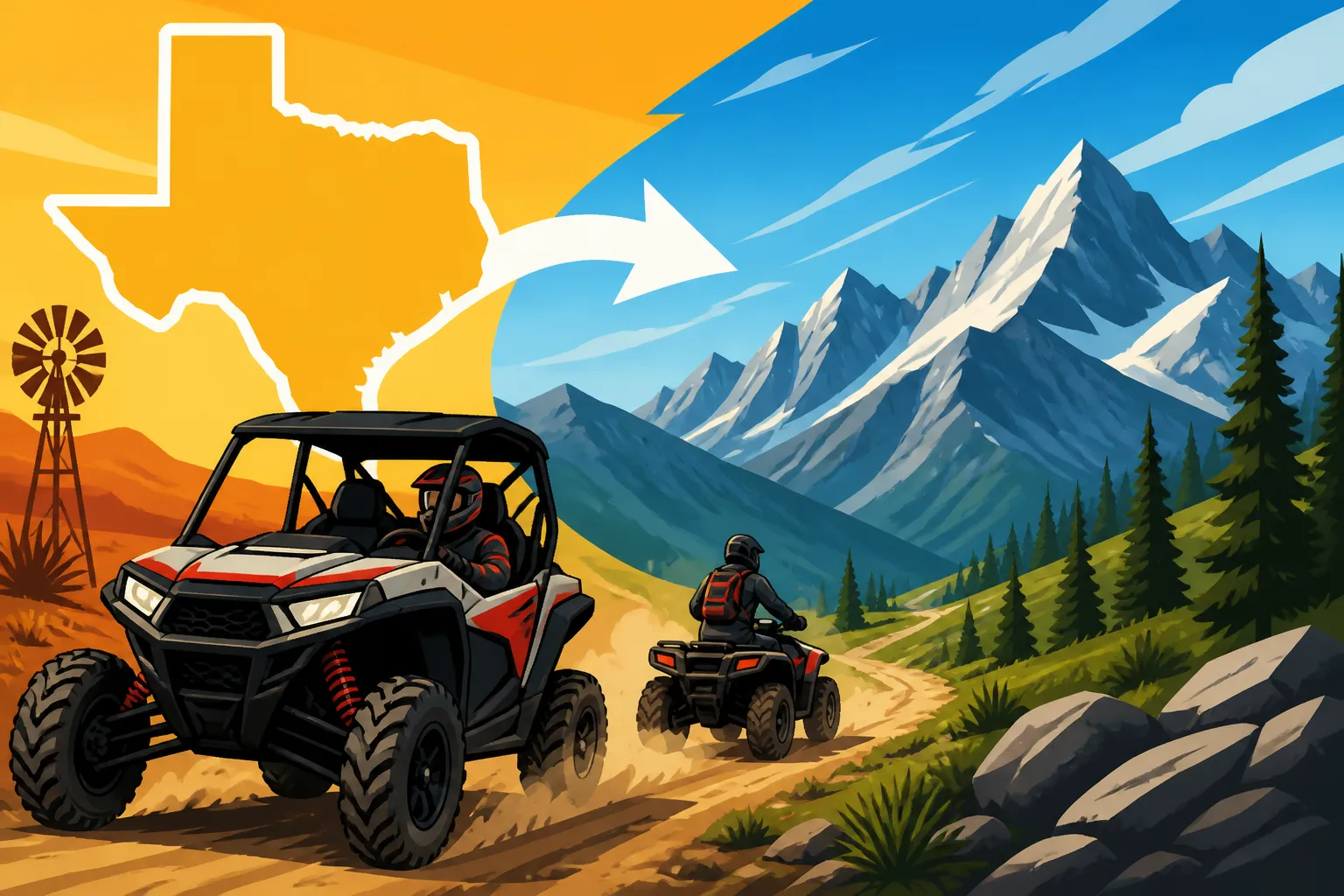
Texas Riders Heading to Colorado Passes
Texas riders planning an ATV, UTV or Jeep trip to Colorado may assume their Texas paperwork travels with them. It does not necessarily satisfy Colorado’s permit rules or make every mountain road legal to ride. The key is to check the vehicle’s status, the land you’ll use and the rules for each route before you leave.
What Texas registration does and does not do in Colorado
A Texas registration, title or plate can help identify your machine and show that it is documented at home. It does not automatically replace a Colorado OHV permit when one is required, and it does not grant access to every road or trail.
For nonresident riders, Colorado’s permit rules depend in part on where the machine will be operated and how it is classified. An ATV or UTV being used on public land may need a Colorado nonresident OHV permit even if it has paperwork from Texas. A street-legal plate does not, by itself, settle the question: the vehicle must also be allowed on the particular road or route under the applicable state, county and local rules. See Colorado OHV Permit Reciprocity With Other States and Colorado Permits for a Plated Jeep for the related distinctions.
| Your situation | What to check before riding |
|---|---|
| Texas ATV or UTV on public land | Whether Colorado requires a nonresident OHV permit for the machine and where it will be operated |
| Texas-plated side-by-side or Jeep | Whether the vehicle qualifies for the route, whether local rules allow it, and whether a Colorado permit is still required |
| Machine used only on private property | Whether the property owner permits the use; public-road or public-land sections may have separate requirements |
| Machine transported to a trailhead on a trailer | The rules for the riding area, not just the machine’s Texas documents |
| A trip that crosses several jurisdictions | Each route’s land-manager, county and town rules, plus current closures |
Do not treat “registered in Texas” and “legal to ride here” as interchangeable. Registration is one part of the paperwork picture. Access depends on the route and the machine. Colorado’s rules for out-of-state street-legal machines are a separate issue from whether a nonresident OHV permit is needed; Colorado Rules for Out-of-State Street-Legal Machines explains why checking both matters.
If your machine has a plate, confirm exactly what vehicle category it falls under and what that plate permits you to do in Colorado. A street-legal vehicle may be allowed on some public roads but still be excluded from a particular trail, seasonal route or town street. Conversely, a route that is open to OHVs is not necessarily open to every vehicle with an out-of-state plate. When the answer is unclear, ask the relevant land manager or county rather than relying on the seller’s description or a map pin.
Check the nonresident permit before you travel
If your ATV or UTV will be used on Colorado public land, check whether you need a Colorado nonresident OHV permit and arrange it before riding. A Texas registration or permit should not be assumed to count as Colorado authorization. Colorado’s permit requirements and exemptions depend on the circumstances, so use the current guidance from Colorado Parks and Wildlife (CPW) and confirm any special case directly. For a fuller overview, see Colorado Non-Resident OHV Permit Explained and Out-of-State Machines on Colorado Trails.
A straightforward pre-trip process is:
- Identify the machine. Note whether it is an ATV, UTV, dirt bike, Jeep or another vehicle, and whether it is registered or plated in Texas.
- Identify where you will ride. Private property, a county road, a Forest Service road and a designated OHV trail can have different rules.
- Check the permit requirement for that use. Confirm whether the machine needs a Colorado nonresident permit, including any rules that apply to a plated vehicle.
- Buy or obtain the required authorization through an approved channel. Check the current instructions for purchasing, displaying and carrying proof of the permit.
- Confirm the route separately. A permit does not open a closed road or authorize riding off a designated route.
- Keep proof accessible. Carry the documents or electronic proof required for your situation, and make sure the permit display is visible as instructed.
Pay attention to the permit’s stated validity period and display instructions when you obtain it. Do not assume that a permit bought for an earlier trip is still valid, or that a receipt alone counts as the permit. Requirements and purchase options can change, so check CPW’s current directions before setting out.
A Colorado OHV permit is not a general recreation pass. You may also need to consider a separate parking, campground or area pass, depending on where you go. Likewise, a permit does not replace a vehicle’s required registration or make an unapproved route legal. The practical distinction is simple: authorization for the machine, permission to use the route and any area-specific pass are separate checks. Permits and Passes a Colorado Trip Needs is useful when you are planning a trip with more than one kind of access requirement.
Private land is different from public land, but it is not a shortcut around every rule. If you are riding only on private property, get the owner’s permission and stay within the agreed boundaries. If your route touches a public road or public trail, check the requirements for that section too. See Do You Need a Permit on Private Colorado Land? for the private-property distinction.
A permit does not guarantee access to a Colorado pass
Colorado mountain routes can cross or connect land managed by different agencies, counties or towns. Their rules may differ, and a road shown on an online map is not automatically open to motorized use. Seasonal closures, local restrictions, vehicle-width limits and trail designations can affect whether your Texas machine can legally travel the route.
Before driving toward a pass, check the official route information for the exact road or trail you intend to use. On Forest Service land, a Motor Vehicle Use Map (MVUM) is an important source for identifying designated motorized routes and any seasonal restrictions. Learn how to interpret one in Reading a Colorado Motor Vehicle Use Map. A general navigation app can help with directions, but it should not be your only proof that a route is open to your vehicle.
For a pass-to-pass or town-to-town ride, verify each piece of the route rather than checking only the destination. The road may change status at a junction, cross a boundary or enter a town with its own restrictions. A route that is legal for a highway vehicle may not be legal for an OHV, and a route open to one class of OHV may not fit a wider side-by-side. On the Alpine Loop, for example, plan around the specific roads, route conditions and access rules rather than assuming that one permit authorizes the entire loop. Riding the Alpine Loop Between Colorado Towns offers more route context.
Check for closures close to departure, too. Snow, mud, maintenance, fire conditions or other land-management decisions can affect access. A route that was open when you planned the trip may be closed when you arrive. Colorado Trail Conditions Reports can help you build a checking routine, but confirm critical closures with the responsible land manager.
Also review the machine requirements for the specific ride. Width and vehicle class can rule out a trail even when the route is open to motorized use. Road sections may have additional requirements for equipment or operation. Do not assume that a Texas inspection, plate or equipment setup automatically satisfies Colorado’s rules. If the route uses a public road, check the rules for that road and jurisdiction; the rules for a designated OHV trail may be different.
A practical checklist for Texas riders
A little checking before departure can prevent an expensive detour or a citation. Use this checklist for each machine and each planned riding area:
- Write down the vehicle details. Record the type of machine, Texas registration or plate status, and any other documents you will carry.
- Confirm the Colorado permit requirement. Check the current rules for nonresident riders and for your vehicle category. Do not rely on a Texas document as a substitute unless the applicable Colorado guidance explicitly says it qualifies.
- Match the machine to the route. Confirm that the road or trail is open to your type and size of vehicle. Check local restrictions as well as land-manager rules.
- Check seasonal status and closures. Review official maps and current closure notices shortly before the ride.
- Plan each jurisdiction crossing. If the route passes through a town or uses county roads, check those rules separately.
- Keep documents and permit proof available. Follow the current instructions for display and carry any required registration or ownership records.
- Recheck before changing plans. A detour may take you onto a road with different access rules. Do not assume the permit or route authorization for the original plan covers it.
For a Texas rider, the safest working assumption is that home-state registration is useful documentation but not a blanket Colorado pass. Confirm the nonresident permit question, then confirm that the exact machine can use each planned route. That approach is especially important for plated UTVs and Jeeps, where road eligibility and OHV permit rules can be separate questions. When guidance is ambiguous, contact CPW or the land manager responsible for the route before riding.
Disclaimer
This article is for general informational purposes only and does not constitute professional advice. Laws, prices and regulations vary by location and change over time. Consult a qualified professional for guidance on your specific situation.