What Immediate Supervision Actually Means
Immediate supervision can sound like a simple rule: an adult rides along while a child drives. In Colorado, though, where the ride takes place and how closely the adult can monitor the young rider matter. Here’s how to understand the requirement, plan a safer ride, and avoid assuming that supervision makes an otherwise restricted road legal.
What immediate supervision means in practice
Colorado’s age rules for OHVs depend on the setting. The rule commonly comes up when a young person operates an ATV, UTV, or other OHV on a public road that has been opened to OHV use. It is not a blanket permission to ride any road, and it should not be treated as a general age rule for every private property or off-road trail.
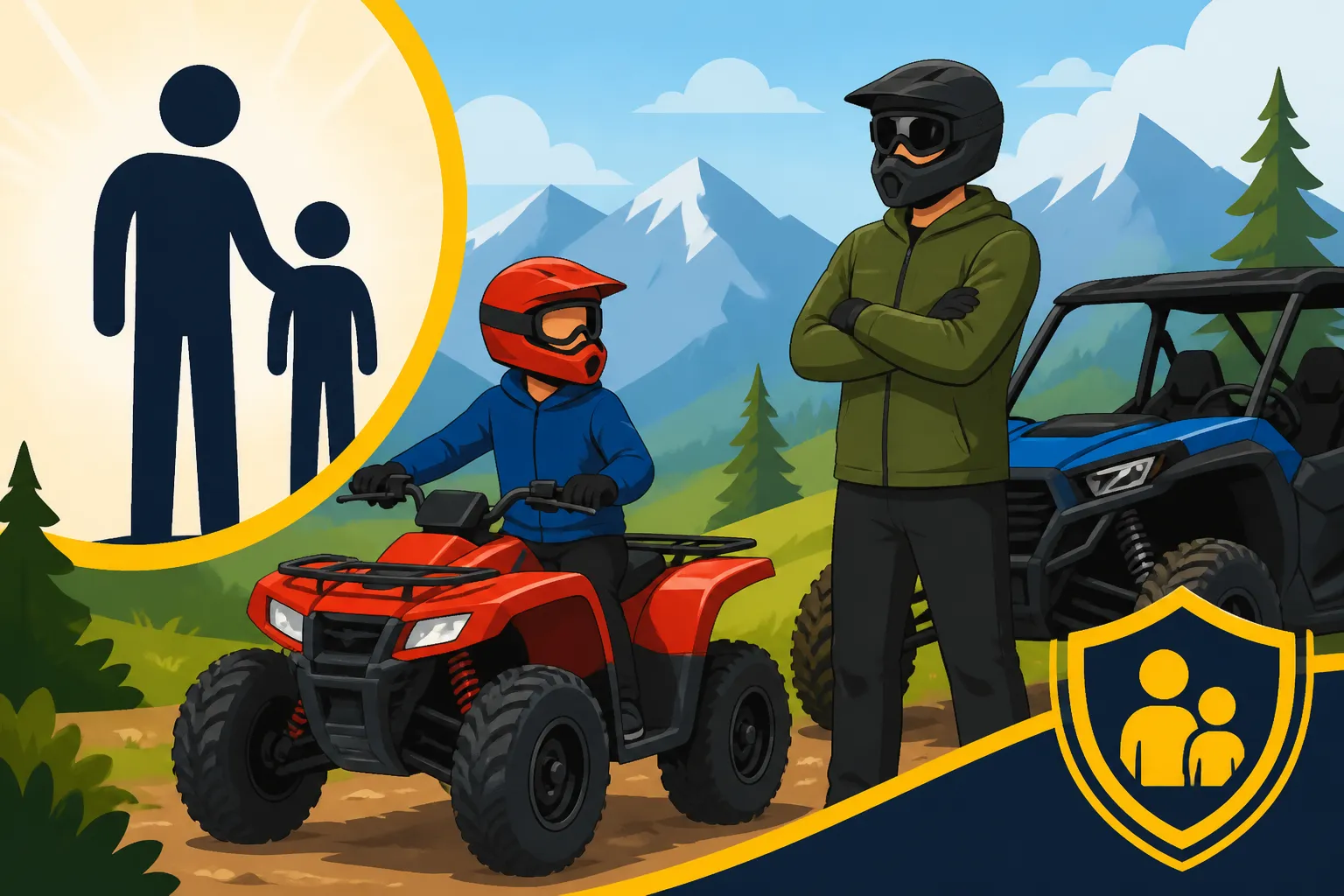
As a practical standard, immediate supervision means an adult is close enough and attentive enough to monitor the young operator and respond promptly. The adult should be able to see what the rider is doing, recognize a developing hazard, and intervene if the situation calls for it. Riding somewhere else on the route, following at a distance, or being available by phone is not a sensible substitute for direct oversight.
There may not be a single distance that makes supervision “immediate” in every situation. A smooth, open stretch and a narrow road with blind turns call for different levels of closeness. The key is whether the adult can genuinely keep the young rider within view and respond quickly, not whether both people are technically on the same ride.
Age and road access are separate questions
For a public road opened to OHVs, Colorado’s age rules generally distinguish riders younger than 10 from riders who are 10 to 15. A child under 10 should not be assumed to qualify to operate on an opened road; reaching age 10 does not remove the supervision requirement for a rider who is still under 16. Check the current rule and the road’s local restrictions before setting out, especially if the child is close to an age threshold.
For a closer look at that threshold, see Colorado’s Age Ten Rule for Riding an Opened Road and Colorado Supervision Rules for Riders 10 to 16. A rider’s age is only one part of the decision. The road must also be open to OHVs, the machine must be permitted to use it, and the operator must follow the requirements that apply to that route.
Do not confuse “supervised” with “authorized.” An adult’s presence does not open a closed road, convert a trail into a road, or cancel a local restriction. Colorado road access can depend on a county or town decision, signs, and designated routes. Use Which Colorado Roads Allow OHVs to understand why checking the specific route matters.
What the adult needs to be able to do
Immediate supervision is easier to put into practice when the adult rides close enough to observe the child’s speed, control, and decisions. Depending on the route and machine, that may mean riding behind the child, leading while maintaining clear visibility, or choosing a position that lets the adult respond without putting either rider at risk. The adult should not be so far ahead that the child is left to manage a hazard alone.
A supervising adult also needs to be focused. Watching the road, traffic, signs, and the young rider is part of the job. A phone, camera, or navigation screen should not distract the adult from active supervision. A radio can help riders communicate, but it does not replace being close enough to observe and respond.
The adult’s legal qualifications matter too. Do not assume that any accompanying adult meets the rule simply because they are older than the child. Colorado’s requirements may depend on the applicable statute and road-use rules, including whether a driver’s license is required in the circumstances. Confirm the current qualification before riding; Does the Supervising Adult Need a License in Colorado? addresses that question directly.
| Situation | Practical approach |
|---|---|
| Rider is under 10 | Do not assume the child may operate on an opened public road. Check the age rule before planning the ride. |
| Rider is 10 to 15 | Treat immediate supervision as close, active oversight, and confirm the adult meets the current requirements. |
| Rider is 16 or older | Check the rules that apply to the route and machine; turning 16 does not make every road open to OHVs. |
| Road status is unclear | Do not rely on the adult’s presence as permission. Verify the route with the responsible local authority. |
| Adult cannot keep the rider in view | Choose another route or wait until the ride can be supervised appropriately. |
The table is a planning aid, not a substitute for checking the current rule. If a route has a stricter local requirement, follow that requirement.
How to plan a supervised ride
A short check before leaving can prevent the common mistake of treating “the adult is there” as the entire rule. Start with the age of the operator, then verify the route, the vehicle, and the adult’s role. If any part is uncertain, resolve it before the machine reaches the road.
- Confirm the child’s age and the rule that applies. A rider under 16 may have supervision requirements on an opened public road. A rider under 10 should not be assumed eligible to operate there. For related age questions, see Can a 10-Year-Old Ride in Colorado? and Colorado Rules for a Rider Turning 16.
- Confirm that the route is actually open to OHVs. A road can be public without being open to OHV travel. Check local signs and current route information rather than relying on an old map, a previous ride, or another rider’s account.
- Check the adult’s qualifications. Verify the current age and any other eligibility requirements for the person supervising. If licensing is relevant, confirm it before departure.
- Choose a route the young rider can handle. Avoid starting with fast traffic, steep grades, blind corners, narrow shoulders, or heavy local activity. A legal route may still be a poor choice for a new operator.
- Agree on how you will ride together. Decide who leads, who follows, where to stop, and what the child should do if the group separates. Keep the young rider within a range where supervision is real, not just assumed.
- Check the machine and protective equipment. Make sure the vehicle fits the rider and is in sound operating condition. Follow the requirements for helmets and eye protection that apply to the ride, and review Youth Machine Size Rules Colorado Parents Ask About before choosing a machine for a young operator.
- Set a simple stop rule. The child should know to stop in a safe place if the adult is no longer visible, a route sign is confusing, or traffic or terrain feels uncomfortable. The adult should stop as well and regroup rather than expecting the child to continue alone.
A beginner may need closer support than an experienced young rider, even when both are the same age. Keep the first road ride short and uncomplicated. Explain signs, turns, stopping points, and what to do around other road users before starting. For foundational riding practice away from a road, Teaching a Child to Ride Off-Road can help parents think through the progression.
Supervision does not replace other requirements
Immediate supervision addresses the relationship between the young operator and the adult. It does not take the place of requirements for the machine, permit, road, or rider. Depending on the circumstances, the vehicle may need the applicable Colorado OHV registration or permit, and the route may have equipment or operating rules. A public-road segment can also involve local restrictions that do not apply on an off-road trail.
That distinction matters for visitors, too. An out-of-state registration or a supervising adult does not automatically authorize a route in Colorado. If your machine is from another state, check Out-of-State Machines on Colorado Trails and Colorado OHV Permit Reciprocity With Other States for the relevant permit and reciprocity issues.
A supervised ride should also account for the young rider’s actual ability, not just the minimum legal conditions. A child who can operate confidently in a familiar open area may still struggle with traffic, a steep descent, dust, or a confusing junction. The adult should be ready to change plans if the route becomes more demanding than expected.
Common mistakes and a safer decision
The most frequent misunderstanding is that “immediate” means the adult is somewhere nearby. In practice, an adult who cannot see the child or respond promptly is not providing useful direct oversight. Another mistake is assuming that a legal age and an accompanying adult make every public road available. They do not: the route must be open to OHVs, and local rules still apply.
Other assumptions can create problems:
- “We are on a group ride, so the child is supervised.” A group does not automatically provide one-to-one attention. Make sure a responsible adult can monitor the young operator rather than assuming another rider will do it.
- “The road was open last season.” Access can change. Check current signs and local information before relying on a past trip.
- “The adult is in front, so the child can follow.” Leading does not guarantee the adult can see or respond to the child. Set up the ride so the child remains observable.
- “The child is old enough, so no other rules matter.” Age does not settle route access, machine eligibility, permits, equipment, or other operating requirements.
- “A radio makes distance acceptable.” Communication can help, but it cannot replace direct visual oversight and the ability to respond.
If the adult cannot stay close, the child cannot comfortably manage the route, or the road’s status is uncertain, the safer choice is to stop and reassess. Find a clearly permitted route that matches the young rider’s ability, or choose an off-road setting where the applicable rules allow the ride. For broader youth requirements, see Colorado Age Rules for Young OHV Riders.
Before departure, the simplest test is: Can the adult continuously monitor the young rider, respond promptly, and confirm that the machine and route are allowed? If any answer is no or uncertain, do not treat the ride as properly supervised until you have resolved it.
Disclaimer
This article is for general informational purposes only and does not constitute professional advice. Laws, prices and regulations vary by location and change over time. Consult a qualified professional for guidance on your specific situation.