Where to Buy a Colorado OHV Permit
A ride can be planned down to the trailer, fuel, and lunch stop, then stall because you are not sure where the Colorado OHV permit comes from. The right place to buy it depends on whether you are a Colorado resident or visiting from another state, and whether you need a registration or a permit. This guide explains the options and how to avoid arriving at a trailhead without the right document.
Start by identifying which Colorado OHV document you need
Residents and visitors generally follow different paths
Colorado residents typically register an off-highway vehicle through Colorado Parks and Wildlife, commonly shortened to CPW. Visitors from outside Colorado generally need a Colorado nonresident OHV permit to ride where that permit is required. These are not simply two names for the same purchase: the correct option depends on residency, the machine, and how and where it will be used.
That distinction matters when you are buying for a trip. A Colorado resident who searches for a visitor permit may end up on the wrong purchase page, while an out-of-state rider may assume an existing home-state registration automatically covers Colorado. Before paying, confirm the category that applies to you and the specific machine you plan to ride.
The basic choice is straightforward: Colorado resident with an OHV, check the resident registration process; visitor bringing an OHV to Colorado, check the nonresident permit process. If you have recently moved, own a machine registered in another state, or are unsure how your vehicle is classified, take a moment to review Colorado Non-Resident OHV Permit Explained and Moving to Colorado With an Out-of-State ATV before purchasing.
A permit, a registration, and a title do different jobs
A permit or registration is about authorization to operate an OHV where the relevant rules require one. A title is an ownership document. Having a title does not automatically mean that the vehicle is registered for Colorado riding, and buying a riding permit does not establish ownership of the machine.
This can be confusing when you are looking at a used ATV or UTV. A seller may hand over a bill of sale, an old registration card, or a title, and it can feel as if that stack of paperwork must cover every requirement. It does not necessarily do so. Check ownership paperwork separately from the riding permit or registration.
For a new-to-you machine, verify the VIN and ownership documents before the ride, then separately confirm which Colorado permit or registration applies. If the seller’s paperwork is incomplete, Proof of Ownership for a Colorado OHV and Buying a Used ATV in Colorado: The Paperwork can help you understand the ownership side without mixing it up with permit purchasing.
The riding location affects what to check
The permit question is especially important for riding on public land, designated OHV trails, and other areas where an OHV registration or permit is required. A machine kept in a garage, used only on private property with the owner’s permission, or transported on a trailer is in a different situation from one being ridden on a public trail.
Do not assume that every location has identical requirements. Public-land rules can differ by land manager, and a route may connect areas with different rules. Check the requirements for the actual place you plan to ride, including any trailhead, road segment, or recreation area along the route. Colorado OHV Permit Rules on Public Land is a useful starting point for sorting out the broader public-land question.
A practical habit is to check both the permit requirement and the route status before leaving home. A permit does not make a closed trail open, and a permit purchase does not authorize riding outside designated routes. Keep the permit question separate from access, closures, and road-use rules so that one confirmed requirement does not create false confidence about the rest.
Where to buy a Colorado OHV permit
Buy through Colorado Parks and Wildlife online
For many riders, the simplest starting point is the official CPW online channel. It lets you review the available OHV purchase options and complete the transaction before you head to the mountains. Use the official agency site rather than a search-result ad or an unfamiliar third-party page, particularly when a page asks for payment or personal information.
Before checking out, read the product description closely. Confirm that you have selected the right type of document, that the machine details are correct if requested, and that you understand whether the permit is delivered digitally, by mail, or through another method. The purchase screen and confirmation should make clear what you bought and what you need to do next.
Online purchase can be a good fit if you are planning ahead and want to avoid a stop at a local agent. It is less convenient if you are already on the road and have not checked delivery details. Read Buying a Colorado OHV Permit Online for more on the online route, and do not assume that clicking “purchase” means a physical decal is immediately in your hand.
Buy in person from an authorized vendor
Colorado OHV permits and registrations may also be available through participating CPW sales agents and other authorized vendors. These can include outdoor recreation retailers, powersports businesses, and sporting-goods stores, though availability varies by location and the type of transaction the vendor handles.
An in-person stop can be helpful if you want to ask a question before buying or if you are already near a trail town and need to sort out paperwork. Call ahead rather than relying on a store’s general description of its services. Ask specifically whether it sells the Colorado OHV document you need, whether it can process your resident or nonresident transaction, and what information you should bring.
A vendor’s ability to sell fishing licenses or other outdoor products does not necessarily mean it handles every OHV transaction. The safest approach is to use CPW’s vendor information or contact the retailer directly. For more detail on finding a seller, see Colorado Permit Vendors and License Agents and Buying a Permit at a Sporting Goods Store.
Phone and mail options may suit some riders
Some riders prefer to handle a purchase by phone, especially when they are having difficulty with an online form or want to ask about a specific situation. If you use a phone option, make sure you are contacting the official agency or an authorized sales channel. Have the vehicle and residency information available so the representative can help you identify the proper product.
Mail can be an option in some circumstances, but it requires extra planning. Processing and delivery take time, and you do not want to leave the purchase until the day before a planned ride. Confirm the application instructions, payment method, mailing address, and expected delivery process through the official channel before sending anything.
A phone or mail purchase should leave you with a clear record of the transaction. Keep confirmation details and any instructions about displaying or carrying the permit. If you are considering mail delivery, review How a Colorado OHV Permit Reaches You by Mail and Buying an OHV Permit by Phone before deciding which method fits your schedule.
| Purchase route | Best suited to | What to confirm before you buy |
|---|---|---|
| Official CPW online channel | Riders planning ahead and comfortable purchasing online | Correct resident or nonresident category, vehicle details, delivery method, and proof of purchase |
| Authorized in-person vendor | Riders who want help or are near a participating retailer | Whether the location handles the exact OHV transaction you need and what documents to bring |
| Official phone option | Riders who need assistance with the purchase process | That you have reached an official or authorized channel and understand how the permit will be provided |
| Mail option | Riders who have enough lead time for paperwork and delivery | Application instructions, payment requirements, address, and delivery expectations |
Choosing an in-person vendor without wasting a trip
Confirm the vendor handles OHV transactions
A business can sell outdoor equipment or other CPW products without offering every OHV service. Even within the same retailer, one location may handle a transaction while another does not. That is why a quick call can save a long detour, particularly if you are driving through a smaller town or trying to reach a trailhead before the day gets busy.
When you call, describe your situation plainly: whether you live in Colorado, whether the machine is an ATV, dirt bike, or side-by-side, and whether you are asking about a registration or a nonresident permit. Ask whether the store can issue that specific document, whether it is available at that location, and whether you need to bring identification or vehicle information.
If the person answering is unsure, ask where the store directs OHV customers or check the official CPW vendor information. Avoid treating a vague “we sell permits” answer as confirmation if you have a special case, such as a recent move, a machine with out-of-state registration, or a plated vehicle. A few questions before the drive are easier than troubleshooting at the counter.
Bring the details that help the transaction go smoothly
Before visiting, gather the information you may need to identify yourself and the machine. Depending on the transaction, this can include your residency information, the vehicle’s make and type, the VIN or serial number, and any current registration documents. Check the official instructions or ask the vendor what is required rather than assuming every purchase asks for the same details.
If you are buying for more than one machine, prepare the information for each one separately. It is easy to mix up VINs when two ATVs are the same color or when several family members are handling the paperwork. A simple written list can prevent a typo that becomes frustrating to correct later.
For a machine you borrowed, rented, or bought recently, clarify who is responsible for obtaining the required document. Do not assume that another person’s permit transfers to you or that a seller’s old document covers a new owner. The requirements can depend on the machine and the type of transaction, so ask the vendor or CPW before relying on paperwork that was issued for a different situation.
Plan for limited vendor hours and seasonal demand
Trail-town retailers may have hours that differ from what you expect, especially outside the main riding season or during holidays. A store that is convenient on a map may close before you arrive, have limited staff available for transactions, or be busy with other visitors. If your ride depends on an in-person purchase, call ahead and leave enough time for a second option.
This matters most when a group is travelling together. One rider may assume someone else has bought the permits, while another expects to purchase at the trailhead. If the nearest authorized seller is farther away than expected, the entire group can lose riding time. Agree in advance who is handling the purchase and check that each machine has the right documentation.
Avoid making an unfamiliar trailhead the first place you investigate permit availability. Some recreation areas have nearby businesses, but that does not mean a permit is sold at every entrance or parking area. Identify the exact vendor and its hours, or purchase through the official online route early enough to resolve delivery or account issues.
Buying online and managing permit delivery
Verify the official purchase page before entering information
Search results can include ads, outdated pages, and third-party explanations that look official at a glance. Start from Colorado Parks and Wildlife’s official website and navigate to the OHV registration or permit section. Check the page title and agency identity before entering payment information, and do not rely on a page simply because it uses Colorado imagery or mentions trail riding.
A safe online purchase is one where you can tell what document is being sold, who is issuing it, and how you will receive it. Read the description before paying. If the wording is unclear, pause and contact CPW or an authorized vendor rather than guessing which option applies.
Keep your confirmation email or receipt after completing the transaction. Save it somewhere accessible offline if you expect weak cell service in the mountains. A screenshot may help you remember transaction details, but do not assume that a receipt alone replaces any required permit display or documentation. Follow the instructions issued with your purchase.
Understand whether the permit arrives digitally or physically
One of the most common frustrations is completing a purchase and then discovering that the physical permit or decal has not arrived yet. The online transaction and the delivery of a physical item are separate steps. Before buying, check what the product page says about delivery, whether a digital record is provided, and what you are expected to display or carry while waiting.
If you need the permit for a trip soon, build in a buffer. A purchase made close to departure may leave little time to address a mailing delay, incorrect address, or order problem. If the delivery timing is uncertain, contact CPW or an authorized vendor about a legitimate alternative rather than printing or improvising a substitute.
When your permit arrives, compare it with your confirmation and check that the information is correct. If something is missing or incorrect, keep the packaging and transaction record and contact the issuer promptly. Do not alter a permit or try to reuse a damaged decal in a way that could make it unreadable or invalid.
Keep the purchase record and the permit together
After purchase, store the confirmation, any receipt, and the physical permit or registration information in a place you can find quickly. A dedicated document pouch in the tow vehicle is useful, but protect paper from moisture, dirt, and sun. If you use a digital record, download or save it before entering areas with limited service.
A receipt can help resolve a question about whether you completed a transaction, while the issued permit or registration is the item you may need to display or carry. Treat them as related but not interchangeable. Read the official instructions for your specific document and follow any placement requirements.
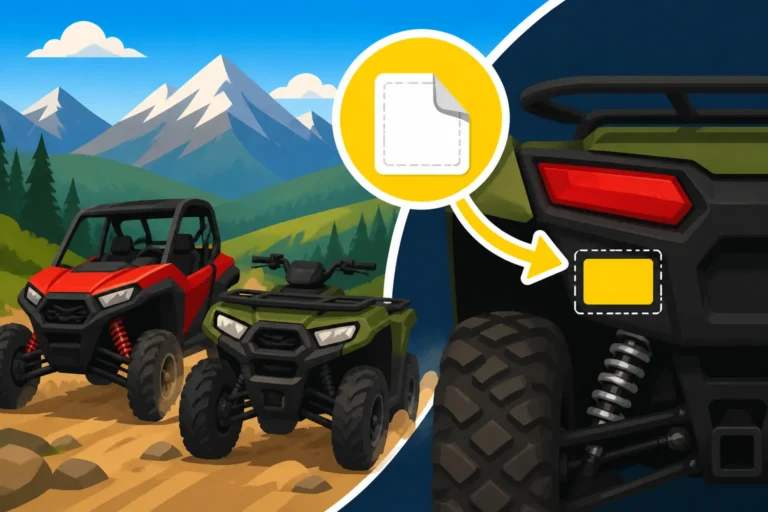
If you travel with multiple machines, label each document with the machine it belongs to, using a method that does not alter the official permit. This is especially helpful for families or groups with similar-looking vehicles. For more on physical placement, see Where to Put a Non-Resident Permit and Colorado OHV Registration for Machines Kept on Private Land for the separate question of where a machine is stored and used.
Reciprocity, plates, and common purchase mistakes
Do not assume another state’s registration replaces Colorado requirements
A visitor may already have a registration, permit, or sticker from a home state. That does not automatically answer whether Colorado requires a separate permit for the planned ride. Rules can depend on the vehicle, the riding location, and the type of credential the other state issued.
Before travelling, identify the machine’s status and check Colorado’s rules for visitors. A state registration may document the vehicle in its home jurisdiction, but Colorado can have a separate requirement for riding on its public lands or designated OHV routes. Do not rely on a friend’s experience unless their vehicle and route are genuinely comparable to yours.
If you are coming from Utah, Wyoming, or another nearby state, review Colorado OHV Permit Reciprocity With Other States and Out-of-State Machines on Colorado Trails. Reciprocity is a specific rule, not a general assumption that one state’s sticker always satisfies another state’s requirements.
A license plate may not settle the OHV permit question
Owners sometimes assume a street-legal plate means no Colorado OHV permit is needed anywhere. That can be an expensive assumption if the machine is going onto a designated OHV trail or public land with a separate permit requirement. At the same time, requirements are not identical for every vehicle or location, so do not buy a permit solely on a broad rule of thumb.
Check the specific vehicle category and intended use. Is the vehicle a plated motorcycle, a side-by-side registered for road use, or an OHV that is only being transported on public roads? Will you ride on a designated trail, a county road, or private property? These details matter when determining which requirements apply.
When in doubt, ask the land manager or CPW with the machine details in front of you. You can also review Why Plated Vehicles Still Need a Colorado Permit and Colorado Permits for Plated Street-Legal Vehicles. The aim is not to buy extra paperwork blindly, but to avoid treating a plate as an automatic substitute for a separate OHV requirement.
Avoid buying from an unverified seller or relying on an old sticker
A permit shown in a classified ad, included with a used machine, or described as “good for Colorado” should not be treated as proof that you are covered. The document may belong to a previous owner, apply to a different year or machine, or no longer be valid. Confirm the rules and buy through an official or authorized channel.
Be particularly cautious with online marketplace listings. If you see a Colorado OHV permit offered on Amazon or another general marketplace, do not assume a seller can issue a valid state credential. Colorado Parks and Wildlife or an authorized sales agent is the proper starting point for the state-issued permit or registration. A marketplace receipt for unrelated riding gear is not a permit, and a photo of a sticker is not proof that it has been issued to you.
Amazon may be useful for non-government items that make paperwork easier to protect, such as a document pouch, but those purchases are separate from getting a permit. If you order a map or gear on Amazon, verify that it suits your route and equipment; do not confuse a retailer’s product with official land access information. For permits, use the official CPW channel or a verified vendor, and keep the actual transaction record.
A practical purchase checklist for Colorado riders
Before you buy
Start with four questions: Are you a Colorado resident? What kind of machine are you riding? Where will you ride it? Is it already registered or plated in another state? These answers help narrow down whether you need a resident registration, a nonresident permit, or further guidance for a special situation.
Next, check the official CPW information and the rules for your destination. Look at the route and land manager, not just the town where you are staying. A machine may pass through several jurisdictions during a day’s ride, and the permit question is only one part of being allowed to use the route.
Finally, decide how you will buy. If purchasing online, confirm the product and delivery details. If purchasing in person, contact the vendor first. If using phone or mail, follow official instructions and allow time for the process. Doing this before loading the trailer means a small paperwork question is less likely to derail a whole trip.
At the point of purchase
Read every screen or form before submitting it. Confirm that the selected document matches your residency and machine, and review any vehicle details for errors. A misspelled name or incorrect VIN may create avoidable follow-up, especially if several family members are purchasing at once.
Save the receipt or confirmation as soon as the transaction is complete. If you are buying in person, keep the receipt with the issued permit until you have confirmed that the document is correct. If something seems wrong, ask the seller or issuing agency to clarify it before you leave or well before your departure date.
For a group, keep a simple list of the rider, machine, and permit status. This does not need to be complicated: one person can check off each vehicle and confirm the paperwork is present. It is a small step that helps prevent the familiar trailhead scramble of everyone searching glove boxes at the same time.
Before unloading at the trailhead
Check that each machine has the required permit or registration and that it is displayed or carried as instructed. Compare the document to the correct machine, especially if the vehicles look alike. Then verify that your route is open and that the trail or road allows your vehicle type and width.
Keep proof of purchase accessible, but do not assume it replaces the issued credential. Store documents where they will not be soaked or lost, and make sure the rider responsible for the machine knows where they are. If a ranger or land manager asks to see paperwork, it should not be buried under camping gear in the back of the tow vehicle.
A final check can be as simple as confirming the vehicle, credential, placement, and route for every machine. If anything is unclear, resolve it before riding rather than hoping it will not come up. For renewal timing and expiration questions, read How Long a Colorado OHV Permit Lasts and confirm the dates printed or provided with your specific credential.
Common questions about buying a Colorado OHV permit
Can I buy a permit when I arrive in Colorado?
Often, riders can purchase through an authorized in-person vendor, but availability depends on the location and the transaction. Do not assume that every gas station, trailhead, or sporting-goods store sells OHV permits. Confirm the vendor and its hours before you depend on a last-minute stop.
If you are travelling to a remote riding area, buying ahead through the official online channel may be less stressful. Just check the delivery and display instructions. If a physical permit must arrive or be applied to the machine, purchasing on the way to the trail may not solve the problem immediately.
Is a confirmation email enough to ride?
Do not assume it is. A confirmation shows that a transaction was submitted or completed, but the applicable instructions may still require a physical permit, decal, or other document. Read the purchase instructions and follow them carefully.
If you purchased close to your ride date and are unsure what to do while waiting, contact CPW or the vendor. Keep the confirmation available, but do not treat it as permission to disregard display or carrying requirements.
Can I buy one permit for several machines?
Do not assume a permit for one machine covers an entire household or group. Permit and registration requirements can be machine-specific. Check the official purchase instructions and obtain the required credential for each vehicle as applicable.
When buying for several vehicles, gather each machine’s details first and review the completed records before leaving. This is a good time to confirm which rider is taking which machine and where each credential is stored.
Do I need a permit if I am only transporting my ATV?
Transporting a machine on a trailer is different from riding it. The permit question generally concerns operation in places where registration or a permit is required, but other rules may apply to the trailer, vehicle, or destination. Confirm requirements for the route you will ride, rather than assuming that carrying the machine automatically requires the same credential as operating it.
When you unload, the location and intended use matter. A machine that was legally transported may still need the appropriate permit before it is ridden on a public trail or other regulated area. Keep the two steps separate in your planning: legal hauling and legal riding.
What if I ride only on private land?
Private property can change which permit requirements apply, but the details matter. The landowner’s permission is essential, and public roads, trail connections, or public-land segments can bring separate requirements into play. Do not treat “private land” as a blanket exemption for an entire trip.
Ask the landowner about the boundaries and whether your route crosses public access. For a more specific discussion of private-property use, see Do You Need a Permit on Private Colorado Land?. If you plan to travel beyond the property, check the rules for every part of the route.
What should I do if the permit is lost or damaged?
Contact the issuing agency or authorized vendor and ask about the official replacement process. Keep any purchase record, receipt, or confirmation that can help identify the original transaction. Avoid copying, altering, or recreating the permit yourself.
If the permit is damaged but still present, do not assume it remains acceptable simply because you can make out some of the information. Ask what to do and replace it through the proper channel if required. A quick check before a ride is much easier than trying to explain an unreadable permit at a trailhead.
Disclaimer
This article is for general informational purposes only and does not constitute professional advice. Laws, prices and regulations vary by location and change over time. Consult a qualified professional for guidance on your specific situation.