Replacing a Lost Snowmobile Certification Card
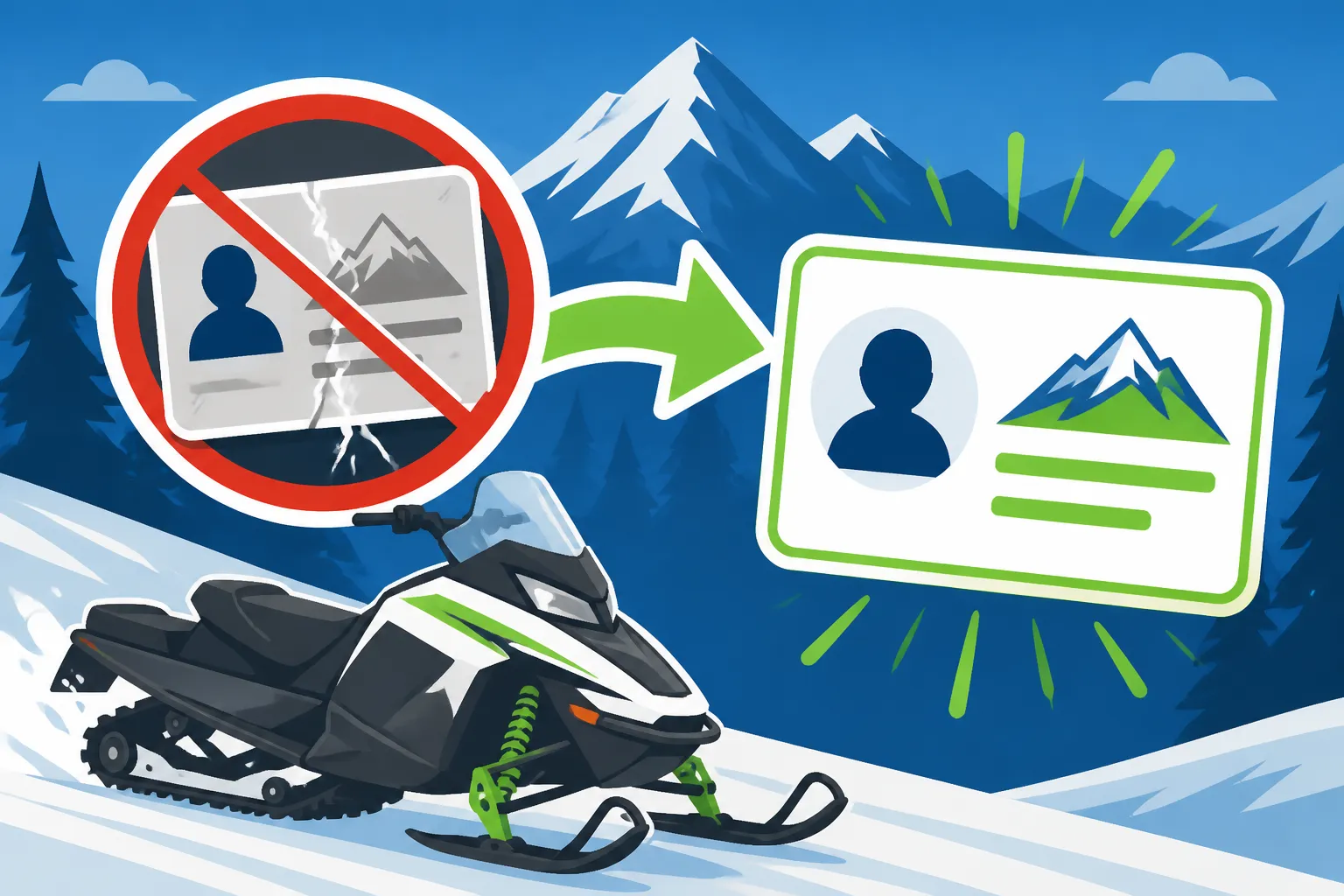
Replacing a lost snowmobile certification card can be stressful when a ride is coming up, especially if you are unsure whether a registration document or another permit will do instead. The key is to recover proof of your completed course through the right record holder, then check which rules apply to the machine and place where you plan to ride.
What a snowmobile certification card proves
A snowmobile certification card is evidence that you completed an approved snowmobile safety course. It is not the same as a snowmobile registration, an ATV or UTV registration, or a permit to ride on a particular trail or area. Each document has a different purpose, and having one does not automatically replace another.
Colorado’s rules for snowmobile safety certification depend on the rider and the current requirements. Before assuming you need a replacement card—or that you can ride without one—check the current information from Colorado Parks and Wildlife (CPW). Requirements can differ by age, type of vehicle, and where you are riding. The overview in Does Colorado Snowmobile Certification Expire? can help you understand the separate question of whether a completed course remains valid.
This distinction matters because “off-highway vehicle” can describe several kinds of machines in everyday conversation, but the rules and proof for one vehicle type may not cover another. A snowmobile course card is not an ATV or UTV registration, and it does not serve as an OHV permit. Conversely, an OHV permit or registration does not prove completion of a snowmobile safety course. For the ATV and UTV side of the distinction, see Why Colorado Requires No OHV Safety Certificate.
| Document | What it generally shows | What it does not replace |
|---|---|---|
| Snowmobile certification card | Completion of a snowmobile safety course | Vehicle registration or an area-specific permit |
| Snowmobile registration | Registration of the machine | A required safety course certificate |
| Colorado OHV registration or permit | Permission or registration for a covered OHV use | Snowmobile course certification |
| Out-of-state safety card | Course completion recorded by another provider or jurisdiction | Any separate Colorado registration or riding permit |
If you have lost the card, the first task is to identify who issued it. The course provider may keep the completion record, while CPW or its current education-system partner may be able to direct you to the record or replacement process. The right contact depends on when and where you took the course and how that course was delivered.
A card can also be confused with an ATV or UTV safety-course card. If you took more than one course, be specific when asking for help: say that you need proof of snowmobile safety-course completion. That reduces the chance of being sent to a process for a different vehicle type.
How to replace a lost card
Start with the course record, not with a new course. Repeating a course may be unnecessary if the original completion is on file, and it may not solve the problem if your name or contact details in the record do not match your current information.
- Check for a digital copy or account record. Search your email for a completion notice, course receipt, or message from the course provider. If you used an online learning account, sign in and look for a certificate or completion history. Check saved files and any wallet or document app where you might have stored a copy.
- Identify the course provider. Look for the provider’s name on an old receipt, email, paper card, or course notes. If you took the course in person, contact the organization or instructor that administered it and ask where its student records are held.
- Gather identifying details. Have your full name at the time of the course, your current name if it has changed, date of birth, approximate course date, and the email address or mailing address you used. A course confirmation number or old card number can help, but do not delay contacting the provider if you do not have one.
- Ask for a replacement or record lookup. Explain that the original card is lost and ask whether the provider can issue a replacement, provide a digital certificate, or direct you to the current agency process. Ask what information they need and whether there is a way to confirm your record while a replacement is being processed.
- Follow the instructions for your specific record. A record held by a current provider may have a different recovery route from an older paper certificate. Use the agency or provider’s current directions rather than assuming that an online course account, a local office, or a general OHV registration service can access it.
- Save the replacement in more than one place. Once you receive proof, keep a digital copy and a paper copy. Store the digital file somewhere you can access without relying on one device, and keep the original card in a secure place.
When contacting CPW or the course provider, keep the request focused. A useful message includes your name, date of birth, approximate course date, course type, and the fact that you need a replacement snowmobile certification card. If you are unsure who holds the record, ask CPW which provider or record system you should contact. Avoid sending sensitive identity details through an unverified email address or message form.
If your name has changed since taking the course, include both the name used when you completed it and your current name. Ask what supporting documents are needed to connect the records. Do not assume that a new name will automatically appear on an older certificate.
If the provider cannot locate your record, ask whether it searched under alternate spellings, a former name, or an old email address. If you took the course a long time ago, ask whether records from that period are held somewhere else. Keep notes of whom you contacted and what they told you, particularly if you need to follow up with another office.
The provider may explain that your record cannot be found or that the old course is not accessible through its current system. In that case, ask CPW what acceptable next steps are before signing up for another course. A new course may be the practical solution, but verify that it is the right course for your situation and that its completion will be documented in a form you can retrieve later.
Riding before the replacement arrives
A lost card and a missing course record are not necessarily the same problem. You may have completed the course and simply lost the physical proof. But if you cannot show the record when asked, it can be difficult to establish completion on the spot. Do not rely on a verbal assurance that a replacement is on the way unless the relevant authority confirms what temporary proof, if any, it accepts.
Before riding, check the requirements for the specific machine and location. If you will ride outside Colorado, check the destination’s rules as well. A certificate accepted in one state may not settle every requirement in another. Where Colorado Riders Need a Certificate Elsewhere and Do Out-of-State Safety Cards Matter in Colorado? address why certification and recognition can depend on where you ride.
Keep your course proof separate from documents for the vehicle. For example, a registration card identifies the machine’s registration status; it does not establish that an operator has completed a required course. A trail permit or land-use authorization likewise does not replace a rider certification. For broader Colorado OHV permit questions, Colorado Non-Resident OHV Permit Explained covers a different document and purpose.
If a ranger, enforcement officer, event organizer, or rental provider asks for proof, show the record or certificate that applies to that request. A receipt for a course is useful to keep, but do not assume it will be accepted as a substitute for the official certificate. Ask the agency or provider what form of proof is acceptable, especially if you are traveling with only a phone or a screenshot.
Young riders may face additional age-related requirements, and a parent’s or supervising adult’s documentation does not stand in for the rider’s own required proof. Snowmobile rules should not be mixed up with ATV and UTV age requirements. For the latter, Colorado Age Rules for Young OHV Riders is a useful separate reference.
Avoiding delays and common mix-ups
The most common delay is contacting the wrong office because the lost card is mistaken for a vehicle registration or OHV permit. When you make a request, use the phrase “snowmobile safety course completion record” and identify the course provider if you can. If you are directed elsewhere, ask for the name of the office or system that holds the record and the best way to reach it.
Another common issue is assuming that a course record will be found under the rider’s current email address. The course may have been completed using an older address, a parent’s email, or a different spelling of the rider’s name. Provide possible variations, but share personal information only through the provider’s verified contact method.
Keep a small document set for future trips:
- Your snowmobile certification card or a confirmed digital certificate
- The machine’s current registration documents, where required
- Any separate permits needed for the riding area
- Contact information for the course provider or agency
- A backup copy stored separately from the original
Before traveling, check both the rider requirements and the machine requirements. A snowmobile card will not cover an ATV or UTV trip, and an ATV or UTV permit will not establish snowmobile course completion. For a trip that includes multiple machine types or more than one state, make a separate checklist for each vehicle and destination.
A replacement card is usually a records-recovery task, not a reason to start over immediately. Locate the course provider, supply enough details to search the record, and follow its current instructions. If no record can be found, ask CPW or the provider what to do next before paying for or taking another course. Once the replacement is issued, save it in both digital and physical form so a lost wallet or damaged card does not leave you starting the search again.
Disclaimer
This article is for general informational purposes only and does not constitute professional advice. Laws, prices and regulations vary by location and change over time. Consult a qualified professional for guidance on your specific situation.