Afternoon Thunderstorms on a Pass
There's nothing quite like the feeling of cresting a high mountain pass in Colorado on your ATV or UTV, the vast expanse of the Rockies stretching out before you. It's a truly breathtaking experience. But all too often, that stunning blue sky can quickly turn a menacing grey, bringing with it the notorious afternoon thunderstorm. Getting caught off guard in a mountain storm is more than just inconvenient; it can be downright dangerous. This guide is here to walk you through everything you need to know about predicting, preparing for, and safely navigating those sudden, sometimes violent, afternoon downpours that are a hallmark of summer riding in Colorado.
The Anatomy of a Colorado Afternoon Thunderstorm
If you've spent any time in Colorado's high country, you know the drill: glorious sunshine in the morning, followed by a gradual buildup of clouds around noon, often culminating in a short, intense thunderstorm in the afternoon. It's a pattern so common it's almost predictable, yet its ferocity can still catch even seasoned riders off guard.
Why the Mountains Brew Afternoon Storms
Colorado's mountains are essentially giant weather factories during the summer months. It all starts with the intense solar radiation heating the ground, especially the exposed rock faces. This warm air then rises, a process called convection. As it rises, it cools, and the moisture within it condenses, forming cumulus clouds – those puffy white ones that look so innocent at first.
What makes the mountains unique is the "upslope flow" and terrain-induced lift. As air masses move across the plains and hit the formidable barrier of the Front Range and beyond, they're forced upwards. This additional lift, combined with the daily thermal heating, turbocharges the convection process. Moist air from distant sources can also be drawn into the mountains, providing the fuel for these storms. By early afternoon, often between 1 PM and 5 PM, these conditions are ripe for rapid cloud development, leading to towering cumulonimbus clouds, the harbingers of thunderstorms. It's a beautiful, yet powerful, natural phenomenon, and understanding it is the first step in respecting its potential.
Typical Timing and Severity
While every storm is unique, there's a strong tendency for these mountain thunderstorms to develop and unleash their fury during the early to late afternoon. Mornings are generally the calmest and clearest, making them ideal for high-altitude rides. As the day progresses, the heat builds, and the atmosphere becomes more unstable. You might see a few wispy clouds around 10 AM, but by noon, they're often growing larger and darker, especially over the highest peaks.
When these storms hit, they don't mess around. We're not talking about a gentle drizzle. Expect heavy rain, often accompanied by hail, strong winds, and, most critically, frequent lightning. The intensity can be shocking, turning a dry trail into a rushing stream in minutes. While they are usually short-lived, often clearing out by early evening, the impact they have on trails and rider safety can be significant and long-lasting. It’s crucial not to dismiss a forecast that mentions "isolated thunderstorms"; in the mountains, "isolated" can mean right over you and be incredibly severe, even if it clears up quickly for your buddy a few miles down the road.
High-Altitude Hazards: Riding Through a Summer Storm
Getting caught in a severe thunderstorm in the high country presents a unique set of dangers that go beyond just getting wet. The combination of altitude, exposed terrain, and the sheer power of mountain weather can quickly turn a fun ride into a survival situation.
The Silent Threat of Lightning
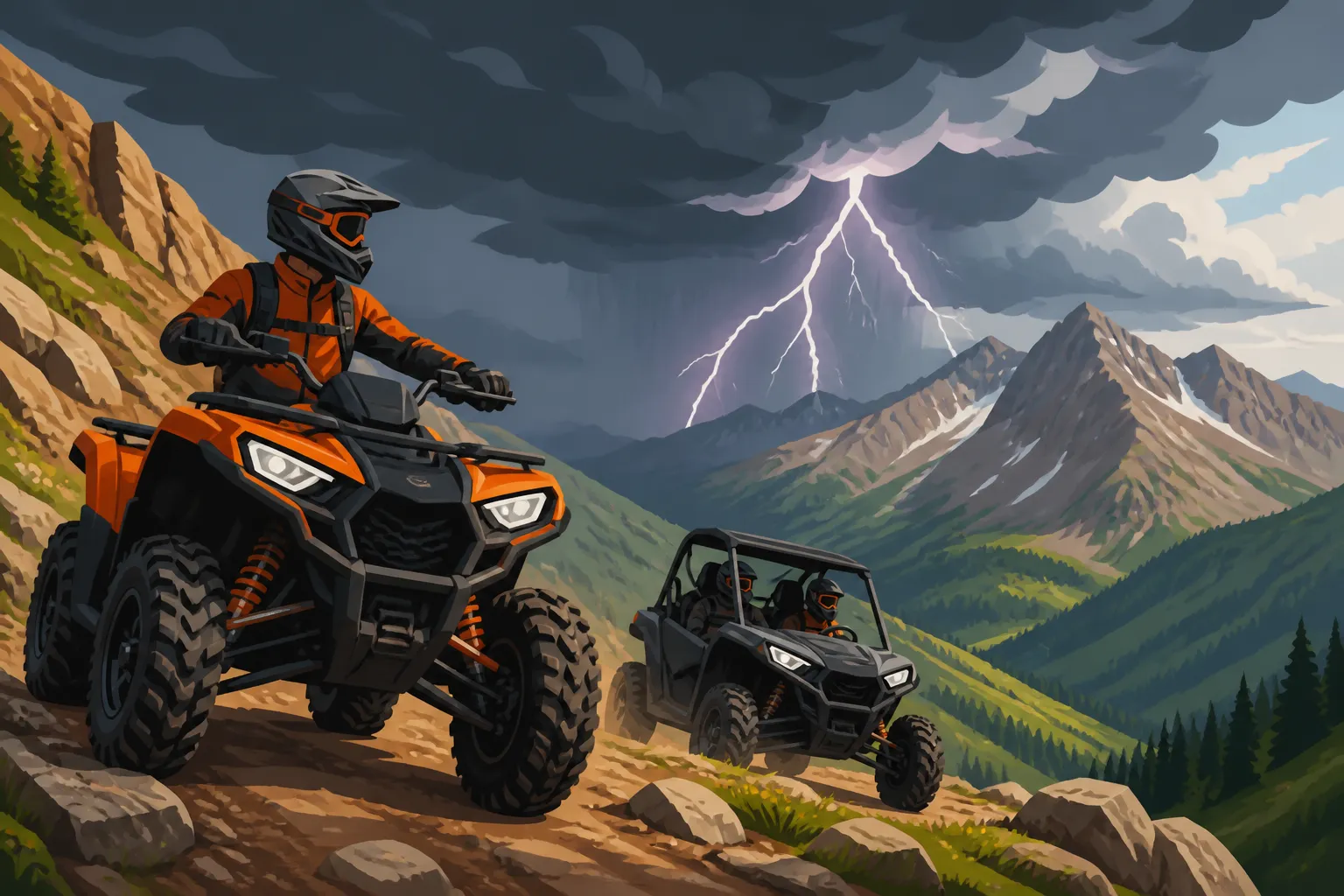
Perhaps the most terrifying and immediate danger in a mountain thunderstorm is lightning. When you're riding an OHV above treeline, you are literally one of the tallest objects in a landscape designed to attract electrical charges. Your machine, especially if it has metal components, can act as a conductor. The rule of thumb for lightning safety is: "If you can hear thunder, you are within striking distance." And thunder travels much slower than light, so by the time you hear it, the danger is already there.
Being above treeline, on a ridgeline, or even near isolated tall trees puts you at extreme risk. There are many myths about lightning – like that it won't strike the same place twice, or that rubber tires will protect you. These are simply not true. Your best defense is distance and seeking safe shelter, which, unfortunately, can be hard to find in a hurry on a high pass. The sheer speed of lightning means decisions need to be made before the storm is directly overhead. Always have a plan for [Lightning Above Treeline on an OHV] if you ride high passes.
Water's Fury: Flash Floods and Mudslides
Heavy rainfall in mountainous terrain doesn't just create puddles; it can trigger flash floods and mudslides with terrifying speed. Colorado's steep canyons, narrow drainages, and burn scars (areas where wildfires have removed vegetation) are particularly vulnerable. A dry creek bed can become a raging river in minutes, carrying rocks, logs, and debris. Washes, which might look like easy routes when dry, become deadly traps.
Imagine riding along a relatively flat section, only to find the trail ahead of you completely engulfed by a sudden torrent of water. Or worse, the ground you're riding on starts to give way. Mudslides, sometimes called debris flows, are even more destructive, as saturated soil, rock, and vegetation slump down hillsides. These events can block trails, make sections impassable, or even sweep you and your machine away. Even if your machine is equipped with rugged SuperATV skid plates and heavy-duty suspension, it won't protect you from the ground collapsing beneath you or a wall of water and mud. Always be aware of drainages and low-lying areas.
Hypothermia and Exposure
Even in the middle of summer, temperatures at 10,000 to 12,000 feet can drop dramatically during a thunderstorm. When you're soaked to the bone from rain or hail, and then exposed to strong winds, the risk of hypothermia becomes very real. Hypothermia is a dangerous drop in body temperature, and it doesn't just happen in winter; it can strike quickly if you're wet and cold.
Symptoms can include shivering, confusion, drowsiness, and loss of coordination. In severe cases, it can be fatal. This is why having proper rain gear and extra layers – even if the morning feels warm – is non-negotiable for high-country riding. That sunny 70-degree morning can turn into a windy, rainy 40-degree afternoon faster than you can say "grab my jacket." For more on staying warm, check out [Cold Weather Gear for a High Pass].
Visibility and Traction Challenges
When a mountain storm hits, visibility can plummet to near zero. Heavy rain, dense fog, and even large hail can make it impossible to see the trail ahead, the edge of a shelf road, or oncoming traffic. This reduced visibility combined with slick, muddy trails creates a treacherous environment.
Wet rocks, loose gravel, and deep mud can cause your tires to lose traction, especially on steep ascents or descents. Without adequate grip, you risk sliding off the trail, getting stuck, or even rolling your machine. You might have invested in top-of-the-line SuperATV tires for aggressive traction, but even the best tires have their limits when the ground turns into a greasy, rocky slop. Headlights and taillights become essential, but even powerful SuperATV LED light bars struggle to cut through a whiteout of rain and fog. Dealing with [Mud and Ruts on a Forest Road] becomes a whole different challenge when they are actively forming around you.
Strategic Preparedness for Mountain Rides
The key to surviving and even enjoying your mountain OHV adventures, despite the weather, lies in meticulous planning and preparation. Hope for the best, but prepare for the worst.
Monitoring the Forecast Like a Pro
Your ride begins long before you load up the trailer. Developing a habit of checking specific mountain forecasts is paramount. Don't just look at the forecast for Denver or Colorado Springs; use apps and websites that provide localized weather for the exact area you plan to ride, often broken down by elevation. These specialized forecasts can give you critical details like afternoon thunderstorm probability, wind speeds at high elevations, and freezing levels.
Pay close attention to wording. "Isolated thunderstorms" at 30% chance in the city might mean a quick shower, but for mountain riders, it translates to "there's a real chance of a severe storm directly impacting your specific trail." Look for phrases like "convective activity," "monsoonal flow," or "unstable atmosphere." If the forecast suggests a high chance (50% or more) of thunderstorms, especially during peak afternoon hours, seriously reconsider your high-altitude plans or opt for a morning-only ride in a lower, more sheltered area. Knowing [Planning a Colorado Riding Trip] properly involves extensive weather research.
Essential Gear for Every High-Country Trip
Your gear list for mountain riding should always include items that can handle sudden shifts in weather, regardless of the forecast. Think of it as your portable safety net.
- Rain Gear: This isn't optional. Invest in good quality, waterproof (not just water-resistant) jackets and pants. They should be easy to put on quickly over your riding clothes.
- Layered Clothing: Even in summer, pack extra layers. A fleece, a wool baselayer, or a puffy jacket can be a lifesaver if temperatures plummet. Synthetic or wool materials are best as they retain warmth even when wet, unlike cotton.
- Emergency Kit: This should be comprehensive. Include a first-aid kit, a headlamp or flashlight, a fire starter, a knife or multi-tool, a small amount of non-perishable food, water purification tablets, and a space blanket or emergency bivvy. Consider a compact SuperATV recovery kit with a winch, straps, and shackles if your machine is equipped.
- Communication Devices: Cell service is notoriously spotty in the high country. Don't rely on your phone. Carry a satellite messenger (like a Garmin InReach or Spot device) or a two-way radio to stay in touch or call for help. Understanding [Cell Service on Colorado Mountain Trails] is vital for emergency planning.
- Navigation Tools: While GPS apps are great, always have a backup. A paper map of the area and a compass (and knowing how to use them) can be critical if your electronics fail or lose signal. This ties into [Reading a Colorado Motor Vehicle Use Map].
- Basic Repair Kit: Tools to fix a flat tire, zip ties, duct tape, and any specific tools for your machine's common issues.
- Gloves and Hat: Even in summer, waterproof gloves and a warm hat can prevent heat loss and keep you more comfortable.
For a detailed list of what to pack, refer to [What to Carry Over a High Pass].
Route Planning with Weather in Mind
When planning your route, think defensively. Can you get to lower elevations quickly if a storm rolls in? Are there sheltered areas along your chosen trail, such as dense tree cover (but still be wary of falling trees during strong winds) or sturdy structures (like a mining cabin, though these offer limited protection from lightning)?
Avoid routes that keep you exposed above treeline for extended periods, especially during the afternoon. If your plan involves crossing several high passes, consider doing them earlier in the day. Look for trails that have multiple bailout points or alternatives to get to safety if conditions deteriorate. Knowing your escape routes is just as important as knowing your destination. High-altitude riding also brings [Altitude and Carburetor Tuning] considerations, which can become critical if you need to quickly descend or manage engine performance in changing conditions.
Navigating a Storm on the Trail
Despite your best planning, you might still find yourself on a trail when a storm decides to make an appearance. Knowing how to react quickly and safely is paramount.
Immediate Actions When Clouds Gather
The moment you notice the sky starting to darken significantly, distant rumbles of thunder, or a sudden increase in wind, take it seriously. Don't wait for the first raindrop. These are your early warning signs.
- Assess Your Location: Are you above treeline? On an exposed ridge? Near a deep canyon? The more exposed you are, the faster you need to react.
- Look for Escape Routes: Can you quickly descend to lower elevations, perhaps into a valley or below the treeline?
- Check for Shelter: Are there any substantial buildings (rare in the remote high country), dense clusters of trees (still risky for lightning but better than open ground), or a hard-sided vehicle nearby?
- Communicate: If you're riding with a group, immediately discuss the situation and make a unified decision. If you're riding solo, let your emergency contact know your updated plans (if you have satellite communication).
- Don Your Rain Gear: Don't wait until you're soaked. Put on your waterproof jacket and pants as soon as you recognize the threat. It’s much harder to get warm once you're cold and wet.
Seeking Safe Shelter and Waiting It Out
Your primary goal when a storm hits is to get to the safest possible location and wait for it to pass.
- Descend to Lower Elevations: The most effective strategy is to get as far below treeline as possible. Lightning risk decreases significantly the lower you go.
- Dense Tree Cover (with caution): If you absolutely cannot get below treeline, seek shelter in a dense forest, away from the tallest, most isolated trees. While trees can be struck by lightning, a cluster of shorter trees offers more dispersion than a single, tall pine. Stay away from the trunks; lightning can travel through the ground from a strike.
- Hard-Sided Vehicles: If you are lucky enough to be near a friend with a truck or SUV, that's often the safest bet. The metal frame acts as a Faraday cage, diverting the electrical charge around the occupants.
- Inside Your UTV (with caveats): If you're in a UTV with a full roll cage, roof, and windshield, it offers some protection compared to being fully exposed. Stay inside, hands in your lap, avoid touching metal parts. But understand that a direct lightning strike is still incredibly dangerous and this is not a perfect solution. You're better off getting low.
- Avoid: Open fields, ridgelines, isolated tall trees, water, and shallow overhangs (which offer no lightning protection and can funnel floodwaters).
Sometimes, the best thing to do is simply pull over in a relatively safe spot (away from potential flash flood paths or falling trees), turn off your engine, and wait. These storms are often intense but brief.
What to Do If You Can't Get to Shelter
If you find yourself caught in the open, above treeline, with nowhere to go and lightning is active, you need to minimize your risk:
- Move Away from Tall Objects: Get off your OHV. Do not stand near it if it's the tallest object around. Move away from any isolated tall trees or rock formations.
- Assume the Lightning Position: Crouch low to the ground with your feet together, head tucked, and hands over your ears. Minimize your contact with the ground. Do not lie flat on the ground.
- Stay Low, Away from Water: Find a low-lying area, but be absolutely sure it's not a drainage path that could quickly become a flash flood zone. Stay away from any standing water.
- Spread Out in a Group: If you're with others, spread out by at least 15-20 feet. This prevents a single strike from affecting everyone.
These are desperate measures, highlighting why proactive planning and seeking proper shelter are so crucial.
After the Storm: Assessing and Proceeding
The storm might have passed, the sun might even be trying to peek through, but the dangers aren't necessarily over. The landscape has likely changed, and new hazards may be present.
Checking for New Hazards
Once the immediate threat of lightning and heavy rain has passed, don't just jump back on your machine and go. The trail you knew might no longer exist in the same way.
- Downed Trees and Debris: Strong winds can bring down trees and branches, blocking trails or creating new obstacles.
- Rockfalls and Landslides: Saturated ground and heavy rain can dislodge rocks and soil, leading to rockfalls or small landslides that can cover the trail or create unstable sections.
- Washed-Out Sections: Areas that were once firm ground might now be deeply rutted, eroded, or completely washed out by rushing water. This applies especially to unpaved roads, where [Riding a Gravel Road After a Rainstorm] can be very different.
- Deeper Water Crossings: What was a shallow stream crossing might now be a deep, fast-flowing torrent. Do not attempt to cross if you can't see the bottom, don't know the depth, or if the water is moving too swiftly.
- Undermined Edges: If you're on a shelf road, heavy rain can undermine the outer edge, making it incredibly unstable. Stay well clear of the edge. [Brake Fade on a Long Colorado Descent] can be amplified on a slick, rutted trail, so test your brakes carefully.
Proceed with extreme caution, and if anything looks questionable, it's always best to scout it on foot before attempting to ride through it.
Machine Inspection and Self-Care
Before you continue your ride, take a few minutes to check yourself and your machine.
- Yourself: Are you cold? Shivering? Change into dry clothes if you have them. Drink some water and eat a snack to warm your core temperature. Check for any minor injuries from slipping or falling.
- Your Machine:
- Electrical System: Check for any exposed wires or water intrusion into critical electrical components. Does everything power on correctly?
- Brakes: Test your brakes gently at a very slow speed. Water and mud can affect their performance.
- Tires: Check for any new punctures or damage from debris that might have been washed onto the trail.
- Fluids: Briefly check oil, coolant, and brake fluid levels, looking for any signs of contamination from water.
- Lights: Ensure all your lights, including your SuperATV auxiliary lights, are working correctly. You might need them if visibility remains poor.
When to Turn Back
This is perhaps the most important decision you'll make after a storm. It takes courage and good judgment to admit that conditions are too dangerous to continue. If the trail is severely damaged, if you're feeling too cold or shaken to ride safely, if your machine is compromised, or if another wave of storms seems imminent, it is absolutely okay, and often the smartest choice, to turn around.
There's no glory in pushing through unsafe conditions, and the mountains will always be there for another day. Prioritize your safety and the safety of your group above all else. Sometimes, the most adventurous decision is knowing when to call it a day and head for lower ground and a warm, dry meal. You may have the best [Recovery Gear for a Shelf Road] money can buy, but sometimes, discretion is the better part of valor.
Disclaimer
This article is for general informational purposes only and does not constitute professional advice. Laws, prices and regulations vary by location and change over time. Consult a qualified professional for guidance on your specific situation.