Letting a Visitor Ride Your Machine
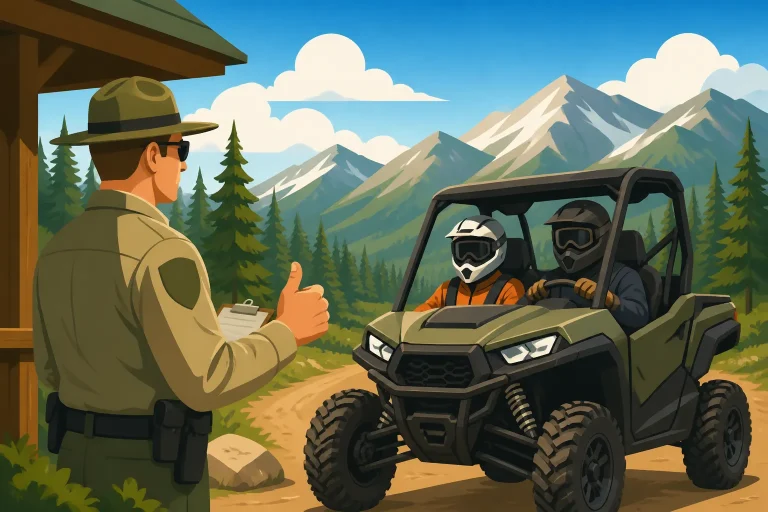
If a friend or visiting relative wants to ride your ATV or UTV in Colorado, the key question is not just who owns the machine. You also need to check its registration or permit, where the guest plans to ride, and whether local rules or your insurance create extra conditions. Here’s how to sort those issues out before handing over the keys.
Check the machine’s Colorado registration or permit
For public land and designated trails, start by checking the machine’s paperwork. Colorado Parks and Wildlife requires off-highway vehicles operated on public land or trails in Colorado to be registered with the agency. Colorado Parks and Wildlife also says an OHV must have either a current Colorado registration card and decals or a Colorado OHV permit to operate in Colorado.
That requirement focuses on the machine’s authorization to ride, not simply on whether the person holding the handlebars is a Colorado resident. If your visitor is riding your Colorado-registered ATV or UTV, check that its registration is current and that its decals are displayed. Colorado Parks and Wildlife says all OHVs owned and operated in Colorado must display current registration stickers in staging areas or on designated trails.
A guest riding your machine is a different situation from a guest bringing an out-of-state machine. Colorado Parks and Wildlife says non-residents are not required to register their OHVs in Colorado but may choose to do so; its permit information also says out-of-state OHVs must display a current Colorado OHV use permit sticker. If your visitor brings their own ATV or UTV, check the current permit requirements for that vehicle before heading out. Colorado OHV Permit Reciprocity With Other States explains why an out-of-state registration may not replace a Colorado permit.
| Situation | What to check before riding |
|---|---|
| Your visitor rides your Colorado OHV | Confirm the machine has current Colorado registration or a valid Colorado OHV permit, with the required decals displayed. |
| Your visitor brings an out-of-state OHV | Check Colorado’s permit requirements for that machine; an out-of-state OHV may need a Colorado use permit. |
| Your visitor rides a plated, street-legal vehicle on a designated OHV trail | Colorado Parks and Wildlife requires a Colorado OHV permit for plated, street-legal vehicles on designated OHV trails. |
| You are heading to the Alpine Loop | Check the route’s additional operator requirements, including driver licensing and liability insurance. |
Colorado OHV registrations and permits follow an annual cycle. According to Colorado Parks and Wildlife, both are valid from April 1 through March 31 and are required annually. Do not assume a sticker is current just because it is still attached to the machine. Check the paperwork and the registration period before the trip.
If you have recently renewed and the official card or decals have not arrived, pay attention to the confirmation paperwork. Colorado Parks and Wildlife says riders who want to use the machine in the field within the next 30 days are required to carry the registration confirmation receipt. The agency also says the registration card and official decals arrive by mail in approximately 10–20 business days. A visitor should know where the receipt is kept and be able to produce it if needed.
Decal placement depends on the machine. Colorado Parks and Wildlife directs owners to put one decal on each outside face of a UTV or side-by-side’s roll bars. For a four-wheel ATV, it directs owners to place decals in an observable location on each side of the front fenders. Check that the decals are visible and attached to the right places before your guest rides. For details and other registration questions, see Colorado Parks and Wildlife OHV Registration Explained and Where to Stick an OHV Decal on a Four-Wheel ATV.
Make sure the guest has permission and understands the route
A current registration does not tell you whether a particular road, trail, or piece of land is open to your machine. Before lending it, decide where the guest may ride and check that the route allows the vehicle type. A trail suitable for a narrower ATV may not be suitable for a wider side-by-side, and access rules can differ between trails, roads, and private land.
COTREX, a project created by the Colorado Department of Natural Resources and Colorado Parks and Wildlife, offers a trail map built using data from more than 230 trail managers. It can help you plan, but a map should not be your only check. Look for current closures, signs, and restrictions from the land manager responsible for the route. Colorado Trail Conditions Reports and Reading a Colorado Motor Vehicle Use Map can help you prepare.
Do not let your visitor assume that riding your machine means they can take it onto any public road. The Colorado State Patrol says a state law prohibiting OHVs on public streets, roads, or highways went into effect on May 7, 2021, with few minor exceptions. That law covers ATVs, four-wheelers, and side-by-sides. Access on a particular route or road requires checking the applicable local rules; a trail connection or a nearby OHV route does not automatically make every road legal to ride.
Some routes also have requirements beyond the general registration rules. According to the Colorado General Assembly, OHV operators on the Alpine Loop Trail in southwest Colorado must possess a valid driver license and carry liability insurance. That can matter if your guest is not licensed or if you have not confirmed that the relevant insurance applies. Check the route before handing over the machine, rather than relying on rules from another trail or town.
Local governments may also enact ordinances requiring items such as a driver license, liability insurance, seatbelts, child restraint systems, eye protection, helmets for riders 18 and younger, or limits on the number of occupants, according to the Colorado General Assembly. These are powers local governments may use, not a single statewide list of rules that applies identically everywhere. Confirm the rules for your destination and the vehicle you plan to lend. Finding Your Colorado County’s OHV Ordinance is useful when you need to check local requirements.
A practical handoff includes more than pointing out the ignition. Explain which route is approved, where the guest must turn around, and what areas or roads are off limits. If you are uncertain about a route’s status, choose a route you can verify rather than asking your visitor to decide at a trail junction.
Agree on safety, insurance, and who carries the paperwork
Before the ride, make sure the guest knows how the machine operates. Show them the controls, explain how to stop, and go over passenger and seat-belt instructions that apply to the vehicle. A visitor who is comfortable on a different model may still need an orientation to your ATV or UTV. If you would not be comfortable with them taking it out without you, keep the ride supervised or choose another plan.
Insurance deserves a direct conversation. Do not assume that your policy covers every guest, every type of use, or every location. Ask your insurer whether a visitor may operate the machine, what coverage applies, and whether there are restrictions tied to the rider, vehicle, or route. Local rules may require liability insurance in some places, and the Alpine Loop has a specific requirement for operators to carry liability insurance, according to the Colorado General Assembly. For more context, see Insuring an ATV in Colorado and Colorado ATV Liability Coverage Limits.
Agree in advance about what the guest should do if the machine gets damaged, stuck, or involved in a collision. Make sure they know how to contact you and where the machine’s registration information is kept. If a crash happens, the reporting requirements may depend on the outcome. Colorado Parks and Wildlife says accidents resulting in property damage of $1,500 or more, or injuries resulting in hospitalization or death, must be reported. The agency says reports must be made within 48 hours to local law enforcement and Colorado Parks and Wildlife. Those reporting rules apply to the incident, not just to the owner’s decision to lend the vehicle.
It can help to set a few clear expectations before the guest leaves:
- Ride only on the route you have agreed on and verified as open to the machine.
- Do not take the OHV onto a public street or road unless a specific exception applies and you have checked the local rules.
- Keep the registration confirmation receipt with the rider when it is required for a recently renewed registration.
- Use required safety equipment and follow passenger, seat-belt, and occupant rules that apply on the route.
- Contact you promptly after a collision, damage, or breakdown.
If the guest will carry paperwork, explain exactly where it is and what it is. Colorado Parks and Wildlife says the registration confirmation receipt must be carried in the field when riding within the specified period after registering. Don’t confuse a registration card or receipt with permission to use a road that is closed to OHVs.
If you are lending the machine for a longer visit, check the registration status again rather than relying on memory. For more on borrowing situations, see Permits for a Borrowed Machine. If your guest is bringing a machine from another state, Out-of-State Machines on Colorado Trails covers the separate issue of Colorado permit requirements.
A quick decision before you hand over the keys
A straightforward handoff starts with three checks: the machine’s paperwork is current, the planned route is open and legal for that machine, and the guest understands any insurance or local requirements. The visitor’s home state matters most when they bring their own OHV; it does not remove the need to check the Colorado authorization and route rules that apply to the machine they will ride.
If anything is unclear, pause the ride and verify the details with Colorado Parks and Wildlife, the relevant land manager, your insurer, or the local government responsible for the route. This is especially important when a visitor plans to ride without you, when the route includes roads, or when the vehicle’s registration has recently been renewed.
Lending an ATV or UTV can be simple once the boundaries are clear. Confirm the machine’s registration or permit, choose a route that allows it, and make sure your guest knows what to do if something goes wrong. Those checks help avoid a preventable registration or access problem while keeping expectations clear for both the owner and the rider.
Sources
- Colorado Parks and Wildlife — Off-Highway Vehicle and Snowmobile Riding | Colorado Parks and Wildlife (checked November 3, 2026)
- Colorado General Assembly — Off‑Highway Vehicles | Colorado General Assembly (checked November 3, 2026)
- Colorado Parks and Wildlife — Register an Off-Highway Vehicle | Colorado Parks and Wildlife (checked November 3, 2026)
- Colorado Parks and Wildlife — Register a Snowmobile | Colorado Parks and Wildlife (checked November 3, 2026)
Disclaimer
This article is for general informational purposes only and does not constitute professional advice. Laws, prices and regulations vary by location and change over time. Consult a qualified professional for guidance on your specific situation.