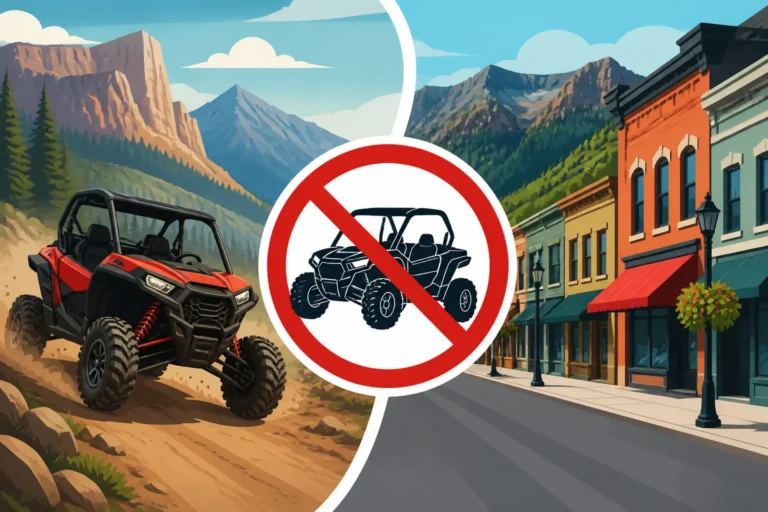
Colorado Fines for Illegal Road Riding
There's nothing quite like the freedom of exploring Colorado's breathtaking backcountry on an ATV or UTV. But that incredible feeling can quickly turn to dread when you see those flashing lights in your rearview mirror, especially if you're caught riding your off-highway vehicle (OHV) where it shouldn't be. Many riders, both residents and visitors, are surprised to learn that Colorado has some pretty specific rules about where and how you can operate an OHV on public roads, and the fines for breaking those rules can put a serious dent in your wallet and your riding plans. This guide is here to walk you through exactly what constitutes illegal road riding, the financial and other penalties you might face, and most importantly, how to steer clear of trouble so your adventures stay on the right side of the law.
Understanding Illegal OHV Road Riding in Colorado
Colorado's rules regarding OHV use on public roads can feel like a maze, and it's easy to get confused. Many riders arrive assuming that if their UTV has blinkers and a horn, it's automatically good to go on any paved road, just like a car. Unfortunately, that's rarely the case, and misunderstanding these nuances is often the first step toward an unexpected citation.
What Constitutes a "Public Road" for OHVs?
When we talk about "public roads" in Colorado, it's crucial to understand that this isn't a single, uniform category. The rules for a dirt forest service road are vastly different from those for a paved state highway or a bustling main street in a mountain town. Generally, Colorado law prohibits OHVs from operating on paved state highways. This is a big one, and it's where many people get into trouble. You might think, "It's just a short hop between trails," but even a few feet on a state highway can land you a ticket.
County roads are a bit of a gray area. Many counties across Colorado have enacted ordinances to open certain county roads to OHV use, typically to connect trail systems or allow access to services in towns. However, these are county-specific decisions, not statewide. This means a county road that's open to OHVs in Hinsdale County might be strictly off-limits in Grand County. Furthermore, even within counties that allow OHV use on some roads, there are often specific restrictions: certain hours, speed limits, or only non-paved segments. It's not a free-for-all, and those seemingly innocuous gravel roads can sometimes transition into prohibited zones without a clear sign.
Lastly, we have forest service roads and Bureau of Land Management (BLM) roads. These are often the arteries of Colorado's incredible trail networks. While many of these unpaved roads are indeed open to OHVs, it's vital to remember that they are still "roads" and may have specific designations. You should always consult a Motor Vehicle Use Map (MVUM) for the area you're riding. These maps clearly mark which roads and trails are open to which types of vehicles, and ignoring them can lead to tickets for riding in restricted areas, even if it feels like you're "in the woods."
Why Colorado Doesn't Have a Statewide Street-Legal Option
This is a point of significant frustration for many OHV owners, especially those coming from states with more permissive street-legal laws. Despite the growing popularity of side-by-sides that look and often perform much like small cars, Colorado does not offer a statewide "street-legal" license plate for ATVs or UTVs that allows them to roam freely on all public roads. This means that even if you've added turn signals, a horn, mirrors, and a windshield – perhaps even upgraded components from a company like SuperATV – your machine is generally not considered street-legal in the same way a car or motorcycle is.
The Colorado Department of Revenue, which handles vehicle titling and plating, generally does not issue standard license plates for machines primarily designed for off-highway use. This is a fundamental difference compared to states that have specific categories or exemptions for OHV street conversion. While your OHV might meet many safety requirements, the legal framework in Colorado simply isn't set up to grant them full street-legal status across the board. This can be especially confusing for out-of-state riders who arrive with their street-legal UTVs from places like Arizona or Utah, only to find Colorado's rules are far more restrictive. [Why Colorado Will Not Plate Your UTV] delves deeper into this topic.
The Role of Local Ordinances in Opening Roads
While Colorado doesn't have a statewide street-legal option, it does empower local jurisdictions – primarily counties and towns – to create ordinances that allow OHV use on their specific roads. This is the good news, but it comes with a big caveat: these ordinances are highly localized and often have strict conditions.
For example, many popular mountain towns like Lake City and parts of Ouray and Silverton's surrounding San Juan County have opened certain streets to OHVs. This is usually done to connect riders to trailheads, allow access to fuel or food, and support the local tourism economy. However, these ordinances almost always come with specific rules: designated routes, speed limits (often very low, like 10-15 mph), requirements for helmets for certain age groups, and specific hours of operation. Many towns also have "no OHV" zones, particularly on their main streets or in residential areas, regardless of whether you're just passing through.
It's absolutely critical to research the specific ordinances of any county or town you plan to ride through. Don't assume that because one town allows it, the next one will. Local jurisdictions can and do enforce their own rules, and ignorance is rarely accepted as an excuse. Signs are usually posted where OHV routes begin and end, and where they are prohibited, but it's always best to have done your homework beforehand. We have more information on this in [Colorado Towns That Let OHVs Use Their Streets].
Specific Fines and Penalties for Violations
Getting caught riding your OHV illegally on a public road in Colorado isn't just a slap on the wrist. Law enforcement, from local sheriffs to Colorado Parks and Wildlife (CPW) rangers, takes these violations seriously, especially given the potential for conflict with other vehicles and the concerns of local residents. The penalties can range from hefty fines to more severe consequences that impact your ability to ride or even drive.
Monetary Fines for Illegal Road Use
The exact dollar amount of a fine for illegal OHV road riding can vary depending on the specific statute violated, the jurisdiction (state highway patrol vs. county sheriff vs. CPW), and whether it's your first offense. However, you can generally expect fines to be substantial. For example, some common infractions, like riding on a state highway where prohibited, can easily result in a base fine that runs into the hundreds of dollars. Many mountain towns, like Silverton, have specific ordinances with established fines for entering restricted areas, such as the [The $300 Fine for Riding Into Silverton]. These aren't minor parking tickets; they're designed to deter unsafe or unauthorized use.
It's not uncommon for officers to issue multiple citations if several violations are observed. For instance, if you're riding on a prohibited road and your OHV doesn't have a current Colorado OHV registration sticker, or perhaps you're missing a spark arrestor, you could be facing fines for each individual infraction. This can quickly add up, turning an afternoon ride into a very expensive lesson.
Additional Penalties: Impoundment and License Points
Beyond the immediate financial hit, there can be other, more serious repercussions. While less common for a simple "wrong road" violation, especially if you're otherwise compliant, impoundment of your OHV is a possibility in certain situations. This typically occurs in cases of extreme disregard for the law, repeat offenses, or if the operator is arrested for a more serious crime like driving under the influence of alcohol or drugs. If your machine is impounded, you'll be on the hook for towing fees, storage fees, and potentially administrative fees, all before you even pay the original fine. This can quickly run into thousands of dollars and be a major headache to resolve.
Another often-overlooked consequence relates to your driving record. While operating an OHV is distinct from driving a street-legal car, some OHV-related violations, particularly those involving reckless operation or impaired driving on public roads (even those open to OHVs), can indeed lead to points on your standard driver's license. Losing points can lead to increased insurance rates, and accumulating too many can result in license suspension. [Colorado Alcohol Limits for OHV Operators] is particularly important to review in this context, as a DUI on an OHV carries severe consequences, just like one in a car.
Penalties for Related Offenses
It's rare that illegal road riding is the only issue. Often, other violations come to light during the stop. Common related offenses include:
- No OHV Registration: Every OHV operating on public land or designated routes in Colorado needs a current [Colorado Parks and Wildlife OHV Registration Explained]. If you're pulled over on a road, even one legally open to OHVs, and you don't have this, that's another fine. [Penalties for an Unregistered OHV in Colorado] can be quite steep.
- Missing or Improper Equipment: Colorado has specific equipment requirements for OHVs, especially when operating on any public land or road section. This includes a functioning muffler, a spark arrestor to prevent wildfires, and often headlights and taillights if riding during certain hours. Riding without a proper spark arrestor, for instance, is a serious offense due to fire danger. Manufacturers like SuperATV offer a range of essential equipment like lighting kits and mirrors that, while not making your machine street-legal statewide, are crucial for compliance in areas where OHV road use is permitted. For road sections where OHVs are allowed, [Lighting Requirements for a Colorado Road Ride] specifies what you need.
- Age and Supervision Violations: Colorado has strict rules about youth riders, engine sizes, and supervision requirements, especially when an OHV is operated on a public road, even if that road is open to OHVs. Letting an unsupervised minor operate an OHV on a road where prohibited, or even one that's open but without proper supervision, can result in significant fines for the adult in charge. [Colorado OHV Road Rules for Young Riders] outlines these specific regulations.
A single stop for illegal road riding can quickly snowball into multiple citations, significantly increasing the total cost and headache.
Common Scenarios Leading to Citations
Understanding the letter of the law is one thing, but knowing the real-world situations that lead to fines can help you avoid them. Many riders, with the best intentions, find themselves in hot water because they misinterpret signs, make assumptions, or simply take a shortcut that seems harmless at the time.
Riding State Highways or Restricted Paved Roads
This is arguably the most common and easily avoidable scenario for receiving a citation. As discussed, paved state highways (think any road with a CO, US, or I designation) are generally off-limits to OHVs in Colorado, with extremely rare exceptions that are usually clearly marked and temporary for specific events. Yet, riders often attempt to use these highways for short distances:
- Connecting Trailheads: You might finish one great trail and see another just a mile down a state highway. The temptation to "just hop over" is strong, but it's a direct route to a ticket. Rangers and state patrol often monitor these known connection points.
- Accessing Services: Needing gas, food, or supplies, some riders mistakenly believe a quick run into town on the main highway is acceptable. Unless there's a specific, signed OHV route into town that avoids the state highway, this is a clear violation.
- Out-of-State Assumptions: Visitors from states where their UTVs are street-legal often assume reciprocity. They've plated their machine in Utah or Arizona, added all the necessary street-legal components from a company like SuperATV, and believe they're good to go anywhere. Colorado's rules, however, apply to all vehicles operating within its borders, regardless of where they're registered. [Colorado Rules for Out-of-State Street-Legal Machines] explains this in detail. This disconnect is a frequent source of citations for non-residents.
The key takeaway here is simple: if it's a paved state highway, assume you cannot ride your OHV on it unless there's explicit, state-level signage indicating otherwise (which is exceedingly rare for OHVs).
Ignoring Local Town Ordinances
Even in counties and towns that do allow some OHV road use, riders often receive tickets for ignoring the specific details of those local ordinances. These are not always broad permissions; they're often highly specific:
- Restricted Areas: Many towns that open some roads still prohibit OHVs on their main street, in specific business districts, or near residential areas to minimize noise and traffic impact. For instance, the town of Silverton has strict prohibitions on OHV use within its town limits, leading to fines for those who ride past the designated staging areas.
- Hours of Operation: Some towns only permit OHV use on their roads during specific daylight hours, or during the main summer riding season.
- Speed Limits: On county roads or town streets opened to OHVs, speed limits are often much lower than for cars, sometimes as low as 10-15 mph. Exceeding these limits is an easy way to attract law enforcement attention.
- Designated Routes Only: In many communities, OHVs are only permitted on specific roads marked as designated routes, typically to connect to a trailhead or a staging area. Veering off these marked routes onto other town or county roads can result in a citation.
It's vital to remember that a town's decision to open roads is often a delicate balance with local resident concerns. Violating their specific rules can jeopardize future OHV access for everyone. Always look for signage and, better yet, check the town or county's website or visitor center for maps and ordinances before you ride.
Operating Without Proper Registration or Equipment
While not strictly about "illegal road riding," a stop for an improper road use often leads to citations for other missing elements. [Colorado Ranger Checks at a Trailhead] often include looking for these items, and a road stop is no different.
- Missing or Expired OHV Registration: As mentioned, if you're riding on any public land or designated OHV route in Colorado, your machine needs a current Colorado OHV registration sticker from Colorado Parks and Wildlife. If you're pulled over for riding on a prohibited road, the officer will almost certainly check for this sticker. If it's missing or expired, that's an additional fine.
- Lack of Required Safety Equipment: This can include a missing spark arrestor, inadequate headlights/taillights (especially if riding at dusk or dawn, even if permitted on that road), or even a missing muffler. While aftermarket parts from companies like SuperATV can enhance your machine, ensuring they comply with Colorado's specific requirements (like DOT-approved lighting, if applicable for permitted road sections, or specific decibel limits for mufflers) is your responsibility.
- Helmet and Eye Protection: While Colorado doesn't have a universal helmet law for adults on OHVs, there are specific requirements for youth riders and sometimes for adults on roads opened by local ordinance. If you're riding a permitted road section and a helmet is required for your age group or the local ordinance, and you don't have one, that's another violation. [Colorado Helmet and Eye Protection: What Is Actually Required] provides the full details.
These "add-on" citations can quickly turn a single mistake into a very expensive day, reinforcing the importance of being fully compliant with all OHV laws, even when you're just driving from your campground to the trailhead.
How to Avoid Fines and Ride Legally
The best way to deal with fines for illegal road riding is to simply avoid them in the first place. This takes a bit of preparation and a commitment to understanding the rules, but it’s far less stressful and costly than dealing with a ticket. Think of it as part of your pre-ride checklist, just like checking your tire pressure or packing water.
Researching Local Ordinances Before You Ride
This is, hands down, the single most important step you can take. Colorado's OHV road access is a patchwork, not a blanket. What's legal in one county or town might be strictly prohibited in the next.
- Consult County and Town Websites: Before you even load your machine onto the trailer, look up the specific county and towns you plan to visit. Many mountain communities have dedicated sections on their official websites (e.g., Chamber of Commerce, Town Clerk, Sheriff's Office) detailing OHV ordinances, including maps of designated routes, restricted areas, speed limits, and any other unique rules. Some even post printable PDFs of their rules.
- Motor Vehicle Use Maps (MVUMs): For federal lands (National Forests, BLM), the MVUMs are your bible. These maps clearly show which roads and trails are open to motorized vehicles, what types of vehicles are allowed, and any seasonal restrictions. They don't cover town streets or county roads that are outside federal land boundaries, but they are essential for understanding where you can ride within the vast majority of Colorado's backcountry.
- Visitor Centers: When you arrive in a trail town, stop at the local visitor center. They often have printed maps, brochures, and knowledgeable staff who can explain the local OHV rules and point out where to stage your machine and where to ride.
- OHV Apps and GPS: Tools like onX Offroad are invaluable. While not a substitute for official maps and ordinances, many of these apps integrate MVUM data and local road information, giving you a digital guide to legal riding areas. However, always cross-reference with official sources, especially for town access rules.
It might seem like a lot of homework, but a little research can save you hundreds, if not thousands, of dollars and a lot of frustration.
Ensuring Your OHV Meets Colorado's Requirements
Even if you're on a legally designated OHV road or trail, you still need to ensure your machine is up to snuff according to Colorado state law.
- Current Colorado OHV Registration: This green sticker from Colorado Parks and Wildlife is mandatory for almost all OHV use on public land in Colorado. Make sure yours is current and properly affixed to your machine. [Colorado OHV Registration Year Runs April to March] explains the validity period. If you're an out-of-state rider, you'll need a non-resident OHV permit.
- Spark Arrestor: This is critical for fire prevention and is a mandatory piece of equipment for all OHVs operating in Colorado. Ensure your exhaust system has a U.S. Forest Service-approved spark arrestor. Many aftermarket exhausts, even those designed for performance, may not have one, or it might be damaged.
- Muffler/Noise Limits: Colorado has noise regulations, and excessively loud machines can draw attention from law enforcement and upset local communities, potentially leading to road closures in the future. Check your muffler to ensure it's in good working order and meets legal decibel limits. [Mufflers and Spark Arresters in Colorado] details these requirements.
- Lights, Brakes, and Mirrors (where applicable): While not universally required for all OHV operation, if you're riding on roads that are opened to OHVs by local ordinance, these ordinances often mandate equipment like headlights, taillights, brake lights, and sometimes mirrors. Ensure your machine has these, especially if you're using it to get to town for supplies. Companies like SuperATV specialize in aftermarket accessories that can help you meet these kinds of requirements, such as durable mirrors or comprehensive lighting kits.
- Safety Equipment (Helmets, Eye Protection): While not universally mandated for adults, youth riders often have helmet and eye protection requirements. Always review these before heading out.
A simple pre-ride inspection of your machine's documentation and equipment can go a long way in preventing an unnecessary citation.
Understanding the Difference Between Trail Access and Road Use
This is a subtle but crucial distinction that many riders miss. Many mountain communities and counties have created "OHV routes" that use short segments of county roads to connect riders to trailheads or to allow limited access into town for services. The purpose of these routes is generally not to treat your OHV as a street-legal vehicle for joyriding on paved roads.
- Purpose of the Route: If a county road is designated as an OHV route, it's typically for transit, not recreation. You're usually expected to proceed directly to your destination (trailhead, gas station, restaurant), not to cruise leisurely through neighborhoods.
- Context Matters: Riding an OHV on a designated connector road to reach an open trail is generally fine, provided you follow all local rules. Riding that same machine on a completely different paved road in an area not designated for OHVs, even if it's "just around the block," is still illegal road riding.
- Respecting the Privilege: Local communities often debate extensively before opening any roads to OHVs. These decisions are frequently contingent upon riders demonstrating responsible behavior, adhering to speed limits, and minimizing noise and dust. Violations of these rules, particularly on designated access roads, can lead to the revocation of OHV access, impacting the entire riding community.
Always approach road sections with the mindset of a responsible transit user, not a casual driver. The privilege of using these connector roads is a precious one, and it's up to all riders to protect it.
What Happens After You Get a Ticket
Receiving an OHV citation can be frustrating, especially if you feel you were trying to do the right thing. However, how you respond to that ticket is crucial. Ignoring it or mishandling the process can lead to more severe penalties and headaches down the road.
Responding to an OHV Citation
Once an officer issues you a citation, you generally have a few options, depending on the nature of the violation and the jurisdiction:
- Pay the Fine: For most minor infractions, the easiest and most common path is to simply pay the fine by the due date. The ticket will usually specify how and where to pay (online, by mail, or in person at a county courthouse). Paying the fine is generally an admission of guilt, and the case is closed.
- Appear in Court: If you believe you were wrongly cited, or if the ticket requires a mandatory court appearance (more common for serious offenses like reckless endangerment or DUI), you will need to appear before a judge. This gives you an opportunity to explain your side of the story or present evidence. The ticket will usually indicate if a court appearance is mandatory or if you have the option to contest it in court.
- Check for Additional Requirements: Always read the citation carefully. Some violations might require you to correct an equipment issue and show proof, or attend a safety course.
It's tempting to put the ticket aside and forget about it, especially after a disappointing end to a ride, but failing to respond by the deadline can lead to much bigger problems.
Consequences of Non-Compliance
Ignoring an OHV citation in Colorado is never a good idea. The consequences for non-compliance can escalate quickly:
- Increased Fines and Fees: If you miss the payment deadline or fail to appear in court, the original fine amount can increase significantly due to late fees and administrative penalties.
- Warrant for Arrest: For more serious offenses, or if you fail to appear in court as required, a warrant for your arrest could be issued. This means that any future interaction with law enforcement, even for a routine traffic stop, could result in you being taken into custody.
- Suspension of Driving Privileges: In some cases, particularly if the OHV violation involved reckless driving, impaired operation, or repeated offenses, your standard driver's license could be suspended by the Colorado Department of Revenue. This can severely impact your daily life, not just your riding opportunities.
- Impact on Future OHV Use: While not as common for minor infractions, a history of repeated or serious OHV violations could potentially affect your ability to register an OHV in the future or participate in certain organized riding events.
It's always better to address the citation promptly, even if it means simply paying the fine and moving on.
Fighting an OHV Ticket in Colorado
If you genuinely believe you received a ticket in error or that the circumstances warrant a dismissal, you do have the right to contest it.
- Gather Your Evidence: Before going to court, compile any evidence that supports your case. This might include photos of signage (or lack thereof), printouts of local ordinances, maps showing designated routes, or witness statements. If you've modified your OHV with compliant parts, like lighting from SuperATV, having receipts or documentation can be helpful if the citation involves equipment.
- Understand the Law: Be clear on the specific statute or ordinance you're accused of violating. If you can demonstrate that you were operating within the legal parameters, your chances of success are much higher.
- Be Respectful in Court: Present your case clearly, calmly, and respectfully to the judge. Avoid arguments or emotional outbursts. State the facts as you understand them.
- Consider Legal Counsel: For more complex cases, or if the penalties are severe (e.g., potential license suspension, significant fines), it might be worthwhile to consult with an attorney specializing in traffic or misdemeanor law. They can advise you on the best course of action and represent you in court.
Successfully fighting a ticket can save you money and keep your record clean. However, it's also important to be realistic about your chances. If you were clearly in violation, accepting responsibility and paying the fine might be the most practical approach. More in-depth guidance on this topic is available in [Fighting an OHV Ticket in Colorado].
Disclaimer
This article is for general informational purposes only and does not constitute professional advice. Laws, prices and regulations vary by location and change over time. Consult a qualified professional for guidance on your specific situation.