Aftermarket Exhaust and Trail Access Rules
You just got that shiny new aftermarket exhaust, right? The one that gives your ATV or UTV that aggressive growl and maybe even a little extra oomph. It feels amazing, sounds powerful, and definitely makes your machine stand out. But then you hear whispers, or maybe even outright warnings, about how those sweet pipes might get you into trouble on Colorado's incredible trails. It’s a real bummer when you invest in an upgrade only to find it could limit where you ride, and honestly, the rules can feel a bit murky. This guide is here to clear up the confusion around aftermarket exhausts and how they impact your trail access in Colorado, so you can ride confidently and legally.
The Allure of Aftermarket Exhausts and Their Potential Pitfalls
It’s completely understandable why so many riders are drawn to aftermarket exhaust systems for their ATVs and UTVs. The promise of enhanced performance, a more aggressive sound, and a personalized look for your machine is certainly appealing. But what often gets overlooked in the excitement of an upgrade are the specific regulations that govern off-highway vehicles (OHVs) on public lands in Colorado.
Performance Gains Versus Trail Legality
Let’s be honest, who doesn't love the idea of squeezing a little more horsepower out of their quad or side-by-side? Aftermarket exhausts are often marketed with claims of increased performance, better throttle response, and reduced weight. And let's not forget the sound – that deep, throaty rumble can be incredibly satisfying. You might be eyeing some performance parts from a brand like SuperATV or another well-known manufacturer, dreaming of how your machine will feel on the next mountain climb.
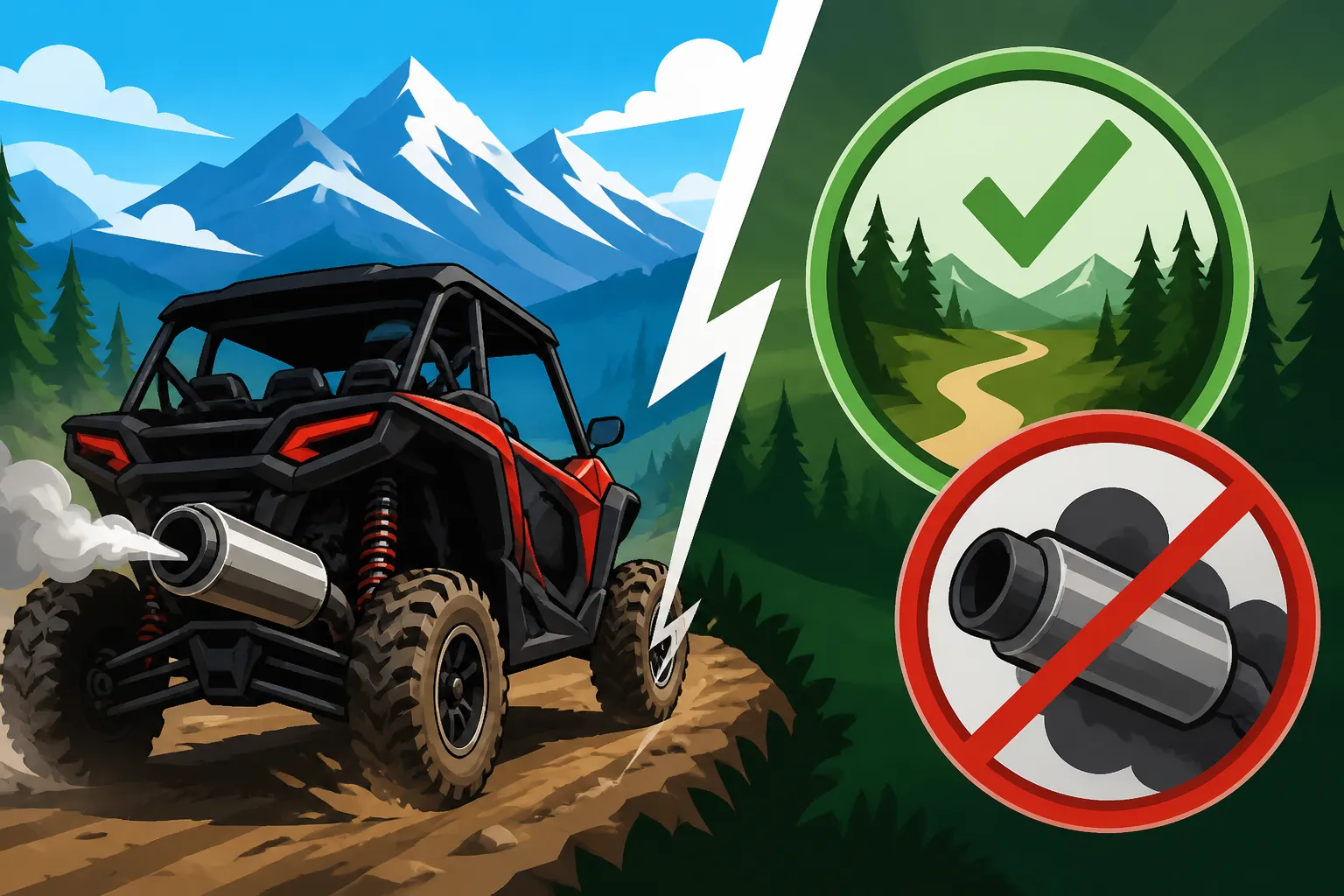
However, this pursuit of performance and sound often comes with a trade-off: compliance with trail rules. Many aftermarket systems are designed primarily for racing or closed-course use, where noise and spark arrester regulations are different, or non-existent. When you bring that powerful, loud machine onto Colorado’s public trails – whether they’re in a national forest, BLM land, or designated OHV parks – you're entering a regulated environment. The state has clear rules designed to protect the environment, prevent wildfires, and ensure a pleasant experience for all public land users, which often clash directly with the characteristics of many performance-oriented aftermarket exhausts.
Understanding Spark Arresters and Why They're Crucial
One of the most critical, yet often misunderstood, components of an OHV exhaust system for trail riding in Colorado is the spark arrester. So, what exactly is it? A spark arrester is a device designed to prevent the emission of hot, glowing carbon particles from the exhaust system. Think of it like a small screen or baffle system that catches these tiny embers before they can exit the muffler.
Why is this so important? Colorado, with its vast forests and dry conditions, is highly susceptible to wildfires. A single spark from an OHV exhaust, especially during dry seasons, can quickly ignite dry grass, leaves, or pine needles, leading to a devastating wildfire. This is why a USFS (United States Forest Service) approved spark arrester is not just a suggestion; it is a mandatory requirement for any OHV operating on public lands in Colorado. If your aftermarket exhaust, or even your stock exhaust, doesn't have one, or if it's damaged or removed, you are in violation of the law. Many stock exhausts come with integrated, USFS-approved spark arresters right from the factory. When you swap to an aftermarket system, you must ensure the replacement also includes this critical safety feature and that it is explicitly USFS-approved. It's not enough for a manufacturer to say it "reduces" sparks; it needs to meet the specific federal standard.
Colorado's Specific Rules: Noise Limits and Spark Arrester Mandates
Colorado's approach to OHV exhaust systems focuses on two main areas: preventing wildfires and minimizing noise pollution. These aren't arbitrary rules; they're in place to protect our cherished public lands and ensure that everyone, from hikers to campers to other riders, can enjoy the backcountry without undue disturbance or danger.
Decibel Levels and How They're Measured on the Trail
The noise generated by your OHV is a big deal in Colorado. Excessive noise isn't just annoying; it can disturb wildlife, negatively impact the experience of other recreational users, and even lead to local communities pushing for tighter restrictions or outright closures of riding areas. To combat this, Colorado has established specific noise limits for OHVs. While the exact methodology can be a bit technical, the general rule of thumb is that your machine shouldn't exceed 96 decibels (dB(A)) when measured using a specific static test. This test typically involves measuring the noise level at a distance of 20 inches from the exhaust outlet, with the engine running at approximately half of its maximum rated RPM.
For the average rider, it's not always easy to know if your machine is compliant without special equipment. Most stock exhausts are designed to meet these limits, but many aftermarket systems, especially those geared towards maximum performance or a "loud" sound, often exceed them significantly. A ranger at a trailhead or during a patrol might carry a decibel meter, and if your machine registers above the legal limit, you could face consequences. It's a frustrating scenario to pull up to a trailhead after a long drive, only to be told your machine is too loud to ride. This is why understanding [Muffler Noise Limits in Colorado] is so important before you hit the trails.
The Non-Negotiable Spark Arrester Requirement
As mentioned before, the spark arrester is not optional. It is a fundamental requirement for operating any OHV on public land in Colorado. This includes national forests, BLM lands, state parks with OHV trails, and county roads open to OHVs. The requirement specifies that the spark arrester must be "USFS-approved" or "Forest Service approved." This isn't just a label; it means the device has been tested and certified to meet specific federal standards for spark mitigation. You'll often find a small stamp, decal, or engraving on the muffler body itself indicating this approval (e.g., "USFS Approved," "USDA Forest Service," or a specific certification number).
If your OHV, whether it's an ATV, UTV, or dirt bike, does not have a functional and approved spark arrester, you are risking not only a citation but also potentially starting a wildfire. It’s a serious offense, and rangers take it very seriously. Many aftermarket exhausts do come with integrated spark arresters, but riders should always double-check for the USFS approval marking before relying on it. Even a small hole or damage to an existing spark arrester can render it non-compliant. For more details on this crucial safety device, check out [Spark Arrester Rules on Colorado Public Land].
The Real-World Impact on Your Colorado Trail Adventures
Ignoring Colorado's exhaust regulations can have significant consequences, not just for you personally, but for the entire OHV community. These aren't just theoretical rules; they are enforced, and violations can quickly turn an exciting day on the trails into a costly and frustrating experience.
Penalties for Non-Compliance on Public Lands
If you're caught riding on public land with an illegal exhaust – either too loud, or lacking a USFS-approved spark arrester – you're looking at more than just a stern talking-to. The most immediate consequence is typically a fine. These fines can vary depending on the specific violation and the jurisdiction, but they are never pleasant. Imagine driving for hours to a remote trailhead, excited for a day of riding, only to be hit with a hefty ticket before you even get past the staging area.
Beyond the monetary penalty, you might be required to immediately remove your machine from the trail system. This could mean trailering it back home, cutting your trip short, and losing valuable riding time. In some cases, repeated offenses or particularly egregious violations could lead to more severe penalties or even the impoundment of your vehicle. While specific to registration, the kind of penalties you might face for an exhaust violation are comparable to those for other rule breaks, which you can learn more about in [Fines for an Unregistered OHV in Colorado].
Navigating Ranger Checkpoints and Trailhead Scrutiny
Think of rangers, sheriff's deputies, and other land managers as the guardians of our public lands. They are out there patrolling trails, visiting staging areas, and yes, conducting checkpoints. During these stops, they will often perform visual inspections of OHVs for required safety equipment, valid registration, and, you guessed it, spark arresters. They’ll also be listening. An overly loud exhaust system is a dead giveaway, often prompting a closer look and potentially a decibel test.
It's a common scenario: you're planning an epic ride on the Alpine Loop, or perhaps exploring the trails around Taylor Park. You pull into the trailhead parking lot, excited to unload your machine, and there's a ranger conducting inspections. They're looking for that USFS stamp on your exhaust and listening for excessive noise. If your aftermarket setup doesn’t pass muster, your day could be over before it even begins. It's a frustrating but entirely avoidable situation if you do your homework beforehand. Being prepared for these checks is part of responsible riding, and understanding [Colorado Ranger Checks at a Trailhead] can help you anticipate what to expect.
The Ethical Rider and Trail Preservation
Beyond the legal and financial repercussions, there's a broader, more impactful consequence of non-compliant exhaust systems: the threat to continued trail access for everyone. When OHVs create excessive noise, it doesn't just annoy a few people; it generates widespread complaints from hikers, campers, equestrians, and nearby residents. Communities bordering popular trail systems often become vocal advocates for stricter regulations, or even outright closures, specifically citing noise pollution as a primary concern.
Loud exhausts contribute to the perception that OHV users are disrespectful or irresponsible, which erodes public support for motorized recreation. Every rider has a responsibility to be a good steward of the land and a good neighbor to other users. Choosing a compliant exhaust system is a direct way to demonstrate that responsibility. When noise complaints escalate, trail access is often the first thing to be restricted. For a deeper dive into how this plays out in local communities, check out [Noise Complaints in a Resort Town]. Ultimately, our actions as individual riders reflect on the entire OHV community and impact the future of trail riding in Colorado. These considerations are part of the larger discussion of [Colorado OHV Grant Program and Trail Funding], as responsible use helps secure funds for maintaining and expanding trails.
Making Smart Choices for Your Colorado OHV's Exhaust
Given the regulations and the potential impact, making an informed decision about your OHV's exhaust system is crucial. It’s entirely possible to enhance your machine's performance and aesthetics while remaining fully compliant with Colorado's trail access rules. It simply requires a bit of research and a commitment to responsible riding.
Verifying Compliance Before You Buy or Install
The best defense against future headaches is prevention. Before you even consider purchasing an aftermarket exhaust, do your due diligence. Here's what to look for:
- USFS Approval: This is non-negotiable for public land use. Look for explicit statements from the manufacturer that the exhaust is USFS-approved. Often, the product description will state this clearly, and the physical exhaust will have a stamp. If it doesn't mention it, or you can't verify it, assume it's not compliant for public trails.
- Noise Ratings: While it’s hard to predict exact decibel levels without a proper test, many reputable aftermarket manufacturers will provide noise ratings for their exhausts. Look for systems that are designed to be "quiet" or "trail-friendly," specifically mentioning compliance with state or federal noise limits. If a manufacturer is boasting about how "loud" their exhaust is, it's likely not going to pass Colorado's 96 dB(A) static test.
- Reputable Brands: When considering upgrades, even from well-known brands like SuperATV, always verify the specific product’s compliance. Different models from the same company can have different levels of compliance. Don't assume. Always check the specs for the exact exhaust you're interested in.
- Read Reviews (Carefully): While rider reviews can be helpful for performance insights, be wary of reviews that praise an exhaust primarily for its volume. What sounds "great" to one rider might be far too loud for legal trail use.
Solutions for Already-Installed Loud Exhausts
What if you've already installed an aftermarket exhaust only to realize it might not be compliant? Don't despair, you have options:
- Add or Replace Spark Arresters: If your aftermarket exhaust is missing a spark arrester, many companies offer universal or specific spark arrester inserts that can be added to your current muffler. Ensure it is USFS-approved.
- Install Baffles or Silencers: Some aftermarket exhausts are designed to accept removable baffles or "quiet cores" which can significantly reduce noise levels. This is often a relatively inexpensive way to bring a loud exhaust back into compliance.
- Re-pack the Muffler: If your muffler is a re-packable type (common on dirt bikes and some ATVs), the internal packing material can degrade over time, leading to increased noise. Replacing the packing can help reduce sound levels.
- Return to Stock: If all else fails, the most foolproof solution is to reinstall your machine's original, factory-installed exhaust system. These are almost always designed to meet all federal and state regulations.
- Consult a Professional: A local powersports dealer or an exhaust specialist might be able to offer solutions or modifications to bring your existing system into compliance.
Balancing Performance and Responsibility
Ultimately, the choice of your OHV's exhaust system is a balance between personal preference, performance desires, and civic responsibility. It is absolutely possible to have a high-performing machine that sounds great without being excessively loud or posing a fire risk. Many manufacturers are now producing aftermarket exhausts that offer performance gains while still adhering to noise and spark arrester regulations.
By prioritizing a USFS-approved spark arrester and reasonable noise levels, you're not just avoiding fines and trail closures; you're actively contributing to the preservation of our beloved Colorado riding areas. You're setting an example for other riders and helping to maintain a positive perception of OHV recreation. This kind of responsible riding is what helps ensure continued access to fantastic places like Colorado’s [Alpine Loop Over Engineer and Cinnamon] and the countless miles of [Colorado Rules on Forest Service Roads] available to riders. Choosing wisely for your exhaust is a small step that yields big benefits for everyone who loves to explore the Colorado backcountry on their OHV. Be aware of common issues like [Colorado Rules Riders Break Most Often] to ensure your riding experience is positive for all.
| Requirement | Description | What to Look For (Compliance) | Risk of Non-Compliance |
|---|---|---|---|
| Spark Arrester | Prevents hot carbon particles from escaping and starting fires | USFS-approved stamp/tag (often on the muffler body) | Fines, immediate removal from trail, fire hazard |
| Noise Limit | Prevents excessive noise pollution on public lands and near communities | Meets Colorado's static test standard (e.g., 96 dB(A)) | Fines, potential trail closures, negative public perception |
| Overall Exhaust System | Designed for safe operation without modification | Intact, free from damage, no missing components | Increased risk of fire, injury, or mechanical failure |
Disclaimer
This article is for general informational purposes only and does not constitute professional advice. Laws, prices and regulations vary by location and change over time. Consult a qualified professional for guidance on your specific situation.