Colorado Supervision Rules for Riders 10 to 16
Colorado’s age rules can be easy to misread because riding a trail is not the same as riding a public road that has been opened to OHVs. For riders ages 10 to 16, the key questions are where they’ll ride, who must supervise, and whether the machine and permit are right for that route. Here’s how to plan around those distinctions.
The supervision rule applies to certain public-road riding
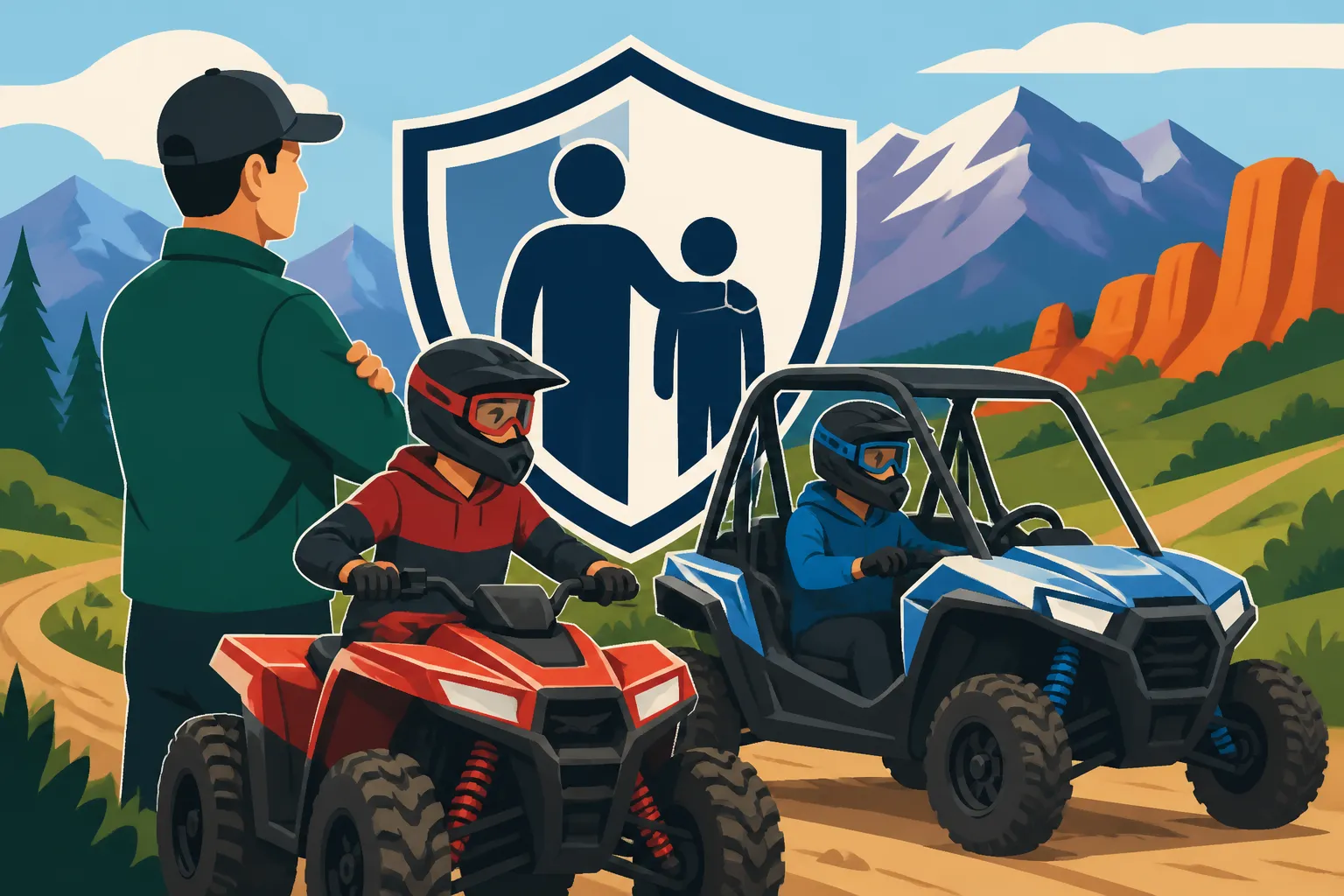
Colorado’s age-based supervision rule is tied to operating an off-highway vehicle on a public road that is open to OHV use. In general, a rider who is at least 10 but under 16 must be accompanied by and under the direct supervision of an adult who is at least 18 and has a valid driver’s license. A rider under 10 cannot operate an OHV on that kind of road, even with an adult present.
The restriction is about the rider operating the machine. Having an adult in the group, following in a truck, or staying in phone contact does not necessarily meet the requirement for direct supervision. If a young rider will use a road section, plan for the supervising adult to be physically present and able to monitor the ride.
At 16, the under-16 supervision requirement no longer applies. That does not mean a 16-year-old can ride anywhere or ignore other conditions. The road still needs to be open to OHVs, and the machine and rider still have to meet the applicable requirements for that route. A local ordinance, road closure, equipment rule, or permit requirement can matter regardless of the rider’s age.
This distinction is especially important on routes that connect trails to trailheads, campgrounds, or towns. A ride may be mostly on an off-road trail but include a short public-road segment. That segment can bring road-specific age rules into play. Before going, check the route’s current access information and local rules rather than relying on a trail map alone.
For background on which roads are open, see Which Colorado Roads Allow OHVs. If your intended route uses a road opened by a town or county, confirm that the specific stretch is currently authorized; local access can differ from one community to the next.
Road riding is not the same as trail riding
The under-16 road rule should not be treated as a blanket statement that every young rider must have an adult beside them on every OHV trail. A public trail, a public road open to OHVs, a private property route, and a road closed to OHVs are different settings, with different rules and land-manager requirements.
That does not make off-road riding automatically unrestricted. Riders still need to stay on routes open to their machine, follow posted closures, use suitable equipment, and comply with any rules that apply to the land or riding area. A land manager or local authority may impose additional conditions. A property owner can also set conditions for access to private land.
If a route changes character during the ride, stop and reassess. A signed trail junction, a road crossing, or a short connector through town may mean the group is now subject to rules that did not apply on the trail. Colorado’s Age Ten Rule for Riding an Opened Road covers the minimum-age distinction in more detail.
The road must be open to OHVs
A rider’s age and an adult’s presence do not make a closed road legal to ride. The road must be open to OHV use under the applicable state and local rules. Riders should follow signs, barriers, closure notices, and route maps, and should not assume that a road is open just because it is paved, unpaved, or regularly used by other vehicles.
Local rules can define where OHVs may travel, whether they can pass through town, and what equipment is required. A county route may connect with a town street that has a different rule. One open segment does not mean every adjoining road is open. Finding Your Colorado County’s OHV Ordinance is useful when a trip crosses county roads, while How a Colorado Town Opens Roads to OHVs explains why municipal access needs its own check.
What direct supervision should look like
The supervision requirement is more than having an adult somewhere nearby. The adult should be able to keep the young rider under observation, respond promptly, and help the rider make safe decisions on the road. A good plan keeps the adult and youth together rather than spreading them across the route.
Colorado’s legal wording should be checked against current official guidance if the details affect a particular ride. As a practical safety standard, however, do not interpret direct supervision as watching from far away, trailing at a distance where the youth cannot be seen, or coordinating by phone. Mountain roads can have blind corners, steep drop-offs, loose surfaces, traffic, and limited cell service. Distance can turn a manageable problem into a dangerous one.
A workable supervision plan
Before setting out, agree on who is supervising each young rider and how the group will stay together. If several children are riding, one adult may find it difficult to observe all of them closely, especially if they are on separate machines or have different skill levels. Match the group size and route to the adult’s ability to supervise.
A practical plan includes:
- The adult rides with the young rider and remains close enough to observe them.
- The group stops at junctions and road crossings so no child has to guess which way to go.
- The adult leads or follows according to the terrain and the child’s skill, while keeping the rider in view.
- No one sends a young rider ahead alone to scout, find the trailhead, or catch up with the group.
- The group has a clear stop signal and a plan for what to do if someone becomes separated.
- The adult checks that every rider understands the route, speed expectations, and what to do if traffic approaches.
These are conservative practices, not a replacement for checking the exact legal requirement. For a closer explanation of what direct supervision means in practice, see What Immediate Supervision Actually Means.
The adult’s qualifications matter
For the road-riding rule, the supervising adult must meet the stated age and valid-driver’s-license requirements. Do not assume that an adult passenger, an older teen, or an adult without a valid license qualifies simply because they are experienced with ATVs or UTVs.
A driver’s license is not the same thing as proof that the adult understands the machine, the route, or how to supervise a young rider. The adult should know how to operate the vehicle safely, understand its controls, and be familiar with the road conditions. If the youth is new to the machine, choose a route where the adult can give calm, immediate direction rather than a demanding pass or a busy connector.
More on the road-ride licensing question is available in Driver’s License Rules for Colorado Road Riding. Rules for machine operation and road access can be separate, so check both rather than treating one as a substitute for the other.
Supervision does not transfer to a permit
A registration, nonresident permit, trail pass, or local road authorization does not cancel the age and supervision rule. Permits address permission to use a machine or area; they do not establish that a particular rider meets the age conditions for operating on a public road.
The reverse is also true: meeting the age and supervision rule does not automatically mean the machine has the correct registration or permit. Before the trip, check which document applies to the rider’s machine and where it will be used. Colorado OHV Permit Reciprocity With Other States can help visitors understand that permits from elsewhere do not necessarily replace Colorado requirements. For a broader comparison of visitor options, see Colorado Non-Resident OHV Permit Explained.
A practical age-by-age guide
A birthday can change whether the under-16 supervision rule applies, but it does not change a route’s access rules or make a young rider ready for every machine. Use age as one part of the decision, alongside the rider’s experience, physical ability, and the machine’s design.
| Rider’s age | Public road open to OHVs | What to check |
|---|---|---|
| Under 10 | The rider may not operate an OHV on the opened public road under the age rule described here. | Choose an appropriate off-road setting and check its rules; an adult’s presence does not remove the road age restriction. |
| 10 through 15 | The rider must be accompanied by and under direct supervision of a qualifying adult. | Confirm the road is open, the adult meets the age and license conditions, and the group can stay together. |
| 16 | The under-16 supervision requirement no longer applies. | Confirm road access, machine requirements, permits, and any other rules that apply to the rider and route. |
This table is a road-riding summary, not a complete list of every rule that can apply to a youth rider. A particular trail system, event, private property owner, or local road authority may have additional requirements. If the route includes both off-road and public-road sections, apply the rules for each section rather than choosing one rule for the entire trip.
For riders ages 10 to 15
A rider in this age range should not operate alone on an OHV-open public road. The qualifying adult needs to be part of the ride and able to supervise directly. For a short road connector, that still means planning the crossing and travel on the road rather than treating it as an informal exception.
If the ride includes several young riders, avoid assuming that one adult can supervise everyone effectively from a distance. Keep the group compact, choose a simple route, and make sure the adult can see and communicate with the riders. A route with frequent traffic, narrow shoulders, steep exposure, or poor sightlines may not be a sensible choice for a young rider even when the legal supervision condition can be met.
It can also help to practice the route’s basic situations away from traffic first: stopping on command, turning around safely, maintaining a predictable speed, and waiting at a junction. Young riders who are still learning should not be asked to handle road traffic and unfamiliar terrain at the same time.
At 16
Turning 16 removes the specific under-16 supervision condition for operating on an OHV-open public road. It does not automatically make a rider qualified to use a road, and it does not override other rules. The road must still be open to OHVs, and the rider must meet any other applicable requirements.
A parent or guardian may still decide that an adult should accompany the rider. That can be a sensible safety choice, particularly for an inexperienced rider, a long trip, a remote route, or a high-country road. The legal minimum and the safest plan are not always the same.
For all ages, machine fit matters. A rider who cannot reach the controls comfortably, use the brakes effectively, or maintain a stable position should not be operating that machine on a road. A passenger’s presence does not make an oversized or unsuitable machine safer.
For riders under 10
The road restriction described here is a firm boundary: an adult’s supervision does not authorize a rider under 10 to operate an OHV on an opened public road. If a route includes a public-road connector, do not plan for a child under 10 to ride that segment.
Instead, look for a suitable riding area that does not require the child to operate on a public road, and verify the rules for that land and activity. Keep the road section out of the child’s riding plan rather than expecting the group to improvise at the junction. If a child will ride as a passenger instead of operating, check the machine’s seating and passenger requirements separately.
Check the route, machine, and permit before you go
A safe, compliant ride depends on more than the rider’s age. Confirm the route, the machine’s status, the group’s documents, and the conditions on the day of the ride. This is particularly important for visitors, families with multiple machines, and groups using local roads to connect riding areas.
Confirm every road segment
Identify the route before unloading or starting the ride. Note where trails meet public roads, where the route enters town, and whether any road segment has its own access restrictions. Look for the current local ordinance or official route information, not just a user-created map or an old trip report.
If the route includes a town street, do not assume the town allows OHVs throughout its boundaries. Local rules may limit which streets can be used, when they can be used, or how riders must travel. Colorado Towns That Let OHVs Use Their Streets provides context, but the town or county remains the place to confirm current access.
A public road may be closed to OHVs even if it looks like a natural continuation of the trail. A route marked open on one map may also be subject to a seasonal closure or temporary restriction. Check for closures before the trip and again when you arrive.
Match the machine to the rider and route
A youth rider needs a machine they can control safely. Consider whether they can reach and operate the throttle, brakes, steering, and any other controls without stretching or shifting into an unstable position. The machine’s size, weight, power, and speed all affect how difficult it is to manage.
The same machine can feel different on a flat, open trail than on a narrow mountain road with loose gravel, traffic, or a steep slope. Start with terrain and routes that match the rider’s skill, and avoid treating a short road segment as automatically easy. A young rider who is confident on a trail may still need practice with road crossings and interactions with other vehicles.
For specific youth and machine-size considerations, see Youth Machine Size Rules Colorado Parents Ask About and Engine Size Limits for Colorado Riders Under 16. These topics can help with choosing a machine, but they do not replace the road supervision rule.
Verify registration or permit status
The document a machine needs can depend on where it is registered, who owns it, and how it will be used. Colorado residents and visitors may face different registration or permit questions. A permit from another state should not be treated as proof that all Colorado requirements are met.
For nonresident machines, check whether a Colorado permit is needed for the intended riding area. For a Colorado-registered machine, verify that its registration is current and that the machine is being used within the scope of that registration. A road’s local OHV authorization and the machine’s permit or registration are separate issues.
If the machine is street legal or carries an out-of-state plate, that does not automatically settle whether a Colorado OHV permit is required for riding on trails or in designated OHV areas. The rule depends on the machine and where it is being used. Colorado Permits for Plated Street-Legal Vehicles and Colorado Rules for Out-of-State Street-Legal Machines address those distinctions.
Keep required documents accessible during the ride, and make sure the supervising adult knows where they are. Do You Carry Paperwork on the Trail? discusses what riders may need to have with them. For permit and registration basics, see Colorado Parks and Wildlife OHV Registration Explained.
Recheck conditions on the day
Mountain weather, road conditions, and closures can change the character of a ride. A route that looked appropriate during planning may be unsuitable after heavy rain, fresh snow, a closure notice, or a change in traffic. High altitude, loose rock, steep grades, and limited visibility can add difficulty for a young rider.
Before leaving, confirm that the intended route is open and that the group has enough time to complete it without rushing. Make a turnaround plan. If the young rider becomes tired, anxious, or overwhelmed, stop and reconsider the route rather than pressing on because the group has already traveled partway.
For trips in remote areas, plan for limited cell service and a delayed response if something goes wrong. Carry suitable safety equipment, water, and a way to communicate within the group. The supervising adult should be prepared to handle a minor breakdown or stop the ride safely without leaving a child alone.
Common scenarios and mistakes to avoid
“We’re only crossing the road”
A short road crossing can still be subject to road rules. Do not treat a brief stretch as exempt just because most of the ride is on a trail. Before the trip, identify whether the crossing is a public road and whether it is open to OHVs. Follow posted crossing instructions and local requirements.
If the route requires a young rider to travel along a road, rather than simply cross it, plan for the supervision rule to apply. If a child is under 10, do not have them operate the OHV on that road section. Change the route or make another arrangement.
“The adult is riding behind us”
Being somewhere in the group is not the same as direct supervision. If the adult cannot see the rider, reach them promptly, or communicate with them, the arrangement may be unsafe and may not satisfy the rule. A long gap between the adult and child is especially risky on a road with intersections, traffic, or blind corners.
Choose a formation that keeps the adult close enough to supervise. The best position can depend on the road and group, but the essential point is that the young rider should not be left to manage road conditions alone.
“The machine has a plate, so the age rule doesn’t apply”
A plate or street-legal status does not by itself erase youth-related requirements. The age rule discussed here concerns operating on a public road opened to OHV use, while a machine’s registration and equipment status are separate questions. Other rules may also apply to a plated vehicle, depending on the road and the way it is being operated.
Do not rely on a seller’s assurance, another state’s registration, or a family’s past practice as a substitute for checking Colorado requirements. This is particularly important for an out-of-state machine or a route that crosses town and county boundaries.
“The adult has a license, so the whole ride is allowed”
A qualified supervisor does not make a closed road open, a missing permit valid, or an unsuitable machine appropriate. The rider still needs to be old enough for that road, and the route and machine still need to meet the rules that apply. Treat supervision as one requirement among several.
“The youth can handle the trail, so they can handle the road”
Road riding introduces different hazards: other traffic, intersections, driveways, dust, changing surfaces, and the need to make predictable decisions. A young rider’s off-road skill may not transfer automatically. Practice in a controlled setting and choose a low-complexity route before relying on a youth rider to manage a road connector.
Avoid riding through a town or along a busy road just to save time. If the legal route is stressful for the young rider, consider a different staging point, a different trail, or an adult-operated vehicle for that connection.
Frequently Asked Questions
Can a 12-year-old ride an OHV on a Colorado road opened to OHVs?
A rider age 12 is under 16, so the rider must be accompanied by and under direct supervision of a qualifying adult when operating on a public road open to OHV use. Confirm the road is actually open and check any local conditions.
Can a child under 10 ride on the road if a parent is beside them?
No. Under the age rule described here, a child under 10 may not operate an OHV on an opened public road. A parent’s supervision does not remove that restriction.
Does the supervision rule apply to every Colorado OHV trail?
The rule discussed here is for operation on public roads opened to OHV use. A trail or private property setting may involve different requirements. Check the rules for the specific land and route, and be alert for road sections within a mostly off-road ride.
Does a Colorado permit let a young rider ride without supervision?
No. A permit or registration does not replace the under-16 supervision requirement for applicable public-road riding. Check both the rider rule and the machine’s permit or registration status.
Does a 16-year-old still need an adult to supervise?
The under-16 road supervision requirement no longer applies once the rider is 16. Other rules, local restrictions, and safety considerations still apply, and a parent may reasonably choose to have an adult accompany an inexperienced rider.
Disclaimer
This article is for general informational purposes only and does not constitute professional advice. Laws, prices and regulations vary by location and change over time. Consult a qualified professional for guidance on your specific situation.