Colorado OHV Permits for Out-of-State Riders
An out-of-state registration or license plate can make it seem as though your ATV or side-by-side is already cleared to ride in Colorado. The confusing part is that Colorado’s OHV permit rules are separate from your home-state paperwork, and trail, road, and private-land rules can differ. This guide explains what visiting riders should check before unloading a machine.
What Colorado’s OHV permit is for
The permit is separate from your home-state registration
Colorado generally requires an OHV permit for an out-of-state machine used on Colorado public lands where OHV use is allowed. A registration, sticker, or plate from your home state does not automatically replace Colorado’s nonresident permit. That distinction catches people off guard: they may have completed every registration step at home and still need a separate Colorado permit for the trip.
Think of your home-state registration as paperwork tied to your home state, and the Colorado permit as permission to use an eligible machine in the places Colorado regulates. They are not interchangeable documents. Before you leave, check the current instructions from Colorado Parks and Wildlife, commonly called CPW, for the permit category that fits your machine and trip.
The term “OHV” can cover different kinds of off-highway machines, including ATVs, dirt bikes, and many side-by-sides. The permit question is about the machine’s intended use and where you will ride it, not just what you call it. For a closer look at the distinction, see Colorado Non-Resident OHV Permit Explained.
The permit is generally tied to a machine, not a whole group
A family traveling with three machines should not assume that one permit covers the group simply because one person paid for it. Permit requirements are generally handled vehicle by vehicle. Check the rules for each machine, including a borrowed or rented one, before assuming it is covered by someone else’s paperwork.
This matters when people share a trailer or plan to swap seats during a trip. The permit question follows the machine being operated, while the driver’s age, supervision, helmet, and road-use requirements are separate questions. A permit on one ATV does not cover another ATV, and it does not give every rider permission to use every road.
A simple pre-trip checklist can prevent a frustrating stop at a trailhead: list each machine, record its identifying details, note who owns it, and confirm which permit or registration applies. If you are riding a friend’s machine, clarify who will obtain the required permit and where its decal or proof should be kept. Read Colorado Permits for a Second Machine if your group is bringing more than one.
A permit does not grant access everywhere
A valid Colorado permit does not turn every forest road, trail, meadow, or town street into an OHV route. It addresses a permit requirement; it does not override a closure, seasonal gate, landowner restriction, local ordinance, or route designation. Riders still need to confirm that their intended route is open to their type and width of machine.
For example, a visitor might buy a permit, reach a marked trailhead near Ouray, and discover that a route is closed for the season or does not allow a full-size side-by-side. The permit is still useful, but it cannot make that route legal. Check the land manager’s current information and on-the-ground signs rather than relying only on a map saved from a previous trip.
Treat the permit as one piece of trip readiness, not a universal riding pass. You may also need to follow local road rules, land-use restrictions, vehicle equipment requirements, and rules about where to park or stage a trailer. The route-specific guidance in Colorado Permit Rules on Designated Trails helps explain why a permit and an open route are two different things.
Choosing the right permit for your machine
Identify the machine before you buy
Start with the machine itself. Is it an ATV, dirt bike, side-by-side, or another off-highway vehicle? Is it registered in another state? Does it also have a street-legal plate? Has it been borrowed, rented, or modified? Those details can affect which instructions you need to follow, so do not select a permit based only on a general trip description like “we’re taking the UTV.”
Look for the vehicle identification number and the existing registration paperwork before beginning an application. If the machine belongs to someone else, ask the owner for the registration details and make sure you are authorized to use it. If the VIN is hard to locate, check the owner’s manual or manufacturer information; a vehicle’s VIN location can vary by make and model.
When a machine sits between categories, do not guess based on its size or appearance. Check the official permit guidance or contact the relevant agency before buying. The best starting point for comparing the nonresident option with other permit types is Which Colorado Permit an Out-of-State Rider Buys.
A plated machine may still raise a permit question
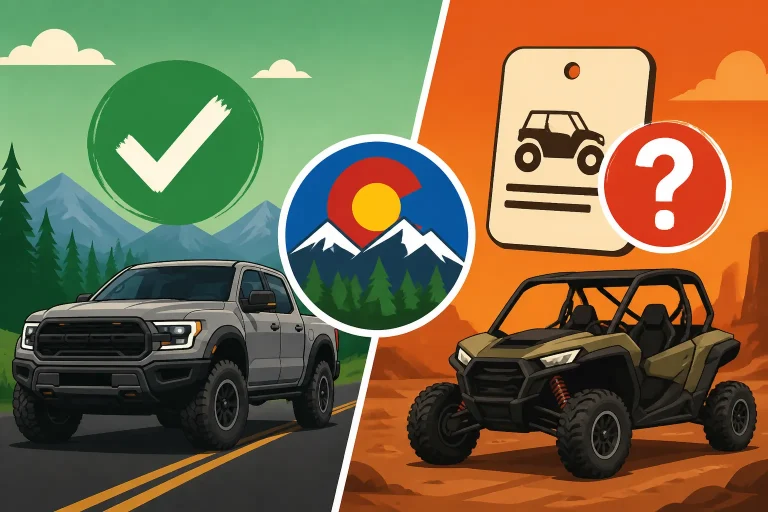
A street-legal plate can create a false sense of certainty. A vehicle that is legal to travel on certain roads may still be subject to OHV permit rules when it is used on designated OHV trails or in an OHV recreation area. Road legality and trail-use rules are separate layers, and one does not automatically cancel the other.
For instance, a visitor might bring a plated side-by-side from another state and plan to ride a route that includes a county road and a designated trail. The road segment may have its own local rules, while the trail may have a separate permit requirement. The right answer depends on where the vehicle will travel and how Colorado classifies it for that use.
Check both the permit rules and the rules for the exact roads or trails on your itinerary. Do not assume that a plate, insurance card, or registration from home covers every kind of Colorado use. These distinctions are discussed in Colorado Permits for Plated Street-Legal Vehicles and Colorado Rules for Out-of-State Street-Legal Machines.
Borrowed and rented machines need a clear plan
If you borrow a machine from a Colorado resident or rent one in a mountain town, ask what permit or registration it already carries before the ride. Do not assume it is covered simply because the owner lives locally, the rental shop handed over keys, or a friend says the machine is “all set.” Confirm the status and what proof you should carry.
A rental provider may include permit arrangements as part of its process, but what is included can vary. Ask specifically whether the machine is permitted for the route you intend to ride, whether the rental agreement limits where you may go, and whether there are routes the machine cannot use. A permit does not eliminate contractual route restrictions.
For a borrowed machine, agree in advance who will handle any permit purchase and how the permit will be affixed or documented. That conversation is easier at home than beside a trailhead with a group waiting. If you are lending your own machine to a visiting friend, review Letting a Visitor Ride Your Machine before the trip.
| Situation | What to check before riding |
|---|---|
| ATV or dirt bike registered outside Colorado | Whether a Colorado nonresident OHV permit is required for the planned public-land use |
| Side-by-side with an out-of-state plate | Permit requirements as well as road, trail, and local access rules |
| Machine rented in Colorado | Whether the permit is handled by the rental provider and which routes are allowed |
| Machine borrowed from a friend | Permit status, owner permission, and what documents the rider should carry |
| Machine used only on private property | Whether the property is truly private and whether any public route or other rule applies |
| Group bringing several machines | Whether each individual machine needs its own permit or registration |
Buying and carrying a Colorado permit
Use an authorized purchase route
Before buying, confirm the permit type and purchase process through CPW’s official information. Permits may be available through designated sales channels, but the available options and instructions can change. Check the official page for current details rather than relying on a forum post, an old travel article, or a seller’s description.
When you purchase, make sure the information matches the machine and that you understand what proof you receive. Save the confirmation and any instructions about the decal or permit display. If the permit is physical, follow the placement directions; putting it somewhere convenient but not compliant can create an avoidable problem during a check.
It can help to complete the permit task well before the group is packed and ready to leave. That gives you time to resolve a category question, correct a typo, or find a missing vehicle detail. For purchase options, see Where to Buy a Colorado OHV Permit. Do not rely on an assumption about a particular retailer or sales channel without checking its current availability.
Follow the display instructions and protect your paperwork
If the permit comes with a decal, place it where the official instructions say to put it. Decal placement can differ by machine type, so a location that works on an ATV may not be right for a dirt bike or side-by-side. Keep it visible and secure, and avoid placing it where bodywork, cargo, or accessories will hide it.
Mud, pressure washing, sun, and repeated handling can wear down stickers or paperwork. A quick check before the first ride is worthwhile: confirm the decal is still attached, readable, and in the instructed location. If it has been damaged or lost, consult CPW’s replacement guidance rather than trying to recreate or alter it yourself.
For documents you need to carry, a small waterproof sleeve or pouch can keep paperwork from turning into a soggy wad after a creek crossing or sudden storm. Outdoor stores and general retailers, including Amazon, carry document-storage options, but any clean, secure pouch that suits your setup can work. Keep the permit confirmation separate from your phone, since a dead battery or poor signal can make a digital copy inconvenient.
Carry useful proof, not a pile of unrelated paperwork
Carry the documents and information that apply to your situation: permit proof, vehicle registration if relevant, and the owner’s permission if you are riding a borrowed machine. Keep the information accessible without making it easy to lose while unloading or changing gear. If you depend on a digital record, save it for offline access and consider a paper backup.
A printed copy can be useful when you are far from reliable cell service. A plastic sleeve—whether bought at an outdoor shop or through Amazon—may help protect it from dust and rain. The practical goal is not to carry every paper you own; it is to have the relevant proof available if a ranger or other official asks to see it.
Check that the name and vehicle details on your paperwork make sense together. A mismatch can happen after a private sale, a borrowed-machine arrangement, or a data-entry error. If something appears incorrect, resolve it through the appropriate agency or owner before the ride instead of hoping nobody notices.
Reciprocity and out-of-state registration
Do not assume your home-state sticker is reciprocal
“Reciprocity” can mean different things to riders. Some people use it to ask whether Colorado recognizes a registration from another state; others mean whether one state’s permit works in another. For a Colorado trip, the practical question is whether your out-of-state paperwork satisfies Colorado’s requirements for the places you plan to ride.
Do not assume that because your state issues an OHV registration, Colorado automatically accepts it as a substitute for a Colorado nonresident permit. Rules can differ between states, and a valid home-state document may identify or authorize the machine at home without meeting Colorado’s separate requirements. Verify the Colorado rule before traveling.
The reverse is also true: a Colorado permit is not a universal pass for riding in Utah, Wyoming, or another state. Each state may have its own registration, permit, and trail requirements. Start with Colorado OHV Permit Reciprocity With Other States and verify the rules with the destination state before crossing the border.
A plate is not the same as an OHV permit
An out-of-state license plate is evidence of road registration under the rules of the issuing jurisdiction. It does not necessarily demonstrate that the machine has the permit required for Colorado OHV trails or public riding areas. A visitor may need to consider both systems, especially when an itinerary combines public roads with off-highway routes.
This distinction is especially easy to miss with a side-by-side that is registered for road use at home. The rider may be accustomed to using it on local roads and assume that a plate settles every question. In Colorado, the allowed road, the land manager, and the vehicle’s use can all matter. Check each part of the route rather than treating “plated” as the end of the analysis.
Keep the documents distinct in your planning: home-state registration, Colorado permit, insurance, and any route-specific authorization are not interchangeable. For the common question about plates and trail use, read Why an Out-of-State Plate Does Not Help in Colorado.
Reciprocity does not override route rules
Even if a machine has the correct Colorado permit, its home-state registration does not determine which Colorado roads are open to it. A town, county, land manager, or road authority may limit OHV use on a particular route. Some connections that appear simple on a map may cross a closed road, a restricted town street, or a segment with different equipment requirements.
Picture a ride that starts on a forest trail, follows a county road for a short stretch, and enters a town for fuel. The permit may address the OHV requirement on the trail, but the county road and town segment can have separate rules. The route may require approved equipment, a local ordinance allowing OHVs, or a different connection altogether.
Before setting off, identify the boundary between trail, public road, and town street on your route. Use current maps and posted signs, and ask the local land manager or visitor information office when the map is unclear. A permit is not a substitute for checking Which Colorado Roads Allow OHVs.
Where and when permit rules matter
Public land use is the central question
For visiting riders, the permit question most often comes up when operating an OHV on public land. That can include designated trails and riding areas managed by different agencies. The permit does not mean that every public parcel is open to motorized use, so riders still need to check the land manager’s route designations and closures.
A trail can be closed even when another trail in the same recreation area is open. Seasonal wildlife protections, snow, mud, maintenance, fire danger, or resource protection can affect access. These restrictions may be posted at trailheads or in official notices, so check both the planning information and signs you encounter on site.
When you arrive, pause before unloading. Confirm that the staging area is appropriate, the route allows your machine, and any gates or signs do not indicate a closure. This small step can save a long drive back down a mountain road and help protect future access for riders.
Private property is not a blanket exception to every rule
A machine used only on private property may be treated differently from one used on public OHV routes, but “private land” is not a magic phrase that resolves every question. You need permission from the owner, and you need to confirm that the ride stays on the private property rather than connecting to a public road or trail without the required paperwork.
A ranch owner may invite a visitor to ride on private land, for example, but the route might cross a county road or link to a public trail. That transition can trigger requirements that do not apply to riding entirely within the private parcel. Be precise about boundaries and the planned route instead of relying on a casual description like “we’ll just ride around the property.”
Rules may also apply for other reasons, including local road ordinances, safety requirements, or land-use agreements. If a ride is entirely private, verify the relevant exemption and keep written permission when appropriate. See Colorado Permit Exemptions on Private Land and Written Permission Before Riding Private Land.
Public roads, town streets, and OHV trails are different
An OHV permit does not make a machine street legal, and a street-legal registration does not necessarily satisfy OHV permit rules. A forest trail, a county road, a state highway crossing, and a municipal street are not interchangeable categories. Each can have its own access rules and equipment requirements.
A route planner may show a road that looks like the easiest way to reach a trailhead. That does not establish that your ATV or UTV may use it. Look for the specific local ordinance or land-manager authorization, and pay attention to signs at intersections. A road that is open to licensed vehicles may still restrict OHVs.
If your trip includes a paved crossing or road section, check that segment separately before riding it. Do not infer permission from the presence of another OHV, a trail map, or a permit decal. Start with Do Street-Legal Trucks Need a Colorado OHV Permit? if your machine is plated, and use local guidance for the specific route.
Planning a Colorado trip as an out-of-state rider
Build a route-specific paperwork checklist
A useful checklist starts with the machines, then follows the route. For each machine, note its type, owner, home-state registration status, and Colorado permit status. For each route segment, note whether it is a designated OHV trail, public road, private road, or town street, and identify the agency or local authority responsible for it.
This is more reliable than a single broad question such as “Do we need a permit in Colorado?” A family might ride a permitted ATV on a public trail one day and use a rented, plated side-by-side on a different route the next. The answer can vary with the machine and where it goes.
A checklist also gives the group a place to record what needs attention before departure: a permit to purchase, a decal to attach, a landowner to contact, or a seasonal closure to confirm. Keep it simple enough that someone can review it at the trailhead without digging through a long email chain.
Check conditions and closures shortly before riding
High-country routes can change with snow, mud, storms, maintenance, or fire conditions. A route that was open during a previous visit may not be open when you return. Seasonal dates and actual conditions are not always the same thing, so check official notices close to the ride and look for signs at the trailhead.
For example, a July trip to the San Juan Mountains may still encounter snow at elevation or a closure on a particular segment. Likewise, a route that is normally open may be temporarily restricted due to weather or resource protection. Keep a backup route in mind, and do not treat a printed map as a live report.
Check the relevant land manager’s information and local notices before loading your machines. If your planned destination is near a town, verify the town’s OHV rules separately. This protects the trip from the familiar disappointment of driving for hours only to find the road or trail closed.
Make a simple document and gear routine
Before leaving camp, check that each machine has the right permit or registration, the decal is attached as instructed, and the rider knows which route is allowed. Carry water, appropriate clothing, communication tools, and basic recovery equipment as the trip requires. Permit paperwork is important, but it does not replace preparation for altitude, weather, mechanical trouble, or limited cell coverage.
Keep documents in a consistent place so the driver is not searching through a cooler or gear bag when asked for them. A waterproof sleeve can protect a paper backup; outdoor retailers and Amazon offer different styles, but a durable pouch you already own may be enough. If storing a digital copy, download it before leaving service and keep the phone charged.
Agree on a stop plan for the group. If someone is unsure whether a route is open or whether a machine is allowed, stop and verify rather than pressing ahead. A short pause at a junction is far less stressful than discovering a restriction after entering a closed area.
Common mistakes and how to avoid them
Treating registration as proof of trail access
One of the most common mistakes is assuming that an out-of-state registration, title, or license plate automatically grants access to Colorado OHV routes. Those documents have different purposes, and the Colorado permit may still be required for the machine’s use on public land. Keep the distinctions clear before you reach the trailhead.
Another related mistake is buying a permit and assuming the ride is now authorized everywhere. The permit does not override a seasonal closure, landowner restriction, width limit, town ordinance, or route designation. Check the actual route and obey posted restrictions even if your paperwork is in order.
A practical fix is to ask two separate questions: “Does this machine have the required permit?” and “Is this exact route open to this machine today?” Answering both prevents a permit from being mistaken for universal access.
Waiting until the trailhead to sort out paperwork
Trailheads are a poor place to discover that you do not know the VIN, cannot reach an online purchase page, or are unsure which category applies. Cell service can be weak in remote areas, and a group may already be waiting. Handle the permit research and purchase steps before leaving home whenever possible.
Take a few minutes to check that the permit details match the machine and that the decal or proof is present. If the information looks wrong, seek correction before riding. Do not alter a document or improvise a decal placement based on what another rider did.
Keep copies in more than one practical form when the instructions allow it. A paper backup can help if a phone battery dies, while a saved digital copy can be handy when paper gets wet. The point is to be prepared, not to carry an unmanageable stack of documents.
Assuming one rider’s permit covers the group
Groups often share a trailer, a campsite, and a route plan, then mistakenly assume that one person’s paperwork covers all the machines. Check each ATV, dirt bike, or side-by-side individually. If one machine belongs to a friend or rental provider, ask for its status instead of guessing.
Also separate machine paperwork from rider requirements. A permit does not establish that a rider meets age, supervision, helmet, or road-use rules. A parent may have handled the machine’s permit correctly and still need to confirm whether a young rider may use a particular route.
Before the trip, assign one person to do a final paperwork check and have each machine’s rider confirm their own documents. That small routine can prevent confusion when the group is eager to get moving.
Frequently asked questions about Colorado OHV permits
Does an out-of-state OHV registration replace the Colorado permit?
Do not assume it does. Colorado’s nonresident permit requirement is separate from your home-state registration for the relevant public-land use. Verify the current rule with CPW and make sure you have the Colorado permit required for your machine and trip.
A home-state registration can still be useful as proof of the machine’s status or ownership. It simply should not be treated as automatic permission to ride all Colorado trails. Keep it distinct from any Colorado permit.
If your machine is plated, check both the OHV permit rules and road-use rules. A plate may answer one question without answering the other.
Does the permit allow me to ride on any Colorado road?
No. A permit does not authorize OHV use on every public road, forest road, or town street. Access depends on the road authority, local rules, land manager, vehicle type, and any posted restrictions.
Confirm each road segment on your planned route. Look for official route information and obey signs at the site. If a route includes a town, check that town’s rules rather than assuming the trail permit applies there.
Do I need a separate permit for each machine?
Plan on checking each machine separately. A group permit should not be assumed to cover multiple vehicles, and a permit associated with one ATV does not automatically cover a second ATV or side-by-side. Review the permit instructions for the exact machine count and categories in your group.
This is especially important when a trip combines personal, borrowed, and rented machines. Ask who is responsible for each machine’s permit and what proof should be carried. Resolve it before traveling.
Can I ride without a Colorado permit on private land?
The answer depends on where and how the machine is used. Riding entirely on private property with the owner’s permission may be treated differently from using public trails, but crossing or connecting to public roads and lands can bring other requirements into play.
Confirm property boundaries and permission, and check whether any other local or safety rules apply. If the route leaves private land, do not assume the private-land situation continues to cover the rest of the ride. The details are covered in Do You Need a Permit on Private Colorado Land?.
What should I do if I lose or damage the permit decal?
Check CPW’s current instructions for replacement or correction. Do not recreate the decal, alter another permit, or assume a damaged one is acceptable without confirming the rule. If the permit information itself is wrong, contact the appropriate agency or sales channel for guidance.
In the meantime, keep any purchase confirmation or related proof accessible. That may help you explain the situation, but it does not necessarily replace the decal or other official requirement. Get the proper replacement instructions before using the machine where a permit is required.
Disclaimer
This article is for general informational purposes only and does not constitute professional advice. Laws, prices and regulations vary by location and change over time. Consult a qualified professional for guidance on your specific situation.