Cattle Guards and Open Range in Colorado
There's nothing quite like the freedom of exploring Colorado's breathtaking backcountry on your ATV or UTV. You've got your machine loaded, the sun is shining, and the trails are calling. But then, as you round a bend on a dusty county road or a remote Forest Service track, you see it: a jarring, metal grate crossing your path, or perhaps, a herd of cattle calmly grazing right in the middle of the road. These are cattle guards and open range, and they're a quintessential part of riding in many parts of Colorado. If you've ever felt a jolt of anxiety wondering how to navigate these obstacles or what your responsibilities are when livestock is present, this guide is for you. We'll dive deep into understanding these unique aspects of Colorado's landscape and equip you with the knowledge to ride safely and respectfully.
Understanding Cattle Guards and Open Range in Colorado
When you're out exploring Colorado's vast network of trails and roads, you're not just in a pristine wilderness; you're often in working landscapes. These areas are vital for ranching, agriculture, and local communities, and the infrastructure reflects that. Cattle guards and open range designations are two critical elements that define how we interact with these lands.
What is a Cattle Guard and Why Are They There?
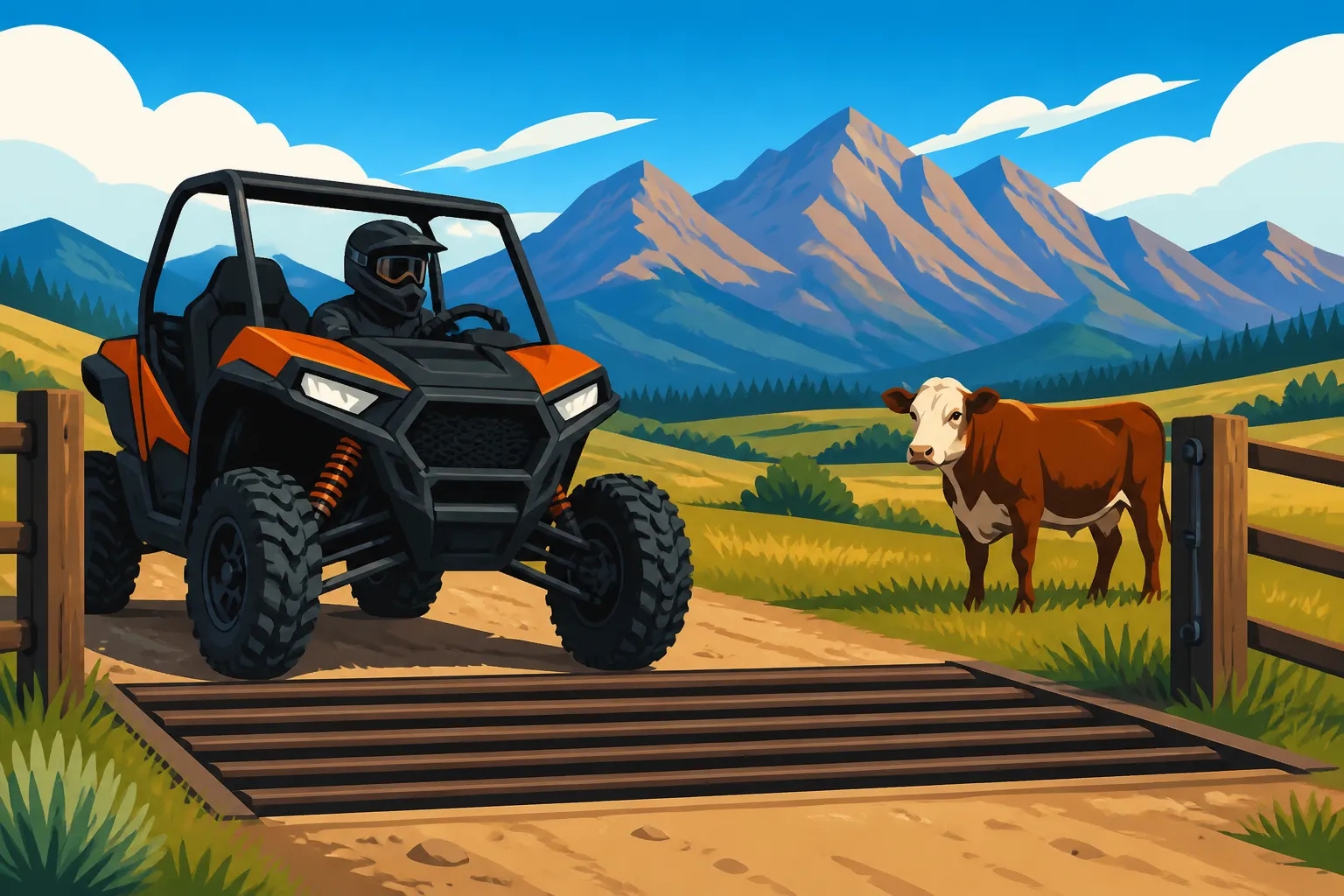
A cattle guard, at its most basic, is a type of road barrier designed to prevent livestock from crossing while allowing vehicles to pass without the need to open and close a gate. Imagine a series of parallel metal or sometimes even concrete bars, often set into a pit, that create a surface too awkward and painful for four-legged animals to walk across. For us humans in our OHVs, it's a bumpy, sometimes jarring, but typically passable stretch of road.
You'll encounter cattle guards in a variety of places across Colorado. They're frequently used where a public road, like a county road or a Forest Service road, crosses into private land or a grazing allotment, effectively marking a boundary without impeding traffic flow. They're also common on [Colorado OHV Rules on Forest Service Roads] and [Colorado OHV Rules on BLM Roads] that traverse areas designated for grazing. The primary purpose is clear: to keep cattle, horses, and sheep contained within their pastures or specific grazing areas, preventing them from wandering off, getting lost, or creating hazards on busier roads. For ranchers, they're an indispensable tool, saving countless hours that would otherwise be spent opening and closing gates or chasing stray animals.
The Concept of Open Range in Colorado
"Open range" is a legal designation in Colorado that essentially means livestock are permitted to roam freely without being fenced in. Unlike "closed range" areas where livestock owners are generally responsible for keeping their animals contained, in open range, the burden is largely on motorists to avoid colliding with livestock. This is a concept that often surprises riders coming from states with different laws, and it's absolutely crucial to understand for anyone venturing into Colorado's rural and mountain areas.
In open range, you're likely to see cattle, horses, or even sheep right on the shoulder, in the ditch, or even sauntering down the middle of the road. They have the right-of-way, period. This isn't just an unwritten rule; it's often backed by law. This designation exists in many parts of Colorado, particularly in ranching communities and on vast stretches of public land where traditional fencing is impractical or cost-prohibitive. It reflects Colorado's deep agricultural roots and the importance of ranching to the state's economy and culture. When you see those "Open Range" signs, it's a clear signal to slow down, be extra vigilant, and prepare to share the road in the most literal sense. It's a fundamental part of [Colorado County Roads Open to OHVs] in many rural areas.
Riding Etiquette Around Cattle Guards
Navigating cattle guards might seem straightforward – just drive over them, right? But there's more to it than that, especially when you consider rider safety, machine longevity, and respect for the working landscape you're traversing.
Approaching and Crossing Safely
The first rule of encountering a cattle guard is to slow down significantly. These aren't speed bumps; they're often rough, uneven, and can be quite jarring if hit at speed. A sudden impact can throw you off balance on a quad or even cause a passenger in a side-by-side to get tossed around. For your machine, hitting a cattle guard too fast can stress your suspension, tires, and even your frame. It's always a good idea to approach at a walking pace, or just a bit faster, allowing your suspension to articulate over the bars rather than slamming into them.
As you approach, visually inspect the cattle guard. Are there any broken bars? Are there large gaps? Sometimes, dirt or debris can accumulate between the bars, making it less effective or creating a different kind of obstacle. If the ground around it is muddy or icy, the approach and departure can be slick, so be extra cautious. While most modern OHVs, especially UTVs with good ground clearance and robust suspension from a company like SuperATV, can handle these without much fuss, it's still about minimizing impact. Pay attention to your tire placement to avoid getting a tire wedged awkwardly if there's a wider gap or a broken section.
The Importance of Gates and Fences
Sometimes, right next to a cattle guard, you'll find a traditional gate. This gate is typically for larger vehicles that might not fit over the cattle guard, or for specific situations like moving livestock. The absolute golden rule here is: if you open a gate, you close it immediately behind you. And if the gate was closed when you arrived, you must leave it closed. Never assume.
This isn't just about courtesy; it's about livelihood. Leaving a gate open, even by accident, can allow an entire herd of cattle to wander off, costing a rancher significant time and money to round them up. It can lead to animals getting injured, lost, or creating hazards on paved roads. If you're unsure whether a gate needs to be opened or if there's a cattle guard alternative, it's usually best to stick to the cattle guard if your OHV can safely cross it. If you do use a gate, be methodical. Unlatch it, hold it open for your machine to pass, then secure it firmly before you continue. Always verify it's latched properly. This simple act of respect helps maintain good relationships with landowners and ensures continued access to trails. This respect extends to understanding rules like [Getting Written Permission From a Landowner] if you're ever venturing onto private property adjacent to these areas.
| Action | Do | Don't |
|---|---|---|
| Approaching | Slow down to a crawl, scan for hazards. | Speed over, assuming it's just a bump. |
| Crossing | Drive slowly and steadily, allowing suspension to work. | Hit it at an angle or with sudden acceleration/braking. |
| Inspection | Look for broken bars, excessive mud, or ice. | Assume all cattle guards are in perfect condition. |
| Gates | If you open it, close it. If it was closed, leave it closed. | Leave gates open, even "just for a minute," or assume someone else will close it. |
| Machine Prep | Consider heavy-duty A-arms or skid plates (e.g., from SuperATV). | Neglect regular suspension checks, especially if you ride rough terrain often. |
| Respect | Acknowledge its purpose and the rancher's needs. | Treat it as an annoyance or a personal challenge. |
Navigating Open Range with Your OHV
Riding in open range territory is a unique experience that requires a higher level of awareness and a different approach to your speed and observation skills. It's not just about avoiding obstacles; it's about sharing the road with living, breathing, sometimes unpredictable animals.
Sharing the Road with Livestock
When you're in open range, you must assume livestock could be anywhere, at any time. This includes cattle, horses, sheep, and sometimes even llamas or alpacas, often herded by dogs. They might be around a blind corner, grazing on the roadside, or standing squarely in the middle of your path. Unlike wildlife, which tends to be more skittish and avoid human contact, ranch animals can sometimes be less bothered by vehicles, or conversely, be easily spooked by sudden noises or movements from your OHV.
The golden rule is that livestock have the right-of-way. Always. If you encounter animals on the road, slow down immediately, stop if necessary, and wait for them to move. Do not honk your horn repeatedly, rev your engine, or try to herd them with your OHV. This can stress the animals, cause them to scatter in unpredictable ways (potentially into traffic), and may even incur the wrath of a nearby rancher – and rightly so. If you need to pass, do so very slowly and cautiously, giving them as wide a berth as possible. Be especially mindful of calves or lambs, as their mothers can be protective. Sometimes, waiting a few minutes is all it takes for them to clear the path. Patience is a virtue here.
Legal and Financial Responsibilities
This is where understanding open range gets serious. In Colorado's open range areas, if your OHV collides with livestock, you, the driver, are generally held responsible for the damage to the animal. This can include the market value of the animal (which can be substantial for a breeding cow or horse), veterinary bills, and even other related costs. The rancher is typically not liable for having their animals on the road in open range country. This is a critical distinction that many visitors overlook, and it can lead to significant financial consequences.
This responsibility underscores why vigilance, low speeds, and defensive riding are paramount. Imagine hitting a thousand-pound steer in your side-by-side – it's not just bad for the animal; it's extremely dangerous for you and your passengers and can cause severe damage to your machine. For this reason, ensuring your machine is properly insured, as discussed in [Colorado ATV Insurance and When It Is Required], is always a good idea, though specific coverage for livestock collisions might vary. Some riders even install additional lighting or improved visibility features, perhaps even from a company like SuperATV, to spot animals sooner, especially during dawn, dusk, or in adverse weather.
Safety and Respect: Coexisting on Colorado's Rangelands
Riding in Colorado's open range and cattle guard areas is about more than just personal safety and legal compliance; it's about being a responsible recreational user and respecting the multi-use nature of these lands.
Best Practices for Responsible Riding
- Reduce Speed and Increase Vigilance: We've mentioned it repeatedly, but it bears repeating: slow down. Always. And keep your eyes peeled. Look ahead, scan the shoulders, and anticipate that animals could appear from anywhere.
- Stay on Designated Trails: Even in open range, it's crucial to stick to marked roads and trails. Veeering off-trail can disturb grazing animals, damage sensitive ecosystems, and encroach on private property. Respect those boundaries.
- Minimize Noise and Sudden Movements: Your OHV can be a loud machine. Try to keep engine revs low when around animals. Avoid sudden acceleration or braking that might startle them. A calm approach is always best.
- Carry an Emergency Kit: Accidents happen. If you do encounter an injured animal, or if your machine is damaged by a collision, having a basic emergency kit, communication device (understanding that cell service is often spotty in remote areas), and knowing who to call (local sheriff, Colorado Parks and Wildlife, or rancher if contact info is available) is crucial.
- Know the Rules: Familiarize yourself with local regulations and signs. Some areas might have specific rules about animal interactions or seasonal closures. Checking resources like [Colorado Parks and Wildlife OHV Registration Explained] can provide valuable insights into general OHV regulations.
- Leave No Trace: This is a fundamental principle of outdoor recreation. Pack out everything you pack in, and leave the landscape as you found it. This helps maintain the beauty and ecological health of these shared spaces.
Building Positive Relationships with Landowners and Ranchers
When you're riding through cattle guards and open range, you're often passing through or near private ranching operations. The relationship between recreational riders and landowners is critical for continued access to many of Colorado's most incredible riding areas. A little courtesy and understanding go a long way.
Think about it from a rancher's perspective: their livelihood depends on these animals and these lands. An OHV rider who speeds through a herd, leaves a gate open, or drives off-trail creates problems that directly impact their work and finances. Conversely, a respectful rider who understands and adheres to the rules contributes to a positive environment, fostering goodwill and helping to ensure that these areas remain open for both ranching and recreation. If you ever have the opportunity to speak with a local rancher, a friendly wave and a courteous demeanor can work wonders. Understanding that these are working lands, not just playgrounds, is the key. While your [Colorado OHV Registration for Machines Kept on Private Land] might mean you don't need a public lands permit, the rules of courtesy and respect still apply.
By understanding what cattle guards and open range mean, practicing safe and respectful riding habits, and recognizing your responsibilities, you can ensure your Colorado OHV adventures are enjoyable for you, safe for livestock, and supportive of the vital ranching communities that share these magnificent landscapes. It's all part of the unique experience of riding in the Centennial State.
Disclaimer
This article is for general informational purposes only and does not constitute professional advice. Laws, prices and regulations vary by location and change over time. Consult a qualified professional for guidance on your specific situation.