Colorado Trespass Rules Along Forest Roads
There’s nothing quite like the freedom of exploring Colorado’s vast network of forest roads and trails on your ATV or UTV. The crisp mountain air, the stunning vistas, the sheer thrill of it all—it's what draws us back season after season. But with that incredible access comes a very real and sometimes frustrating challenge: figuring out exactly where you can legally ride. It's shockingly easy to take a wrong turn, miss a subtle sign, or simply misinterpret a map, only to find yourself wondering if you've strayed onto private land. This guide is here to walk you through the complexities of Colorado’s trespass rules along forest roads, helping you understand the boundaries, avoid accidental infractions, and ride with confidence.
Understanding the Colorado Landscape: A Mix of Public and Private Land
Colorado's magnificent mountains and forests aren't a monolithic block of public land. What looks like an endless expanse of wilderness from a distance is actually a complex, often confusing, patchwork quilt of different land ownerships. This mix of federal, state, and private parcels is especially pronounced in the very areas where we love to ride our off-highway vehicles, and it's a primary reason why understanding trespass rules is so crucial.
The Patchwork Quilt of Ownership in Mountain Areas
Imagine looking down from a high mountain pass. You see national forests, Bureau of Land Management (BLM) lands, maybe a state park or wildlife area, all interspersed with private ranchlands, mining claims, and residential properties. These parcels often don't follow neat, straight lines, especially in rugged terrain. A single forest road might weave in and out of public and private ownership multiple times over just a few miles, or a vast public area might be entirely landlocked by private property with no legal access.
This intricate pattern is a result of historical land grants, homesteading, mining patents, and various land sales over the centuries. For the casual rider, it means that while you might feel like you're "in the middle of nowhere," you're almost always near someone's property. This complexity is why getting turned around or misreading a boundary can happen to even the most experienced riders, leading to that gnawing worry about whether you’re breaking the rules. It's not always obvious where the National Forest ends and a private ranch begins, especially when there isn't a clear fence line or distinct marker.
The Role of Easements and Rights-of-Way
To further complicate matters, some private lands might have legal easements or rights-of-way that allow public access, even if the land itself is privately owned. An easement is a legal right to use another person's land for a specific purpose, such as a road or trail. Sometimes, these are for utility lines, but other times they're for public access to reach a national forest or a particular recreational spot.
The challenge here is that these easements aren't always clearly marked on the ground, or even on all maps. You might be riding a road that appears to cross private land, but you're actually on a legally established public easement. Conversely, a seemingly public road could abruptly end or transition to private property without any public right-of-way, meaning any further travel constitutes trespass. It’s enough to make your head spin, and it certainly highlights the need for diligent pre-ride planning and careful observation while out on the trail. Just because a track looks like a road and goes somewhere doesn't automatically mean it's fair game for public use.
Identifying Forest Roads and Public Access Points
Navigating the terrain effectively and staying on the right side of the law hinges on your ability to correctly identify public forest roads and understand where legal access truly exists. It's not enough to simply guess; proactive identification is your best defense against accidental trespass.
Reading Motor Vehicle Use Maps MVUMs and Digital Tools
The absolute best resource for identifying legal routes on federal lands is the Motor Vehicle Use Map, or MVUM. These maps are issued by the U.S. Forest Service and Bureau of Land Management (BLM) and are the definitive guide for where motorized travel is permitted. They show roads and trails that are open to OHVs, usually distinguishing between full-size vehicle routes, ATV/UTV trails, and sometimes even single-track for dirt bikes. Critically, anything not marked on an MVUM as open for motorized use is, by default, closed.
The good news is that MVUMs are often available for free at ranger stations, and many are now digital. Apps like onX Offroad or Gaia GPS have revolutionized trail navigation, allowing you to overlay MVUM data, property boundaries, and satellite imagery directly onto your phone or tablet. This combination is incredibly powerful for seeing exactly where you are in relation to public and private lands, and which trails are legal. Even with great aftermarket accessories like a SuperATV roof to protect your device from the elements, always have a backup plan. Cell service can be spotty in the mountains, so download maps for offline use or carry a paper MVUM. Understanding how to [Reading a Colorado Motor Vehicle Use Map] is essential for any rider.
Recognizing Boundary Markers and Signage
While digital maps are invaluable, what you see on the ground is equally important. Landowners often take steps to mark their property, and it's your responsibility to heed these warnings. Here's what to look for:
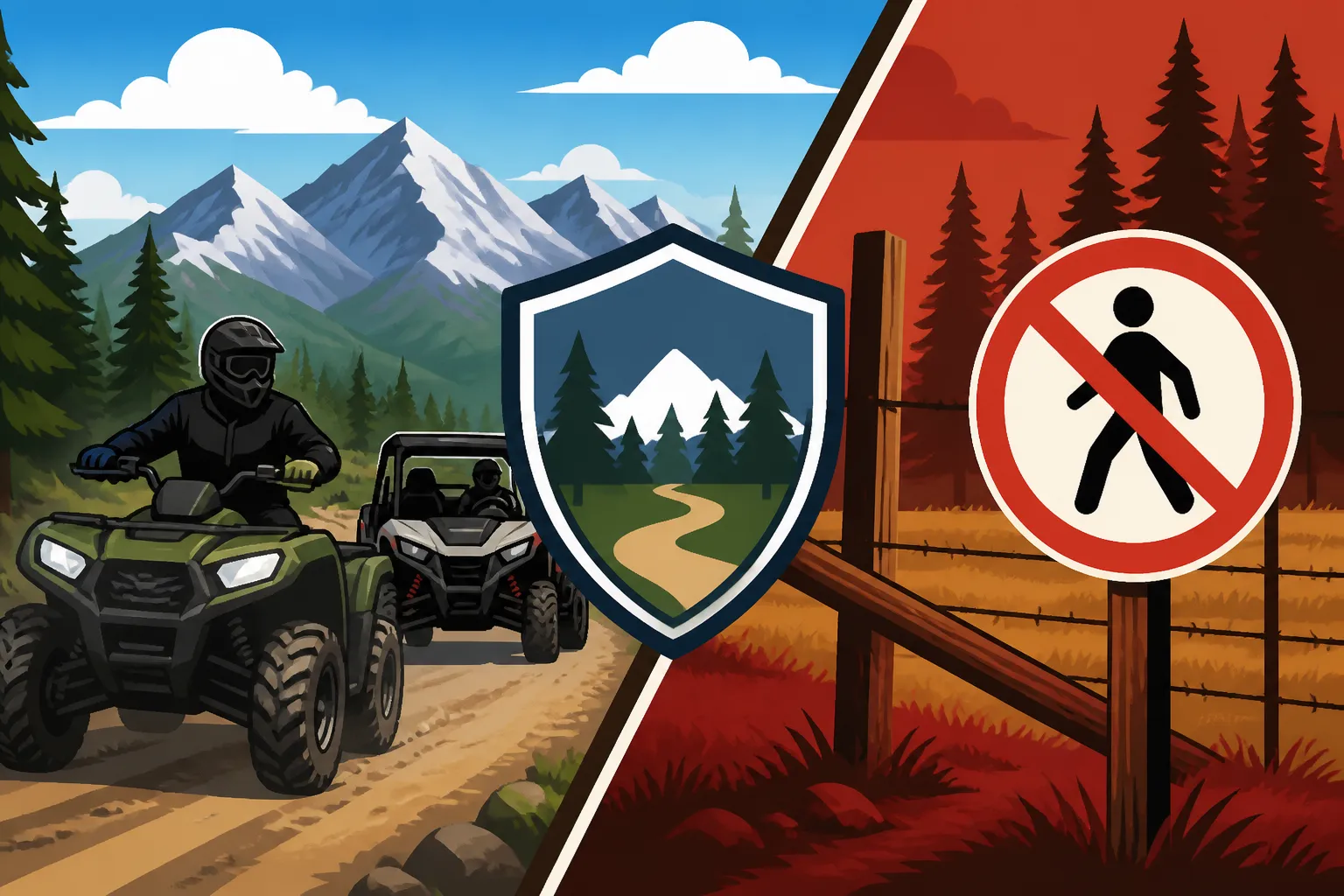
- "No Trespassing" Signs: These are the most direct and unmistakable warnings. They can be large, official-looking signs, or simple handmade placards. Regardless of their appearance, they mean exactly what they say.
- Fences and Gates: A fence, especially a new or well-maintained one, or a closed gate (even if unlocked), often signifies a property line or a desire for privacy. Never go around, climb over, or cut a fence, and always close any gate you open if you've been given permission to cross.
- "Private Property" or "Private Road" Signs: Similar to "No Trespassing" signs, these indicate that the land or road is not for public use.
- Property Line Markers: These might be less obvious, such as painted posts, small flags, or even changes in fencing style. In some areas, you might see brightly colored paint marks on trees (like blue for state forest, yellow for private timber). Learn to recognize these local indicators.
- Absence of Public Land Signs: When riding on federal lands, you'll often see signs indicating "National Forest," "BLM Land," or trail numbers. A sudden absence of such signs, especially combined with other indicators, should raise a red flag.
Riding through an area equipped with SuperATV LED lights can help you spot these crucial signs, particularly if you're riding in changing light conditions or through areas with dense foliage. Taking the time to properly identify these markers can save you a lot of trouble and maintain positive relationships with local landowners.
The Nuances of Trespass: What It Means on a Forest Road
Trespass isn't always a clear-cut issue, especially when dealing with the convoluted nature of forest roads and property boundaries. It's important to understand the different forms it can take and why it's a serious matter in Colorado.
Accidental Versus Intentional Trespass
Colorado law generally distinguishes between accidental and intentional trespass, though both can carry consequences. Accidental trespass usually occurs when a rider inadvertently crosses onto private property due to unclear signage, misleading maps, or simply getting lost. Perhaps you were using an older paper map that didn't show recent property divisions, or you mistakenly followed a faint two-track that seemed to continue from a public road onto what turned out to be private land. While the intent wasn't malicious, the act itself is still a violation. Authorities may be more lenient with warnings in these cases, but that's not a guarantee.
Intentional trespass, on the other hand, involves knowingly entering or remaining on private property without permission. This could be ignoring "No Trespassing" signs, cutting fences, or deliberately riding off a marked public trail onto clearly private land. This type of trespass is viewed much more seriously and can result in harsher penalties, including significant fines and potential criminal charges. It's this intentional disregard for property rights that often fuels landowner frustration and can lead to increased restrictions on public land access for everyone. The best way to avoid either scenario is thorough planning and constant vigilance.
When a "Road" Isn't Always a Public Road
One of the trickiest aspects of riding in Colorado's backcountry is that not every two-track, dirt path, or seemingly abandoned road is a public right-of-way. Many private landowners maintain their own extensive networks of roads for logging, ranching, mining, or personal access to their property. These private roads can look identical to public forest roads, especially if they're not clearly marked at every intersection or boundary.
A common scenario involves a public forest road that appears to continue indefinitely but actually dead-ends or turns into a private road without any obvious transition. Without proper mapping or signage, it's easy to assume continuity and inadvertently trespass. This is why relying solely on visual cues can be risky. Just because a road is well-maintained, graveled, or looks like it's been used by other vehicles doesn't make it public. Always cross-reference your location with an MVUM or a reliable digital map to confirm the status of the road you're on. Remember, even if a road looks inviting, if it's not explicitly marked as public or on an approved OHV route, it's best to proceed with caution or turn back. [Riding an OHV on the Road in Colorado] offers more insight into road legality.
Avoiding Accidental Trespass: Best Practices for Riders
Nobody wants to be that rider who causes problems for landowners or leads to trail closures. The good news is that with a bit of preparation and awareness, you can significantly reduce your risk of accidental trespass and ensure your rides remain enjoyable and lawful.
Pre-Ride Planning and Route Verification
The key to avoiding trespass often starts long before your tires hit the dirt. Thorough pre-ride planning is your most powerful tool.
- Consult MVUMs: As mentioned, these are non-negotiable. Download or pick up the relevant MVUMs for your riding area. Study them closely, paying attention to what's open to your specific type of vehicle (ATV, UTV, dirt bike, full-size).
- Use Digital Mapping Apps: Invest in a robust GPS app like onX Offroad, Gaia GPS, or similar. These apps allow you to view property boundaries, public land ownership, and designated OHV trails directly on your device. Always download maps for offline use before you leave home, as cell service is unreliable in the backcountry.
- Cross-Reference Sources: Don't rely on just one map. Compare information from MVUMs, digital apps, and even local trail maps from ranger districts or visitor centers. Sometimes, an older paper map might show a route that has since been closed or privatized.
- Scout Your Route Virtually: Use satellite imagery (available in many mapping apps) to get a bird's-eye view of your intended route. Look for fences, gates, or other potential boundary indicators that might not be obvious on a line-drawing map.
- Identify Potential Problem Areas: Specifically look for sections where public roads transition near private property, where roads dead-end, or where trails seem to vanish. Plan alternative routes if you encounter such an area. For instance, if you're planning a multi-day trip, ensure you know the legal routes for [Riding from Lake City to the Alpine Loop] to avoid missteps.
This meticulous planning might seem like a lot of work, but it pays dividends in peace of mind and hassle-free riding. Consider mounting your GPS device with a sturdy SuperATV mount for easy, hands-free navigation while you ride.
Staying on Designated Trails and Roads
The most fundamental rule for staying legal is to simply "Stay The Trail." This isn't just about environmental protection; it's also about respecting property boundaries and established access.
- Don't Go Off-Piste: Unless you are in a designated "open riding area" (which are rare in Colorado's national forests and BLM lands and will be clearly marked), you must stick to marked trails and roads. Creating your own "new" trail is almost always illegal and a sure way to trespass or damage sensitive habitats.
- Heed Closures: If a trail or road is marked as closed, whether seasonally, temporarily due to fire danger, or permanently, do not enter it. Closures are often put in place for safety, resource protection, or to prevent trespass onto adjacent private lands.
- Recognize Trail Markers: Look for official trail signs, numbers, and blazes. These confirm you are on an authorized route. The absence of such markers, especially after a clear sign indicating public land, should make you question where you are.
- Avoid Ambiguous Paths: If you come across a faint two-track or a path that clearly looks less maintained than the main route, and it's not on your map as an open trail, resist the urge to explore it. It's often an old logging road, a game trail, or a private access road that leads nowhere good.
The mantra "If in doubt, turn around" is particularly apt when it comes to potential trespass. No view or shortcut is worth the risk of a fine, vehicle impoundment, or the negative impact on OHV access.
Seeking Permission for Ambiguous Areas
Sometimes, despite all your planning, you might find yourself in a situation where you're genuinely unsure if you're on public or private land. Perhaps the signage is confusing, or your map's accuracy feels questionable on the ground.
- Don't Assume: Never assume a piece of land is public just because it's unfenced or undeveloped. In Colorado, "open range" laws for livestock don't negate private property rights for land access.
- Identify the Landowner: If you suspect you're near private property and want to continue, your best (and often only) legal recourse is to try and identify the landowner and seek explicit permission. This is obviously much easier to do in advance, perhaps by calling the local county assessor's office for parcel information. Doing this on the fly while riding is rarely practical.
- Respect "No Entry" Indications: If you see any signs, fences, or gates that indicate "no public access," even if you're still unsure about the boundary, respect them. Erring on the side of caution is always the safest bet.
- Turn Around: If you cannot confirm public access and cannot obtain permission, the only responsible action is to turn around and find a verified public route. It’s far better to retrace your steps than to risk a citation.
In remote areas, communication can be an issue. Carrying a satellite messenger can be invaluable if you get truly lost and need to contact someone, though it won't help you get permission from a random landowner. For general safety and awareness, always consider notifying someone of your planned route and expected return time.
What Happens If You Trespass in Colorado?
Trespassing is more than just an inconvenience; it carries real legal and social consequences that can affect both individual riders and the broader OHV community. Understanding these repercussions can help reinforce the importance of respectful and lawful riding.
Legal Consequences and Fines
In Colorado, trespassing is typically classified as a misdemeanor, and the specific charges and penalties can vary depending on the nature of the trespass, the damage caused, and whether it's a first offense.
- Warnings: For an accidental, non-malicious trespass, you might initially receive a warning from a local sheriff, a Forest Service ranger, or even the landowner themselves. This is often the best-case scenario and highlights the importance of being polite, apologetic, and immediately complying with instructions to leave.
- Fines: Even for accidental trespass, you can be cited and fined. Fines can range from a few hundred dollars to more substantial amounts, especially if there's any perceived damage to property or resources. For intentional trespass, fines are often higher.
- Vehicle Impoundment: In more severe cases, particularly for repeated offenses or blatant disregard for private property, authorities have the power to impound your ATV or UTV. Getting your machine back can be costly, involving impound fees, storage fees, and administrative headaches.
- Criminal Charges: For egregious cases of intentional trespass, particularly those involving property damage (like cutting a fence, tearing up private land, or disturbing livestock), you could face criminal charges beyond just a fine, leading to a court appearance and potentially a criminal record.
- Loss of Privileges: While not directly a "legal" consequence, repeated instances of trespass can lead to local authorities or land managers scrutinizing your riding privileges or even banning you from certain areas. This is why [Penalties for an Unregistered OHV in Colorado] and trespass rules are so strictly enforced.
It's critical to remember that landowners in Colorado have the right to protect their property. They are often fed up with repeated trespassers, and their patience can wear thin. Encountering an upset landowner can be an uncomfortable and potentially confrontational situation, which is best avoided at all costs.
The Impact on Trail Access and Community Relations
Beyond the personal legal consequences, individual acts of trespass have a ripple effect on the entire OHV community. Every instance of illegal riding, especially on private land, strains the relationship between riders and landowners.
- Trail Closures: When landowners experience repeated trespass, damage, or disrespect, they often pressure land management agencies (Forest Service, BLM) to close access points or entire sections of trails that run adjacent to their property. This is a common and unfortunate outcome, reducing legal riding opportunities for everyone.
- Negative Perception of OHV Riders: A few bad apples can spoil the bunch. Trespassing contributes to a negative public perception of OHV riders as irresponsible or disrespectful, making it harder for OHV advocacy groups to secure and maintain trail access.
- Increased Regulations: Landowner complaints and trespass incidents can lead to increased enforcement, more stringent regulations, and even calls for outright bans on OHV use in certain areas. Communities and counties may decide against [Colorado Counties With OHV Road Ordinances] if they face too many issues.
- Erosion of Trust: The trust between land managers, landowners, and the riding community is fragile. Trespass erodes this trust, making it more challenging to negotiate new trails, secure easements, or collaborate on trail maintenance projects.
This is why "Stay The Trail" and respecting private property are not just suggestions—they are fundamental tenets for preserving the future of OHV riding in Colorado. Each rider has a responsibility to be an ambassador for the sport, demonstrating respect for the land and its owners.
Navigating Specific Situations and Shared Access
The complexity of Colorado's land ownership means that some situations require particular attention to avoid trespass. Understanding these nuances can make a big difference in your riding experience.
Ranch and Farm Roads
Many parts of Colorado's backcountry are still active ranching and farming communities. What appears to be a remote dirt road might actually be a critical access point for agricultural operations. These roads might be private, or they might be public roads that happen to cross through active ranch land.
- Cattle Guards and Gates: Expect to encounter numerous cattle guards on roads passing through ranch land. While most public roads will have these, some private roads will too. If you encounter a gate that is closed, it's a strong indicator of private property, or at the very least, a request to keep livestock contained. If you're authorized to pass, always close the gate behind you. [Cattle Guards and Open Range in Colorado] explains this further.
- Respect Livestock: If you're on a public road that crosses open range, you'll likely encounter cattle or other livestock. Slow down, give them a wide berth, and never harass them. Disturbing livestock on private property is not only trespass but can also lead to charges of animal cruelty or economic loss for the rancher.
- Signs of Active Use: Look for signs of active agricultural use, such as farm equipment, hay bales, irrigation pivots, or fresh tracks from work vehicles. These are all clues that you are near or on working private land.
Remember, a rancher's livelihood depends on their land and livestock. Be extra cautious and courteous in these areas, and if in doubt, assume it's private.
Crossing Private Land to Reach Public Trails
One of the most frustrating scenarios for OHV riders is when a fantastic public trail system is only accessible by crossing a section of private land. In these cases, legal access is only possible if an easement or a formal agreement is in place with the landowner.
- Explicit Easements: Some public trails have legally established easements across private property. These easements are usually well-marked and will appear on MVUMs as a continuous public route. You must stick strictly to the easement corridor, as deviating from it is still trespass.
- Written Permission: For other areas, particularly smaller, informal access points, you might need [Written Permission Before Riding Private Land]. This permission should be in writing, clearly stating the scope of access (which route, what dates, what activities), and carried with you at all times. Without this, even a verbal "it's okay" might not hold up if challenged by law enforcement or another landowner.
- Guided Tours and Outfitters: If you're on a guided OHV tour, especially one that uses routes crossing private land, the outfitter should have all necessary permissions in place. However, it's still wise to confirm this if you have concerns.
- "Landlocked" Public Land: Be aware that some public lands are simply "landlocked" by private property with no legal public access. While it might be tempting to try and find a way in, doing so without an established right-of-way or explicit permission is illegal trespass. This is a common point of contention and something land managers and advocacy groups are constantly working to address.
Always verify the legitimacy of any access route across private land before you attempt it. Relying on outdated information or rumors can lead you into a world of trouble. Ensuring your vehicle is up to scratch with reliable components from SuperATV for any challenging, permitted routes will also give you peace of mind.
Disclaimer
This article is for general informational purposes only and does not constitute professional advice. Laws, prices and regulations vary by location and change over time. Consult a qualified professional for guidance on your specific situation.