Where Colorado OHV Permit Money Is Spent
Where Colorado OHV Permit Money Is Spent
When you buy a Colorado OHV registration or permit, it is fair to wonder what the money actually pays for. The answer is broader than the trail under your tires: funds can support trail work, restoration, access and education through public programs and grants. Here’s how that system works, what it can support, and how to look for evidence of local projects.
What Colorado OHV permit money is intended to support
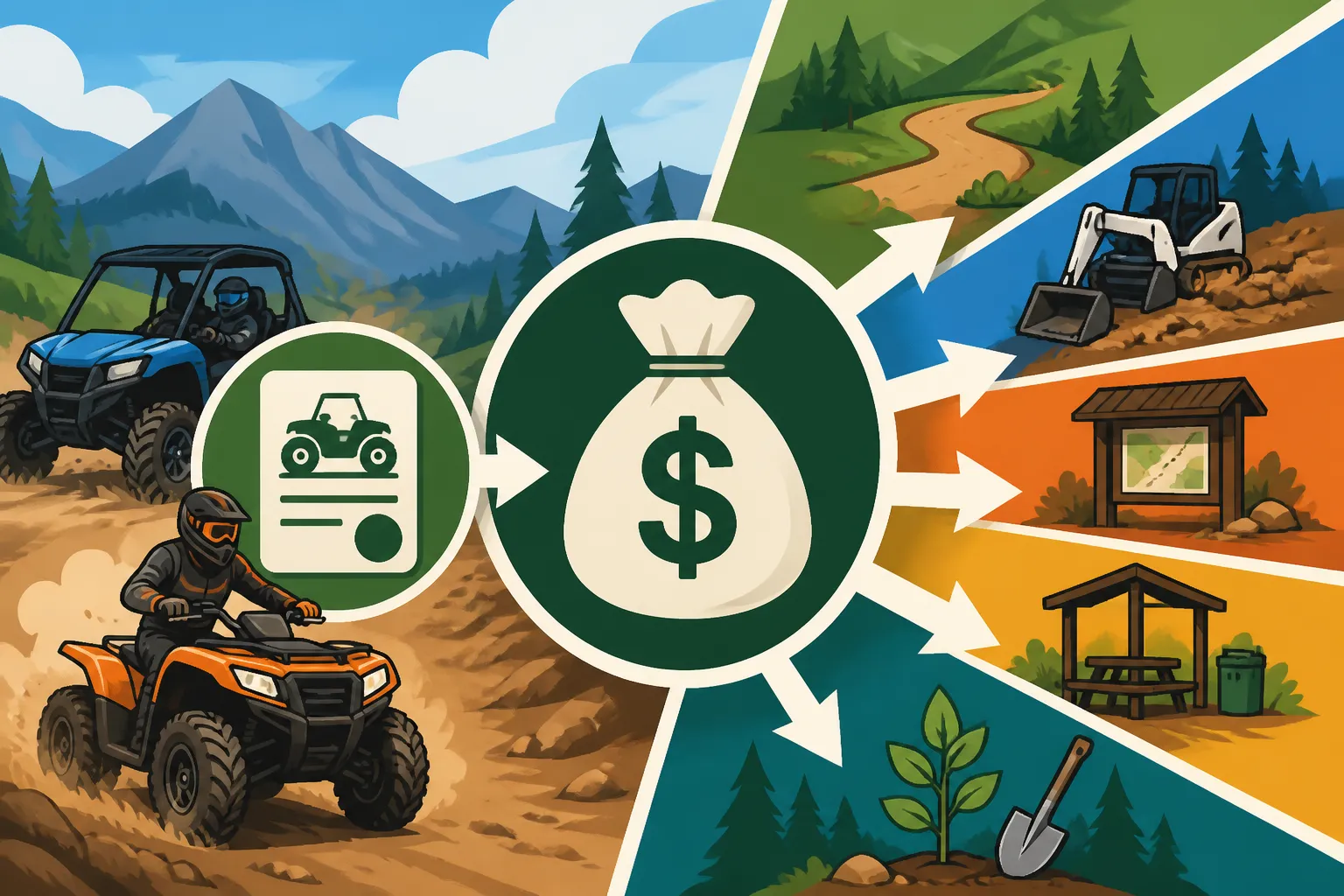
Colorado’s OHV program is designed to support responsible motorized recreation, including the places and services riders depend on. Permit and registration revenue helps fund OHV-related work, but it does not function like a personal pass that pays for upkeep on one particular trail. The money is handled through programs, with funding decisions made through an application and review process.
Projects can include maintaining or improving trails, repairing damage, planning routes, protecting natural resources, and helping riders understand how to use public land responsibly. Depending on the project and program, funding may also support equipment, signs, facilities, or work that helps manage and maintain an OHV area. A project’s eligibility and funding source depend on the current program rules; not every type of work qualifies for every grant.
A useful way to think about the spending is as a shared pool that supports the OHV system. Riders use different kinds of land and trails, and maintenance may involve several organizations. A local trail group might help with volunteer work, while a land manager oversees access and environmental requirements. A grant can help fund a particular project without being the only source of money or labor behind it.
The type of permit or registration you buy matters to the overall program, but it does not assign your payment to a named trail or county. For an overview of the different kinds of Colorado registration, see Colorado Parks and Wildlife OHV Registration Explained. If you are visiting from outside the state, Colorado Non-Resident OHV Permit Explained covers the permit designed for nonresident riders.
It is also worth separating OHV program funding from the larger budgets that manage public land. A trail may receive OHV grant support while also relying on agency staff, partner organizations, volunteers, or other funding. Conversely, a road or trail that OHV riders use may be maintained under a different program and not receive a direct OHV grant.
| Permit or registration money may support | What that can mean on the ground |
|---|---|
| Trail maintenance and improvement | Repairing worn or damaged sections, improving drainage, or addressing erosion |
| Planning and access work | Evaluating routes, preparing plans, or managing designated motorized access |
| Resource protection and restoration | Repairing impacts and helping protect land, water, vegetation, or wildlife habitat |
| Signs and rider information | Clarifying route rules, closures, difficulty, or responsible riding practices |
| Education and outreach | Helping riders understand safe and responsible use |
| Grant-supported project costs | Helping an eligible organization complete a defined OHV-related project |
These are examples of the kinds of work that may be supported, not a promise that every item is funded in every place or every year. The current grant materials and financial reports are the best place to confirm the categories, conditions, and amounts that apply to a particular funding cycle.
How funding moves from permits to projects
A permit purchase does not usually trigger a payment to the trail where the rider happens to be that day. Instead, revenue supports the broader program, and eligible organizations can seek funding for projects through grant processes. That structure gives the program a way to weigh proposed work against priorities such as need, feasibility, land-manager coordination, and expected benefits.
The Colorado OHV grant program is one important route for funding trail and recreation work. Applications can come from organizations involved in managing, maintaining, or supporting OHV recreation. The exact eligible applicants, project types, application requirements, and review steps can change, so an organization planning to apply should use current program guidance rather than rely on an old application or a summary from another year. For a closer look at the role of grants in trail projects, see Colorado OHV Grant Program for Trails and Colorado OHV Grant Program and Trail Funding.
A typical grant-funded project has a defined purpose and scope. For example, a proposal might identify a section that needs repair, explain the work required, and describe how the work will improve the route or reduce impacts. A proposal may need to show that the applicant has permission to work on the land, that the project fits the applicable funding rules, and that the organization can complete and report on the work. The details depend on the particular grant program and project.
Funding decisions are not simply a count of permits purchased near a trail. A heavily used area may have a strong case for maintenance, but usage alone does not determine whether a specific proposal receives support. The project still has to fit the program, be practical to complete, and meet the relevant review requirements. Land ownership and management also matter: an organization cannot carry out work on land without appropriate coordination and authorization.
Grants may also be only one part of a project’s budget. An award can help pay for eligible expenses, while an organization or land manager contributes staff time, volunteer labor, equipment, or other resources. The overall project may therefore look larger than the grant amount alone. At the same time, a grant announcement does not necessarily mean that all planned work is finished; weather, access, contracting, permits, or other conditions can affect the schedule.
The program’s financial and grant information can help answer different questions. Financial reports may show how funds were collected or distributed at a broader level. Grant records can show which proposals were selected and what work they were intended to support. Project reports, when available, help indicate what was completed. Those records are more useful together than a single headline about an award.
For an example of how local organizations can participate in trail work, see Colorado OHV Grants to Trail Clubs. The article Colorado Trail Crews and Summer Repairs can also help explain why on-the-ground maintenance takes coordination and labor beyond the initial funding decision.
What funded work can look like on a trail
To understand where permit money goes, it helps to picture the practical work behind a rideable route. Trail maintenance is not just smoothing a rough spot. Depending on the site, a project may involve correcting drainage, stabilizing a damaged section, improving a trail surface, replacing signs, or rerouting use away from a sensitive area. The work has to suit the terrain and the land manager’s requirements.
Drainage is a good example of work riders may not notice until it is missing. Water running down a trail can carry soil and widen ruts. A project might reshape a section or add features that direct water off the route. The goal is not simply to make the ride more comfortable; good drainage can reduce erosion and help keep a designated route from deteriorating quickly.
Other work may focus on a route’s layout or condition. A trail manager might assess whether a section can be maintained safely, whether a damaged portion should be repaired, or whether a change in the route is needed to address resource concerns. Work might include moving or clarifying signs so riders can tell which routes are open. On a network with many intersections, clear information can help reduce accidental travel onto closed or unsuitable routes.
Restoration can also be part of OHV-related work. Where riding has damaged land outside a designated route, a project may seek to repair or stabilize the area and guide use back to authorized routes. Restoration is not always quick or visually dramatic. Vegetation recovery and erosion control can take time, and a project may need follow-up visits to check whether the site is holding up.
Education is another part of managing recreation. Information about designated routes, closures, trail etiquette, and resource protection can help prevent problems before they occur. Education does not replace signs, rules, or enforcement. It complements them by helping riders understand why restrictions exist and how their choices affect continued access.
These examples also explain why there may be no visible construction after a grant is announced. Some funded work involves planning, assessments, coordination, or equipment rather than a large physical change. A project may be focused on a limited section, or the improvement may be less erosion or fewer route impacts rather than a new feature. The results can be easy to miss if you are not familiar with the area’s previous condition.
Some trail networks are maintained with volunteer support. Volunteers may provide labor, help with signs, report problems, or work alongside land managers. Grant funding can make it possible to organize more substantial work, but it does not eliminate the value of local knowledge and ongoing care. A funded project and volunteer effort may be parts of the same effort rather than competing explanations for who maintains a trail.
Riders can help protect the value of that work by staying on designated routes, respecting closures, and reporting damage through the appropriate channel. If you spot a washed-out section or a missing sign, do not assume that a grant has failed or that nobody knows about the issue. Share a clear location and description with the relevant land manager or trail organization. Reporting a Colorado Trail Problem explains why timely, useful reports can help direct attention to a problem.
Why a nearby trail may not show an obvious return
A common frustration is paying for a permit, riding a local area, and not seeing a new sign or freshly repaired trail. That does not necessarily mean the money has gone unused. There are several reasons a rider might not see a direct, immediate change.
First, the program funds projects through a broader process, not a transaction tied to the purchaser’s home area or chosen riding destination. Revenue and grant decisions are not necessarily distributed evenly by county or by the number of riders on a single trail. The program is intended to support eligible OHV work, but an individual rider should not expect a specific local trail to receive a set share of permit revenue.
Second, the most important work may be preventive or hard to see. Better drainage, route planning, or resource protection may reduce future damage without producing a dramatic before-and-after view. Some projects focus on keeping access sustainable rather than expanding the trail network. In places where the priority is protecting a resource or correcting damage, success may mean that the route stays open and impacts do not spread.
Third, project timelines are affected by conditions outside the grant process. Work may depend on weather, seasonal access, environmental review, land-manager approval, contractor availability, or the ability to bring equipment to a remote location. A grant award indicates support for a project, not necessarily immediate work on the ground. It may take time for planning and coordination to lead to completed improvements.
Fourth, not every route riders use is managed or funded through the same channels. A trail can cross land with different owners or managers, or connect to a road whose maintenance comes from another budget. An OHV grant might support one segment but not every approach, road, or facility riders use to reach it. That can create a mismatch between the area a rider experiences as one trip and the responsibilities of the organizations maintaining its different parts.
Finally, grant funding is competitive and rule-bound. A project that seems important to a rider may not have an eligible applicant, a complete proposal, the required coordination, or a workable plan. Another proposal may be selected because it is ready to proceed or meets program priorities more clearly. This is not a simple measure of which trail matters most to riders; it reflects the application and review system.
Those limits do not make the funding process pointless. They are a reason to check what the program actually reports, rather than judging it only by whether one favorite trail looks different after a visit. If a trail has a closure or a damaged section, check the current land-manager information before riding. Colorado Trail Closures and Where They Are Posted is useful for understanding how to verify closure information, while Colorado Permit Rules on Public Land provides context on where permit requirements apply.
How to check spending and support useful projects
If you want to see where Colorado OHV funds have gone, start with current information from Colorado Parks and Wildlife and the applicable OHV grant program. Look for grant announcements, award lists, program reports, and project updates. Each document may answer a different question: who received support, what the project was meant to do, how funds were distributed, or whether the work was completed.
When reviewing a grant record, check more than the title. Read the project description, location, applicant, proposed work, and any available update or completion report. A broad label such as “trail maintenance” may cover work on a particular route, a set of signs, or another defined task. The award itself is not always enough to tell you what riders will see.
If you are checking on a trail you ride, identify who manages that land or route. A local club may be involved, but the land manager may be the right contact for access, closures, or project status. A county or federal land unit may have information that does not appear in a statewide grant summary. For a route that crosses management boundaries, more than one organization may be involved.
Riders who want to contribute can support responsible work in practical ways:
- Follow posted route designations and seasonal closures. Staying on open routes helps prevent avoidable resource damage.
- Report specific problems. Include the route name or number, a clear location, and a description of what you observed. Photos can help if they are safe and appropriate to take.
- Volunteer with a recognized trail group or land manager when opportunities are available. Ask what tasks are authorized before doing work on public land.
- Share accurate route and closure information with other riders. Outdated maps or informal directions can send people onto closed or unsuitable routes.
- Review grant and project information before drawing conclusions about a local area. Work may be planned, underway, complete, or funded through a different source.
For background on the broader flow of registration funding, Where Colorado OHV Registration Money Goes may help distinguish registration revenue from a specific project award. If you are comparing the permit system with your own riding needs, Colorado Permit Rules on Public Land can help clarify when a permit is required. Requirements vary by the type of machine, location, and use, so check current official guidance before a trip.
If you are part of a club or organization that wants to apply for support, begin with the current grant instructions. Confirm that your group is eligible, that the proposed work is allowed, and that you have coordinated with the land manager. Build a clear project plan, budget, schedule, and method for reporting progress. Avoid assuming that an older award or application describes today’s requirements.
The most useful way to assess permit spending is to connect the source of funding to the project records and then to the work completed. A permit helps support a statewide OHV program; grants and partner efforts can turn that support into specific projects. That system does not guarantee a new improvement on every route, but it provides a way to fund eligible work across the network and to make the results more visible through public records.
Frequently Asked Questions
Does my Colorado OHV permit pay for the trail I ride most?
No. Permit and registration money supports the broader OHV program. It is not assigned to the specific trail you choose to ride, and there is no guarantee that a particular local route will receive funding.
Does every trail project receive Colorado OHV grant money?
No. Projects must meet the applicable program requirements and go through the relevant application and review process. Some work may also be funded or carried out through other sources.
Why might a grant award not produce visible work right away?
Projects can require planning, land-manager coordination, suitable seasonal conditions, and other steps before work begins. An award is not the same as a completed project.
Where can I check what a grant supported?
Start with current Colorado Parks and Wildlife OHV program and grant information. Look for the project description and, if available, a progress update or completion report.
Disclaimer
This article is for general informational purposes only and does not constitute professional advice. Laws, prices and regulations vary by location and change over time. Consult a qualified professional for guidance on your specific situation.