Riding a Friend’s Ranch Without a Permit
A friend’s invitation can make a ranch ride sound simple: bring your ATV or UTV and go. The permit question depends on where you ride, though—not just who owns the machine or invited you. Here’s how to tell when private land may be permit-exempt, what changes if a route reaches public land, and what to confirm before unloading.
When a ranch ride may not need an OHV permit
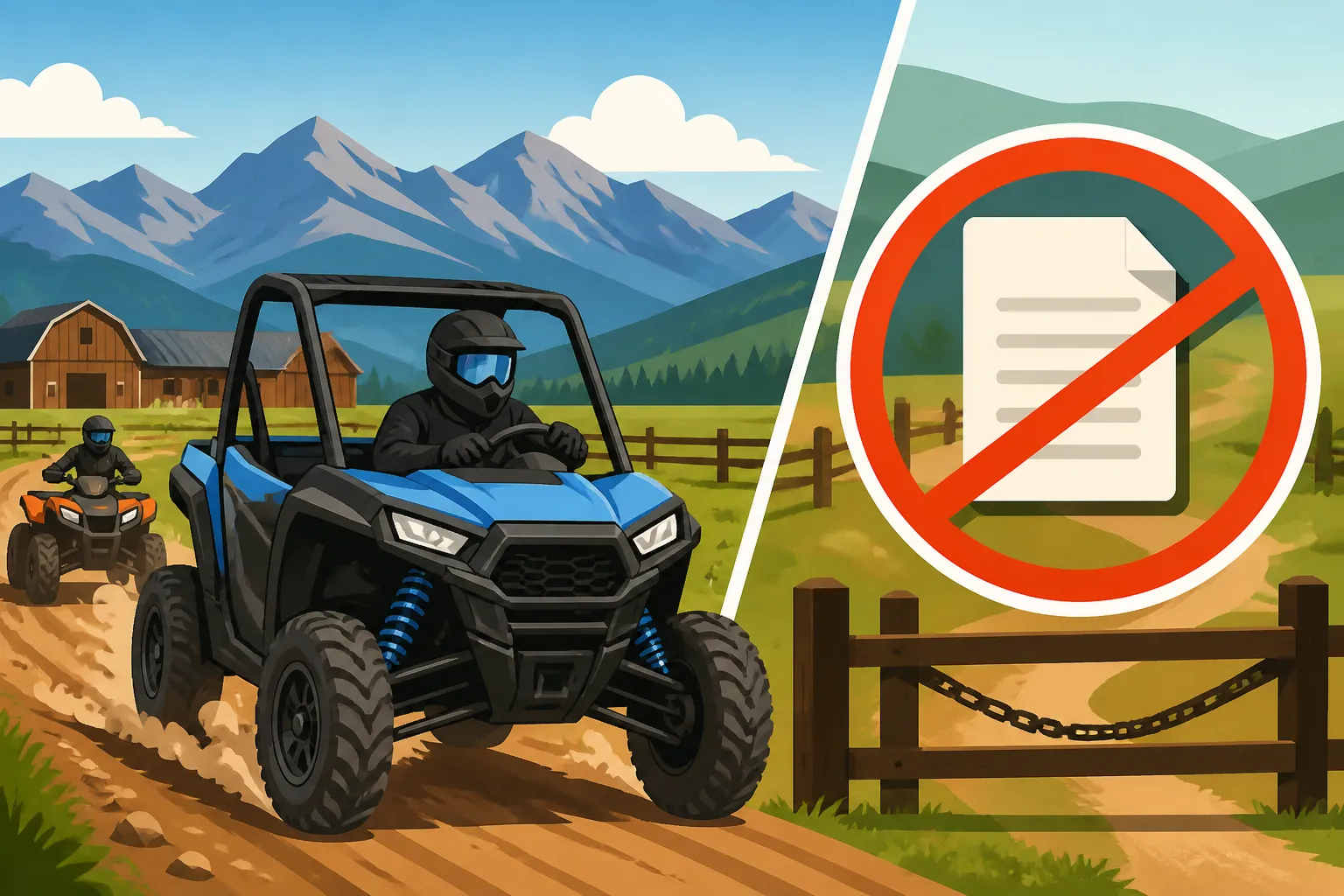
In Colorado, a ride that stays entirely on private property is generally treated differently from riding on public land. If your friend owns or controls the ranch, has given you permission, and the entire route remains on private land, a Colorado OHV registration or nonresident permit for public-land riding is generally not needed for that ride.
That limited answer depends on the route actually staying private. A ranch can contain or border roads, trails, or parcels with a different legal status. A vehicle can leave private land without anyone noticing if a route follows a fence line, crosses an access road, or connects with a trail. An invitation to ride the ranch does not grant permission to use a neighboring property or a public route.
A landowner’s permission and an OHV permit address different things:
- Permission answers whether you may use the land.
- Registration or a permit addresses the requirements that apply when an OHV is operated in places such as public lands or designated riding areas.
Permission from a friend does not replace a permit when one is required. Likewise, having a valid registration or permit does not give you permission to ride on someone else’s land.
This is why it helps to separate the words “permit” and “registration.” Colorado residents generally deal with OHV registration for machines used where registration is required. Nonresidents may need a Colorado OHV permit for qualifying public-land riding. Requirements can also depend on the vehicle and the route. If you are unsure whether your situation calls for a state registration, a nonresident permit, or something else, review Colorado OHV Registration for Machines Kept on Private Land and Colorado Non-Resident OHV Permit Explained.
| Where you ride | Landowner permission | Public-land OHV credential |
|---|---|---|
| Entirely within private ranch land | Get permission from the owner or authorized manager | A public-land permit or registration is generally not required for that private-land ride |
| Partly on public land or a public route | Permission is still needed for any private section | The required registration or permit may apply to the public section |
| On land with unclear boundaries or access status | Confirm who controls each section | Do not assume the route is exempt; check its status and the applicable credential |
| On land open through an access arrangement | Follow the landowner’s and access program’s conditions | Check whether the route is treated as public access and what credential it requires |
These are practical guideposts, not a substitute for checking the specific property and current rules. The private-land exemption is not a general permission to ride wherever a ranch trail happens to lead. For more on the distinction, see Colorado Permit Exemptions on Private Land and Private Land Riding and Colorado Registration.
Confirm the property and the route before riding
A ranch is not always one uninterrupted block of privately controlled land. It may include separate parcels, leased ground, public access easements, or routes that connect to nearby public land. Before you ride, ask your friend to identify the route—not just the general riding area—and confirm who has authority over the land.
A useful conversation covers these points:
- Where the private property begins and ends. Ask which gates, roads, trails, and landmarks mark the boundary. A fence is useful information, but it does not always establish the legal property line.
- Whether the route uses a road or trail with public access. A road crossing ranch property may still have a public right of way or other access conditions. Ask specifically about any route that connects to a county road, public trail, or trailhead.
- Whether the property is leased or managed by someone else. The person who invited you may not be the person authorized to approve motorized use. Confirm permission with the owner or manager who controls the land.
- Where you may ride and where you may not. A ranch owner may allow riding only on certain tracks or at certain times. Avoid fields, livestock areas, crops, buildings, and closed gates unless the owner says otherwise.
- What to do if you get turned around. Agree on a stopping point or a way to contact the host rather than continuing along an unfamiliar road.
If the property is leased, hunting ground, or part of a managed access arrangement, permission may be limited to certain users, seasons, or activities. Do not treat an invitation to visit as permission to operate an ATV or UTV. Permit Rules on Leased Hunting Property covers why access conditions matter, and Written Permission Before Riding Private Land is a helpful reference when permission needs to be clear.
When the boundary or access status is uncertain, the safest choice is to stay on a route your host has confirmed. If the owner cannot verify whether a segment is private, contact the appropriate land manager or check official property and route information before taking the machine there. Do not rely only on a map app, a trail marker, or another rider’s assumption.
What changes when the ride reaches public land
The moment a ride leaves private property, the requirements may change. A short connector to a public trail, a public road crossing, or a detour onto nearby public land can bring the machine under rules that do not apply to the private portion. Your friend cannot waive those rules on behalf of a public land manager.
Before using a mixed private-and-public route, identify the public segment and determine what credential applies to your machine and your residency. Colorado residents and visitors from other states may have different registration or permit processes. A machine’s home-state registration, a license plate, or permission to ride on the ranch does not automatically settle every Colorado requirement. Look at Out-of-State Machines on Colorado Trails if you brought a machine from elsewhere, and Colorado Permit Rules on Public Land for the public-land side of the question.
A street-legal vehicle can also have different requirements from an unregistered OHV, and rules may depend on whether it is using a public road, a designated trail, or another public riding area. Do not assume that a plate removes every permit requirement. If your trip includes roads, check the route’s rules as well as the machine’s status; Do Street-Legal Trucks Need a Colorado OHV Permit? explains why road legality and trail access are separate questions.
A practical approach is to treat the whole route as a series of land segments:
- Private ranch section: Get permission from the person who controls the land and follow the ranch’s restrictions.
- Public road or trail section: Confirm whether the route is open to your machine and what registration, permit, or operating rules apply.
- Unclear section: Stop and verify before entering. Do not assume that a gate, tire tracks, or an old route makes the road private or open.
If the public segment requires a credential, have it in place before riding there. The ranch owner’s invitation covers only the land and use they are authorized to approve. It does not extend across a public trail or another owner’s parcel. Riders planning to combine a private visit with public riding can use Where to Buy a Colorado OHV Permit to check available purchase options, then confirm the current requirements with Colorado Parks and Wildlife.
A simple pre-ride check for guests
A few minutes of planning can prevent an awkward conversation, an unwanted trespass, or a ride that stops at the property line. Before you load the ATV or UTV, use this checklist:
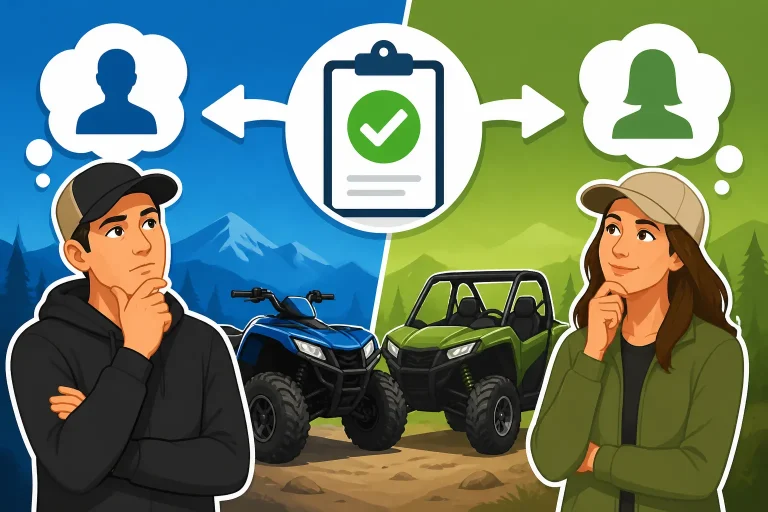
- Get clear permission. Confirm that your friend is authorized to allow motorized riding, and ask whether permission applies to every rider and machine in your group.
- Get the route. Ask for a map, marked route, or specific directions. Confirm whether any portion uses a public road, public trail, easement, or neighboring property.
- Check the credential question. If the ride is entirely private, a public-land permit or registration is generally not required for that ride. If any part reaches public land, check the current requirement for your residency, machine, and route.
- Ask about local restrictions. Ranch rules may limit speed, hours, passenger use, or where you can ride. Follow them even when a state permit is not needed.
- Keep the route private unless you have verified otherwise. If a gate is closed, signs prohibit entry, or directions become unclear, stop and ask rather than riding through.
- Plan for the machine and riders. Use a machine appropriate for the terrain and rider, carry suitable safety gear, and keep the group together. Private land does not eliminate the risk of steep ground, livestock, other vehicles, or remote conditions.
If you are riding only on a friend’s property, it may be tempting to skip all paperwork and planning. The better distinction is simple: do not confuse a permit exemption for private-land use with a general exemption from the owner’s rules, safety obligations, or other applicable laws. The permission should be clear, the route should be known, and any public portion should be treated as its own separate ride.
For a straightforward ranch visit, ask your host to confirm that the planned route stays on land they control. If the answer is yes and you remain there, you generally do not need a Colorado public-land OHV permit for that ride. If the route crosses into public space, stop treating it as a private-land-only trip and verify the credential and access rules before you go.
Disclaimer
This article is for general informational purposes only and does not constitute professional advice. Laws, prices and regulations vary by location and change over time. Consult a qualified professional for guidance on your specific situation.