Towing Off a Mountain Trail
A disabled ATV or UTV on a Colorado mountain trail can turn a great ride into a stressful one fast, especially when the route is narrow, steep, or far from cell service. This guide explains how to assess the scene, choose a sensible recovery option, prepare for a tow, and avoid turning a breakdown into a rollover or a bigger trail emergency.
Start by making the scene safe
Stop before you decide how to recover
When a machine loses power, gets a flat, or slides off its line, the first impulse may be to hook it to another vehicle and pull. Pause first. Put every machine in a stable position, keep riders out of the travel lane, and check whether the disabled ATV or UTV could roll, slide, or tip. On a narrow shelf road near Ouray or above Lake City, even a small movement can matter.
Look for immediate hazards: loose rock, an exposed edge, steep cross-slope, oncoming traffic, weather, and leaking fuel or other fluids. If the machine is unstable, do not stand downhill from it or between it and the towing machine. If there is an injury, fire risk, or danger of a vehicle going over an edge, treat it as an emergency rather than a routine trail recovery. Call 911 when there is immediate danger and share your location as clearly as possible.
Before anyone handles a winch line or strap, account for the group. Keep passengers and bystanders well away from the line and the direction of pull. A recovery line under tension can cause serious injury if it breaks or a connection lets go. If you do not have a clear, controlled plan, stop and seek qualified help instead of improvising.
Decide whether a trail-side fix is safer
Some problems are better handled where the machine sits. A puncture may be repairable with a tire plug kit and compressor; a dead battery may respond to a jump pack; a loose connection might be safely corrected after the engine is off and the machine is secure. A quick diagnosis can prevent an unnecessary tow that strains both vehicles.
Other problems call for a tow or professional recovery. A damaged steering or suspension part, a locked wheel, a machine that will not stay in gear, or a UTV that has rolled should not be dragged casually down a trail. A machine with a damaged wheel may not track straight, and a seized drivetrain can make towing difficult or unsafe. If you are uncertain whether the vehicle can roll freely, do not assume it can.
For a rocky trail puncture, it helps to be prepared before leaving the trailhead; see Flat Tires on a Rocky Trail. For a vehicle that is stuck or needs controlled extraction, Recovery Gear for a Shelf Road and Winching on a Narrow Shelf Trail are useful subjects to understand before you need them.
Choose a recovery method that fits the terrain
Compare repair, winching, towing, and outside help
A tow is not automatically the safest answer. The right choice depends on what failed, how stable the machine is, how much room there is to maneuver, and whether the towing vehicle can hold its line. A narrow, exposed trail may make a slow winch pull safer than driving one machine close to another. In other situations, a short, level tow to a wider turnout may be reasonable.
| Option | May make sense when | Main concern |
|---|---|---|
| Trail-side repair | The fault is minor and the machine is stable | Repairs can be unsafe if the vehicle may move or has serious damage |
| Winch recovery | The disabled machine needs a controlled pull and there is a suitable anchor | Anchor strength, line direction, and bystander position |
| Low-speed tow | The machine can roll and the route is wide enough to control both vehicles | Braking, steering, slack, and steep or uneven terrain |
| Professional recovery | The vehicle is unstable, badly damaged, or in a hazardous location | Access, communication, and the time needed to arrange help |
If you use a winch, choose an appropriate anchor and connect only to a suitable recovery point. Do not attach a winch or tow line to a ball hitch, steering component, suspension arm, or an unverified frame point. A tree saver can help protect a tree when using it as an anchor, where permitted and appropriate. Keep people away from the loaded line and follow the winch and vehicle manufacturers’ instructions.
A winch does not make every recovery safe. If the anchor is questionable, the pull angle could drag the machine toward an edge, or the ground beneath either vehicle is shifting, stop. A modest pull from a stable position is often preferable to a powerful pull that changes the vehicle’s balance.
Tow slowly and keep the connection controlled
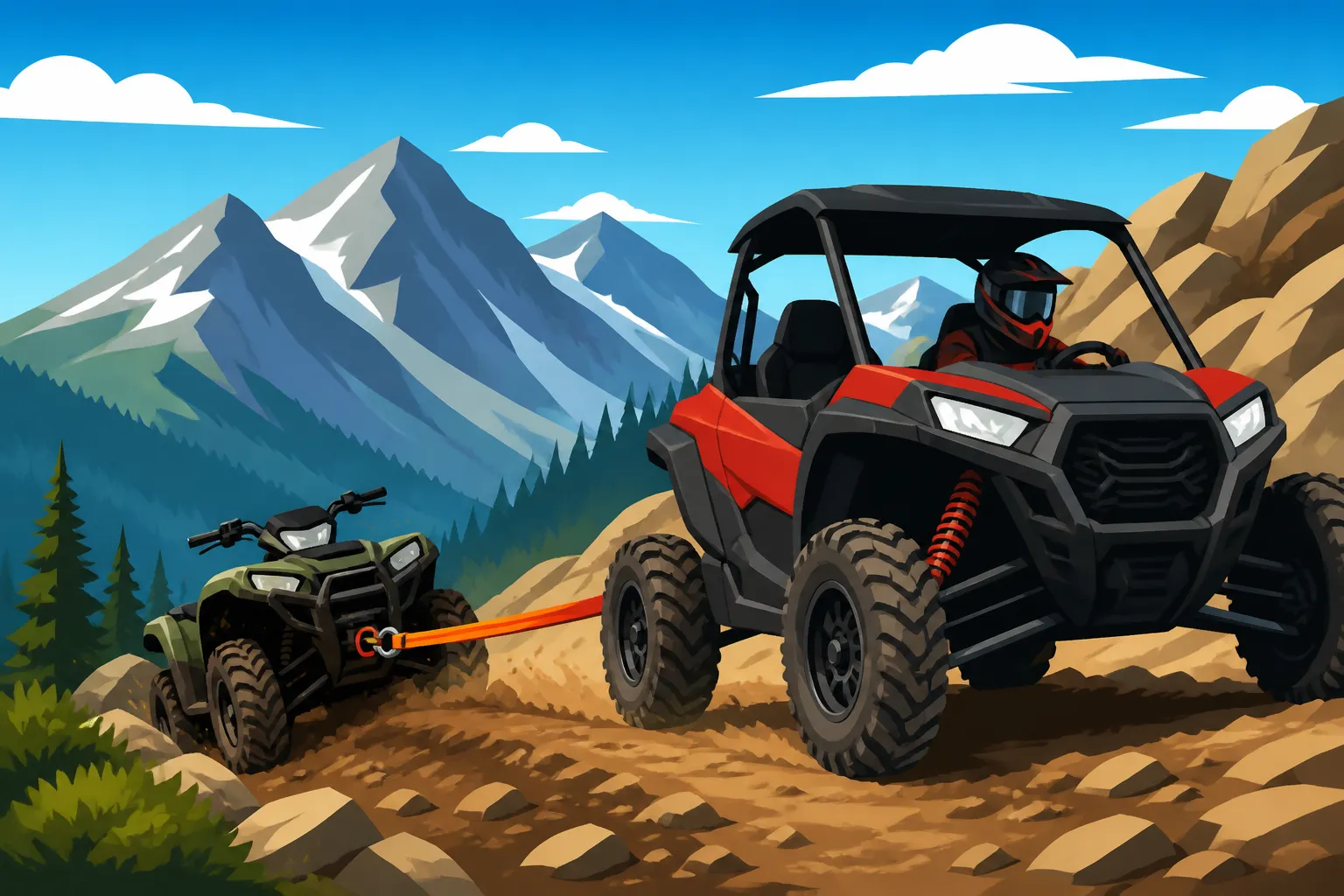
For a basic tow, both operators need to agree on the route, signals, and stopping plan before moving. Use a properly rated tow strap and approved recovery points on both machines. Keep the line short enough to avoid dragging it over rocks, but do not let the vehicles collide. Avoid sudden acceleration, sharp turns, and abrupt braking.
The operator in the disabled vehicle should remain in control if the machine can steer and brake safely. If the machine cannot be controlled, do not tow it down a steep or narrow section just because it is attached to another vehicle. A towed ATV or UTV can swing, slide sideways, or push the towing machine, especially on loose gravel. On a descent, the towing vehicle may not be able to hold the combined load.
Do not use a tow ball as a recovery point. A ball or hitch component can fail under a sharp load and become a dangerous projectile. Do not use a kinetic recovery strap for a fast, forceful snatch pull in exposed mountain terrain. Dynamic pulls can produce large forces and unpredictable movement. A slow, controlled recovery is easier to stop if conditions change.
Prepare for the tow and protect the group
Check the machine, route, and recovery gear
Before connecting anything, inspect both vehicles and the trail. Confirm that the disabled machine can roll, that its steering and brakes work well enough for the planned move, and that the towing machine has enough traction and braking control. If the trail is too narrow for the vehicles to stay aligned, find a safer staging point or wait for assistance.
Review the route ahead rather than focusing only on the first few feet. A sharp switchback, washout, rock step, steep descent, or blind corner can make a short tow unexpectedly difficult. If there is a wider turnout nearby, moving the disabled machine only as far as that safe place may be better than trying to tow it all the way back to the trailhead.
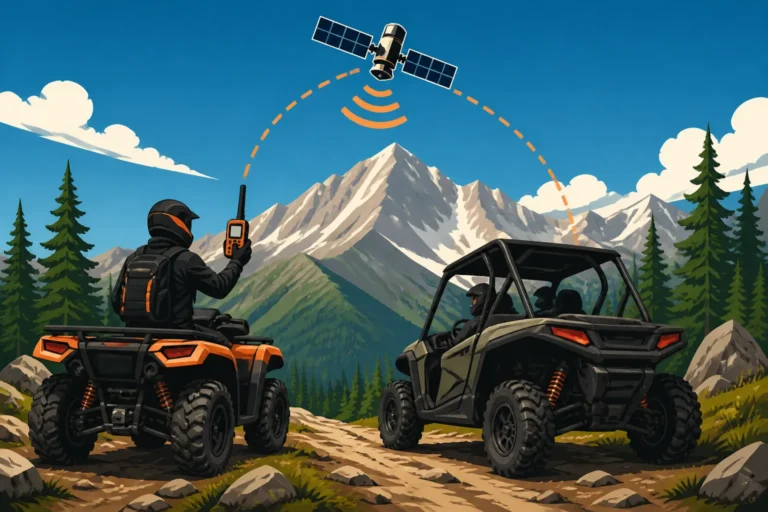
Pack recovery gear before the ride, not after something breaks. A sensible kit can include a rated tow strap, gloves, basic tire-repair supplies, a portable compressor, a shovel, and a winch kit if the machine is equipped for one. Carry a first-aid kit, water, warm layers, and a way to communicate when phones have no service. What to Carry Over a High Pass and Cell Dead Zones in the San Juans cover two practical parts of planning for remote rides.
For route planning, onX Offroad can help riders review mapped routes and save information for use where mobile coverage is limited. Check the route details and closures before leaving, and carry a backup navigation option rather than relying on a phone alone. A map can help you communicate where the group is, but it cannot replace a safe recovery plan or local closure information.
Communicate clearly and keep bystanders out
Agree on simple commands before tension goes on a line. One person should direct the recovery while the operators concentrate on their vehicles. Use clear signals for “stop,” “slack,” and “pull,” and stop immediately if anyone loses sight of the operator or the line. Do not shout competing instructions from several places.
Keep riders away from the line, anchor, and likely path of movement. Nobody should straddle a strap, stand over a winch line, or stand between the two machines. If the line is under tension, maintain a safe distance and use only equipment designed for the task. A line damper may reduce some hazards, but it does not make a failed line harmless.
If communication is unreliable, identify a person who can ride out for help only if the route and conditions make that safe. Do not split the group casually in remote terrain. A partner should know the location, the route taken, the machine involved, and what assistance is needed. For solo riders, the margin for safe self-recovery is much smaller; Riding Alone Over a High Pass explains why a simple route plan and check-in arrangement matter.
Know when to stop and call for help
Do not force a recovery on exposed ground
A tow should stop if the disabled machine starts sliding sideways, the towing vehicle loses traction, the line shifts toward a sharp edge, or the route becomes too steep to control. Stop and reassess from a safe position. Repositioning may help, but only if it can be done without placing people or machines in a more dangerous spot.
Colorado’s high-country routes can change quickly with rain, snowmelt, loose rock, and afternoon storms. A trail that seemed manageable on the way up may feel very different with a damaged machine on the way down. If weather is worsening, visibility is poor, or a storm is moving in, prioritize shelter and communication over a risky attempt to reach the trailhead.
Do not drag a disabled machine off an established route just to get around an obstacle unless you know the move is permitted and will not damage the trail or surrounding ground. If the vehicle is blocking a route, communicate the obstruction to the appropriate land manager or local authorities when possible. Colorado Trail Closures and Where They Are Posted and Colorado Trail Conditions Reports can help riders think ahead about closures and changing trail conditions.
Make the next trip easier to recover from
After a recovery, inspect the tow points, strap, winch, tires, steering, and brakes before riding again. A vehicle that was towed successfully may still have damage that makes the next descent unsafe. If anything is bent, loose, leaking, or behaving differently, stop riding and arrange transport rather than hoping it will hold together.
Before the next outing, match the route to the least capable machine and rider in the group. Check weather and access information, tell someone your planned route and return time, and save relevant map details offline. onX Offroad may be useful for organizing route information, but pair it with a backup plan for dead batteries, lost devices, and areas without signal. Keep recovery gear accessible rather than buried under luggage.
A well-planned group ride is not one where nothing ever goes wrong. It is one where people know when a repair is reasonable, when a slow recovery is appropriate, and when the safest choice is to stop and get help. On a Colorado mountain trail, restraint is often the most valuable piece of recovery equipment.
Disclaimer
This article is for general informational purposes only and does not constitute professional advice. Laws, prices and regulations vary by location and change over time. Consult a qualified professional for guidance on your specific situation.