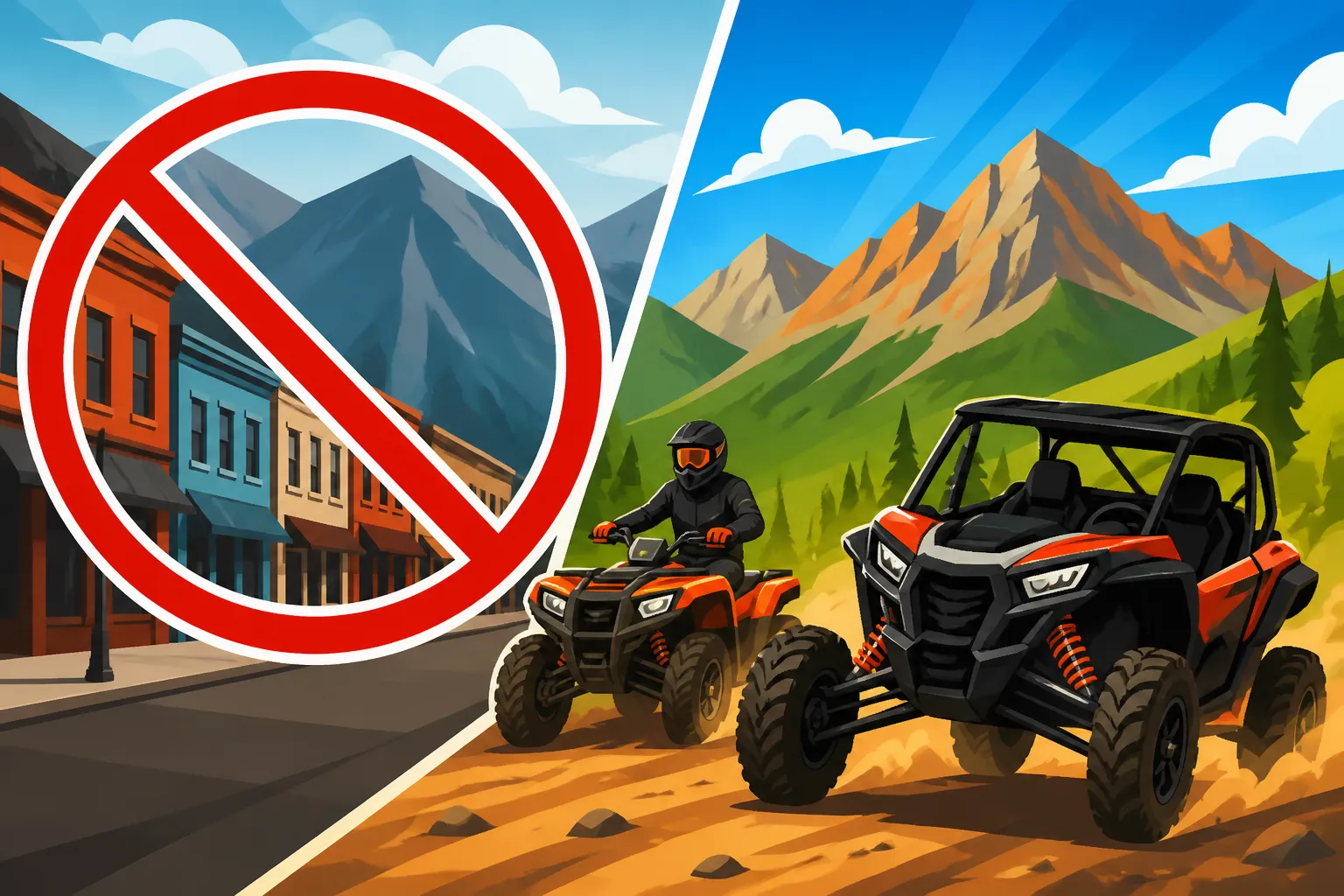
Telluride OHV Street Restrictions
It can be incredibly frustrating to roll into a picturesque Colorado mountain town with your side-by-side or ATV, eager to explore, only to discover that your machine isn't welcome on the very streets you hoped to traverse. Telluride is one of those places that, despite its close proximity to some of the most stunning OHV trails, maintains a strict stance on off-highway vehicles within its town limits. This guide aims to clear up the confusion and help you navigate the unique rules in place, so you can plan your adventure without unwelcome surprises or fines.
Understanding Telluride's Unique Stance on OHVs
Imagine pulling your rig into the San Juan Mountains, the crisp alpine air filling your lungs, and the anticipation of riding high passes like Imogene or Ophir Pass just buzzing in your veins. You might see other OHVs around the region, especially if you've driven through towns like Ouray or Lake City, where side-by-sides and ATVs are a common sight on main street. It’s easy to assume this freedom extends everywhere. However, when you arrive in Telluride, you'll quickly notice a stark difference: no off-highway vehicles (OHVs) are permitted on the town’s streets. This isn't just a suggestion; it's a firm rule, enforced to maintain the town's unique character and manage traffic.
This can be a significant point of confusion, even frustration, for riders. You've invested in your machine, perhaps adding heavy-duty components from SuperATV for durability on rugged terrain, only to find you can't even drive it to grab a coffee in town. It means your entry point to the trails won't be from Main Street, but rather from designated staging areas or trailheads outside the immediate town core. The town of Telluride has chosen to preserve its historic downtown and pedestrian-friendly atmosphere by strictly limiting motorized traffic, and that includes your beloved ATV or UTV, even if it has an out-of-state "street legal" plate. Colorado law allows individual towns and counties to set their own rules for OHV access on local roads, and Telluride has exercised that option to essentially ban them from their public roadways.
The reasoning behind this often boils down to a blend of historical preservation, noise abatement, traffic control, and maintaining a specific aesthetic. While other towns in the region, recognizing the economic benefit and cultural fit of OHV tourism, have opened their streets, Telluride has held firm. This means if your riding plans include enjoying the charm of Telluride itself, you’ll need to leave your machine on the trailer or parked outside the municipal boundaries and explore the town on foot, by bike, or via their excellent free gondola system. It’s a different experience, certainly, but one that preserves the town's character even for visitors passing through.
Why Telluride's Rules Differ from Other Mountain Towns
The contrast between Telluride and its neighbors like Ouray or Lake City regarding OHV street access is significant and can be a source of bewilderment for many riders. While towns like Ouray have embraced OHVs as an integral part of their tourism and local economy, even providing direct access to the [Alpine Loop Over Engineer and Cinnamon] from their main streets, Telluride has taken a different path. This isn't an arbitrary decision; it's rooted in distinct community priorities and a long-standing vision for the town's identity. Telluride often markets itself as a more upscale, pedestrian-oriented destination, emphasizing its arts, film festivals, and ski culture, which means minimizing vehicular traffic, especially recreational vehicles, is a core part of their brand.
Consider the layout and history: Telluride, nestled deep in a box canyon, has a compact, historic core. Residents and town officials have consistently voted to restrict OHV traffic to preserve this unique environment. This decision reflects a community desire to prioritize quiet streets, pedestrian safety, and a specific kind of visitor experience. It's a choice that stands in direct opposition to the policies found in places like Lake City, where the [Highway 149 OHV Corridor at Lake City] explicitly welcomes OHVs to use town streets to access trails and services. These varying local ordinances highlight the importance of doing your homework for each individual town you plan to visit in Colorado, as assuming uniform rules across the state can lead to disappointment or even fines.
Furthermore, the enforcement in Telluride is generally strict. You won't find the same leniency that might exist in areas less accustomed to OHV traffic. Law enforcement is aware of the local ordinances and will issue citations to those operating OHVs on town streets. While you might have a high-performance machine with great articulation thanks to SuperATV suspension components, that impressive hardware won't exempt you from Telluride's local traffic laws. Understanding this fundamental difference is crucial for planning your journey, especially if your itinerary involves riding iconic trails that happen to start or end near Telluride's boundaries. It means being prepared to stage your vehicle outside town or using alternative transport to explore the town itself.
Here's a quick comparison of OHV street access in some popular Colorado mountain towns:
| Town/City | OHV Street Access within Town Limits | Notes |
|---|---|---|
| Telluride | Strictly Prohibited | OHVs are not allowed on any public streets within the incorporated town limits. Access to trails requires staging outside of town. |
| Ouray | Generally Permitted | Known as the "Switzerland of America," Ouray is very OHV-friendly, allowing direct access from town streets to popular trails. Check local signage for specific routes. [Riding Into Ouray on a Side-by-Side] is common. |
| Lake City | Generally Permitted | OHVs are allowed on most town streets to access services and trailheads, especially for the Alpine Loop. |
| Silverton | Restricted | Silverton initially had an OHV ban but, after a vote, now allows OHV access on some designated streets within town limits, primarily for transit to trails. Still, some core areas are restricted. See [Silverton's Ban on OHVs in Town]. |
| Crested Butte (Town) | Prohibited | Similar to Telluride, the town of Crested Butte generally prohibits OHV use on its streets, though some surrounding county roads may allow it. |
Navigating Telluride's Perimeter and Parking as an OHV Rider
So, if you can't ride your OHV on Telluride's streets, what are your options when you want to explore the incredible trails in the surrounding area? This is where strategic planning for parking and staging comes into play. You’ll need to treat Telluride itself as a destination separate from your riding adventure. The good news is that while the town limits are off-limits, the trails surrounding Telluride, including parts of the iconic Alpine Loop, are very much accessible. Many riders choose to stage their machines outside the town's immediate jurisdiction, often in designated parking areas or trailheads located along the county roads just beyond the town''s perimeter.
For example, when you're headed to trails that connect near Telluride, like Imogene Pass or Ophir Pass, you'll want to look for staging areas on National Forest Service or BLM land, or other publicly accessible spots on the county roads before you enter Telluride's municipal boundaries. These locations often have ample space for truck and trailer parking. It's crucial to consult a Motor Vehicle Use Map (MVUM) for the specific area you plan to ride, as these maps clearly delineate which roads are open to OHVs and where parking is permitted. Remember, the goal is to get to the trailhead without ever putting a tire on a Telluride town street. Failing to do so can result in [Colorado Fines for Illegal Road Riding], which no one wants on a vacation.
If your plan includes actually visiting the town of Telluride – perhaps for dinner, shopping, or to enjoy one of its many festivals – you'll need to park your truck and trailer in designated parking areas and use alternative transportation into town. Many visitors utilize the free gondola that connects Telluride to Mountain Village, or simply walk from parking areas on the outskirts. This is where understanding [Ouray and Telluride OHV Town Restrictions] becomes particularly vital, as the approach to each town is vastly different. While your machine might be fully outfitted with durable SuperATV tires and a winch for self-recovery on tough trails, it won't make the town of Telluride any more welcoming to street use. Always check for up-to-date information on parking regulations, especially during peak season, as designated OHV staging areas can fill up quickly.
The Impact of Telluride's Restrictions on Your Riding Experience
The strict street restrictions in Telluride undeniably shape the experience of an OHV rider visiting the area. Instead of a seamless ride from your lodging to the trailhead, you're faced with a multi-step process: trailer your machine, find legal staging outside town, unload, and then ride the trails. This might seem like a hassle, and for some, it might even deter them from choosing Telluride as their base camp for an OHV adventure. However, it also means that the trails you do access are often pristine, offering breathtaking views without the constant worry of navigating through congested town streets.
The upside of these restrictions, from the town's perspective, is a reduction in noise, dust, and traffic congestion within its historic core, fostering a more serene environment for pedestrians and other visitors. For riders, it means accepting that Telluride is a "no-ride" zone for OHVs on pavement. This necessitates a shift in mindset and careful itinerary planning. Instead of thinking of Telluride as an OHV-friendly hub, consider it a beautiful town adjacent to fantastic riding. Your focus then shifts to maximizing your time on the incredible high-country trails themselves, whether it's conquering Engineer Pass or exploring the historic mining roads.
This also means that if you're traveling with a group, coordinating staging and meeting points becomes even more important. You might find it more convenient to base your operations out of a more OHV-friendly town like Ouray or Lake City, where you can ride directly from your accommodation, and then make a separate, vehicle-based trip to Telluride to explore its town amenities. The experience of [Riding From a Colorado Campground to the Trail] is very different when a town blocks the route. Ultimately, while Telluride's rules might feel restrictive, they encourage riders to appreciate the vast and beautiful backcountry, ensuring that when you do hit the dirt, your machine, perhaps with its upgraded SuperATV axles, is truly in its element, far from the paved streets of the town.
Disclaimer
This article is for general informational purposes only and does not constitute professional advice. Laws, prices and regulations vary by location and change over time. Consult a qualified professional for guidance on your specific situation.