Riding Two Abreast on a Colorado County Road
Riding two ATVs or UTVs side by side on a Colorado county road can feel safer and more social, but it is not automatically allowed just because the road is open to OHVs. This guide explains how to check local rules, when riding single file is the safer choice, and how to plan a road ride without guessing about access or passing.
Check whether the road is open to OHVs
County road does not automatically mean OHV road
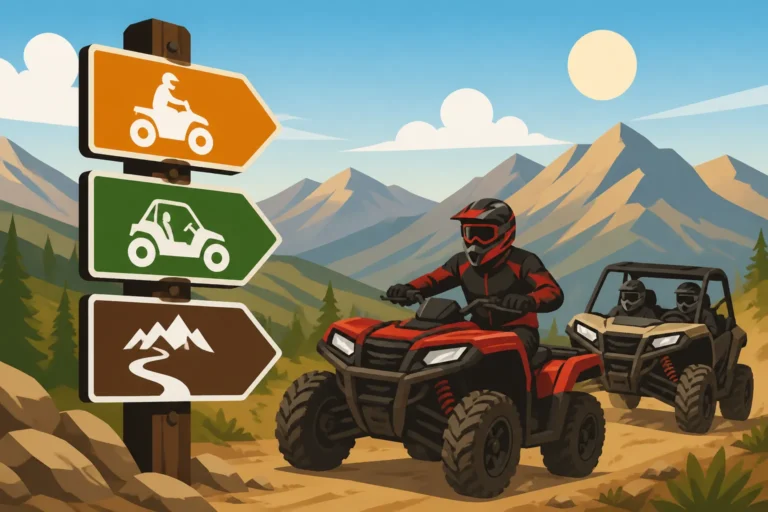
Colorado does not give riders blanket permission to operate ATVs and UTVs on every county road. Access can depend on the county, the road, and any local rules that apply. One road may be open to OHVs while a nearby road is closed, or an authorized route may have conditions riders need to follow.
Before riding, identify the exact road and the agency responsible for it. Look for the county’s OHV road ordinance, route map, or posted signs. If a route crosses from a county road onto a town street or a Forest Service road, check those rules separately. A route that is legal for one stretch does not make every connecting road legal too. [Which Colorado Roads Allow OHVs]
The same caution applies to out-of-state plates. A machine’s registration or street-legal status in another state does not, by itself, establish that it may travel on a particular Colorado county road. Confirm both the route’s local authorization and the requirements for your machine. [Why an Out-of-State Plate Does Not Help in Colorado]
Verify the specific route and any restrictions
A practical route check starts with the county or municipality responsible for the road. Read the ordinance or official map rather than relying only on a trail app, a friend’s memory, or a route someone posted online. Signs at entrances and junctions matter, too. If signs and a map seem inconsistent, pause and get clarification before riding through.
Pay attention to restrictions that may affect the ride: which road segments are open, when access is allowed, whether certain vehicle types are excluded, and whether any local equipment or operating rules apply. Road access can also change at jurisdiction boundaries. A route passing through a mountain town may have different rules inside town limits than on the county road outside them. [Finding Your Colorado County's OHV Ordinance]
If your planned trip links several communities, check each segment before you go. Routes around Silverton, Ouray, Telluride, Lake City, and other mountain towns may involve different local rules. Do not assume that a route shown on a map is currently open or that authorization in one town carries into the next. [Colorado Counties With OHV Road Ordinances]
Is riding two abreast allowed
Do not assume the bicycle rule applies to ATVs or UTVs
Riders sometimes hear that certain road users may travel two abreast and assume that rule also applies to OHVs. That is not a safe assumption. Rules written for bicycles do not automatically authorize two ATVs or UTVs to ride next to each other on a county road. For OHV use, the first question is whether the road is open to your machine; the next is whether local rules or applicable traffic requirements restrict how you may use it.
If the local ordinance or other governing rule does not clearly address side-by-side riding by two separate machines, choose single file and ask the responsible agency for clarification. “There was room for both of us” is not the same as permission to occupy the road that way. A rider can avoid a preventable argument, citation, or close call by treating single file as the default unless the route’s rules clearly allow otherwise.
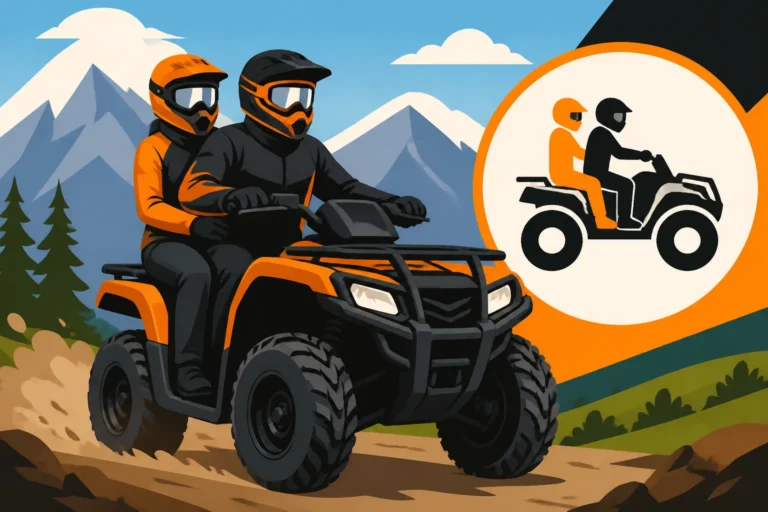
Also distinguish two vehicles traveling alongside each other from two people sitting side by side in a UTV. The latter is simply the seating arrangement of one machine; it does not answer whether that vehicle is authorized to use the road or what operating requirements apply.
Why single file is usually the safer default
Colorado county roads can be narrow, winding, dusty, or bordered by steep drop-offs, drainage ditches, and limited shoulders. Two machines riding abreast take up more lateral space and leave less room for an oncoming vehicle, a cyclist, a ranch truck, or another OHV. On a blind bend, the other road user may not see the pair until there is little time to react.
Single file also gives each rider more room to respond to changing surfaces. A pothole, loose gravel, cattle guard, washboard section, or sudden braking maneuver can make one machine move sideways. If the machines are close together, that movement can push a rider toward the road edge or into the other vehicle’s path.
Communication is another issue. Riders may think they can talk more easily side by side, but wind, engine noise, helmets, and dust can make conversation difficult. Agree on hand signals or a safe stopping place before the ride, and pull fully out of the travel lane before regrouping. [Group Riding Etiquette in a Small Town]
Plan a road ride that leaves room for others
Leave space and manage the group
On an authorized county road, give the vehicle ahead enough space to brake and react without forcing the rest of the group into abrupt stops. Keep a position that lets you see the road surface and the rider in front of you. Dust can reduce visibility quickly, especially when the road is dry, so increase the gap rather than closing it to stay together.
For a group with mixed experience, a simple formation is often easier to manage: a lead rider who knows the route, individual machines traveling in single file, and a final rider who can check that nobody has been left behind. Stop only where the whole group can get clear of traffic. A narrow shoulder or a blind corner is not a good place for a group huddle.
If the road has enough width for safe passing, that still does not settle whether riding two abreast is allowed. Width is a safety consideration, not a substitute for checking the local rule. When another road user approaches, avoid forcing them to slow or move toward the edge. Be especially patient around cyclists, pedestrians, livestock, and large work vehicles. [Sharing a Mountain Road With Cyclists]
| Situation | Safer approach |
|---|---|
| You have not confirmed local permission for OHVs | Do not enter the road until you verify access |
| The rule on riding abreast is unclear | Ride single file and contact the responsible agency |
| The road is narrow, winding, or has limited sightlines | Stay single file with extra space between machines |
| Dust is blocking the view ahead | Slow down and increase following distance |
| The group needs to regroup | Stop somewhere fully clear of the travel lane |
| A vehicle, cyclist, or livestock approaches | Keep to a predictable line and avoid blocking or crowding them |
Prepare the machine and rider for road conditions
A road ride can expose a machine to conditions that feel different from a trail: faster-moving traffic, gravel shoulders, pavement transitions, dust, and longer stretches without a convenient pullout. Before leaving, check the tires, brakes, steering, fuel, and lights. Carry the registration or permit documents the route requires, and make sure the person operating the machine understands the route and local restrictions.
Visibility can be a real concern in bright sun, shade, dust, and changing mountain weather. If you are considering mirrors or other visibility accessories, match them to your machine and intended use. Some riders compare machine-specific mirror options from SuperATV, but an accessory does not make an unauthorized road legal or replace any equipment required by the applicable rules. SuperATV options should be treated as one part of a broader setup check, not as a legal shortcut.
For example, a mirror may help a rider notice a vehicle approaching from behind, but it cannot make a blind corner safe or give a group permission to occupy more of the roadway. Check that accessories are secure, do not interfere with controls, and are appropriate for your specific machine. Riders who are unsure whether a particular part meets a local requirement should confirm that requirement with the agency responsible for the road.
Common mistakes and a simple pre-ride check
Avoid relying on assumptions
A common mistake is treating a familiar road as open because someone else rode it last season. Another is assuming that a county road, a town street, and a Forest Service road all follow the same rules. They may be governed by different agencies and different restrictions. Check the route again when plans change, particularly if a detour sends the group onto a road you did not originally research.
It is also easy to confuse “two abreast” with being able to pass safely. Even if the road looks wide in one spot, it may narrow around a bend, bridge, gate, or cattle guard. A rider who pulls alongside a friend to chat may also unintentionally block a faster vehicle or make it harder for other road users to predict the group’s movement. Keep the formation consistent and use designated or safe pullouts to stop.
For broader requirements that may apply to a road ride, review [What Colorado Requires on an OHV Road Ride]. If you are uncertain about a permit or registration requirement, check the relevant rules for your machine and route instead of relying on another rider’s paperwork or experience. [Colorado OHV Registration Explained]
Use this checklist before setting out
- Confirm the route. Identify the exact road segments and the agency responsible for each one.
- Check local authorization. Review the county or town ordinance, official map, and posted signs.
- Resolve the formation question. If the rules do not clearly allow two separate machines to travel abreast, ride single file.
- Check the machines. Inspect tires, brakes, steering, lights, fuel, and any visibility accessories.
- Brief the group. Choose a lead rider, agree on hand signals, set a comfortable following gap, and name a safe regrouping point.
- Adjust to conditions. Slow down for dust, poor sightlines, loose gravel, livestock, cyclists, and oncoming traffic.
- Recheck after a route change. A detour can cross into a different jurisdiction with different access rules.
When riders cannot confirm that side-by-side travel is permitted, single file is the practical choice: it leaves more room for other road users, makes the group easier to manage, and avoids treating an assumption as a rule. If adding mirrors for rearward visibility, some owners look at SuperATV’s machine-specific options; fit and suitability still need to be checked for the individual vehicle. For the road itself, the controlling question remains the local authorization and applicable requirements, not the accessory brand.
Disclaimer
This article is for general informational purposes only and does not constitute professional advice. Laws, prices and regulations vary by location and change over time. Consult a qualified professional for guidance on your specific situation.