Colorado Campgrounds With Trail Access
Finding a Colorado campground that welcomes ATV or UTV riders is only half the job. The campsite may be near a trail, but the route from your parking spot could still require a trailer, cross private land, or be closed to your machine. This guide explains how to choose a base camp, check access, and plan a ride without unpleasant surprises.
What campground trail access really means
Near a trail is not the same as connected to one
A campground can advertise itself as close to riding and still leave you with a separate drive to the trailhead. “Trail access” might mean a legal route begins at the campground, that there is a staging area nearby, or simply that public riding areas are within a short drive. Those differences matter when your machine is on a trailer and you are trying to avoid unloading, reloading, and finding another place to park.
Before booking, ask the campground to describe the connection in practical terms: Can you ride from your campsite to a signed, legal route? Is that route open to your specific machine? Does it lead to a trail system, or only to a road where OHV travel is restricted? If you need to use a county road to reach the trail, confirm that the road permits your machine and that you meet its operating requirements. Which Colorado Roads Allow OHVs
It also helps to separate “rideable from camp” from “rideable from camp for your group.” A narrow trail may suit dirt bikes but not a wide side-by-side. A steep route may be a poor fit for a new driver or a loaded four-seat machine. Check the route’s width, difficulty, seasonal status, and allowed vehicle types before assuming that proximity means a good match. Colorado Trails Rated for Full-Size Vehicles
Types of campgrounds riders use as a base
Colorado riders commonly choose among developed campgrounds, private RV parks, and dispersed campsites. Developed campgrounds may offer established sites and facilities, but access rules and vehicle parking arrangements differ. Private campgrounds can be convenient near popular riding towns, though their own vehicle policies may limit where you can ride or park. Dispersed camping may offer more solitude, but it comes with fewer services and requires careful attention to land-use rules and site availability.
| Camp type | What may work well | What to confirm before you go |
|---|---|---|
| Developed campground | Established facilities and designated sites | Whether OHVs are allowed at the site, where trailers can be parked, and how to reach legal routes |
| Private RV park or campground | Services and proximity to a town or riding area | Machine storage, trailer space, noise rules, and whether riding directly from the property is permitted |
| Dispersed campsite | A quieter, more flexible base when sites are available | Land-manager rules, road access, fire restrictions, parking limits, and distance to an open route |
| Trailhead staging area | Convenient unloading near a riding route | Whether overnight camping is allowed; a staging area is not automatically a campsite |
Where you stay does not replace a permit or registration requirement. Check what applies to your machine and destination, particularly if you are visiting from out of state. Colorado OHV Permit Rules on Public Land If you are camping on forest land, review the applicable camping and vehicle rules rather than assuming that a pullout beside a road is an approved overnight site. Dispersed Camping Rules on Colorado Forest Land
Questions to ask before reserving
A quick call or message can prevent the classic arrival-day headache: your family is ready to ride, but the campground has nowhere to leave the trailer, or the “trail access” turns out to be a drive away. Ask whether your particular machine type and width are allowed on the route from camp, whether trailers can stay at the campsite, and whether overnight parking is available for extra vehicles.
Also ask about the route’s surface and traffic. A gravel access road used by campers, cyclists, and local traffic is a different experience from a dedicated motorized trail. Find out whether the route reaches the riding area without requiring an unlawful road segment, and whether there are seasonal gates or closures that affect the connection.
Get specific about the lodging setup, too. A site that fits a camper may not also fit a truck, trailer, and side-by-side. Ask about the number of parking spaces, maneuvering room, unloading areas, quiet hours, and whether the campground expects machines to be transported rather than ridden around the property. Keep the campground’s answer, then cross-check the route with the relevant land manager or current map before traveling.
Colorado riding areas where a campground can make a useful base
Taylor Park and the Gunnison area
Taylor Park is a popular high-country riding area, and the surrounding region offers a mix of campgrounds and other places to stay. It can be an appealing base for riders who want access to a network of routes rather than a single out-and-back. The practical details still depend on your exact campsite and route: a campground near the riding area does not automatically allow you to drive an OHV on every road between the two.
When comparing places around Taylor Park, check where you will unload, what routes your vehicle can legally use, and whether your planned loops are suitable for your machine. A route that looks straightforward on a map can take longer than expected when it includes rough surfaces, elevation changes, or stops for other users. Taylor Park in the Gunnison National Forest
Plan for changing mountain conditions. Weather, snow, mud, and seasonal access can affect a ride, and a route that was open during one visit may not be open during another. Check local notices before setting out, bring a paper or offline map, and give your group a turnaround point. Colorado Trail Conditions Reports
Grand Mesa and the central Colorado high country
The Grand Mesa area can suit riders looking for forested routes, lakes, and a cooler summer base than lower-elevation desert riding areas. Campgrounds around the mesa may be convenient for a multi-day stay, but convenience varies by location. Confirm whether your chosen campground connects to legal motorized routes or whether you will need to trailer to a staging area.
The mesa’s route network includes different surfaces and settings, so match your plans to the machine and the people riding with you. If your group includes children or new riders, choose routes that allow a comfortable pace and easy breaks rather than picking a loop solely because it looks short on a map. A half-day ride can feel very different when the route is rough, the weather shifts, or someone needs to turn back. Grand Mesa’s 150 Miles of Trails
Bring a plan for navigation even when the trails seem well marked. Download maps before leaving reliable service, carry enough water and warm layers, and note the route back to camp. The combination of tree cover, junctions, and changing conditions can make it easy to miss a turn or misjudge how far you are from your starting point.
Ouray, Lake City, and the Alpine Loop
Campgrounds in and around Ouray and Lake City can serve as bases for exploring the San Juan Mountains, but they are not interchangeable starting points for every route. Terrain, road restrictions, seasonal access, and the capability of your machine all affect what is realistic. A campground may be close to the Alpine Loop geographically while still requiring a trailer trip or a specific legal approach to reach the route.
For this region, be especially cautious about treating public roads and motorized trails as one continuous system. Some roads have local rules, and access can vary by town, county, and road segment. Verify the route you intend to use rather than relying on a broad claim that a town or campground is “OHV friendly.” Riding the Alpine Loop Between Colorado Towns
High elevation also calls for a more conservative day plan. Conditions can change quickly, and a ride that begins in sunshine may encounter wind, rain, cold, or poor visibility later. Start early, carry warm layers and water, and avoid assuming that a familiar-looking pass will be easy for every passenger or driver. What to Carry Over a High Pass
How to check campground access and plan your ride
Confirm the route from campsite to trail
Start with the campground’s address and the exact route you hope to ride. Ask the campground whether riding directly from the property is permitted, then check the land manager’s maps and notices for legal motorized access. Look for road or trail designations, seasonal dates, vehicle-width restrictions, and closure information. If the connection uses a county road or passes through a town, check those local rules separately.
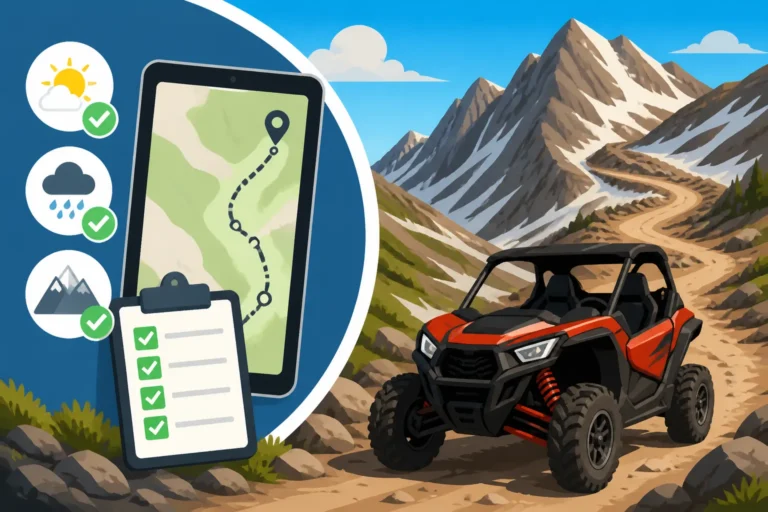
A mapping app can help you understand distances and junctions, but do not treat a colored line as proof that your machine is allowed there. onX Offroad can be useful for reviewing route options and saving maps for areas where cell service is unreliable. Pair digital navigation with official land-manager information and posted signs; a route that appears open on a screen can still be subject to a gate, temporary closure, or local restriction. Reading a Colorado Motor Vehicle Use Map
For a group ride, share the planned route and a backup option with everyone before you leave camp. Agree on a turnaround time, identify likely meeting points, and make sure each rider can navigate back if the group separates. This is especially helpful when one machine has to return early or a passenger becomes uncomfortable with the terrain.
Match the campground and route to your machine
A full-size side-by-side, a compact UTV, an ATV, and a dirt bike may have very different access options. Check the route’s width and surface, but also think about turning room, passing space, steep grades, and trailer logistics at camp. If your machine is close to a posted width limit, confirm its actual width as equipped, including any accessories that make it wider.
Consider the least experienced rider when choosing a route. A technically capable machine does not make a steep, exposed, or narrow trail comfortable for a new driver. Choose a route with room to stop safely, and do not plan a long loop that leaves no easy way back to camp if weather or fatigue becomes a problem. Colorado Trails Suited to Beginners
Campground fit matters just as much as trail fit. A site may have a tight entrance, limited parking, or a slope that makes unloading awkward. Tell the operator what you are bringing, including the tow vehicle and trailer, and ask whether the site can accommodate the full setup. If there is no safe, permitted space to unload, choose a campground with suitable parking or use an approved staging area.
Pack for the realities of a camp-based ride
Build your packing list around both camping and riding. Bring navigation that works offline, a charging plan, basic repair supplies, a first-aid kit, water, food, and layers for changing conditions. Carry any required documents and permits, and store them where they will remain dry and easy to access. If the campground has limited services, arrive with fuel and supplies rather than assuming you can find everything nearby.
Set clear expectations with your group before starting. Agree on speed, spacing, passing etiquette, and what to do if someone stops. Keep the ride within signed routes, avoid creating new tracks around mud or obstacles, and respect nearby campers and residents. A little restraint around camp—especially with engine noise and dust—helps keep a shared campground comfortable for everyone. Stay The Trail Ethics in Colorado
Finally, check conditions again close to departure. Confirm that your intended route remains open, review weather, and ask about any changes to campground access or parking. If a pass or trail is closed, use the backup plan rather than trying to work around a gate or route restriction. A flexible itinerary is often the difference between a frustrating trip and a good weekend in the mountains.
Disclaimer
This article is for general informational purposes only and does not constitute professional advice. Laws, prices and regulations vary by location and change over time. Consult a qualified professional for guidance on your specific situation.