Stay The Trail Ethics in Colorado
A Colorado trail can look wide enough to pass around a muddy rut, a downed branch, or a crowded staging area. But that small detour can widen into lasting damage, cross a closure, or upset a nearby community. This guide explains Stay The Trail ethics for ATV and UTV riders, with practical ways to protect routes, land, wildlife, and access.
What Stay The Trail Means in Colorado
Stay on the designated route, even when the shortcut looks harmless
Stay The Trail is a simple idea with real consequences: ride only on routes open to your machine, and keep your wheels on the established trail. That means not cutting switchbacks, making a new path around an obstacle, or riding across a meadow because the official route feels longer than expected. A shortcut can turn into a new track that other riders follow, multiplying the damage long after you have left.
In Colorado, a route’s appearance does not tell you whether motorized use is allowed. A worn track might be an old route, a nonmotorized trail, a private access road, or a path closed for resource protection. Use current land-manager maps, signs, and closure notices to confirm where you can ride. If a route is not clearly open to your vehicle type, do not assume that it is.
The rule matters especially on high-country trails, where short growing seasons and fragile alpine vegetation make recovery slow. A tire mark across tundra can remain visible for years. At lower elevations, leaving a road can disturb soil and vegetation, create erosion channels, or damage habitat. The responsible choice is to turn around or wait for a safe passage on the route—not to invent a new one.
Follow the map and the signs on the ground
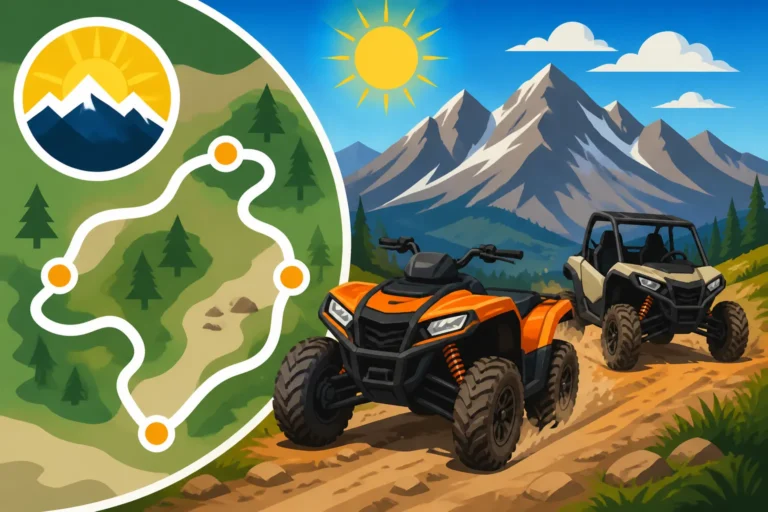
A trail map is useful only when you match it to the land you are actually riding. Route numbers, junctions, gates, and seasonal signs help identify where you are and what is permitted. Before the ride, review the relevant Motor Vehicle Use Map and any local notices. Then carry a way to check your location if a junction is confusing or the paper map is difficult to read in wind, rain, or fading light.
Digital tools can help with navigation, but they should support—not replace—official route information. Riders who use onX Offroad can save map areas for offline use before heading into places with weak cell service. That is useful around remote sections of the San Juan Mountains or Grand Mesa, where a phone may show a location but fail to load fresh map details. Check that your planned route and map layer are appropriate for your land manager and vehicle before setting out.
Treat a closure sign as a boundary, not a suggestion to search for a way around it. A gate may protect a seasonal habitat, a road under repair, or a route closed because of unsafe conditions. Do not move barriers, drive around them, or rely on another rider’s claim that “everyone goes through.” For more on checking access before a ride, see [Reading a Colorado Motor Vehicle Use Map] and [Colorado Trail Closures and Where They Are Posted].
Protecting Trails, Soil, and Water
Avoid creating ruts and widening muddy trails
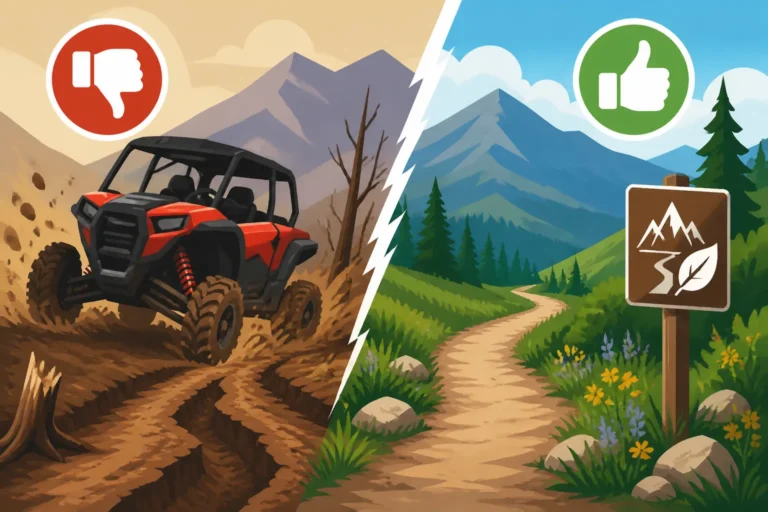
A muddy stretch can be frustrating, especially when a group has driven a long way to reach a trail. The temptation is to steer around the deepest rut, but repeated bypasses turn a narrow trail into a broad scar. If riders keep choosing the same outside edge, vegetation disappears, loose soil moves downhill, and the route becomes wider and harder to maintain.
Before you enter a muddy section, pause and assess whether your machine can cross without leaving the designated route or causing damage. If the mud is deep enough that you expect to get stuck, or the ground is soft and easily churned, turning around is often the better decision. Do not spin the tires to force your way through. Wheelspin can dig a hole quickly, leaving a deeper obstacle for the next rider and more work for trail crews.
Conditions can change significantly after rain, snowmelt, or a freeze-thaw cycle. A route that was firm in the morning may become slick and fragile later in the day. For trip planning, check the season and closure context as well as the general route description. [Colorado's Mud Season Closure Order] and [Colorado Trail Damage and Resource Protection] are useful topics to review before riding in sensitive conditions.
Keep sediment and waste out of waterways
Colorado routes may cross creeks, drainages, wetlands, or seasonal streams. These areas are especially vulnerable to erosion and contamination. Use only designated crossings, approach them slowly, and do not drive along a streambed to find a more convenient place to cross. A stream’s shallow appearance does not make its banks or surrounding vegetation durable.
Pack out everything you bring in, including food scraps, cans, tissues, and broken gear. Leaving waste beside a trailhead or tossing it into a fire ring creates a problem for the next visitor and for the people who maintain the area. If you need to stop for a break, choose a durable surface away from water and vegetation, and leave the spot as you found it.
Washing a machine in or near a creek can introduce mud, oil, and other contaminants. If a machine needs attention after a ride, handle it away from waterways and follow applicable site rules. Trail ethics are not only about where tires go; they also include protecting the water and habitat that make a riding area worth visiting.
| Trail situation | Responsible choice | Avoid |
|---|---|---|
| Muddy rut | Assess conditions and stay on the established route, or turn back | Making a parallel bypass or spinning tires |
| Closed gate | Stop and choose an open route | Driving around, moving, or opening a barrier |
| Stream crossing | Use the designated crossing at low speed | Riding in the streambed or along the bank |
| Congested trail | Wait in a safe place and communicate calmly | Forcing a pass on fragile ground |
| Unclear junction | Stop and confirm your location and route | Guessing or following an unverified track |
Sharing Trails With Other People and Wildlife
Ride at a pace that leaves room for others
Colorado trails are shared spaces. You may meet hikers, mountain bikers, horseback riders, hunters, anglers, or another motorized group around a blind corner. Slow down where visibility is limited, near trailheads and campsites, and anywhere people or animals may be close to the route. Dust and engine noise can travel far in dry mountain air, so a considerate pace helps preserve both safety and goodwill.
When you meet another user, ease off the throttle and make your presence known without startling them. Give people room to move to a safe place, and avoid revving the engine or crowding them. If the trail is narrow, wait where your machine can remain on durable ground rather than squeezing past through vegetation. A little patience is usually faster than a tense encounter or a damaged trail edge.
Large groups need extra care. Keep the group together without blocking a junction, staging area, or access road. If riders become separated, choose a safe place to regroup rather than stopping on a blind rise or narrow section. Discuss hand signals and the riding order before departure, particularly if some people are new to the area. For broader advice on considerate group behavior, see [Group Riding Etiquette in a Small Town].
Give wildlife space and respect seasonal sensitivities
Wildlife encounters are part of riding in Colorado, but they are not an invitation to approach for a closer look. Slow down, remain on the route, and give animals time and space to move away. Never chase, surround, feed, or deliberately flush wildlife. If an animal is near the trail, stop at a safe distance and wait rather than trying to pass close by.
The same care applies when you see nesting areas, young animals, or signs that wildlife is using a corridor. A quiet, brief pause may let animals move off without added stress. If the route is posted closed or subject to seasonal restrictions, follow those rules even when no wildlife is visible. Closures are often intended to reduce disturbance during a particular period, not only when visitors happen to see animals.
Livestock may also be present on open-range routes. Give cattle and horses wide room, keep speed low, and avoid sudden throttle or horn use. Do not try to herd animals off the road. If livestock are blocking the route, wait patiently or turn around if there is no safe way through. For more on this kind of encounter, see [Cattle Guards and Open Range in Colorado].
Respecting Access, Closures, and Local Communities
Confirm land boundaries and permitted routes
Colorado riding areas can cross a patchwork of public and private land. A road that looks continuous may pass from one management area to another, and permission to ride one segment does not automatically apply to the next. Check the route’s land status and access conditions before leaving the staging area. If you are unsure whether a route is open, do not use a fence opening, informal track, or old sign as proof of permission.
Pay attention to route designations for your machine. A narrow motorcycle trail may not be suitable or legal for a wider side-by-side, while a road open to full-size vehicles may have different operating expectations. Width restrictions and vehicle categories are there for a reason, including safety, resource protection, and the physical limits of the route. Review [Colorado Trails Rated for Full-Size Vehicles] and [Wide Side-by-Sides on Narrow Mountain Trails] when planning a ride with a larger machine.
Permission from a landowner is specific, not a blanket right to explore nearby property. If you have access to private land, stay within the area and conditions the owner approved. Keep gates as instructed, avoid livestock and equipment, and do not invite additional riders without permission. A good relationship with a landowner can help preserve access; a single careless visit can put it at risk.
Make trail towns better neighbors
A ride can affect a community well beyond the trail. In towns such as Ouray, Lake City, and Silverton, local street access and route rules can differ. Do not assume that a machine allowed on a particular county road may be ridden on every street, or that the same rules apply from one town to the next. Check posted signs and local restrictions before riding into town, and use the designated route rather than improvising a shortcut to a restaurant or fuel stop.
Noise and dust are common sources of friction between riders and residents. Keep speed low around homes, businesses, and pedestrians. Avoid unnecessary engine revving, especially early or late in the day, and do not accelerate hard on loose streets. If a community has set a route or operating limit, follow it even when the road is quiet. Being considerate on the last mile can matter as much as good behavior on a remote trail.
Support local access by being easy to live with: park in designated areas, avoid blocking driveways, secure machines and trailers without spilling into neighboring spaces, and carry out litter. If a town’s restrictions are unclear, ask a local visitor center or land manager rather than relying on hearsay. For location-specific access questions, see [Finding Your Colorado County's OHV Ordinance] and [Ouray and Telluride OHV Town Restrictions].
Preparing for a Responsible Ride
Plan for the route you can safely complete
Ethical riding starts before the engine does. Choose a route suited to your machine, experience, passengers, and the day’s conditions. A route that is manageable for a narrow ATV may be uncomfortable for a wide UTV, and a trail that looks short on a map can take much longer at altitude. Build in time to stop, check junctions, and turn around if weather or trail conditions change.
Check weather and seasonal access before leaving, then carry enough water, warm layers, food, and basic recovery supplies for a delay. High-country weather can shift quickly, and cell service may be unreliable. A downloaded map can help with navigation, while a paper map provides a backup if a device battery fails. Share your general plan with someone who is not on the ride, especially when traveling into a remote area.
A responsible plan includes a realistic turnaround decision. Decide in advance what conditions mean the group will stop: a closure, deep mud, an unsafe crossing, worsening weather, or a machine that cannot continue without damage. That makes it easier to turn around without feeling that the day has been wasted. The ride is not a failure just because the planned destination was out of reach.
Leave the route ready for the next rider
Before you leave a staging area, check that your machine is secure, your group has the needed equipment, and everyone understands the route. During the ride, avoid sudden stops in unsafe places, keep control of loose items, and do not leave damaged parts behind. If you discover a new hazard, note its location and report it through the appropriate land-management contact rather than attempting repairs that could affect the route.
At the end of the ride, take a moment to look back at your impact. Pick up litter, make sure gates are left as instructed, and confirm no one has left gear behind. If your tires are coated with mud or seeds, avoid carrying them into a different riding area without cleaning them; moving plant material can spread invasive species. Follow any local cleaning or inspection instructions.
The best measure of a good ride is not only whether you reached the overlook or ghost town. It is whether the route remains open, the land is no worse for your visit, and other users can enjoy it safely afterward. Following closures, staying on designated routes, and treating people and wildlife with care are small choices that add up to continued access across Colorado.
Disclaimer
This article is for general informational purposes only and does not constitute professional advice. Laws, prices and regulations vary by location and change over time. Consult a qualified professional for guidance on your specific situation.