Colorado Reciprocity With Utah and Wyoming
Colorado Reciprocity With Utah and Wyoming
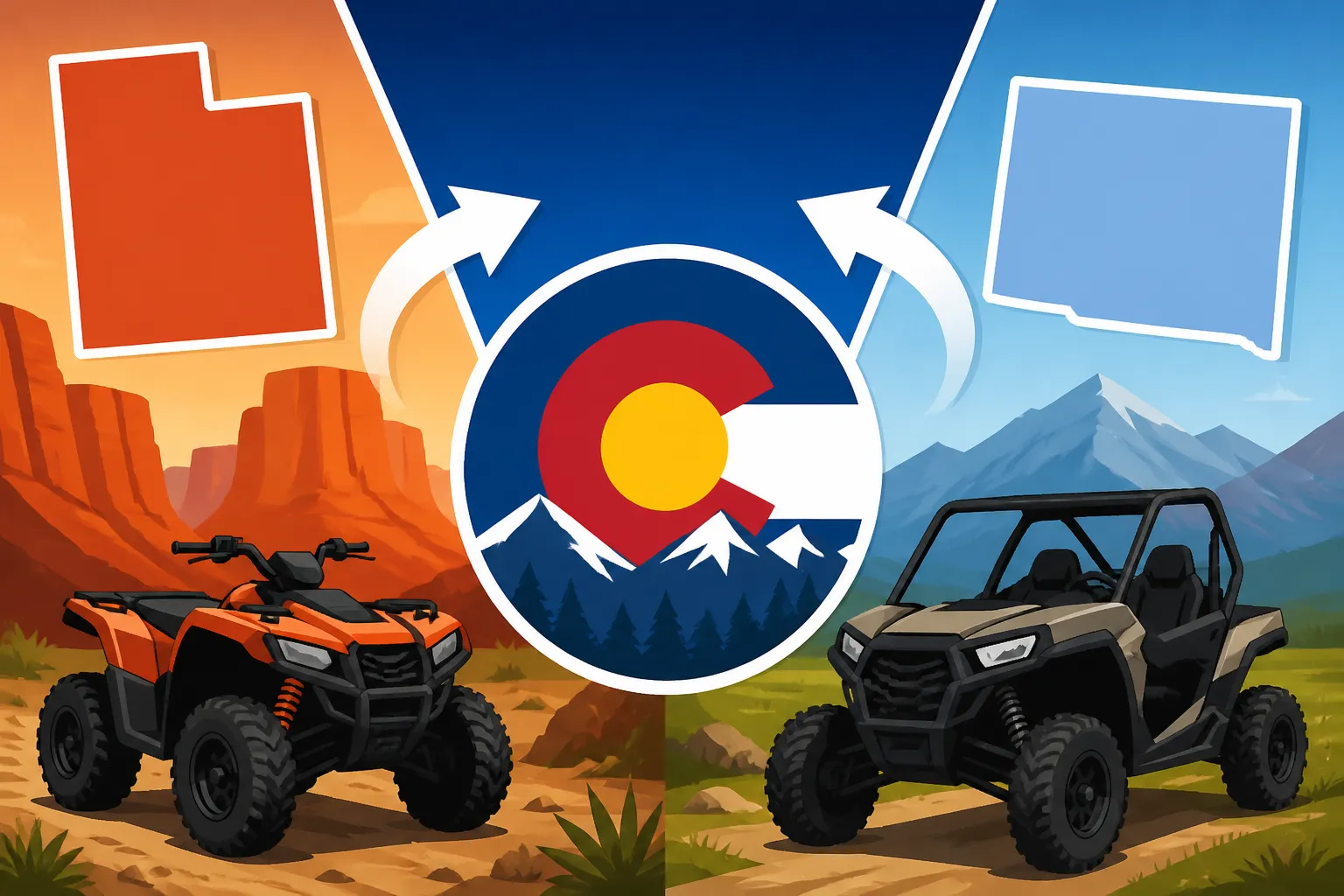
A Utah or Wyoming registration sticker can look like the paperwork you need for a Colorado ride, but it may not meet Colorado’s requirements. The key is to separate a machine’s home-state registration from the permit needed where you plan to ride. Here’s how to check the rules in both directions and avoid arriving at a trailhead with the wrong paperwork.
What reciprocity means for an ATV or UTV
Reciprocity is not a general promise that one state’s registration, decal, or permit works everywhere. It usually refers to a particular state recognizing a particular document for a particular kind of vehicle or use. Even where states recognize some out-of-state credentials, that does not automatically remove every local permit requirement.
For riders crossing between Colorado, Utah, and Wyoming, it helps to treat these as separate questions:
- Is the machine properly registered or permitted in its home state?
- Does the state where you plan to ride require an additional permit?
- Does the specific trail, road, or public-land area allow your machine?
- Are there separate equipment or road-use rules?
An ATV or UTV’s home-state paperwork answers only the first question. A Colorado permit, for example, does not make a Utah trail open to your machine, and a Utah or Wyoming sticker does not by itself establish that you can ride on Colorado public land.
Colorado’s OHV requirements are administered through Colorado Parks and Wildlife (CPW). For an out-of-state rider, the practical rule is to check whether the machine needs a Colorado nonresident OHV permit for the intended use. Do not assume that a Utah or Wyoming registration replaces it. The details, exemptions, and accepted documentation can depend on the machine and where it will be operated, so confirm the current rule before traveling.
The word “registration” can also cause confusion. A state may register an off-highway machine for identification or state compliance, while a separate permit authorizes a particular kind of use. A license plate for road travel is another category. Those documents may overlap in some situations, but they are not interchangeable by default.
| Document or status | What it generally addresses | What it does not automatically establish |
|---|---|---|
| Home-state OHV registration | Whether the machine is recorded or registered under its home-state rules | Permission to ride on every out-of-state trail |
| Colorado nonresident OHV permit | Colorado’s permit requirement for qualifying out-of-state machines | Permission to ride on a closed route or enter restricted land |
| Street-legal registration and plate | Road-use status under applicable motor-vehicle rules | Access to every OHV route or exemption from every OHV permit |
| Land-manager authorization or route designation | Whether a route or area is open to a particular use | Compliance with registration, permit, or equipment rules |
For a broader explanation of the distinction between out-of-state credentials, see Colorado OHV Permit Reciprocity With Other States and Colorado Non-Resident OHV Permit Explained. If you are deciding which Colorado credential applies to your machine, Which Colorado Permit an Out-of-State Rider Buys is also useful.
Bringing a Utah or Wyoming ATV or UTV to Colorado
If you are visiting Colorado with a machine registered in Utah or Wyoming, plan around Colorado’s rules rather than relying on the sticker from home. A Colorado nonresident permit may be required when you ride an eligible OHV on public land. The home-state registration is still worth carrying, but it should not be treated as a substitute unless CPW confirms that it satisfies the rule for your exact machine and use.
This is especially important when the trip includes several kinds of riding. A day might involve a public trail, a county route open to OHVs, a private road, or a section managed by a federal agency. The answer can change with the route and its rules. A permit does not open a closed trail, authorize travel through private property, or override a local restriction.
Confirm the machine’s category
Before buying a permit or packing paperwork, identify what the machine is legally considered. An ATV, a UTV or side-by-side, a dirt bike, a full-size buggy, and a street-legal vehicle may be treated differently under particular rules.
A machine with a license plate deserves special attention. A plate does not necessarily mean the vehicle is exempt from Colorado OHV requirements when it is used on designated OHV routes or other public riding areas. At the same time, an off-highway sticker does not grant general road privileges. Check the rules for the specific vehicle and route rather than guessing from its appearance or its home-state status.
The guidance in Out-of-State Machines on Colorado Trails, Colorado Rules for Out-of-State Street-Legal Machines, and Colorado Permits for Plated Jeeps can help you sort out those distinctions. If your machine is registered as street legal, confirm the route’s road-use rules as well as any OHV permit requirement.
Check where you will ride
“Public land” is not one uniform riding area. A route may be managed by a federal agency, a state, a county, or a local government, and each can have access rules. The fact that a road is physically passable does not mean it is open to OHVs.
Before leaving home:
- Identify the exact trails and roads you hope to ride.
- Check whether each route is open to your vehicle type and width.
- Review seasonal closures and local restrictions.
- Confirm whether the land manager requires anything beyond the Colorado permit.
- Check whether a route crosses private land or connects to a road with separate rules.
A permit is not a route map or access pass for every public road. For more on the distinction between authorization and access, see Colorado Permit Rules on Public Land.
Carry documents that answer likely questions
Bring the machine’s home-state registration or ownership paperwork, the Colorado permit or confirmation of purchase, and any relevant road-legal documents. Keep them accessible, and follow the instructions for displaying the Colorado permit. If you are using a rental, borrowed vehicle, or a machine registered to someone else, make sure you know whose paperwork must be carried and what the operator needs to show.
Photographs of documents can be helpful as backups, but do not assume a phone image will satisfy every check. Carry the required physical documents if the rules or permit instructions call for them.
If your trip involves several machines, check the requirements for each one. Do not assume that buying or displaying one permit covers an entire family or group. Colorado OHV Permits for Out-of-State Riders explains the visitor side of the process, while Colorado Permit Rules for a Borrowed Machine can help with a machine you do not own.
Taking a Colorado machine to Utah or Wyoming
A Colorado registration or permit is not a universal pass for riding in Utah or Wyoming. Before taking a Colorado machine across the state line, check the destination state’s current OHV requirements and the rules for each riding area. The question is not simply whether the Colorado sticker is visible; it is whether the destination recognizes that specific credential for that machine and use.
Do not assume that Colorado’s nonresident permit rules work in reverse. A Colorado permit is issued for Colorado’s requirements. Utah or Wyoming may have their own registration, permit, equipment, and access rules. Some routes may also be subject to federal land-manager requirements or seasonal closures, regardless of the machine’s paperwork.
Check the destination state’s rules for your machine
Use the official OHV information for the state you are visiting and look for rules that apply to a nonresident vehicle. Check whether the state distinguishes between:
- An ATV or UTV registered in another state
- A vehicle with a street-legal plate
- A machine that is not registered in its home state
- A vehicle used on public land versus private land
- A machine operated on a designated route versus an open riding area
If the wording is unclear, ask the relevant state agency how it applies to your vehicle’s exact registration and intended use. Be ready to provide the state of registration, machine type, and the kind of route you plan to ride. A general statement such as “Colorado has reciprocity” is not enough to establish that your particular machine is covered.
Verify route and land-manager restrictions
A state permit does not guarantee that a chosen trail is open. Utah and Wyoming, like Colorado, have routes with access restrictions, closures, or vehicle-size limits. The route may be on state, federal, county, or private land, and its rules may differ from the statewide permit requirement.
Check route maps and closure notices close to your departure. Confirm the permitted vehicle width, whether the route allows your type of machine, and whether it connects to a road where different rules apply. If you are riding a street-legal UTV, verify both the vehicle’s road status and the route’s access rules; one does not necessarily settle the other.
Keep Colorado documents, but do not rely on them alone
Bring your Colorado registration or permit documentation and ownership or rental paperwork. These can help establish where the machine is registered and who is authorized to use it. Still, carry or obtain any destination-state credential the official rules require.
If the destination state recognizes a Colorado document for a specific purpose, keep evidence of that recognition with your trip information. If it does not, or if you cannot confirm that it does, arrange the required local credential before riding. This is a safer approach than trying to resolve a paperwork question at a trailhead.
A practical pre-trip check for cross-border riding
The simplest way to avoid a reciprocity mistake is to make a short checklist for each state and each machine. Do not use one answer for an entire group if members are bringing different vehicle types or registrations.
- Write down the machine details. Note whether it is an ATV, UTV, dirt bike, or street-legal vehicle, and record its home-state registration status.
- List the planned routes. Include trail systems, roads, staging areas, and any route that crosses into another jurisdiction.
- Check the destination state’s credential rule. Look for specific information about nonresidents and out-of-state registrations.
- Check the route’s access rule. Confirm that your machine type and width are allowed and that the route is open.
- Ask the responsible agency if the rule is ambiguous. Provide the machine type, registration state, and intended use rather than asking only whether “reciprocity” exists.
- Get permits before riding. Follow the official purchase and display instructions for each required credential.
- Pack proof. Carry relevant registration, permit, ownership, rental, and road-use documents.
- Recheck before departure. Closures and local access rules can change, so confirm the route and its status near the trip date.
A comparison by trip direction can help keep the tasks straight:
| Trip | What to verify first | Common mistake to avoid |
|---|---|---|
| Utah or Wyoming machine visiting Colorado | Whether Colorado requires a nonresident OHV permit for the planned use | Treating the home-state registration as a Colorado permit |
| Colorado machine visiting Utah | Whether Utah accepts the Colorado document for that machine and use, or requires its own credential | Assuming Colorado’s permit automatically applies in Utah |
| Colorado machine visiting Wyoming | Whether Wyoming’s current rules require a credential for the machine and route | Assuming the same rule applies in both neighboring states |
| Street-legal machine crossing any state line | Road status, OHV permit rules, route access, and local restrictions | Treating a plate as permission to ride every OHV trail |
If the trip includes both states, handle Utah and Wyoming as separate destinations. Rules that happen to be similar are still not necessarily identical. Keep your notes and confirmations with the trip documents, especially if you are transporting a group’s machines or riding somewhere remote.
Frequently Asked Questions
Does a Utah or Wyoming OHV sticker replace a Colorado permit?
Do not assume it does. Colorado’s requirements apply to riding in Colorado, and an out-of-state registration or sticker may not satisfy the Colorado permit requirement. Confirm the rule for your machine and intended use with CPW before riding.
Does a Colorado OHV permit let me ride in Utah or Wyoming?
Not automatically. A Colorado permit addresses Colorado’s requirements. Check the destination state’s current rules and the access requirements for the specific trail or riding area.
Is a street-legal plate enough to avoid an OHV permit?
Not necessarily. Road-legal registration and OHV permit rules are separate questions, and rules can depend on the route and vehicle. Check both before taking a plated machine onto an OHV trail.
Do I need to check reciprocity if I only ride on private land?
Private-land use may be treated differently from public-land riding, but do not assume that every private route is exempt from all rules. Confirm who owns or manages the property, get permission where needed, and check any applicable state requirements.
Disclaimer
This article is for general informational purposes only and does not constitute professional advice. Laws, prices and regulations vary by location and change over time. Consult a qualified professional for guidance on your specific situation.