Out-of-State Machines on Colorado Trails
Out-of-State Machines on Colorado Trails
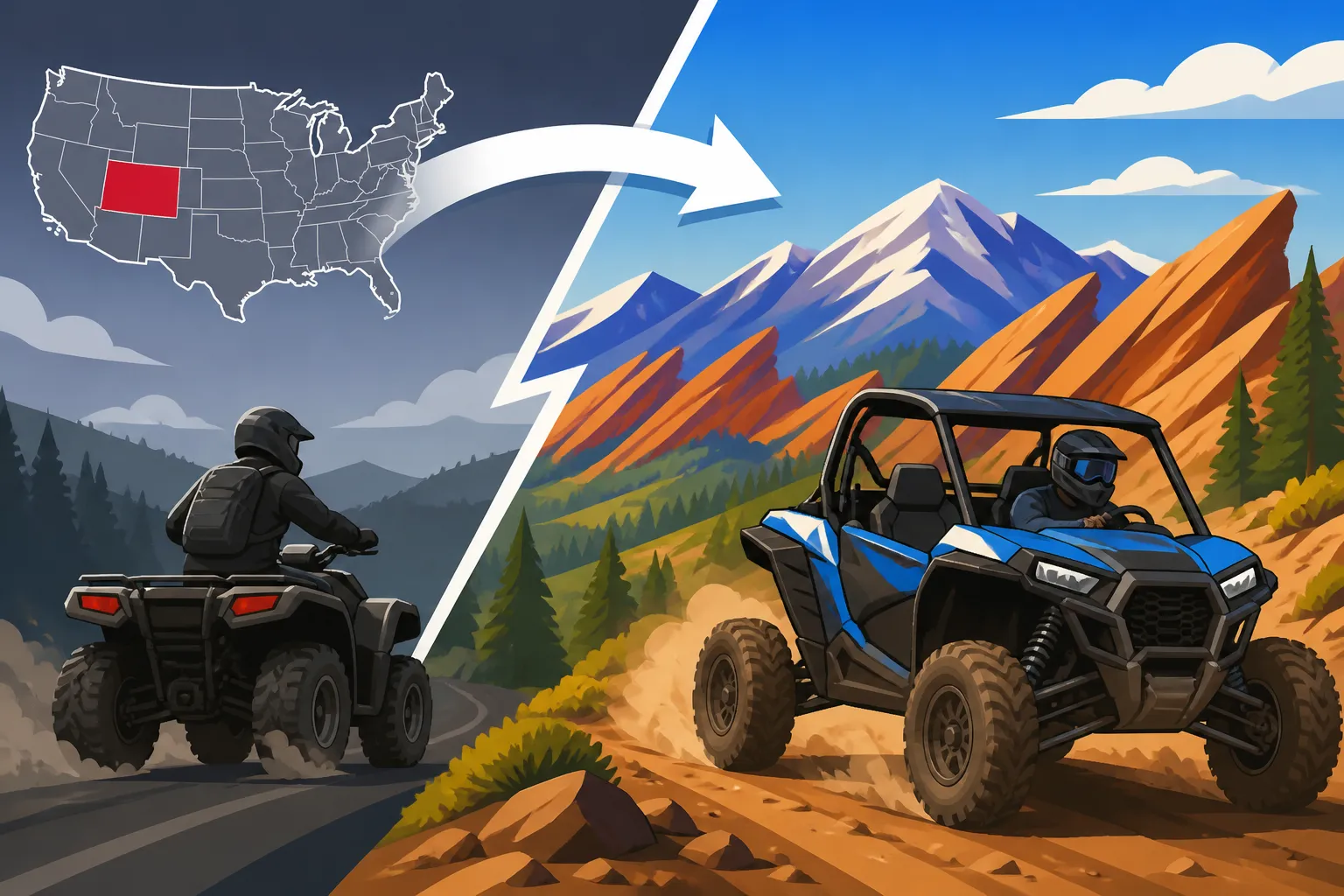
Bringing an ATV or UTV from another state does not automatically give it permission to ride Colorado trails. The key questions are whether it needs a Colorado OHV permit, what its home-state plate or registration covers, and whether the route allows that kind of machine. Here’s how to sort out the paperwork and check the ride before you unload.
Can an out-of-state ATV or UTV ride Colorado trails?
Usually, yes, provided the machine has the required Colorado permit for public-land OHV use and the trail is open to it. A registration, OHV sticker, or plate from another state does not generally replace Colorado’s permit requirement when a nonresident operates an OHV on Colorado public lands or trails.
That can catch visitors off guard. A machine may be fully registered at home and legal to ride on trails in its home state, but that does not mean its paperwork travels with it as permission to ride in Colorado. Colorado has its own permit system, and a permit issued by another state is not automatically accepted in its place. For details on that distinction, see Colorado OHV Permit Reciprocity With Other States.
A separate question is whether the trail itself is suitable and open to your machine. Colorado routes may have limits based on vehicle width, type, or use. Seasonal gates, temporary closures, local ordinances, and land-manager rules can also affect access. A permit does not make a closed route open, turn a narrow trail into a route for a wide side-by-side, or grant permission to ride off the designated route.
It helps to keep three separate checks in mind:
- Colorado permit: Does the machine need Colorado’s OHV permit for the public-land riding you plan to do?
- Machine documentation: Are its home-state registration, ownership records, and any plate current and appropriate for its use?
- Route access: Is that specific route open to your machine, and are there local rules or seasonal restrictions?
These checks solve different problems. A valid permit does not establish ownership, and a title or plate does not by itself establish permission to ride a Colorado OHV trail. Likewise, a route being open to OHVs does not necessarily mean every size or type of vehicle can use it.
If the machine will be used only on private land, the public-land permit question may be different. But private land use still depends on the landowner’s permission and any applicable rules; it is not a blanket exemption for riding from a private property onto a public road or trail. For that distinction, see Colorado Permit Rules on Public Land and Do You Need a Permit on Private Colorado Land?.
Which Colorado permit or registration applies?
For a nonresident bringing an ATV or UTV to ride public trails, the practical starting point is Colorado’s nonresident OHV permit. Colorado’s system generally distinguishes between resident machines that are registered in Colorado and nonresident machines that use the applicable permit. A machine’s home-state registration does not turn its owner into a Colorado resident or replace the Colorado requirement for a nonresident riding on public land.
The rules can be easy to mix up because people use “registration,” “permit,” “sticker,” and “plate” as if they mean the same thing. They do not. In broad terms:
| Document or status | What it generally addresses | What it does not automatically do |
|---|---|---|
| Home-state registration | The machine’s registration status under its home state’s rules | Replace a Colorado OHV permit for Colorado public-land riding |
| Home-state plate | Road-use status under applicable laws | Make every Colorado trail or road open to the machine |
| Colorado nonresident OHV permit | Colorado OHV access requirements for qualifying nonresident use | Register the machine in its home state or legalize road use |
| Title or bill of sale | Ownership documentation | Serve as a riding permit |
| Trail or road authorization | Whether a particular route is open to a particular vehicle | Replace required machine paperwork |
Before travel, check the current Colorado Parks and Wildlife information for the permit that applies to your machine and how it must be obtained and displayed. Requirements and procedures can change, so use current official instructions rather than relying on an old sticker, a friend’s experience, or an online forum. Colorado Non-Resident OHV Permit Explained provides more background on the nonresident permit, while Which Colorado Permit an Out-of-State Rider Buys focuses on choosing the right one.
The permit is associated with the machine, not simply with the person who happens to be riding it. If you are bringing more than one ATV or UTV, check what is required for each machine rather than assuming one permit covers a whole trailer or riding group. The same applies if you borrow a machine, switch vehicles during a trip, or arrive with a spare unit. See Colorado Permits for a Second Machine and Permits for a Borrowed Machine if those situations apply.
Do not assume a permit bought for one state, one vehicle, or one kind of use will cover another. If a riding group has a mix of local and out-of-state machines, identify the status of each one before leaving home. A Colorado resident’s registration does not cover a visitor’s ATV, and a visitor’s permit does not automatically cover every machine in the party.
If you are unsure whether your specific vehicle falls under the OHV rules, describe it accurately when checking with the appropriate agency. A recreational side-by-side, a street-legal vehicle, a utility machine used for work, and a machine transported on a trailer may raise different questions. Don’t rely only on the name used in a sales ad or on what the manufacturer calls it. Start with Colorado Permits for Plated Street-Legal Vehicles if your machine has a road plate.
Do out-of-state plates make a machine street legal in Colorado?
A plate issued by another state can matter for road use, but it does not automatically grant OHV trail access or remove Colorado permit requirements. Road legality and trail permission are separate issues.
A machine that is street legal in its home state may be allowed on some Colorado roads under applicable rules, but that does not mean it can ride every public trail. Some routes are limited to specified vehicle types or widths; others may not be open to motorized use at all. Local road ordinances can also differ from the rules for nearby trails. Check Colorado Rules for Out-of-State Street-Legal Machines for the road-use question and Why an Out-of-State Plate Does Not Help in Colorado for the limits of relying on a plate.
The same caution applies to a UTV that has been modified with equipment intended for road use. Lights, mirrors, a windshield, a horn, or a home-state plate may be relevant to vehicle standards, but they do not answer every question about whether it can use a particular Colorado road or trail. A county road, town street, forest road, and designated OHV route may each have different rules. Confirm the specific route rather than treating “street legal” as universal access.
For a plated vehicle, consider the trip in two parts:
- On roads: Check the vehicle’s registration and road-use requirements, along with any county, town, or road-specific restrictions.
- On OHV routes or trails: Check Colorado’s permit requirements and the land manager’s vehicle-access rules, even if the machine carries a plate.
A machine can be legal for one part of a trip and not the next. For example, a route may include an open road section followed by a trail with a width limit or a separate permit requirement. A plate does not waive a posted closure, local restriction, or equipment rule.
If your trip includes both roads and trails, plan the transition between them. Know where the designated route begins and ends, whether the connecting road allows your machine, and whether you need to leave the road to reach the trailhead. Do not assume that a route is open just because another vehicle is using it, or because a mapping app displays it as a line.
What to check before leaving home
A little preparation can prevent an expensive detour or a ride-ending misunderstanding. The goal is to verify the machine’s paperwork, the Colorado permit, and the route using current information.
- Identify the machine and its status. Note the vehicle type, width, plate status, and home-state registration status. If it has been modified, check whether the changes affect its road-use classification or trail access.
- Confirm the Colorado permit requirement. Check current official instructions for nonresident OHV use. Do not assume a home-state sticker, plate, or permit is reciprocal.
- Check the permit instructions. Confirm how to obtain it, what information is needed, and where and how it must be displayed. Follow the current directions for that permit rather than copying another rider’s placement.
- Verify the route. Check the responsible land manager’s route information and any applicable motor vehicle use map, closure notice, or local ordinance. Confirm that the route is open on the day you plan to ride and allows your vehicle type and width.
- Keep ownership and registration documents available. Carry the paperwork you may need to establish the machine’s status or respond to a question about it. A bill of sale can be useful when ownership records are in transition, but it is not a substitute for an OHV permit.
- Check whether your plan crosses jurisdictions. A ride that passes through a town, county, or more than one public-land area may involve different road or access rules. Check each part instead of assuming the rules at the trailhead apply everywhere.
- Recheck close to the ride. Seasonal openings, snow, mud, fire restrictions, maintenance, and temporary closures can change access. An old map or past trip report is not proof that a route is open now.
Colorado’s high-country routes make this last check especially important. A trail can be snowed in, closed for resource protection, or unsuitable after weather even if it is normally open during the riding season. For route planning, Reading a Colorado Motor Vehicle Use Map and Colorado Trail Closures and Where They Are Posted can help you understand what to look for. A map shows route information, but it may not capture every last-minute closure, so check current notices as well.
Paperwork should be accessible during the ride, not buried under luggage at the bottom of a trailer. Keep the permit displayed as directed and carry any required supporting documents in a secure place. If you are unsure what to show during a stop, Do You Carry Paperwork on the Trail? covers the practical question of carrying documents.
If you haul the machine rather than riding it from lodging, remember that trail access begins when the vehicle is unloaded and operated. Merely transporting an ATV or UTV on a trailer is not the same as riding it on a trail, but an unplanned ride from a campsite or parking area can still trigger the applicable rules. See Colorado Permits for a Machine Left on a Trailer if you are trying to distinguish transport from operation.
Common situations for visitors
Your home state issued an OHV sticker
Treat that sticker as evidence of compliance with your home state’s system, not as a Colorado permit unless current Colorado rules explicitly say otherwise. Colorado and your home state may have different permit programs, and they do not necessarily recognize each other’s documents. Check Colorado OHV Permit Reciprocity With Other States before relying on a sticker from elsewhere.
Your UTV has a license plate
A plate is not a general-purpose trail pass. It may address road registration, but you still need to check Colorado’s OHV permit rules and the access rules for the trail you plan to use. If your UTV will alternate between roads and designated trails, check both sets of rules. The related topic Do Licensed Vehicles Need a Colorado OHV Permit? addresses this common point of confusion.
You bought the machine recently
A recent purchase can leave the registration, title, and ownership records in transition. Bring the documents that show your connection to the machine, and check what Colorado requires for OHV access separately. A purchase agreement or bill of sale can help document a sale, but it does not replace the required Colorado permit. For paperwork after a purchase, see Buying a Used ATV in Colorado: The Paperwork and Proof of Ownership for a Colorado OHV.
You are visiting from another country
Do not assume that foreign registration or a permit from a neighboring country automatically satisfies Colorado requirements. Check the Colorado permit rules for visitors and confirm that your documents support the machine’s status. Colorado Rules for Canadian Visitors is a useful starting point for that situation.
You plan to ride only on private property
The rules for riding on private land can differ from public-land permit requirements, but property permission matters. A private parcel may also connect to a public road or trail where separate requirements apply. Confirm where the boundaries are and what permission covers; permission to ride one property does not authorize crossing neighboring land. If you will enter a public route at any point, check the permit and access rules for that portion of the trip.
You are lending your machine to someone else
Make sure the person riding understands which paperwork belongs to the machine, what routes are allowed, and whether the permit requirement has been met. Do not assume that your own permit or the other rider’s home-state paperwork is enough. For this case, see Letting a Visitor Ride Your Machine.
The simplest approach is to treat Colorado access as its own checklist: verify the permit, verify the machine’s road or registration status where relevant, and verify each route. That remains the safer assumption whether you are bringing a trail ATV, a side-by-side with a plate, or several machines for a group trip.
Frequently Asked Questions
Does an out-of-state OHV permit work on Colorado trails?
Do not assume it does. A permit or registration from another state does not generally replace Colorado’s applicable nonresident OHV permit. Check current Colorado requirements before riding.
Does a plate from another state exempt my ATV or UTV from Colorado’s OHV permit?
Not automatically. A plate may relate to road use, but it does not necessarily satisfy Colorado’s permit requirements for public OHV trails. Check the permit rules and the route’s access rules separately.
Is a Colorado OHV permit permission to ride any trail?
No. It addresses a permit requirement, not every access restriction. Trails may have vehicle-type or width limits, seasonal closures, local rules, or other restrictions.
Do I need a Colorado OHV permit if I only transport my machine on a trailer?
Transporting a machine is different from operating it on a trail. Check the current rules for your situation, and make sure the machine has the required permit before riding it on public land.
What should I check if my trip includes both roads and trails?
Check the machine’s road status and any local road restrictions, then separately verify the Colorado OHV permit and trail access requirements. A plate or permit does not automatically cover both kinds of use.
Disclaimer
This article is for general informational purposes only and does not constitute professional advice. Laws, prices and regulations vary by location and change over time. Consult a qualified professional for guidance on your specific situation.