Overnight Trailer Parking in a Colorado Trail Town
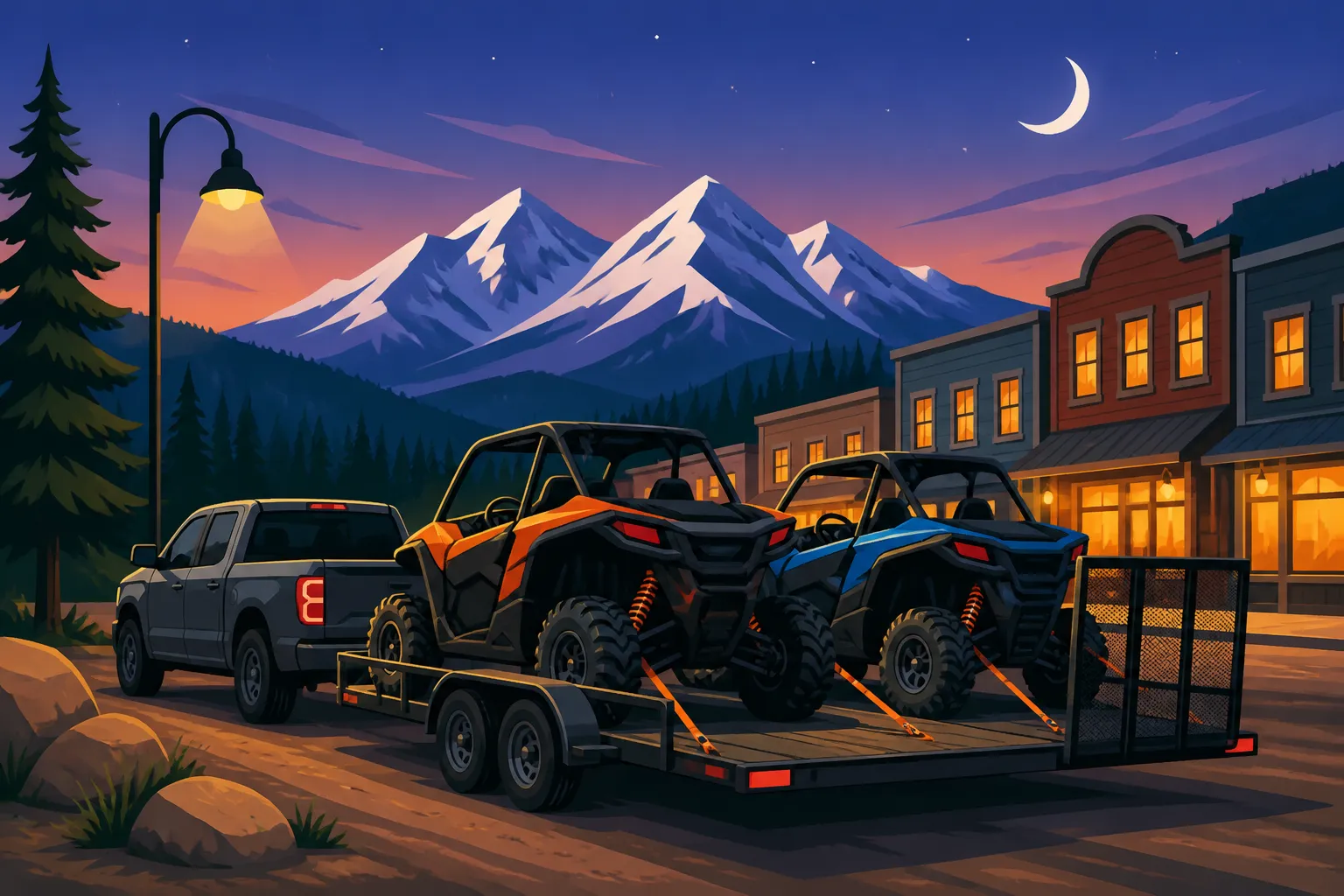
A long trailer can turn a Colorado trail-town overnight into a parking puzzle: the motel lot may be tight, the street may not allow overnight parking, and a trailhead may not be a place to leave a rig unattended. This guide explains how to plan a legal, practical overnight stop for your truck, trailer, and ATV or UTV—and what to confirm before you arrive.
Start with the kind of parking you actually need
Separate overnight parking from trailhead staging
“Parking for a trailer” can mean several different things: a place to leave the trailer overnight, a spot to unload and ride for the day, or a base where you can park the truck and trailer while staying nearby. Those needs do not always overlap. A trailhead may have room for vehicles but not for a long trailer, and a lodging property may offer guest parking without space for a tow vehicle and trailer together.
Before choosing a town, write down what must fit: the truck, trailer, ATV or UTV, and any space needed to turn around or unload. A setup that works in a wide gravel lot near Gunnison may be awkward in a compact downtown lot in Ouray or Silverton. The trailer’s overall length matters, but so do its width, turning radius, and whether you can back it safely without blocking traffic.
If you want to stage near the Alpine Loop, research the specific access point and town rather than assuming that a general town parking area can serve as a trailhead lot. Where to Stage a Trailer for the Alpine Loop is a useful companion when you are deciding where to begin that ride. For broader trip planning, Colorado Trailhead Parking and Staging can help you think through the difference between parking, unloading, and staging.
Confirm permission before relying on a spot
A visible, empty lot is not automatically available for overnight trailer parking. It may be private property, reserved for customers, subject to a time limit, or closed after business hours. A roadside pullout can be tempting when you arrive late, but it may not be safe, permitted, or suitable for leaving a valuable trailer unattended. Posted signs and instructions from the property owner or land manager should take precedence over assumptions based on what other vehicles are doing.
Ask the person responsible for the property a specific question: “May I leave my truck and this trailer here overnight, and where should I park it?” Include the trailer’s approximate length and whether the machine will remain loaded. If you are booking lodging, ask whether the answer applies to the exact lot you plan to use—not just guest parking in general.
Get the details before making the reservation. A quick call or message can prevent the frustrating situation of arriving after dark and discovering that the only available space is too short, already full, or not authorized for overnight use. If a town has multiple lots, ask for the location and any arrival or departure instructions rather than relying on a vague “there should be room.”
Compare parking choices before you book
Ask lodging providers about the whole rig
Hotels, cabins, campgrounds, and vacation rentals may handle trailer parking very differently. Some can direct guests to a larger overflow area; others have narrow entrances, limited maneuvering room, or no space for a separate trailer. Even a property with a large lot may restrict where trailers can be left, so ask about permission and placement instead of judging by a map or a photo.
When you call, describe the complete setup and ask whether the truck and trailer can remain connected overnight. If they cannot, confirm whether there is room to unhitch and where the truck and trailer may be parked separately. Also ask whether you need to arrive during a particular window, whether a reservation is required for the parking space, and whether the area is suitable for a loaded trailer.
| Parking option | What it may work well for | What to confirm first |
|---|---|---|
| Lodging property | Keeping your rig close to your overnight stay | Trailer dimensions, guest permission, maneuvering room, and any parking restrictions |
| Campground or RV park | Staying with a larger vehicle or trailer | Whether your equipment fits the site and whether trailers may remain loaded |
| Designated public lot | A short-term stop or a town-approved parking arrangement | Overnight rules, posted limits, location, and whether trailers are permitted |
| Trailhead or staging area | Beginning a ride when the site allows vehicle and trailer parking | Space, access, overnight permission, closures, and whether unattended trailers are allowed |
| Private lot by arrangement | A possible option when the owner explicitly agrees | Written or clearly documented permission, exact location, timing, and any conditions |
Do not treat “RV friendly” as a promise that a property can accommodate every ATV trailer. RV sites are laid out for particular vehicle lengths and access patterns, and a trailer that fits a campsite may still be difficult to park alongside a separate truck. Share the trailer’s dimensions when you ask, especially if it is an enclosed trailer or has a long tongue.
For trip bases, compare the practical parking arrangement along with the room or campsite itself. Guides to Lodging in Lake City for Riders and Lodging in Ouray for OHV Trips can help you think about where you might stay, while Colorado Trail Towns Worth a Base Camp offers a wider starting point for choosing a town.
Treat public lots and street parking as rules to verify
A town’s parking rules can differ from those at a nearby campground or trailhead. Signs may specify permitted hours, vehicle types, or restrictions on overnight stays. Some lots are intended for a particular use, and a large paved area is not necessarily a designated place for trailers. Read posted notices when you arrive, and contact the relevant town office or property manager if the rules are unclear.
Street parking deserves extra caution. A trailer can take up more curb space than a passenger vehicle, interfere with visibility, or make it harder for residents and service vehicles to pass. Even if the truck fits, the combination may not. Avoid blocking driveways, business access, sidewalks, or emergency routes, and never assume that a quiet street is available for overnight storage.
This matters especially in small mountain towns, where narrow roads and limited parking can be part of everyday life. A spot that appears open during a midweek afternoon may be busy by evening or subject to local restrictions. Confirm the arrangement before you unload or leave the rig, and be ready with a backup plan if the first option is unavailable.
Plan for access, security, and changing conditions
Check the route and parking layout in advance
A parking space is only useful if your rig can reach it. Before towing into town, look at the route for tight turns, steep grades, narrow streets, low-clearance structures, and places where turning around may be difficult. A route that looks short on a map can be stressful with a long trailer, particularly after a full day of riding or when traffic is heavy.
Mapping tools can help with general orientation, but they do not replace signs, local instructions, or a careful look at the actual route. onX Offroad can help you review riding routes and nearby access points as you plan a trip, but do not assume a mapped trail or parking symbol confirms that overnight trailer parking is allowed. Verify the parking arrangement with the town, property owner, campground, or land manager responsible for that location.
When comparing options, consider whether you can pull through or must back into a space. Backing a trailer on a busy street or into a tight lot can create avoidable risk. If you are traveling with another adult, decide in advance who will guide the driver and agree on clear signals. If the entrance feels too narrow when you arrive, pause and ask for help rather than trying to force a difficult turn.
Protect the trailer and prepare for mountain weather
An overnight stop does not mean your equipment is automatically secure. Choose an authorized location with appropriate lighting and a reasonable amount of visibility, and secure the trailer using the equipment you normally rely on. Lock the coupler and any storage compartments, remove valuables from view, and keep registration or ownership paperwork accessible without leaving sensitive documents exposed.
Colorado weather and terrain can also affect the plan. Rain, snow, mud, or a steep approach can make a marginal parking space harder to use. A trailer that is easy to maneuver on dry pavement may be more difficult on a sloped or loose surface. Avoid parking where runoff could collect, and take care not to block a drainage route or leave a vehicle in a position where it could roll.
Have a backup location identified before you reach town. If the first lot is full, closed, or not authorized for overnight use, you should know whom to call or which confirmed alternative to try. onX Offroad can be useful for understanding your riding area and organizing route notes, while direct confirmation with the parking provider is still the step that establishes whether the trailer can stay there.
Build a low-stress overnight plan
Use a simple confirmation checklist
A good parking plan is specific enough that you can act on it after a long drive. Keep the provider’s contact details, the exact location, and any parking instructions with your trip information. If you are arriving late, confirm that the space will still be accessible at that time and ask whether a gate, check-in procedure, or designated arrival route applies.
Before leaving home, confirm these details:
- Permission: Is overnight trailer parking explicitly allowed at this location?
- Fit: Can the truck and trailer fit together, or must they be separated?
- Dimensions: Has the provider confirmed the approximate length and width of your setup?
- Access: Can you enter, turn, and park without blocking traffic or other guests?
- Timing: Are there arrival, departure, or check-in instructions?
- Backup: What is your next option if the space is full or unavailable?
- Ride plan: Is your planned trail access open and appropriate for your vehicle?
Planning the ride itself is a separate task from confirming the parking. Check route conditions, access rules, and seasonal closures before setting out; a trail shown on a map is not necessarily open or suitable on the day you arrive. Resources such as Where to Ride an OHV in Colorado and Reading a Colorado Motor Vehicle Use Map can help you prepare, while current local notices should guide your final decision.
Make arrival and departure easier on everyone
When you reach town, follow the confirmed directions and park only in the approved area. If you need to unload, do it where you have permission and enough room to work safely. Keep ramps, gear, and equipment out of driveways and travel lanes, and avoid running a machine in a way that creates unnecessary noise near homes or lodging.
In the morning, secure loose gear before driving away and check that the trailer lights, hitch, and safety connections are ready for the road. If you are leaving a shared lot, take a moment to make sure you have not blocked another guest or left debris behind. A considerate arrival and departure help preserve the goodwill that makes overnight trailer arrangements possible in small Colorado communities.
Finally, keep the plan flexible. A trail-town visit may involve a full parking lot, a weather change, or a route adjustment. Having confirmed permission, a suitable backup, and a realistic trail plan makes those changes much easier to handle than trying to solve everything from the driver’s seat with a trailer behind you.
Disclaimer
This article is for general informational purposes only and does not constitute professional advice. Laws, prices and regulations vary by location and change over time. Consult a qualified professional for guidance on your specific situation.