Spark Arrester Rules on Colorado Public Land
There's nothing quite like the feeling of loading up your ATV or UTV, knowing you're about to hit some of Colorado's incredible trails. But before you even start the engine, a little voice in the back of your head might be wondering: "Is my machine truly ready for public land, especially when it comes to those tricky spark arrester rules?" It's a common worry, and for good reason – the stakes are high, especially with fire danger a constant concern here. This guide is all about demystifying those regulations, helping you understand why spark arresters are so important, what to look for, and how to ensure your off-highway vehicle (OHV) is fully compliant before you ever leave the driveway.
Why Spark Arresters Are Absolutely Non-Negotiable on Colorado Public Land
Let's be real, nobody enjoys having more rules to follow, especially when all you want to do is get out and ride. But when it comes to spark arresters on your ATV, UTV, or dirt bike here in Colorado, this isn't just about ticking a box; it's about protecting our breathtaking landscapes and the communities that call them home. The dry climate, especially during the summer and fall, makes our forests incredibly susceptible to wildfires. A single spark from an improperly equipped exhaust system can devastate thousands of acres, destroy homes, and even claim lives. That's why land management agencies like the U.S. Forest Service (USFS) and the Bureau of Land Management (BLM) are so stringent about this.
The Real Threat of Wildfires from OHVs
Imagine you're deep on a beautiful trail, maybe somewhere in the San Juans or out on the Grand Mesa, and your machine backfires or a tiny piece of glowing carbon escapes your exhaust. If it lands on dry grass, pine needles, or fallen leaves, it can ignite a fire in mere seconds. This isn't just a hypothetical scenario; it's happened many times. Our OHVs, with their hot engines and exhaust systems, carry a unique responsibility to operate safely in these fragile environments. It's why there's such a focus on specific equipment designed to mitigate these risks.
The rules aren't designed to make your life harder; they're in place because we all love these trails and want to preserve them for future generations. Losing access to riding areas due to fire closures is a devastating consequence that affects everyone. Ensuring your spark arrester is up to snuff is a small but critical step we can all take to be responsible stewards of Colorado's natural beauty. It's a key part of what rangers check for during [Colorado Ranger Checks at a Trailhead].
Legal Requirements and What's at Stake
Beyond the moral imperative, there are very real legal consequences for non-compliance. Operating an OHV on Colorado public land – whether it's a national forest, BLM land, or a state park – without a proper spark arrester is a violation of federal and state regulations. This isn't a minor infraction; you could face significant fines, and in severe cases, even be held liable for fire suppression costs if your machine is found to be the cause of a wildfire. Think about how many times you've seen fire danger ratings posted at trailheads or campgrounds; those aren't just suggestions.
It's a serious matter, and enforcement officers, including Forest Rangers, BLM officers, and Colorado Parks and Wildlife (CPW) staff, are trained to look for these details. They're out there not to ruin your fun, but to ensure everyone is operating safely and legally. When you understand the magnitude of what's at stake – both environmental and legal – the importance of a compliant spark arrester becomes crystal clear. It's similar to the concerns around [Muffler Noise Limits in Colorado], where environmental impact and public peace are paramount.
What Exactly Qualifies as a Compliant Spark Arrester?
So, you know why you need one, but what does a spark arrester actually look like, and how do you know if yours meets the standards? It's not just any screen or baffle you can stick in your exhaust. A truly compliant spark arrester for OHVs operating on Colorado public land must meet specific federal criteria, typically set forth by the U.S. Forest Service. This usually means it's a device that traps or destroys carbon particles (sparks) from the exhaust stream before they can exit into the atmosphere.
The USFS-Approved Stamp
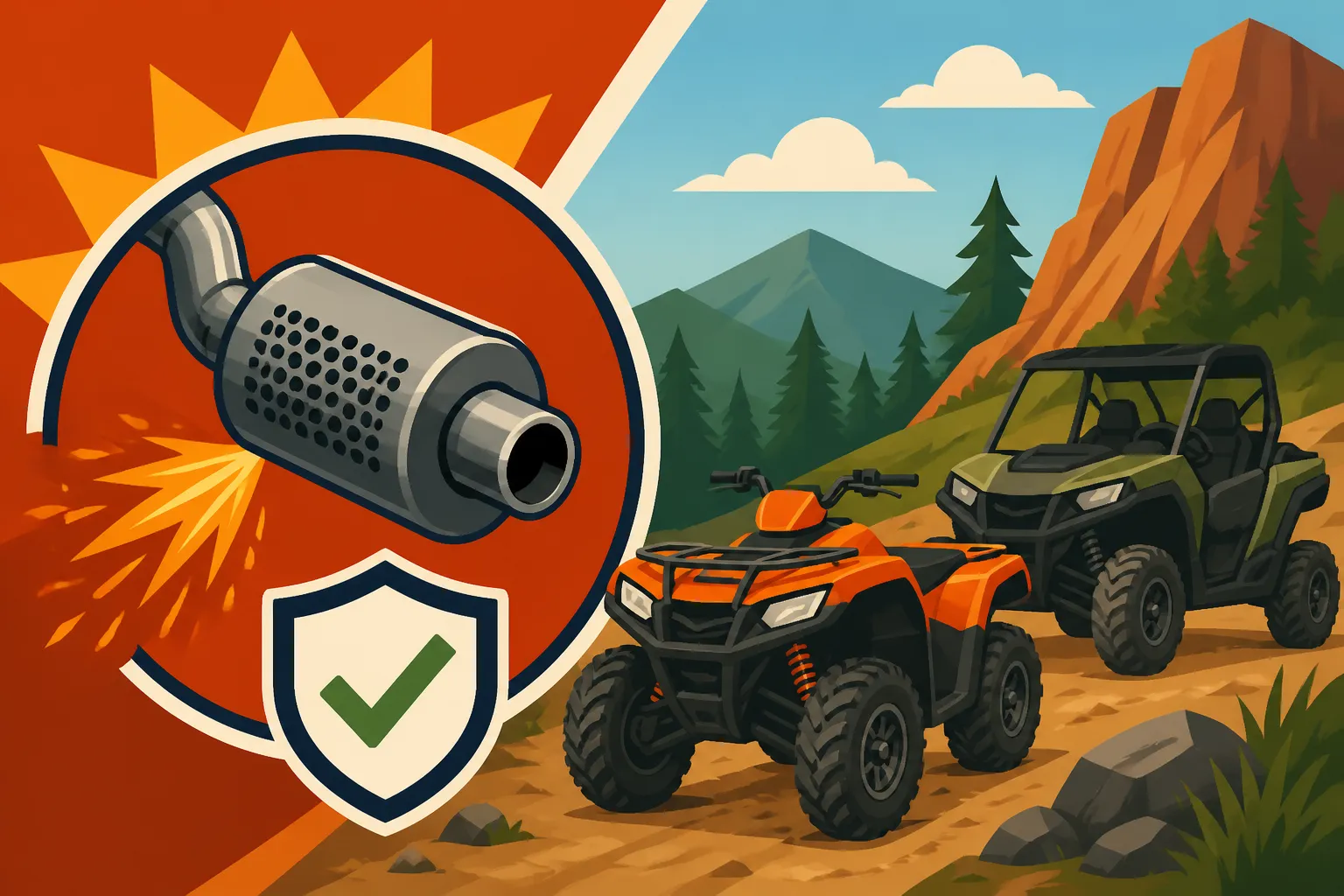
The golden standard for a compliant spark arrester is one that is "USFS-approved" or "USDA Forest Service approved." This isn't just a fancy label; it means the device has been tested and certified to effectively prevent the emission of sparks. You'll typically find this approval indicated by a stamp or mark directly on the muffler or the spark arrester itself. It might say "USFS Approved," "USDA Forest Service Approved," or display a specific code indicating its certification.
When you're checking your machine, look for this distinct marking. Without it, even if you have what looks like a screen in your exhaust, a ranger might deem it non-compliant. Many aftermarket exhaust systems, especially performance-oriented ones, sometimes come without an integrated USFS-approved spark arrester, or they might come with a removable one that often gets lost or damaged. If you've upgraded your exhaust, this is definitely something to double-check. Companies like SuperATV often offer exhaust systems that include USFS-compliant spark arresters, or sell stand-alone units that can be integrated into compatible aftermarket setups, making compliance straightforward.
Common Types and How They Work
Most spark arresters for OHVs utilize either a screen-type or a centrifugal-type design.
- Screen-Type: These are the most common. A fine mesh screen is placed in the exhaust stream. As hot exhaust gases pass through, any glowing carbon particles (sparks) are trapped by the screen, preventing them from escaping. Over time, these screens can get clogged with carbon deposits, reducing exhaust flow and potentially rendering them less effective. Regular cleaning is crucial.
- Centrifugal-Type: Less common on smaller OHVs, these systems use baffles and internal designs to force exhaust gases to swirl. This centrifugal force throws heavier carbon particles out of the gas stream and into a collection chamber, while the cleaner gases exit. These designs are often self-cleaning to some extent, but still require periodic inspection.
Regardless of the type, the key is that it's designed to trap or cool sparks to a point where they are no longer a fire hazard. If your machine's exhaust has been modified, or if you've purchased a used ATV or UTV, verifying the spark arrester's presence and compliance should be high on your pre-ride checklist. Even if you're just riding on [Colorado Trails That Link Two Mountain Towns], compliance is essential.
Checking Your Machine and Staying Compliant (and Avoiding Fines)
Now that we've covered the why and the what, let's talk about the practical side: how to make sure your machine is ready to roll without running afoul of the rules. A quick pre-ride inspection can save you a lot of hassle, potential fines, and the profound regret of accidentally starting a wildfire. It’s a good habit to get into, just like making sure your [Colorado OHV Registration Explained] sticker is current.
Locating and Inspecting Your Spark Arrester
For most ATVs, UTVs, and dirt bikes, the spark arrester is integrated into the muffler or end cap of the exhaust system.
- Find your muffler: It's the large canister at the end of your exhaust pipe.
- Look for the USFS stamp: As mentioned earlier, visually inspect the muffler or its end cap for the "USFS Approved" stamp or an equivalent certification mark. If you can't find one, or if it's illegible, assume it might not be compliant until you can verify it.
- Check for physical integrity: Is the spark arrester screen or baffling system present and intact? Sometimes, screens can get damaged, torn, or fall out. If you can easily see straight through your exhaust pipe, chances are your spark arrester isn't doing its job or is missing entirely. Make sure there are no holes or large gaps that would allow sparks to escape.
- Cleanliness: If it's a screen-type arrester, it needs to be clean. Over time, carbon deposits can build up, restricting exhaust flow and potentially making the arrester less effective. Many designs allow for easy removal of the screen for cleaning. Refer to your owner's manual for specific instructions on how to access and clean it.
If you have an aftermarket exhaust, be particularly vigilant. Some performance exhausts are sold "for closed course competition only" and may not include a USFS-approved spark arrester. If you're running one of these, you'll need to purchase and install a compliant spark arrester kit if you plan to ride on public land. [Aftermarket Exhaust and Trail Access Rules] goes into more detail on this, but the bottom line is, you need to verify it. Companies like SuperATV understand these requirements and often specify whether their exhaust components are USFS compliant, which can save you a lot of guesswork and ensure you're ready for the trails.
The Consequences of Non-Compliance
Let's not sugarcoat it: riding without a compliant spark arrester on Colorado public land can lead to a bad day.
- Fines: The most immediate consequence is a citation and a fine. These can vary depending on the specific land management agency and the severity of the violation, but they are rarely cheap. It's certainly more expensive than the cost of ensuring compliance in the first place. You might be interested in the broader context of [Penalties for an Unregistered OHV in Colorado].
- Being Turned Around: A ranger has every right to prevent you from riding or to make you leave the trail if your machine isn't compliant. That means your long-planned trip is over before it even began, or worse, cut short in the middle.
- Liability: In the worst-case scenario, if your non-compliant machine is found to be the cause of a wildfire, you could be held personally responsible for the costs of fighting that fire, which can easily run into the millions of dollars. This is a risk no one should ever take.
It’s truly a situation where an ounce of prevention is worth a pound of cure. A few minutes checking your machine now could save you thousands of dollars, endless headaches, and the unimaginable burden of contributing to a wildfire. Ensure your machine, whether it's an ATV, UTV, or dirt bike, meets all federal and state requirements, especially when exploring our beautiful [Colorado Rules on Forest Service Roads] or [Colorado OHV Rules on BLM Roads].
Navigating Specific Land Management Rules for Spark Arresters
While the general rule for USFS-approved spark arresters applies across most public lands in Colorado, it's worth understanding how different land management agencies approach enforcement and what additional details you might need to consider. The good news is that if your spark arrester is USFS-approved, you're generally in good shape for federal and state lands, but a little extra knowledge never hurts.
US Forest Service (USFS) and Bureau of Land Management (BLM)
These two federal agencies manage the vast majority of public lands where OHV riding is permitted in Colorado. Both the USFS and BLM strictly enforce the requirement for USFS-approved spark arresters. When you're out on a National Forest trail or BLM-managed riding area, expect rangers from either agency to be checking for compliance.
Their guidelines are typically the source of the "USFS Approved" standard that most spark arresters adhere to. They are primarily concerned with fire prevention and protecting natural resources. Therefore, their enforcement is usually quite direct: if you don't have one, or if it's damaged or non-compliant, you're not allowed to ride. These are the rules for pretty much all [Where to Ride an OHV in Colorado] that is federal land.
Colorado State Parks and State Trust Lands
Colorado State Parks also have regulations regarding OHV use, and a USFS-approved spark arrester is a standard requirement for riding within designated OHV areas in state parks. Colorado Parks and Wildlife (CPW) officers enforce these rules, just as they do with registration requirements. While state trust lands might have different access rules, if OHV use is permitted, federal spark arrester standards usually apply due to the shared concern over fire danger.
The key takeaway is consistency: the standard for spark arresters is largely uniform across public lands in Colorado, regardless of whether it's federal or state-managed. This simplifies things for riders, as you don't typically need to worry about different spark arrester standards for different agencies; if it's USFS-approved, you're usually good to go.
What Rangers Look For During an Inspection
When a ranger pulls you over for a spot check, or at a trailhead checkpoint, they're typically looking for a few things, and the spark arrester is high on that list.
| Inspection Point | What the Ranger Checks For | Your Action for Compliance |
|---|---|---|
| USFS Approval Stamp | They will visually inspect your muffler for the "USFS Approved" stamp or an equivalent certification. This is the primary verification. | Ensure your muffler has a clear, legible USFS stamp. If your machine has an aftermarket exhaust, verify the component supplier (e.g., SuperATV) specifies USFS compliance or that you have added a compliant unit. |
| Physical Integrity | They'll check if the spark arrester screen or baffling is present and intact within the exhaust. Damaged, missing, or altered arresters are non-compliant. Some might even do a quick visual check inside the exhaust tip. | Regularly inspect your spark arrester for damage, tears, or missing components. Replace damaged parts promptly. If you cleaned it, make sure it's reinstalled correctly. |
| Excessive Carbon | While less common for a roadside check, if an arrester is visibly clogged with carbon, it raises questions about its effectiveness and could lead to further inspection or a warning. | Clean your spark arrester regularly according to your machine's manual. A clean arrester functions better and looks well-maintained. |
| Noise Levels | While a separate issue, excessive noise often goes hand-in-hand with modified or missing exhaust components, including spark arresters. If your machine is unusually loud, it might draw more attention to your exhaust system for inspection. | Ensure your exhaust system also meets Colorado's noise regulations. A compliant spark arrester might not solve a noise issue if other parts of the exhaust are modified, but it's a good start. |
Staying on the right side of the law and keeping our trails safe is truly a group effort. Understanding and complying with spark arrester rules is a fundamental part of responsible OHV ownership in Colorado. It ensures that every one of us can continue to enjoy the incredible riding opportunities our state offers without putting our precious natural resources at risk.
Disclaimer
This article is for general informational purposes only and does not constitute professional advice. Laws, prices and regulations vary by location and change over time. Consult a qualified professional for guidance on your specific situation.