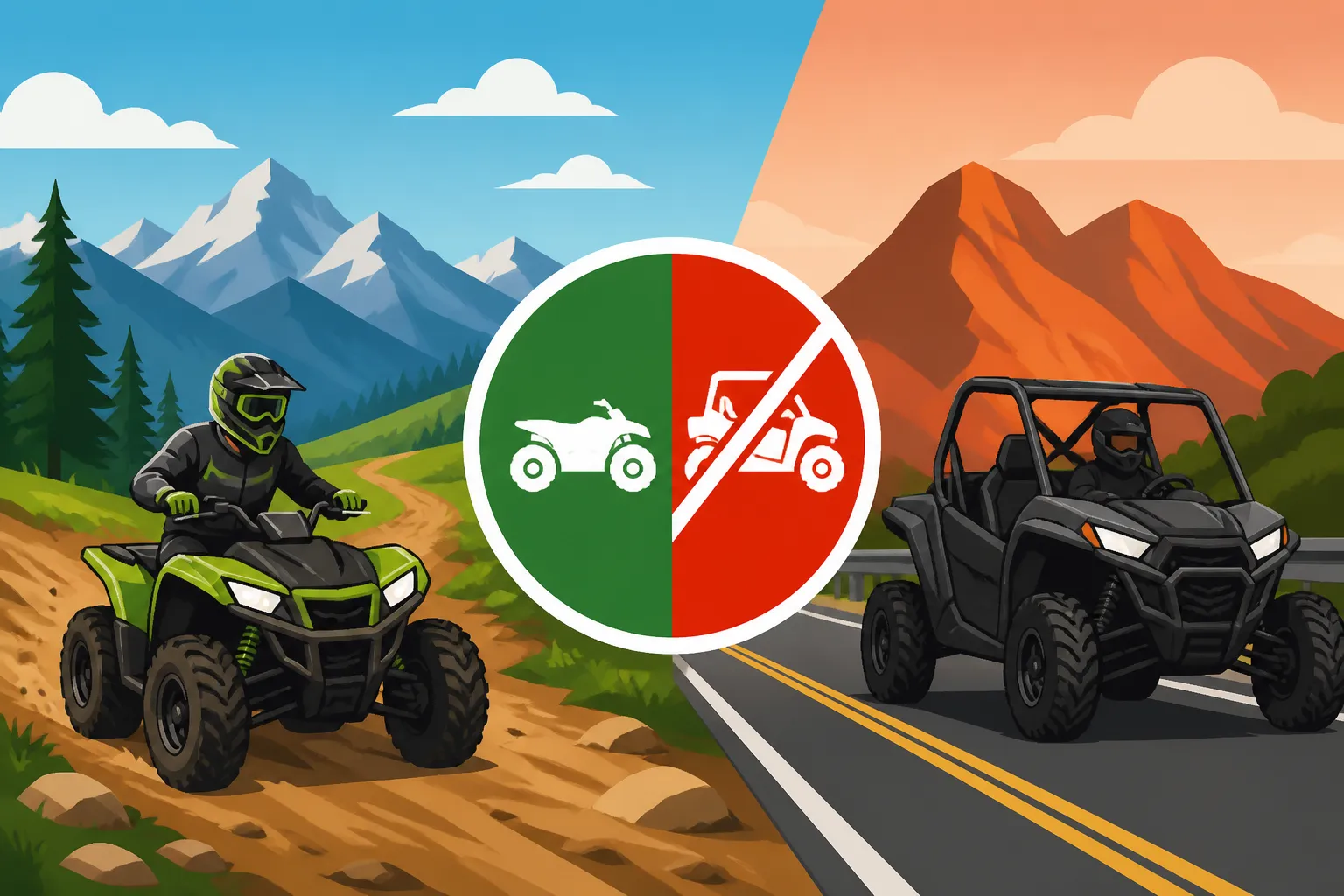
Colorado OHV Rules on State Highways
It's incredibly frustrating when you're out enjoying Colorado's stunning backcountry on your ATV or UTV, only to hit a paved state highway and feel like you've run into a brick wall. Many riders dream of smoothly connecting trails or popping into a mountain town for lunch without having to trailer their machine, but the rules for state highways are notoriously tricky and often misunderstood. This guide is here to untangle the complexities surrounding off-highway vehicle (OHV) use on Colorado's state highways, helping you understand exactly where you can and cannot ride, and how to avoid an unwanted citation.
The Big Picture: Why State Highways Are Different
Let's be real, the distinction between a local county road and a state highway can feel arbitrary when you're just trying to get from point A to point B. However, in Colorado, this difference is absolutely crucial for OHV operators. State highways are designed for high-speed, high-volume traffic, and the laws governing them reflect this focus on rapid transit and safety for all road users, typically meaning OHVs are not welcome. It’s not about stifling your fun, but about managing very real safety risks.
Jurisdiction and Enforcement: State Patrol Versus Local Sheriff
One of the biggest differences when you're looking at a state highway versus a county road or a town street is who's in charge. On a county road, you're primarily dealing with the local county sheriff's department or perhaps a town marshal. They often have a deep understanding of local ordinances and the specific needs of their community, which sometimes includes carving out unique OHV access rules. Many of these local agencies are even funded in part by OHV registration fees, so they often see riders as part of their community.
However, once you hit a state highway, you're primarily under the jurisdiction of the Colorado State Patrol. These officers enforce state laws across county lines, and their focus is on maintaining safe, efficient travel on major arteries. They generally operate with a stricter interpretation of state statutes regarding OHVs on these roads. While local authorities might sometimes give a warning for a minor infraction on a seldom-used county road, the State Patrol is often less lenient when it comes to OHV violations on state highways, given the higher speeds and increased risk involved. This means you need to be acutely aware of state-level rules, not just local ones.
Safety Concerns: High Speeds and Traffic Volume
Think about the environment of a state highway compared to a gravel forest road. On a forest road, you're likely traveling at lower speeds, encountering other recreational users who are also going slowly, and generally have a wide field of view for hazards. On a state highway, however, you're suddenly sharing the road with cars, trucks, and RVs moving at highway speeds – often 55 MPH or more. These vehicles are heavier, faster, and their drivers aren't always looking for a side-by-side or an ATV.
The inherent design of most OHVs, with their higher center of gravity, knobby tires, and open cabs, makes them less stable and much more vulnerable in high-speed traffic. A sudden stop or swerve that's manageable in a car can be disastrous on an OHV. Furthermore, the noise, dust, and general chaos of highway traffic can be overwhelming for OHV operators, making it difficult to react safely. These safety concerns are the primary reason why Colorado's state statutes severely restrict OHV access on these roads. It's less about the vehicle itself and more about the environment it's being operated in.
What Is a State Highway in Colorado?
It might sound obvious, but understanding what precisely constitutes a "state highway" is the first step in knowing where you can and cannot legally ride your OHV. Colorado's road network is complex, weaving through mountains, deserts, and bustling towns, and not every paved road is a state highway. Misidentifying a road could lead to an unexpected ticket.
Understanding Colorado's Numbered Routes
In Colorado, state highways are generally identified by a numbered route designation, usually starting with "Colorado State Highway" or simply "Highway" followed by a number. Think of routes like Highway 550, Highway 149, or Highway 24. These roads are part of the state highway system, maintained by the Colorado Department of Transportation (CDOT), and typically connect cities, towns, and major recreational areas. They are the backbone of the state's transportation infrastructure.
These routes are usually well-marked with distinctive shield-shaped signs. If you see one of these signs, or a road denoted with a "CO" shield, you can be fairly certain you're on a state highway. The speed limits are generally higher than on local roads, and you'll typically see a greater volume of traffic. While some segments might pass through small towns where the speed limit drops, the underlying designation as a state highway usually remains. Understanding these designations on your map or GPS is crucial for planning legal OHV routes.
Distinguishing State Highways From County Roads
The real confusion often arises when a paved road might look like a state highway but is actually a county road. County roads are maintained by local county governments and are often identified by "County Road" or "CR" followed by a number or letter designation (e.g., CR 32, CR G). While many county roads are gravel, a significant number, especially near populated areas or connecting important points, are paved. These paved county roads are often where local OHV ordinances come into play, potentially allowing limited OHV travel.
The key difference lies in jurisdiction and designation. State highways are part of a statewide system; county roads are managed by individual counties. While some maps clearly differentiate between state highways and county roads, others might not be as explicit. When in doubt, consult a Motor Vehicle Use Map (MVUM) for federal lands, or check with the local county sheriff or town office for their specific road ordinances. Don't assume that just because a road is paved, it's automatically a state highway, or conversely, that a paved county road offers the same OHV access as a dirt trail. This distinction is vital for avoiding trouble.
Limited Exceptions for OHV Use on State Highways
While the general rule is "no OHVs on state highways," Colorado does have a few, very specific exceptions. These exceptions are critical to understand, as they are not blanket permissions but rather narrowly defined situations where OHVs might briefly interact with these roads. It's never about joyriding down the main drag; it's about practical, limited access for specific purposes.
Controlled Crossings: When and How You Can Cross
One of the most common and widely understood exceptions allows OHVs to cross a state highway. This is often necessary when a designated trail system or a county road network is bisected by a state highway. However, this isn't a free-for-all. When you cross a state highway, you must do so at a 90-degree angle, at an intersection, and in the most direct and safest manner possible. You are not allowed to ride on the state highway for any distance, even a short one, to reach your crossing point. You must stop, look both ways, and yield to all highway traffic, just as if you were pulling out in a car.
This kind of crossing is common in areas where trail networks are extensive, like around the San Juan Mountains. You might be riding a county road that leads directly to a state highway, and then another county road picks up on the other side. This is often designated on local OHV maps. Always prioritize safety, and remember, the onus is on the OHV operator to make the crossing safely and legally. Trying to sneak a short ride down the shoulder will likely result in a ticket, and more importantly, could put you in a very dangerous situation.
Designated Highway Corridors: Specific Examples Like Highway 149
In very rare and specific instances, Colorado law allows for OHVs to be operated on certain short segments of state highways, but only where explicitly designated by both the state and local authorities. These are not widespread, but they exist to connect critical parts of trail systems or to provide access between trailheads and mountain towns. One of the best-known examples is a specific segment of [The Highway 149 OHV Corridor at Lake City] during certain times of the year, which helps connect riders to the larger Alpine Loop network.
These designated corridors are typically very short, clearly marked with signage indicating OHV access, and usually come with strict rules about speed, time of day, and even the direction of travel. They are usually the result of significant local effort and agreement with CDOT. You should never assume that if one segment of a state highway allows OHVs, others do too. Always check current local ordinances and signage. If you're using a device like a SuperATV GPS unit, make sure your maps are up to date and reflect these very specific, often seasonal, allowances.
Emergency or Utility Use
There are also practical, albeit less common, exceptions for emergency services or utility workers. For instance, a search and rescue team might need to use an OHV on a state highway shoulder for a short distance to reach an incident site if no other access is available. Similarly, utility workers might use a specialized OHV for maintenance on power lines or other infrastructure that happens to run along a state highway.
These are not recreational uses and typically require official authorization or are performed by professionals in the line of duty. For the average recreational rider, these exceptions do not apply. It's important to differentiate between necessary professional use and personal recreational riding when considering these limited allowances.
The "Street Legal" Myth Versus Reality for Colorado State Highways
This is perhaps one of the biggest points of confusion and frustration for OHV owners. Many people believe that if they just add a few accessories – a turn signal kit, a horn, mirrors, maybe a windshield from SuperATV – their machine magically becomes "street legal" for any road, including state highways. Or, they might have an OHV titled and plated in another state that does allow street-legal OHVs. Unfortunately, when it comes to Colorado state highways, these beliefs generally don't hold true.
Colorado's Stance on Out-of-State Plated OHVs
Let's address the out-of-state issue first. Colorado does have a law, passed in 2021, that generally recognizes out-of-state registered "street-legal" OHVs on some public roads. However, this law has very specific limitations. It explicitly states that such machines are not permitted on state highways or interstates, except to cross them at a 90-degree angle, as discussed earlier. So, if your side-by-side has a Utah license plate and is technically street legal in Utah, [Colorado's 2021 Law and Out-of-State Registered OHVs] still prohibits you from cruising down Colorado State Highway 50.
This can be a tough pill to swallow for riders who have invested time and money in making their machine street legal in their home state. The intent of the Colorado law was primarily to open up access on county and local roads that have passed specific ordinances, not to grant carte blanche access to the entire road network. The safety concerns on high-speed state highways remain paramount, regardless of where your machine is registered. So, while your out-of-state plate might help you in [Colorado Towns That Let OHVs Use Their Streets], it won't typically grant you access to state highways.
Why Colorado Will Not Plate Your UTV
Colorado has a very clear stance on plating OHVs for street use, and it's something that often catches new residents or aspiring "street-legal" owners off guard: [Why Colorado Will Not Plate Your UTV]. Colorado state law does not have a mechanism to issue a standard street-legal license plate for ATVs, UTVs, or dirt bikes that were originally manufactured for off-highway use. Even if you install all the necessary safety equipment – lights, turn signals, horn, mirrors – the fundamental vehicle classification in Colorado typically prevents it from being registered as a street-legal vehicle for general road use.
This is different from some other states that have specific categories for "low-speed vehicles" or "restricted use motorcycles" that allow for street registration. In Colorado, an OHV is an OHV, and while it requires a Colorado Parks and Wildlife (CPW) registration sticker for public land use, this is distinctly separate from a Department of Motor Vehicles (DMV) title and license plate that would permit general road use. This is why you'll see many street-legal Jeeps and other full-size vehicles on Colorado trails, but rarely a plated side-by-side or ATV. The lack of a state-issued street-legal plate means that even with all the bells and whistles, your machine is still largely restricted from state highways.
Penalties and Risks of Illegal State Highway Riding
The temptation to take a shortcut on a state highway or just "connect the dots" can be strong, especially when you're close to your destination. However, the risks and potential penalties for illegally operating an OHV on a Colorado state highway are significant and far outweigh any minor convenience. It's not just about a simple fine; it can involve legal hassles, financial burdens, and even serious injury.
Fines and Citations for Illegal Use
Getting caught riding an OHV illegally on a state highway will likely result in a citation from the Colorado State Patrol. [Colorado Fines for Illegal Road Riding] can vary, but you should expect to pay a significant sum. Beyond the basic traffic ticket, you might also face additional charges depending on the specifics of the situation, such as reckless driving, operating an unregistered vehicle (if you haven't bought your CPW sticker), or operating without proper safety equipment. Each of these can add to the financial burden.
Furthermore, a citation often means dealing with court appearances, which can be a huge time sink. Points might even be assessed against your driver's license, depending on the severity of the offense. It's a hassle you absolutely want to avoid, and it's a stark reminder that state highways are serious business.
Insurance Implications for Accidents
This is perhaps the most concerning aspect. If you are operating your OHV illegally on a state highway and are involved in an accident, your insurance coverage may be completely voided. Most standard ATV/UTV insurance policies are designed to cover off-highway use or limited, legally permissible road use (like crossing a road or riding on a designated county road where allowed). They are generally not designed to cover high-speed collisions on state highways where OHVs are explicitly prohibited.
Imagine a scenario: you decide to ride a mile down a state highway to get to a different trail. A car, not expecting an OHV, clips you. Not only might you face severe injuries, but your insurance company could deny any claims, leaving you personally responsible for property damage to both vehicles, medical bills, and potential liability claims from the other driver. This could amount to hundreds of thousands of dollars. It’s a gamble that no rider should ever take, especially when simple alternatives exist. [Colorado ATV Insurance and When It Is Required] generally covers you for accidents where you are legally operating the machine. Illegal operation introduces a huge liability risk.
Alternatives for Connecting Trails and Accessing Services
So, if state highways are largely off-limits, what's a rider to do when they need to bridge gaps between trails, reach a trailhead, or grab a burger in town? Thankfully, Colorado offers several viable and legal alternatives that allow you to enjoy your OHV adventures safely and responsibly.
Trailering Your Machine
The most straightforward and safest solution for traversing state highways is to trailer your OHV. This might seem like an extra step, but it ensures you're operating within the bounds of the law and significantly reduces your risk of an accident on high-speed roads. Many OHV enthusiasts have dedicated trailers, from small single-machine trailers to large toy haulers. [Trailer Registration for Hauling ATVs in Colorado] is a separate but necessary step for this option.
When planning a multi-day trip, it's common practice to use a base camp and trailer your machines to different trailheads or staging areas each day. This allows you to explore diverse riding areas without illegal road use. Yes, it takes a little extra time to load and unload, but the peace of mind knowing you're legal and safe is well worth it. Companies like SuperATV even offer heavy-duty tie-down straps and trailer accessories designed to keep your machine secure on the road, making this option even more reliable.
Riding County Roads Where Allowed
While state highways are a no-go, many Colorado counties and towns have embraced OHV tourism and enacted ordinances that allow OHVs on designated county roads and city streets. These areas are specifically signed, and riders are expected to adhere to local rules, which might include lower speed limits, specific hours of operation, and requirements for basic safety equipment like headlights, taillights, and mirrors.
These local ordinances are a game-changer for riders looking to access trail systems directly from town or connect various county roads. Before heading out, always research the specific county and town ordinances for your riding area. Resources like the Colorado Parks and Wildlife (CPW) website or local county sheriff's offices often provide maps or lists of approved OHV routes. This allows you to legally ride from your campsite into town for supplies or to connect directly to a different trail network. Remember, even on these approved roads, you're usually still subject to all standard traffic laws, including those regarding speed, passing, and yielding.
Using Designated City Streets
Similar to county roads, many [Colorado Towns That Let OHVs Use Their Streets] have enacted specific ordinances to welcome OHV riders. Towns like Lake City, Silverton (with its specific limitations), and others in the San Juan Mountains understand that OHVs are a significant part of their local economy and tourist draw. These towns often have clearly marked routes that allow OHVs on specific streets, usually at reduced speeds, to access services like gas stations, restaurants, or lodging, or to connect to nearby trailheads.
Again, the key here is local ordinance and designation. You cannot just assume any city street is open to OHVs. Always look for signage, check town websites, or ask at local visitor centers. When riding through these towns, be extra courteous to pedestrians and other drivers, keep your dust down, and respect noise limits. Responsible riding in these areas helps maintain and expand OHV access for everyone.
State Highway vs. County Road OHV Access
Understanding the critical differences between state highways and county roads regarding OHV access in Colorado is paramount for legal and safe riding. This table provides a quick comparison.
| Feature | Colorado State Highway | Colorado County Road (Designated) |
|---|---|---|
| Jurisdiction | Colorado Department of Transportation (CDOT) & State Patrol | County Government & Local Sheriff |
| General OHV Access | Highly Restricted: Generally prohibited, except for limited, explicit exceptions. | Potentially Permitted: Many counties allow OHVs on designated segments via local ordinance. |
| Common Uses | Connecting major towns, high-speed travel | Accessing rural areas, connecting trails, local traffic |
| Signage | Numbered shield signs (e.g., CO 149, US 50) | "CR" or "County Road" signs, often with local OHV access signs. |
| Typical Speed Limits | 45-65+ MPH | Varies, often lower (15-35 MPH) on designated OHV routes. |
| Enforcement | Colorado State Patrol (strict enforcement) | Local County Sheriff, Town Marshals (may be more nuanced based on local rules). |
| Out-of-State Plates | Not Permitted for general travel, only 90-degree crossings. | May be Permitted if street-legal in home state and county has ordinance. |
| Required Equipment | Not applicable for general travel. | Headlights, taillights, brake lights, mirrors, horn, insurance, CPW sticker, etc. (Check local ordinance). |
| Safety Risk | Very High (high speeds, heavy traffic) | Lower (lower speeds, less traffic, often shared with other recreational users). |
Navigating Colorado's diverse terrain with your ATV or UTV is an incredible experience, but understanding the rules, especially those concerning state highways, is key to keeping those adventures positive. While state highways are largely off-limits, the growing network of designated county roads and town streets, combined with the practicality of trailering, means you still have endless opportunities to explore. Always plan ahead, stay informed about local ordinances, and ride safely!
Disclaimer
This article is for general informational purposes only and does not constitute professional advice. Laws, prices and regulations vary by location and change over time. Consult a qualified professional for guidance on your specific situation.