Can a 10-Year-Old Ride in Colorado?
A 10-year-old may be able to ride an ATV or UTV in Colorado, but age alone does not decide where it is legal. The key distinction is whether the child is riding a trail, private land or a public road opened to OHVs. Here’s how to understand the age rule, supervision and permit questions before heading out.
The short answer: yes, but the route matters
Colorado’s age-ten rule is about operating an OHV on a public road that has been opened to OHV use. It is not a rule that automatically gives a 10-year-old permission to ride on every road, nor does it set one minimum age for every trail or private property.
On a qualifying public road, riders ages 10 to 16 must ride under adult supervision. A 10-year-old is at the start of that age group, so do not assume that turning 10 removes the need for an adult. The applicable road rules and local restrictions still matter.
The most important question is therefore not simply, “Can a 10-year-old ride in Colorado?” It is, “What kind of route is this, and what rules apply to that route?” A forest trail, a private ranch road and a county road opened by local ordinance may have different access and operating requirements.
| Where the child will ride | What to check before going |
|---|---|
| A public road opened to OHVs | Confirm the road is legally open to OHVs, check the age and supervision rules, and review local operating requirements |
| A designated public-land trail | Check the land manager’s current access rules, closures and machine restrictions; do not assume the public-road age rule applies in the same way |
| Private property | Get the owner’s permission and consider any applicable state rules, property conditions and machine-manufacturer limits |
| A road that is not open to OHVs | Do not ride it just because it is near a trail or other OHV route |
For details on the road-specific age requirement, see Colorado’s Age Ten Rule for Riding an Opened Road. The rules for different ages are also covered in Colorado Age Rules for Young OHV Riders and Colorado Supervision Rules for Riders 10 to 16.
Public roads, trails and private land are not interchangeable
A public road is not automatically an OHV route. A road may be paved or unpaved, county-maintained or locally managed, and still be closed to OHV use. Permission to ride a nearby trail does not make the connecting road legal, either.
Before a ride, verify the route itself. Look for official road signs and check the responsible county or municipality’s rules. A map or route description can help with planning, but it is not a substitute for current closure information. Local restrictions may also set conditions such as permitted hours, route boundaries or required equipment. For more on that distinction, see Which Colorado Roads Allow OHVs and Finding Your Colorado County’s OHV Ordinance.
On public-land trails, check the rules for the specific area and trail. Forest Service and BLM routes can have seasonal closures, machine-width limits or other access conditions. A route shown on a general map may be closed or unsuitable for a particular machine. Do not treat a trail’s public access as proof that a child may ride any machine on it without supervision or other precautions.
Private property has a different access question: the owner’s permission. That permission does not necessarily answer every safety or legal question, and it does not authorize riding on a public road to get there. If a child will ride on someone else’s land, get clear permission and agree on where riding is allowed. Written Permission Before Riding Private Land explains why a verbal assumption can create problems.
It also helps to separate riding from road travel. A machine may be allowed on an OHV trail but not on the public road that leads to it. Similarly, a street-legal vehicle and an OHV can have different permit and equipment requirements. When in doubt, confirm that the whole route—not just the destination—is open to the machine your family plans to use.
Supervision, machine fit and safety planning
Adult supervision is more than having an adult somewhere in the group. For a rider ages 10 to 16 on an opened public road, the adult should be able to watch the young operator, respond quickly and help manage traffic, hazards and route decisions. A large or spread-out group can make that harder. Keep the child close enough for meaningful oversight, especially at intersections, blind corners and road crossings.
The meaning of “immediate supervision” can affect how a ride should be organized. Review What Immediate Supervision Actually Means before relying on an adult’s presence as the only safety plan. Also confirm whether the adult needs to meet any additional requirements for the particular road or route. Road-specific rules can differ from off-road trail conditions.
Choosing an appropriately sized machine is just as important as choosing an open route. A child should be able to reach the controls, steer, brake and stop the machine reliably. They should understand how throttle response, braking and turning work before riding near other vehicles or challenging terrain. A machine that is too powerful or too large can make basic control difficult, even if the child is enthusiastic and the route is technically open.
For a UTV, check the seating arrangement and the manufacturer’s instructions for the particular model. A passenger seat does not necessarily make a machine suitable for a young driver. For an ATV, confirm that the child can operate the controls without stretching or losing a stable riding position. Do not use engine size alone as a measure of whether a machine is a good fit. Youth Machine Size Rules Colorado Parents Ask About and Choosing a First Quad for an Eight-Year-Old offer more on matching a machine to a young rider.
Before riding, agree on simple rules: stay on the approved route, keep a safe distance from other machines, stop when asked, and do not race or attempt an obstacle without permission. Explain what to do if the child loses sight of the group or the machine stalls. A brief practice session in a quiet, appropriate area can reveal control problems before they become serious on a busy route.
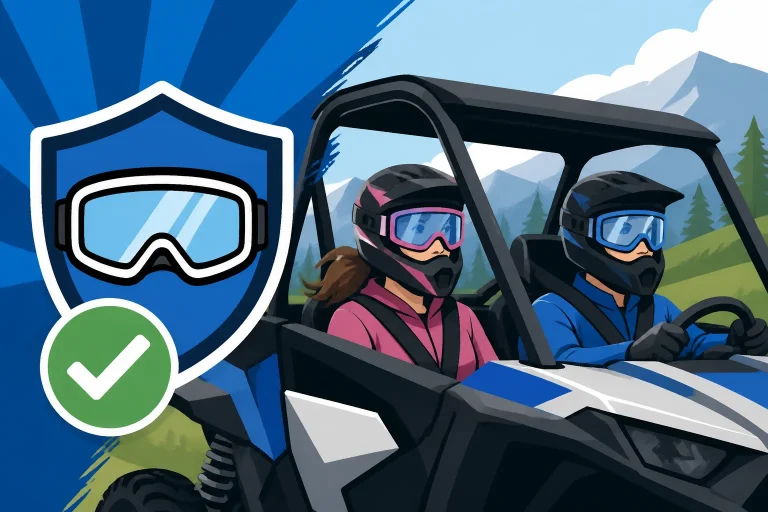
Protective equipment matters, too. Check the requirements for the route and the machine, then choose properly fitting gear. A helmet that shifts or blocks vision can undermine its purpose. Eye protection, gloves and clothing suited to the weather and terrain can also help. Conditions in Colorado can change quickly, so plan for dust, cold, sun and sudden weather rather than dressing only for the trailhead.
Permits, reciprocity and a before-you-go checklist
A young rider’s age does not by itself settle whether the machine needs a registration or permit. Permit rules depend on where the machine will be used, what kind of machine it is and whether it is registered or otherwise eligible for an exemption. Check the requirements for the specific riding area and machine before leaving home.
Do not assume that an out-of-state registration, permit or plate automatically satisfies Colorado requirements. Reciprocity and permit rules can be different for different types of vehicle and land access. Review Colorado OHV Permit Reciprocity With Other States if the machine is registered elsewhere, and Colorado Permit Rules for Youth Machines for permit questions involving a young rider’s machine. A permit is not permission to ride a road or trail that is closed to OHVs.
Use this checklist before a 10-year-old rides:
- Identify the route. Decide whether it is a public road, designated trail or private property. If any part is a public road, verify that it is open to OHVs.
- Check the age and supervision rule. For an opened public road, plan on the required adult supervision for riders ages 10 to 16. Confirm any route-specific conditions before departure.
- Confirm the machine is appropriate. Make sure the child can control it and that the machine meets the route’s size or equipment restrictions.
- Check permits and registration. Confirm what the machine needs for that location. Do not assume another state’s paperwork replaces a Colorado permit.
- Review closures and local rules. Check current information from the responsible land manager or local authority, especially if the ride crosses jurisdictions.
- Prepare the child and adult. Agree on how to ride together, what to do if separated and when to stop. Choose protective gear that fits and suits the conditions.
If the planned ride includes a county road, a town street or a connection between trails, ask the relevant local authority whether that specific segment is open and what conditions apply. If the answer is unclear, choose a route whose access status you can verify. The safest and simplest plan is a machine the child can control, an adult who can supervise closely and a route confirmed open to that machine.
Disclaimer
This article is for general informational purposes only and does not constitute professional advice. Laws, prices and regulations vary by location and change over time. Consult a qualified professional for guidance on your specific situation.