Colorado OHV Rules for Utility and Work Machines
For many folks in Colorado, an ATV or UTV isn't just a toy for weekend adventures; it's a vital tool, a workhorse that helps get things done around the property, on a job site, or for various utility tasks. But when your off-highway vehicle (OHV) pulls double duty as a piece of equipment, it can get incredibly confusing to figure out which registration and titling rules actually apply. This guide is here to untangle the specifics of Colorado's OHV regulations for machines primarily used for utility and work purposes.
Defining "Utility" and "Work" OHVs in Colorado: What Makes Them Different?
First things first, let's clarify what we're talking about when we say "utility" or "work" OHVs in Colorado. From the state's perspective, an OHV is generally defined by its design – built for off-highway travel, typically with low-pressure tires and a gross dry weight of 1,500 pounds or less (for ATVs) or designed for recreational off-highway use (for UTVs and dirt bikes). The critical distinction for "work" machines often isn't in their physical makeup, but in their intended use and where that use takes place.
Is Your Machine a "Work" Vehicle or Still Recreational?
Many side-by-sides, for example, are equally adept at hauling firewood around a ranch or tackling a challenging mountain trail. The machine itself might be the same Polaris Ranger or Can-Am Defender that someone else uses purely for recreation. The difference lies in whether you're using it to clear brush on your acreage, access a remote utility pole for maintenance, or pull a small trailer full of tools. If the primary purpose of your OHV is to perform tasks related to agriculture, ranching, construction, landscaping, property management, or utility services, you're likely in the "work machine" category for the sake of these rules.
However, Colorado's regulations don't always create a separate, explicit category for "work" OHVs that exempts them from all standard requirements. Instead, they often provide specific exemptions or different rules based on who is operating the machine, where it's being operated, and for what specific purpose. A machine used by a land surveyor to access remote plots might still need a permit for public land, while a farmer moving hay bales across their own fields typically wouldn't. It's less about the label "work machine" and more about the context of its operation.
Common Misconceptions About Work Machines
A common misconception is that if an OHV is used exclusively for work, it automatically doesn't need to be registered or titled. This isn't entirely true in Colorado. While certain scenarios, like strictly private land use, might exempt you from the annual Colorado Parks and Wildlife (CPW) registration decal, the requirement for a title from the Department of Revenue (DOR) for proof of ownership generally still stands, just like any other motor vehicle. The idea that a "work machine" is somehow completely outside the state's oversight can lead to some unpleasant surprises down the road, especially if you ever need to sell it or prove ownership after an accident. Understanding these nuances is key to staying compliant.
Colorado Parks and Wildlife Registration for Utility Machines
The annual OHV registration through Colorado Parks and Wildlife (CPW) is what gets you that little green sticker. This sticker is primarily a user fee that contributes to trail maintenance, safety programs, and education. For most recreational riders, it's a non-negotiable part of hitting the trails. But for utility and work machines, the rules can vary depending on where and how the machine is used.
When Your Work Machine Needs a CPW Registration
If your utility or work machine will touch any public land in Colorado that is open to OHVs – even just for a brief moment to cross a designated route or access a remote work site – it almost certainly needs a valid CPW registration. This applies whether you're a land manager, a construction crew, a survey team, or someone clearing downed trees in a national forest. The funds from these registrations directly support the trails and access roads that often facilitate these work tasks.
For instance, imagine a crew tasked with inspecting power lines that run through a national forest. They use their side-by-sides to access remote sections of the line. Even though their purpose is work-related, because they are traversing public forest roads and designated trails, their machines need the current CPW registration sticker. Failing to have it could result in a citation from a Colorado Park Ranger or Forest Service official. You can find more details on [Colorado OHV Permits for Official and Utility Use] to ensure you're covered for these scenarios.
Exemptions for Agricultural and Private Land Use
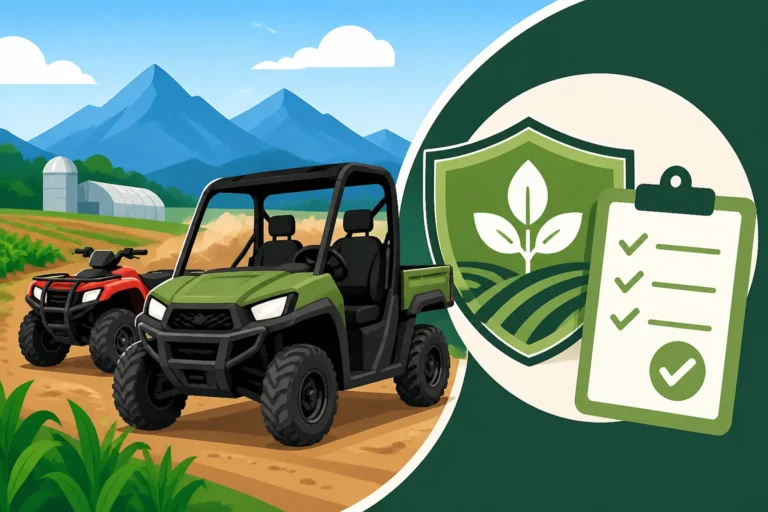
Now, here's where the "work machine" distinction often becomes important: exemptions. If your ATV or UTV is used exclusively for agricultural purposes on private land, it may be exempt from the CPW registration requirement. This is a big one for ranchers and farmers. Think about a farmer checking fences, moving irrigation equipment, or herding livestock on their own property. In these cases, the machine is truly a piece of farm equipment. However, the definition of "agricultural purposes" can be specific, so it's always wise to confirm if your use truly falls under this umbrella. [Agricultural Exemptions From Colorado OHV Rules] covers this in more depth.
Similarly, if your machine is used only on private land for non-agricultural work – say, a landscaper maintaining a large private estate, or a homeowner hauling materials around their acreage – it typically doesn't need a CPW registration. This is because the CPW registration is specifically for the privilege of using public lands. If the machine never leaves private property, that fee isn't applicable. However, proof that you have permission to ride on that private land is still crucial, especially if you're not the landowner. A well-drafted document, perhaps created using resources like LawDepot, confirming your authorization can be incredibly helpful. You can learn more about this in [Colorado OHV Registration for Machines Kept on Private Land].
Titling Your Work Machine Through the Colorado Department of Revenue
While CPW handles the annual registration for trail use, the Colorado Department of Revenue (DOR), through the county clerk and recorder's office (often referred to as the DMV), is responsible for issuing titles. A title is the legal document that proves ownership of your OHV. Unlike registration, which is often tied to where you ride, titling is about who owns the machine.
The Importance of a Colorado Title for Work Machines
Even if your work machine never sees a public trail and is always used on private land, having a Colorado title is incredibly important. Without a title, proving ownership can be a nightmare. Imagine you run a landscaping business, and one of your UTVs is stolen. Without a title, reporting it as stolen and recovering it becomes significantly more difficult, as you lack formal proof of ownership that the state recognizes. Similarly, if you ever decide to sell the machine or use it as collateral for a business loan, a title is essential.
For machines primarily used in a business, the title will often be in the name of the business (e.g., your LLC or corporation). This clearly delineates the asset as company property, which is crucial for accounting, insurance, and legal purposes. When purchasing a new machine for your business, the dealership will typically handle the title application paperwork. For used machines, you and the seller will need to navigate the process of transferring the title. [Titling an Off-Highway Vehicle in Colorado] provides a comprehensive overview of this process. It’s also worth noting the distinction covered in [Colorado OHV Title Versus CPW Registration].
Steps to Title a Work Machine
The process for titling a work OHV is generally the same as for a recreational one. You'll typically need:
- Proof of Ownership: This could be a manufacturer's certificate of origin (MCO/MSO) for a new machine, or a properly assigned title and a bill of sale for a used one. If you're buying from a private seller for your business, it's wise to use a robust bill of sale. LawDepot offers templates for bills of sale that can help ensure all necessary information, like VINs and purchase prices, are accurately recorded, which is vital for the titling process.
- Identification: A valid ID for the individual applying, or business registration documents if titling under a company name.
- Sales Tax Documentation: If applicable, proof of sales tax payment. For businesses, keeping meticulous records of these transactions is paramount.
- Application for Title: You'll fill out the necessary forms at your local county clerk and recorder's office.
Even if you're registering an OHV under a Colorado business, the title process through the DOR remains consistent. [Registering an OHV Under a Colorado Business] further elaborates on this specific scenario. It's often asked, [Do You Need Both a Title and a Registration in Colorado?], and the answer is usually yes for most situations.
Special Scenarios: Agricultural, Business, and Road Use Exemptions
The intersection of work, private land, and public roads creates specific scenarios where Colorado's OHV rules need careful interpretation. It's not always a clear-cut "yes" or "no."
Agricultural Exemptions and Specific Uses
As touched on earlier, agricultural machines used solely on private land are generally exempt from CPW registration. This is a critical distinction for the many farms and ranches that rely on ATVs and UTVs daily. However, this exemption doesn't mean you can drive your agricultural OHV on public roads just because you're doing farm work. There are very limited exceptions, typically involving crossing a road at a 90-degree angle or driving a short distance to access another part of your property, and these usually require specific lighting and safety equipment. You should always check local county ordinances, as some areas may have slightly different rules for farm vehicles. For anyone involved in ranching, understanding [Ranch and Farm ATV Use in Colorado] is vital.
| Scenario for Work OHV Use | CPW Registration (Green Sticker) | Title (DOR) | Road Use (Limited/Exemptions) | Primary Consideration |
|---|---|---|---|---|
| Private Agricultural Land | No (if purely ag use) | Yes | Highly Restricted/Specific Ag | Exclusively farm/ranch work on owned land |
| Private Non-Ag Land | No | Yes | No | Property maintenance, landscaping on private land |
| Public Land (Designated Trails) | Yes | Yes | Limited (county/town specific) | Surveying, official trail maintenance (CPW permit required) |
| Public Roads (Official Use) | Yes (sometimes exempt if government) | Yes | Allowed (official capacity) | Utility line patrol, law enforcement, emergencies |
| Public Roads (Ag Crossing) | No (if purely ag use) | Yes | Restricted Crossing | Moving between fields, specific agricultural tasks |
Official and Utility Company Exemptions
Certain government agencies or utility companies operating OHVs for official business may have specific exemptions or different requirements. For example, a Forest Service ranger patrolling a trail might operate a side-by-side that falls under specific federal or state agency guidelines, which could differ from a private citizen's requirements. The same might apply to utility crews maintaining power lines or pipelines. These are typically highly specific exemptions granted to public entities or companies performing essential public services. If you work for such an entity, you'll want to verify your company's policies and any relevant memorandums of understanding with state agencies. [Colorado Rules for Utility Company Machines] will give you more context here. If you're operating a machine as part of a resort's operations, there might also be specific rules, as discussed in [Colorado Permits for a Machine Used at a Resort].
Road Use for Work Machines
One of the most frequently asked questions is about using work OHVs on public roads. Colorado generally does not allow OHVs to be driven on paved state highways, and while some counties and towns have opened their roads to OHVs, these are typically for recreational access to trails. For work machines, the rules for road use are extremely limited.
An OHV used for agricultural purposes might be allowed to cross a public road or travel a very short distance on the shoulder if it's the only way to get from one part of a farm to another, but this is not a general permission to drive on roads. Such use often requires the vehicle to be clearly marked as an agricultural implement, meet specific lighting requirements, and operate at low speeds. These are usually county-level regulations, so what's permissible in rural Weld County might be entirely different from the rules near a mountain town. For official and utility machines, road use is usually only allowed when directly related to the official duty being performed, and often with specific safety signage or escorts. It's crucial not to confuse these very narrow exceptions with a blanket permission to drive a work OHV on public roads. Trying to use your machine to drive to the hardware store, even if you're picking up parts for a job, likely won't fall under these exemptions.
Navigating Colorado's OHV rules for utility and work machines requires a careful look at how and where you're using your vehicle. While some specific exemptions exist, particularly for agricultural use on private land, the default position is often that OHVs, regardless of their purpose, are subject to titling requirements and, if used on public lands, CPW registration. Always verify the specific regulations for your situation to ensure you're in compliance and to protect yourself and your valuable work machine.
Disclaimer
This article is for general informational purposes only and does not constitute professional advice. Laws, prices and regulations vary by location and change over time. Consult a qualified professional for guidance on your specific situation.