Cinnamon Pass From Lake City
Cinnamon Pass is a high, rocky route that can look manageable on a map but feel very different once you’re climbing above treeline. This guide explains how to plan a ride from Lake City, what terrain and weather to expect, how to prepare your ATV or UTV, and where to check access details before you leave town.
Planning a Cinnamon Pass Ride From Lake City
Understand the route before you set out
Cinnamon Pass is part of Colorado’s Alpine Loop, a network of mountain roads connecting the Lake City and Silverton areas. From Lake City, the route climbs through increasingly rugged high-country terrain toward the pass, which sits at roughly 12,600 feet. The scenery is a big part of the appeal: alpine slopes, old mining-country traces, and wide views that open up as the road gains elevation.
This is not a quick spin on a smooth gravel road. Expect a slow, demanding ride over uneven ground, with loose rock, ruts, steep sections, and exposed stretches. Conditions can vary from one part of the route to another, and a road that felt straightforward on the way up may feel more challenging on the descent. Build your schedule around a careful pace rather than an optimistic estimate of travel time.
Cinnamon Pass is often discussed alongside nearby routes such as Engineer Pass, but don’t assume the two are interchangeable in difficulty or conditions. Check route details and access information for the specific ride you plan to take. Guides to [Alpine Loop Mileage and Direction of Travel] and [Cinnamon Pass and Its Summer Window] can help you think through the larger route and seasonal planning.
Check access, permits, and route restrictions
High-country access changes with snow, road damage, maintenance, and seasonal closures. A route shown as open on an older map may have a gate or restriction in place when you arrive. Before leaving Lake City, check posted signs and current information from the responsible land manager or local authorities. If a road is closed, don’t ride around the gate or follow tire tracks past it.
Make sure your machine and your group meet the requirements for the roads you intend to ride. Vehicle width, road designation, and local restrictions can matter, especially for larger side-by-sides. A route suitable for a narrower machine may not be appropriate for a wide UTV. Review [Colorado Trails Rated for Full-Size Vehicles] and [Narrow Trails and Machine Width] if you are unsure whether your vehicle fits the route.
Colorado registration and permit rules also depend on the machine and the kind of use. Riders visiting from outside the state should check which permit applies before heading to a trailhead; a registration or permit from another state may not replace Colorado requirements. See [Colorado OHV Permits for Out-of-State Riders] and [Colorado Permit Rules on Public Land] for more background. Carry the required paperwork, and keep it somewhere it can be reached without unpacking your entire machine.
Plan a realistic day from Lake City
Start early enough to give yourself room for a slower ride, rest stops, changing weather, and unexpected delays. Mountain roads can be busy, and a mechanical issue or a vehicle needing extra help on a rough section can hold up everyone behind it. Avoid planning the day so tightly that you feel pushed to take risks or continue through worsening weather just to stay on schedule.
Decide in advance what your group will do if someone wants to turn back. It’s common for riders to have different comfort levels once they encounter steep grades, exposed edges, or loose rock. Agree on a turnaround point, keep the group together, and resist the pressure to continue simply because the pass is close. A good ride is one where everyone gets back safely, not one where every planned mile is completed.
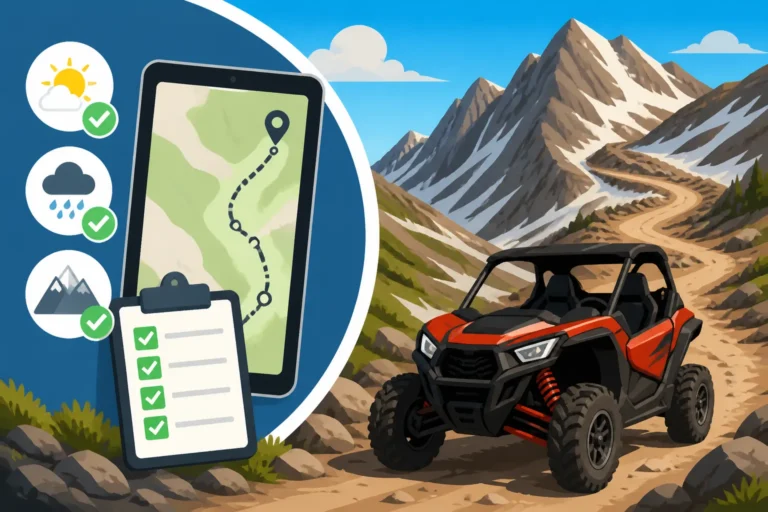
If you’re using a digital map, download the relevant area before leaving town and learn how to use it offline. Tools such as onX Offroad can help you review mapped routes and keep track of your location, but a phone or GPS is not a substitute for paying attention to signs, gates, and road conditions. A paper map is useful backup, particularly where cell service is limited. For more preparation ideas, see [Downloading a Motor Vehicle Use Map] and [Carrying a Paper Map Above Treeline].
What to Expect on the Trail
Rough ground, grades, and exposed sections
The climb toward Cinnamon Pass becomes more demanding as you gain elevation. You may encounter rocks that require a deliberate line choice, uneven ruts, drainage dips, and sections where the road narrows. Keep a steady, manageable pace and look far enough ahead to spot changes in the surface before your front wheels reach them. Sudden steering or braking can unsettle a machine on loose ground.
Give yourself space from the vehicle ahead. Dust can obscure the road, and following too closely leaves little room to stop if the rider in front slows, changes line, or encounters an obstacle. When visibility is poor, wait until the dust settles rather than pushing forward blindly. On a narrow section, be patient and communicate clearly before attempting to pass another group.
The route’s elevation and exposure deserve respect even when the ground is dry. A tire slipping on a steep or rocky section can turn a routine climb into a stressful recovery. If an obstacle looks beyond your machine’s capability or your group’s experience, stop somewhere safe and reassess. The pass will still be there another day.
Weather and altitude can change the ride quickly
At high elevation, a sunny start does not guarantee a calm afternoon. Clouds can build, temperatures can drop, and wind or rain can make a rocky road feel much more difficult. Thunderstorms are especially concerning in exposed terrain. If the sky is deteriorating, don’t continue upward simply to reach the pass; turn around or seek a safer place to wait before conditions worsen.
Altitude can affect riders as well as machines. You may feel unusually tired, short of breath, headachy, or lightheaded, especially if you arrived in Lake City from a much lower elevation. Take breaks, drink water, and pay attention to how everyone in the group is feeling. If someone seems unwell, treat that as a reason to stop and reassess rather than something to push through.
Bring layers even if the forecast looks warm in town. A windproof outer layer, gloves, eye protection, and extra water can make a long pause much more manageable. For more detail on high-country preparation, see [Riding Colorado Above 12,000 Feet], [Afternoon Thunderstorms on a Pass], and [Water and Sun at 11,000 Feet]. onX Offroad can be useful for reviewing the route before you go, but no navigation app can tell you that the weather is safe to continue.
Plan for other road users
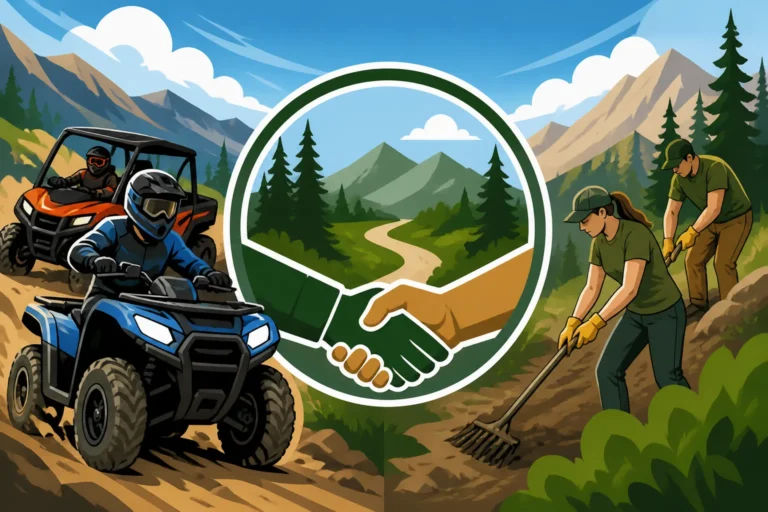
Cinnamon Pass is a shared mountain route. You may meet other OHVs, four-wheel-drive vehicles, cyclists, hikers, or people traveling between trail destinations. Slow down when approaching others, stay alert around blind corners, and avoid assuming that the person coming toward you can see or hear your machine.
When you meet another vehicle on a narrow stretch, don’t rush to squeeze past. Look for a safe, stable place to yield, and communicate calmly about who will move. On a steep or exposed section, stopping in the wrong place can create a difficult situation for both drivers. Avoid parking where you block the road, restrict access, or leave another group with no safe way through.
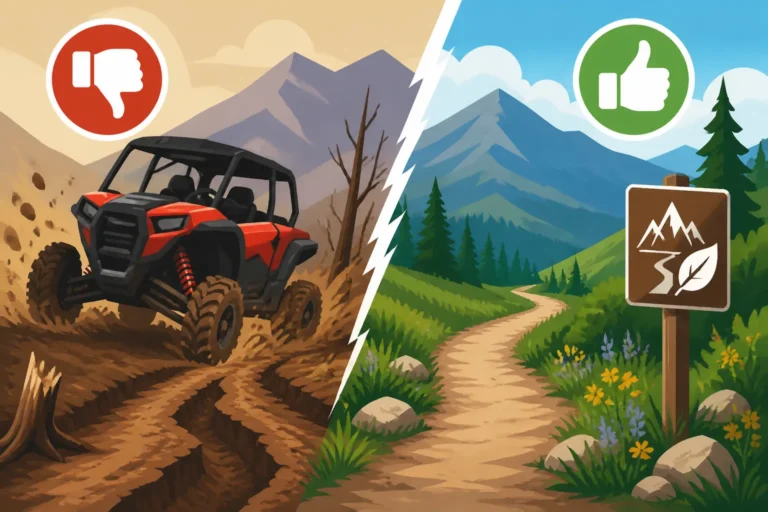
Respect posted rules and keep your machine on the designated route. Cutting a corner or riding around a muddy patch may damage fragile ground and widen the road. If a section looks rough, slow down and follow the established route rather than creating a new line. [Stay The Trail Ethics in Colorado] offers helpful context for responsible riding on public land.
Preparing Your ATV or UTV
Inspect the machine before leaving Lake City
A basic inspection can prevent a small issue from becoming a trail-side problem. Check tire condition and pressure, brakes, steering, lights, belts or chains, and fluid levels. Look for loose hardware, leaks, or damage that might worsen under a long climb and descent. Make sure your fuel plan allows for the complete ride, not just the distance to the pass.
Altitude and sustained climbing can put extra demands on an engine. A machine that runs well in town may behave differently on a steep ascent, especially if it is carrying passengers or gear. Don’t ignore warning lights, unusual smells, overheating, or a sudden loss of power. Stop somewhere safe, let the machine cool if appropriate, and avoid continuing until you understand what is wrong.
Pack a small repair and recovery kit suited to your vehicle and your group’s experience. Useful items may include a tire repair kit, basic tools, a compact first-aid kit, and equipment for a safe recovery. Know how to use what you carry before you need it. For additional ideas, consult [What to Carry Over a High Pass], [Flat Tires on a Rocky Trail], and [Recovery Gear for a Shelf Road].
Carry essentials for people as well as the machine
Riders often remember fuel and tools but underestimate the value of ordinary comfort items. Bring enough water and food for delays, warm layers, sun protection, and a way to communicate if your phone has no service. Keep essential items accessible rather than buried under luggage. A snack and an extra layer are especially helpful if a group has to wait for a repair or for another vehicle to clear a narrow section.
Before the ride, tell someone where you plan to go and when you expect to return. Share your route and a reasonable check-in plan. If your group has a satellite messenger or another off-grid communication device, make sure someone knows how to use it. Cell reception can be unreliable in mountain terrain, so don’t make a phone call your only backup plan.
Digital navigation can add confidence when used thoughtfully. onX Offroad can help you examine mapped roads and prepare offline navigation, but downloaded mapping should be treated as a planning aid—not permission to ignore a closure or enter a restricted route. Pair it with current official information, physical signs, and a paper backup when practical.
| Planning item | What to check before leaving Lake City |
|---|---|
| Route access | Closures, gates, seasonal restrictions, and posted notices |
| Vehicle suitability | Width, condition, tires, brakes, and ability to handle rough grades |
| Permits and paperwork | Requirements for your machine and where you plan to ride |
| Weather | Forecast, wind, storm risk, and a clear turnaround plan |
| Navigation | Offline maps, route familiarity, and a paper backup |
| Group readiness | Fuel, water, warm layers, first aid, tools, and communication plan |
Making a Safer Ride From Start to Finish
Use a steady pace and choose conservative lines
The safest approach is usually a controlled one. Keep enough space to react, look ahead for changing terrain, and avoid abrupt throttle or steering inputs on loose rock. If you’re riding with people who have different experience levels, set the pace for the least experienced rider. A faster rider can always wait at a safe stopping point; a less experienced rider shouldn’t feel pushed to match a pace that makes them uncomfortable.
Choose lines that keep the machine stable and leave room to correct course. Don’t turn a difficult section into a race or attempt an obstacle just because another machine has already crossed it. Different vehicles, tires, passengers, and rider skills can produce very different results. If you are uncertain, stop in a safe place and consider whether continuing makes sense.
Be particularly cautious on descents. A long downhill can demand steady braking and careful speed management, and a machine can feel different when it is loaded or when the surface is loose. Avoid riding so fast that you need to brake sharply around every bend. If you notice brake fade, unusual handling, or fatigue, find a safe place to stop and address the issue.
Know when to turn around
Turning back is a practical decision, not a failure. A worsening forecast, a rider who feels unwell, a machine problem, an unexpectedly difficult section, or a closure sign are all good reasons to change the plan. Don’t let the effort you’ve already spent climbing—or the desire to reach a photo spot—make the decision for you.
Talk through the choice as a group. Make sure everyone understands the reason for stopping and knows what happens next. If only part of the group wants to continue, splitting up can create additional risks, particularly where cell service is weak and road conditions are challenging. In many cases, keeping the group together is the safer option.
Before you head out, review route conditions and alternatives so a turnaround doesn’t leave you scrambling for a plan. onX Offroad may help you understand where mapped routes connect, but confirm that any alternative is open and suitable before using it. For broader trip planning, [Planning a Colorado Riding Trip] and [Colorado Trail Conditions Reports] can help you build a more flexible day.
Finish the ride responsibly
When you return to town, check the machine for damage, debris, loose parts, or leaks. Give yourself time to unload and inspect it rather than assuming everything is fine because the engine made it back. If something feels wrong, have it addressed before the next ride. A small issue found at the end of the day is often easier to manage than one discovered halfway up another pass.
Also take stock of the ride itself. Did the group have enough water? Was the departure time realistic? Did the route feel appropriate for your machine and experience? Those answers make the next trip smoother and help you choose routes that match your comfort level. If Cinnamon Pass felt more demanding than expected, consider a shorter or less exposed ride before planning another high pass.
The most memorable part of a Lake City ride should be the landscape and the time outdoors—not a preventable emergency. Check access before departure, keep your group flexible, ride within your ability, and leave the road and surrounding terrain as you found them.
Disclaimer
This article is for general informational purposes only and does not constitute professional advice. Laws, prices and regulations vary by location and change over time. Consult a qualified professional for guidance on your specific situation.