Does the Supervising Adult Need a License in Colorado?
A young rider may be allowed to operate an OHV on some Colorado roads, but the adult accompanying them has to meet the applicable supervision rules. The key distinction is where the ride takes place: a road opened to OHVs is not the same as an off-highway trail. Here’s when the supervising adult needs a driver’s license and what else to check before riding.
The short answer: yes, for a young rider on an opened road
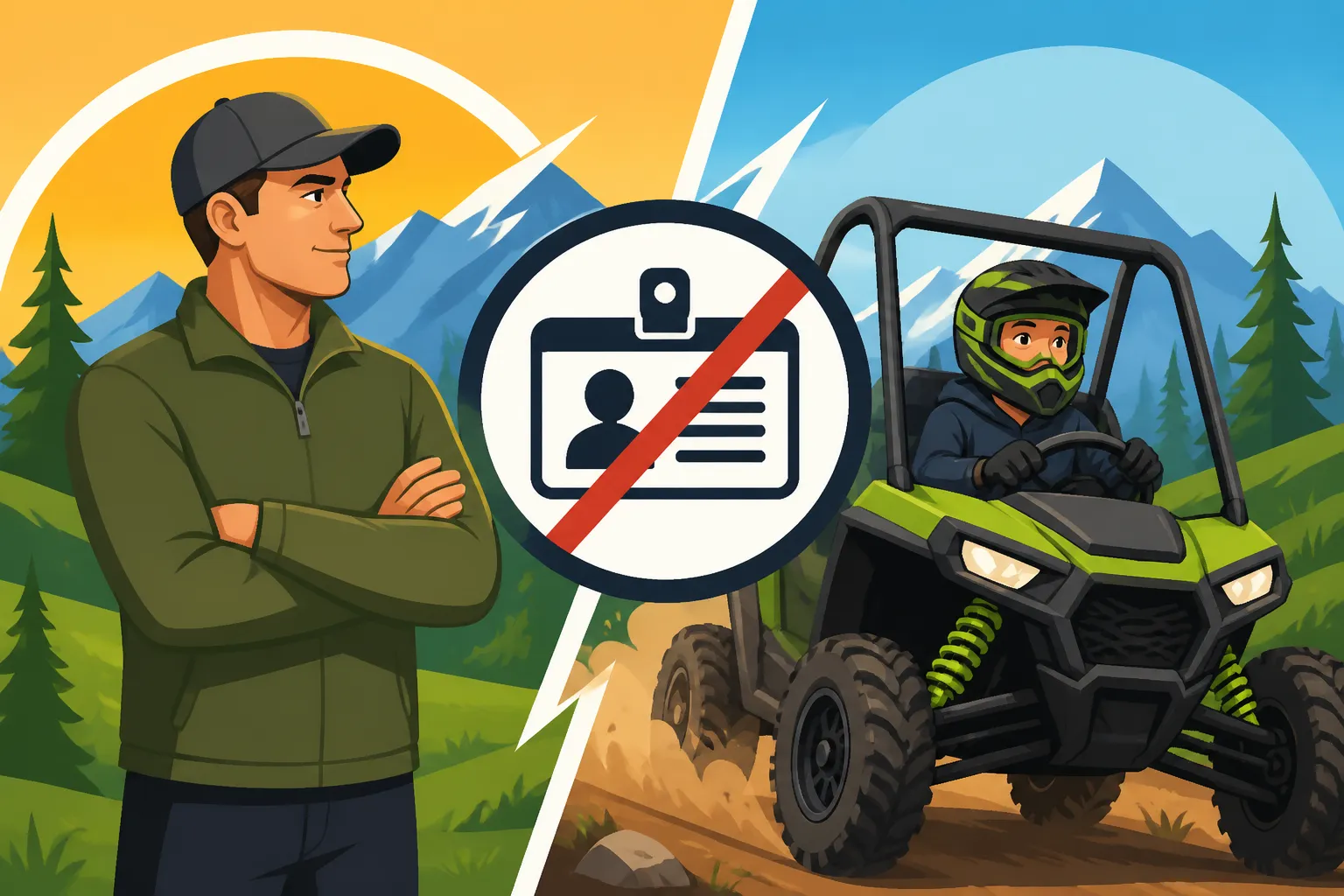
When a rider ages 10 through 15 operates an OHV on a public road that has been opened to OHV use, Colorado’s road-riding rules require supervision by an adult who is at least 21 and has a valid driver’s license. In other words, simply being an adult, or being old enough to supervise a child in other settings, may not be enough for this kind of road ride.
The requirement concerns the supervising adult. It does not mean the young OHV operator must have a driver’s license. Nor does an adult’s license make a road legal for OHVs if the local government has not opened it to them. The road must first be authorized for OHV use, and riders must comply with the rules that apply there.
| Situation | What to check about the supervising adult |
|---|---|
| Rider ages 10 through 15 on a public road opened to OHVs | The supervisor must meet the applicable age and valid-driver’s-license requirements |
| Rider under 10 on a public road | Do not assume adult supervision makes the ride legal; check the minimum-age restriction |
| Rider on an OHV trail or other public riding area | Check the rules for that land and activity; the opened-road supervision rule may not be the only rule that applies |
| Rider on private property | Confirm permission and any rules that apply to the property and the activity |
For the road rule, plan on a supervisor who is at least 21 and holds a current, valid driver’s license. If the adult has only a learner’s permit, a suspended license, or an expired license, don’t assume that satisfies the requirement. Confirm with the relevant agency or local authority before relying on an unusual license status.
The age and license condition applies to the young person riding on an opened public road; it is not a general permission to ride on any road in Colorado. A county, city, or town decides whether particular roads are open to OHVs, and local rules can include route limits and other conditions. See Colorado’s Age Ten Rule for Riding an Opened Road for more on the age threshold, and Colorado Counties With OHV Road Ordinances for why checking local access matters.
What “supervising” means on a road ride
The supervising adult should be able to do more than show a license if asked. Supervision needs to be meaningful: the adult should know where the young rider is, be able to monitor the ride, and be close enough to respond if the rider gets into trouble. A supervising adult who stays far behind, takes a different route, or cannot keep track of the child may not provide the kind of oversight the rule is intended to require.
The details of what counts as immediate or adequate supervision can depend on the rule and setting. Don’t treat a phone call, a general plan to meet later, or another adult somewhere in the group as a substitute for being present and attentive. For a closer look at the practical meaning of supervision, see What Immediate Supervision Actually Means.
Make sure the right adult is responsible
Before departure, identify which adult is supervising the young rider. That person should understand the route, the group’s plan, and the limits of the rider’s experience and machine. If the group splits up, make sure the child stays with the adult who is responsible for them.
A valid license is a legal qualification, not a riding-skill qualification. A licensed adult may still be a poor choice to supervise if they cannot keep pace safely, do not know the route, or are occupied with other riders. Choose someone who can focus on the young rider and make conservative decisions.
Don’t assume a passenger counts as supervision
Being on the same ride does not automatically settle whether the adult is supervising the child in the required way. If the adult is riding a separate machine, they should remain close enough to observe and assist. If the adult is a passenger on the young rider’s machine, check that the machine is designed and equipped for a passenger and that carrying one is allowed. A passenger seat, handholds, and footrests are not optional details on a machine built for one rider.
For guidance on youth riders and road operation, Colorado Supervision Rules for Riders 10 to 16 is a useful companion topic. The same adult may need to think about separate requirements for helmets, eye protection, road equipment, and local access.
Road rides and trail rides are not the same
The license requirement in this article is tied to a young rider operating on a public road opened to OHV use. It should not be used as a shortcut for deciding what is permitted on a trail, in an open riding area, on private land, or on a road that remains closed to OHVs.
Colorado has different rules depending on the place and kind of riding. Public-land operators may be subject to age, supervision, safety-equipment, and land-management requirements. Private-property riding brings its own practical and legal questions, including permission and any applicable local rules. A rider’s age, machine, and location all matter.
The useful approach is to check the route first, then the rider rules for that route:
- Identify the exact place. Is it a public road, a designated OHV route, a trail, an open riding area, or private property?
- Confirm that OHVs are allowed there. A road’s being unpaved or lightly traveled does not make it open to OHVs.
- Check the rider’s age category. Rules can differ for riders under 10, riders ages 10 through 15, and older teens.
- Confirm the supervisor’s qualifications. For the opened-road situation described above, verify the adult meets the age and driver’s-license requirements.
- Check equipment and local restrictions. Helmet, eye protection, lighting, and other requirements may apply, especially on roads.
- Keep the group together. Make sure the responsible adult can actually supervise throughout the ride.
A driver’s license does not give a supervisor permission to take a young rider onto a closed road or to ignore a route’s posted restrictions. It also does not convert an OHV into a street-legal vehicle. For the separate rules about operating on a road, see Driver’s License Rules for Colorado Road Riding and Riding an OHV on the Road in Colorado.
Riders under 10 need separate attention
Do not read the supervision rule as permission for a child under 10 to ride on an opened public road. A supervising adult’s age and license do not necessarily overcome a minimum-age restriction. If the rider is younger than 10, check the specific rule for that location and activity before planning a road ride. See Riders Under 10 on Colorado Public Roads.
On trails or private property, avoid assuming that the road age rule answers the question. Check the relevant land manager’s requirements, local restrictions, and the machine’s suitability for the child. An adult’s presence cannot make an oversized or unfamiliar machine safe for a young rider.
A practical pre-ride check for parents and supervisors
A little preparation can prevent the common mistake of treating “the adult has a license” as the only condition. Before riding, confirm that both the route and the supervision arrangement are lawful and workable.
Verify the adult’s status
The person supervising a rider ages 10 through 15 on an opened public road should be at least 21 and hold a valid driver’s license. Check the actual license rather than relying on someone’s verbal assurance if there is any uncertainty. If the adult’s license is expired, suspended, restricted, or otherwise unusual, ask the appropriate authority whether it qualifies before the ride.
Do not confuse a driver’s license with an OHV safety card, permit, registration, or title. They serve different purposes. The adult’s license is relevant to the road-supervision rule; the OHV’s registration or permit and any required equipment are separate issues.
Check route access and local rules
Find out whether the specific road is open to OHVs and whether the route has conditions such as a limited season, restricted hours, or equipment requirements. Local rules can vary, so a route that is open in one town or county does not establish that nearby roads are open too.
If the ride uses a mix of public roads and trails, check the requirements for each portion. A route can cross between jurisdictions or land types, and the rules may change along the way. When access information is unclear, contact the authority responsible for the road or land rather than relying only on a map pin or an old trip report.
Match the machine and ride to the child
A legal minimum is not a recommendation that every child should ride every machine. Consider the child’s size, experience, ability to reach and use the controls, and capacity to follow instructions. Review passenger limits and the manufacturer’s guidance. Start with a route and pace that leave room to stop, regroup, and turn around.
Before leaving, go over basic signals, spacing, stopping points, and what the child should do if the group separates. The supervising adult should be ready to end the ride if weather, fatigue, traffic, dust, or terrain makes the route unsuitable.
Confirm protective gear
Helmet and eye-protection rules can depend on age and where the ride takes place. Do not assume that the adult’s license or a road being open to OHVs removes those requirements. Review Colorado Helmet and Eye Protection: What Is Actually Required and confirm what applies to the specific rider and route.
A properly fitted helmet, eye protection, sturdy footwear, and clothing suited to the weather are sensible basics even where a particular item is not required. In Colorado, conditions can change quickly, and dust, cold, and sun can affect a young rider’s focus and comfort.
Bottom line
For a rider ages 10 through 15 operating an OHV on a public road opened to OHVs, the supervising adult should be at least 21 and hold a valid driver’s license. That qualification does not make every road ride legal: the route must be open, and other age, equipment, and local rules still apply.
Treat the road rule as one part of the check, not the whole answer. Verify the exact route, confirm the adult’s license status, keep supervision immediate and attentive, and check the requirements for any trails or private land along the way. If the ride is not on an opened public road, find the rules for that setting instead of assuming the same license requirement governs every kind of OHV riding.
Disclaimer
This article is for general informational purposes only and does not constitute professional advice. Laws, prices and regulations vary by location and change over time. Consult a qualified professional for guidance on your specific situation.