Colorado Rules for Riders Aged 10 to 16
A rider’s age can change what they may do on a Colorado OHV, especially when a route includes a public road opened to off-highway vehicles. The key is to separate trail riding from road riding, then check supervision, machine fit, permits, and protective gear before leaving home. These steps help families avoid assuming that one set of rules applies everywhere.
The rules depend on where the young rider goes
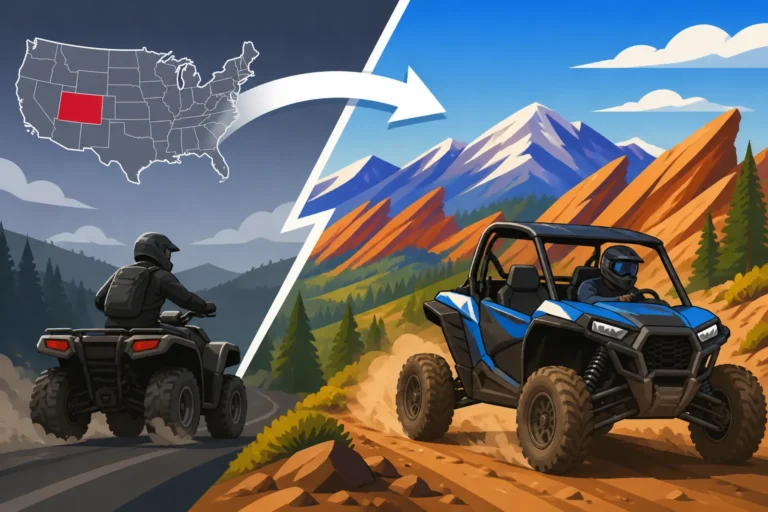
Colorado’s age rules are easiest to understand when you first identify the riding area. A designated off-highway trail, an open riding area, private land, and a public road opened to OHVs are not interchangeable. A route that starts on a trail may also include a road segment, where a different minimum age can apply.
For riders aged 10 to 16, the important general distinction is this: a rider must be at least 10 to operate an OHV on a public road that has been opened to OHV use, and young riders are subject to adult-supervision requirements. The road must actually be open to OHVs; an ordinary public road is not automatically a legal OHV route. Local rules and posted restrictions may add conditions.
Rules for trails and open riding areas can differ from rules for public-road sections. Don’t use a trail-age assumption to decide whether a child may ride a road, or assume that being old enough for a road removes supervision requirements. For a broader age overview, see Colorado Age Rules for Young OHV Riders and Colorado’s Age Ten Rule for Riding an Opened Road.
| Riding setting | What families should check for a rider aged 10 to 16 |
|---|---|
| Designated OHV trail or open riding area | Applicable age and supervision rules, land-manager restrictions, trail difficulty, and machine suitability |
| Public road opened to OHVs | Whether the exact road is open, the minimum age, supervision conditions, and any local operating requirements |
| Private land | The landowner’s permission and any applicable state or local requirements |
| Route combining trails and roads | The rules for every section, not just the starting point |
A public-road section is a particular point of risk for confusion. A county road, town street, or forest road may have its own restrictions. Before riding, confirm that the specific segment is open to OHVs and that the young rider meets its age and supervision conditions. A map or a route description from another rider is not a substitute for current signs and local rules.
For the state-level distinction, Colorado Supervision Rules for Riders 10 to 16 is a useful next read. The practical takeaway is simple: if the planned route touches an opened public road, check that road’s rules separately before the trip.
Supervision means planning, not just riding nearby
A young rider’s supervision requirement is not a detail to improvise at the trailhead. Families should confirm who qualifies as a supervising adult and what “supervision” requires for the type of riding planned. Depending on the rule and setting, distance, visibility, communication, and the adult’s ability to intervene can matter. Do not assume that an adult somewhere in the same riding group is automatically enough.
The safest plan is for the responsible adult to stay close enough to observe the young rider and respond promptly. Keep the group together, agree on signals and stopping points, and avoid putting a child at the front of a group where turns or route choices could separate them from the adult. On a narrow or steep route, an adult may need to ride immediately ahead or behind rather than several machines away.
Before riding, work through these checks:
- Confirm the rider’s age against the route. If any part of the ride uses a public road opened to OHVs, confirm the minimum age for that section.
- Identify the supervising adult. Check the applicable requirements rather than assuming that any adult passenger or group member qualifies. Does the Supervising Adult Need a License in Colorado? covers a related question.
- Agree on how close the adult will stay. Choose a simple plan the child can follow, including where to stop if the group gets separated.
- Choose a route the rider can manage. A route that is legal may still be a poor match for a new rider or a small machine.
- Check signs and closures on arrival. Conditions and restrictions can vary along a route. If signs conflict with an older map or online description, follow the posted restriction and confirm the route before continuing.
Supervision is not a substitute for skill, and a safety course does not replace supervision where supervision is required. Colorado does not generally require an OHV safety certificate simply because a rider is under 16, but a course can still help a young rider learn controls, safe stopping, trail etiquette, and hazard awareness. See Why Colorado Requires No OHV Safety Certificate for the distinction between legal requirements and voluntary training.
A short practice session in a controlled area can reveal issues that are easy to miss on a family ride: trouble reaching the controls, hesitation on a slope, or difficulty judging a turn. Give the rider time to practice starting, stopping, turning, and using the brakes before attempting a longer route. If they are uncomfortable, change the plan rather than expecting them to catch up on a difficult trail.
Match the machine and protective gear to the rider
Age alone does not tell you whether an ATV or UTV is suitable. Riders of the same age can differ in reach, strength, coordination, and experience. The rider should be able to use the controls confidently, sit in the intended position, and follow instructions without struggling to manage the machine. Manufacturer guidance about age and machine size is a useful starting point, but it does not replace an adult’s judgment about the child’s abilities.
For an ATV, check that the young rider can reach and operate the controls while maintaining a stable position. For a UTV, confirm that the rider fits the seat and restraint system as designed. A passenger should use the correct seat and restraint; do not carry more people than the machine is designed for. A seat belt or helmet cannot make an undersized or unsuitable machine safe.
Protective equipment should fit correctly and stay in place during movement. Colorado has helmet requirements for young OHV riders in covered settings, and the exact rules may depend on where and how the machine is being used. Check the applicable requirements before the ride. Even where a particular item is not legally required, a properly fitted helmet, eye protection, long sleeves, long pants, gloves, and over-the-ankle footwear are sensible choices for off-road riding. Helmet and Eye Protection Requirements in Colorado provides more detail.
When choosing a helmet, verify that it meets the relevant safety standard and fits the rider snugly without blocking vision or movement. If shopping through Amazon or another retailer, read the product specifications and inspect the certification markings on the helmet itself; a product listing alone is not proof that a specific helmet is suitable. Replace equipment that is damaged or no longer fits.
The route also needs to match the machine. A narrow trail may be unsuitable for a wide UTV, while a steep or rocky route may demand more control than a young rider has developed. Check the trail’s difficulty, width restrictions, surface, exposure, and expected traffic. In mountain areas, weather, altitude, loose rock, and sudden changes in visibility can make a familiar-looking route more demanding than expected.
Build in breaks and an easy way to turn around. A child who is tired, cold, overheated, or anxious may make less reliable decisions. Agree in advance that the rider can ask to stop without being pressured to continue. That is especially important on routes with exposure, limited places to pull over, or long stretches between trailheads.
Permits and route checks still apply
A young rider’s age does not usually remove the machine’s permit or registration obligations. In general, permit rules attach to the machine and the location where it is used, not simply to the age of its operator. Before setting out, confirm which permit or registration applies to the machine, whether the land or route requires it, and what proof should be carried. Start with Colorado Permit Rules on Public Land if the ride includes public land.
Residents and visitors may face different permit processes. An out-of-state registration or permit should not be assumed to satisfy Colorado requirements; check the rules for the machine and trip. Colorado Non-Resident OHV Permit Explained outlines the visitor permit question. If the machine is plated for road use, do not assume that a plate gives it access to every OHV route or removes other permit requirements.
A practical pre-ride check looks like this:
- Confirm the exact route and identify any public-road sections.
- Verify that each road segment is open to OHVs and that the rider meets its age and supervision rules.
- Check closures, local restrictions, and posted signs.
- Confirm the machine has the required Colorado registration or permit for the planned use.
- Make sure the adult understands the supervision rules and can stay with the young rider.
- Check the machine’s fit, controls, restraints, and condition.
- Confirm that helmets and other protective gear fit and are in good condition.
- Carry a way to contact the group and agree on what to do if anyone becomes separated.
If a route crosses jurisdictions, check each relevant agency or local authority rather than relying on a single statewide map. Rules can differ between a trail system, a county road, a town street, and private property. Written permission is also important when a ride uses private land; permission for one property does not grant access to adjoining public or private routes.
When in doubt, choose a route that avoids road riding until you have confirmed the young rider’s eligibility and the route’s status. That is often a more practical decision than trying to resolve a disputed road rule during a ride. Colorado’s age and supervision rules are only one part of the plan: route access, permits, equipment, skill, and adult oversight all need to line up.
Disclaimer
This article is for general informational purposes only and does not constitute professional advice. Laws, prices and regulations vary by location and change over time. Consult a qualified professional for guidance on your specific situation.