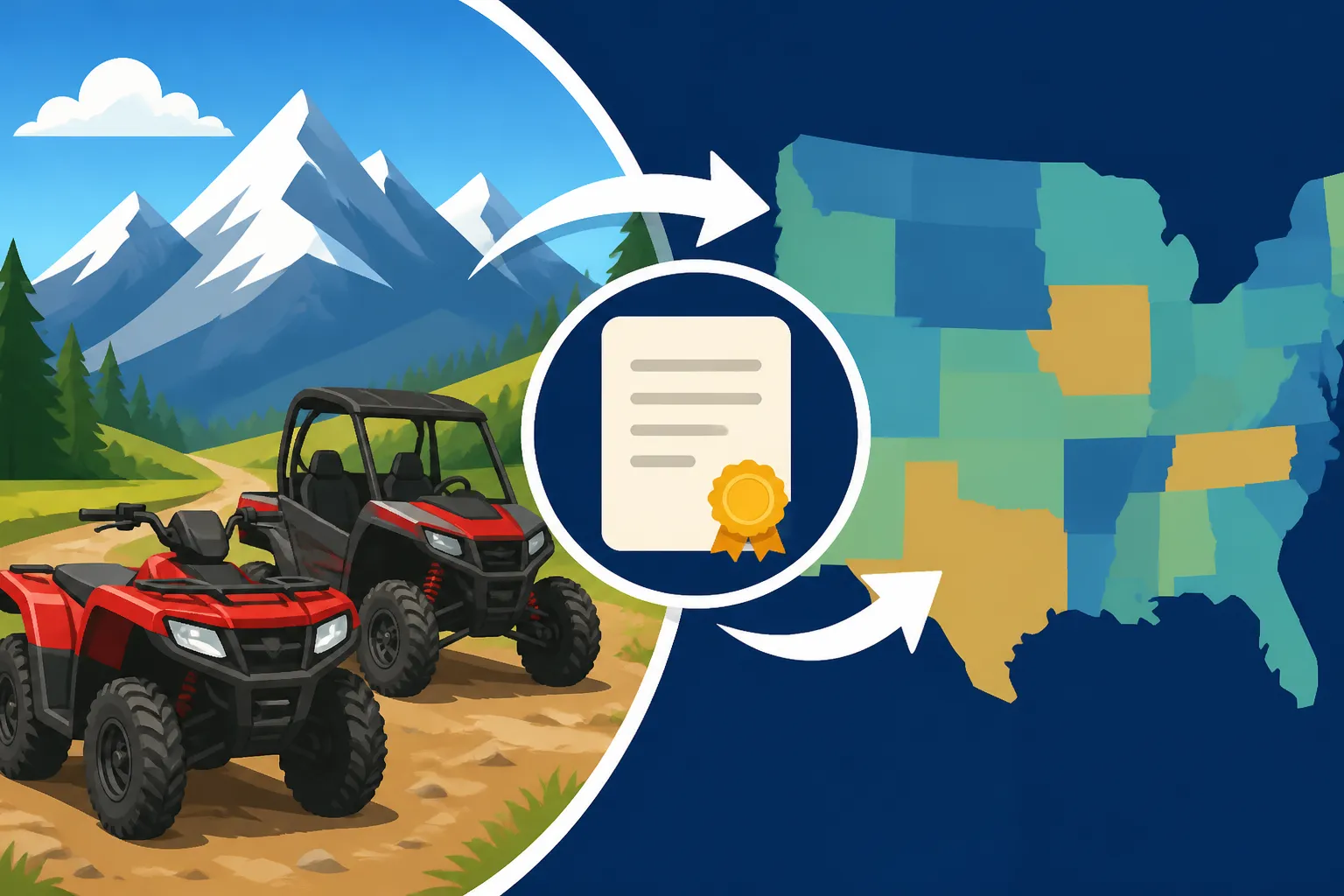
Where Colorado Riders Need a Certificate Elsewhere
Colorado ATV and UTV riders can cross a state line and find that the destination has different safety-course rules. The tricky part is that a Colorado card, registration, or permit may not meet another state’s requirements. Here’s how to check whether a certificate is needed, whether your course counts, and what to confirm before the trip.
What “certificate” means when you ride out of state
A safety certificate is proof that an operator completed an approved off-highway vehicle education course. It is not the same as an OHV registration, riding permit, driver’s license, or vehicle title. A destination state may require one of those documents, several of them, or none for a particular ride.
Rules often depend on the operator’s age, the kind of machine, and where it will be ridden. A state may require education for younger operators on public land but not impose the same rule on every adult. Another may set requirements based on a rider’s date of birth or the machine being operated. Rules can also differ between public trails, private property, and roads open to OHVs.
Colorado riders should not assume that a requirement ends at the state border—or that Colorado paperwork satisfies the destination’s rules. Colorado has its own age and supervision requirements; those do not automatically carry over to a neighboring state. For background on the home-state rules, see Colorado Age Rules for Young OHV Riders.
It also helps to separate two questions:
- Do you need a certificate to operate there? This is about the rider and the destination’s education rules.
- Does your machine need a permit or registration there? This is about the vehicle and the location where you plan to ride.
A safety card does not replace a permit, and a Colorado registration does not necessarily exempt a rider from another state’s education requirement. The same distinction matters in reverse: a visitor’s safety card may address a training requirement in Colorado but does not automatically serve as an OHV permit. Do Out-of-State Safety Cards Matter in Colorado? covers that separate question.
Where Colorado riders may need a certificate
There is no single certificate rule for every state outside Colorado. Requirements are set by each destination, and a rider may be covered by one state’s rule but not another’s. Even neighboring states can treat age, course approval, and the kind of land differently.
Utah is a state Colorado riders should check before heading out. Wyoming riders should check the destination’s rules too, rather than relying on what applies at home. The key is to look up the current requirement for the exact activity, operator, and vehicle—not just search for a broad statement about “OHV safety courses.” For a starting point on nearby-state differences, see Colorado Reciprocity With Utah and Wyoming, then confirm details with the state agency responsible for OHVs where you intend to ride.
| What to check | Why it matters | What to confirm |
|---|---|---|
| Operator’s age or eligibility | Education requirements may apply only to certain riders | Whether the rule is based on age, date of birth, or another condition |
| Machine type | Rules may distinguish between ATVs, UTVs, dirt bikes, and other vehicles | Whether the certificate requirement covers your particular machine |
| Riding location | Public land, private land, trails, and open roads may have different rules | Whether the requirement applies to your planned route |
| Course approval | A certificate from one state may not be accepted by another | Which courses or cards the destination recognizes |
| Permit or registration | A certificate does not authorize the vehicle to ride | Whether a separate permit, registration, or other document is required |
| Supervision rules | A certificate may not remove restrictions on younger riders | Whether an adult must accompany or supervise the operator |
If the rules apply only to certain age groups, check each person who may operate a machine. A parent’s certificate or registration does not stand in for a young rider’s own required credential. Likewise, a passenger does not necessarily need the same documents as the person operating the vehicle, but separate helmet, age, or passenger rules may still apply.
Do not assume that a certificate is needed only on public trails. Some states draw boundaries by land type or route, while others attach requirements to operating an OHV more broadly. Confirm the rule for the exact trail system, riding area, or road you plan to use. If your trip crosses more than one state, check each state separately.
How to check whether a Colorado course card counts
Taking a Colorado safety course can be useful preparation, but completing a course does not guarantee that another state will accept its certificate. Recognition is a decision for the destination state, not something to infer from the course provider’s description or from the fact that both courses cover safe riding.
Before relying on a Colorado card, find the destination’s official OHV or natural-resources agency page and look for its current education requirements. If the page does not clearly address an out-of-state course, contact the agency and ask directly. A useful question is: “Will you accept this Colorado OHV safety course certificate for an operator who meets your education requirement?” Give the course name and explain who will ride, what machine they will operate, and where they plan to ride.
Check the certificate itself, too. Confirm that the rider’s name is correct, that the card or record is accessible, and that the destination accepts the form of proof you have. A digital record may be convenient, but do not assume it is sufficient if the state asks for a specific card or documentation. Save a copy of the course information and any written confirmation from the destination agency.
If the destination does not accept your Colorado course, ask what course it does accept and whether the operator must complete it before riding. Avoid relying on an informal answer from a social-media group, a trail discussion, or a retailer. Those can be useful leads, but they may describe a different rider’s age, machine, location, or rule.
This is also a good time to verify the vehicle-side requirements. A certificate does not answer whether your ATV or UTV must display a destination permit, carry registration documents, or meet equipment rules. Colorado’s rules for taking a machine elsewhere and another state’s rules for visiting riders are related but distinct; Taking a Colorado Machine to Utah and Taking a Colorado Machine to Wyoming can help frame those separate trip questions. For a broader look at how state permit rules may differ, see Colorado OHV Permit Reciprocity With Other States.
A practical pre-trip checklist
Use this process before loading the trailer or leaving with the machine. It is especially helpful when a young rider will operate, when you will cross multiple jurisdictions, or when the route includes both trails and roads.
- List every place you plan to ride. Include the state, riding area, trail system, and any public road segments. A route that crosses a boundary may bring more than one set of requirements into play.
- Identify every operator. Record who will drive each machine, including younger family members who might take a turn. Do not check the rules only for the primary adult operator.
- Look up the destination’s safety-course requirement. Use the official agency responsible for OHVs in that state. Check whether the rule depends on age, birth date, vehicle type, land type, or road access.
- Ask whether your Colorado certificate is accepted. If the answer is unclear, contact the agency before the trip. Keep the response with your travel paperwork.
- Check the machine’s permit and registration separately. Find out whether your Colorado registration is enough, whether an additional permit is needed, and how the document must be displayed or carried.
- Review supervision and equipment rules. A certificate may not remove age restrictions or supervision requirements. Check for any separate rules about helmets, eye protection, passengers, or equipment.
- Carry proof in a practical form. Have the operator’s certificate or course record available as directed by the destination, along with the machine’s relevant registration and permit documents.
For families, it is worth checking the rules well before departure rather than at the trailhead. If a required course is unavailable on short notice, the operator may have to sit out even if the rest of the group’s paperwork is in order. Where a rule is unclear, get a direct answer from the agency responsible for the riding area and retain it with the trip documents.
If you are visiting Colorado instead, do not assume your home-state certificate covers every Colorado requirement. The direction of travel matters: Colorado’s acceptance of another state’s card and another state’s acceptance of a Colorado card are separate questions. Utah Riders Coming to Colorado explains the visitor-side issue for one common border crossing.
The safest rule is simple: treat each state’s certificate requirement as its own check. Verify whether the operator needs a course, whether the exact course is recognized, and whether the machine needs separate registration or a permit. That small bit of planning can prevent a rider from reaching the trail with the right machine but the wrong paperwork.
Disclaimer
This article is for general informational purposes only and does not constitute professional advice. Laws, prices and regulations vary by location and change over time. Consult a qualified professional for guidance on your specific situation.