Does Colorado Snowmobile Certification Expire?
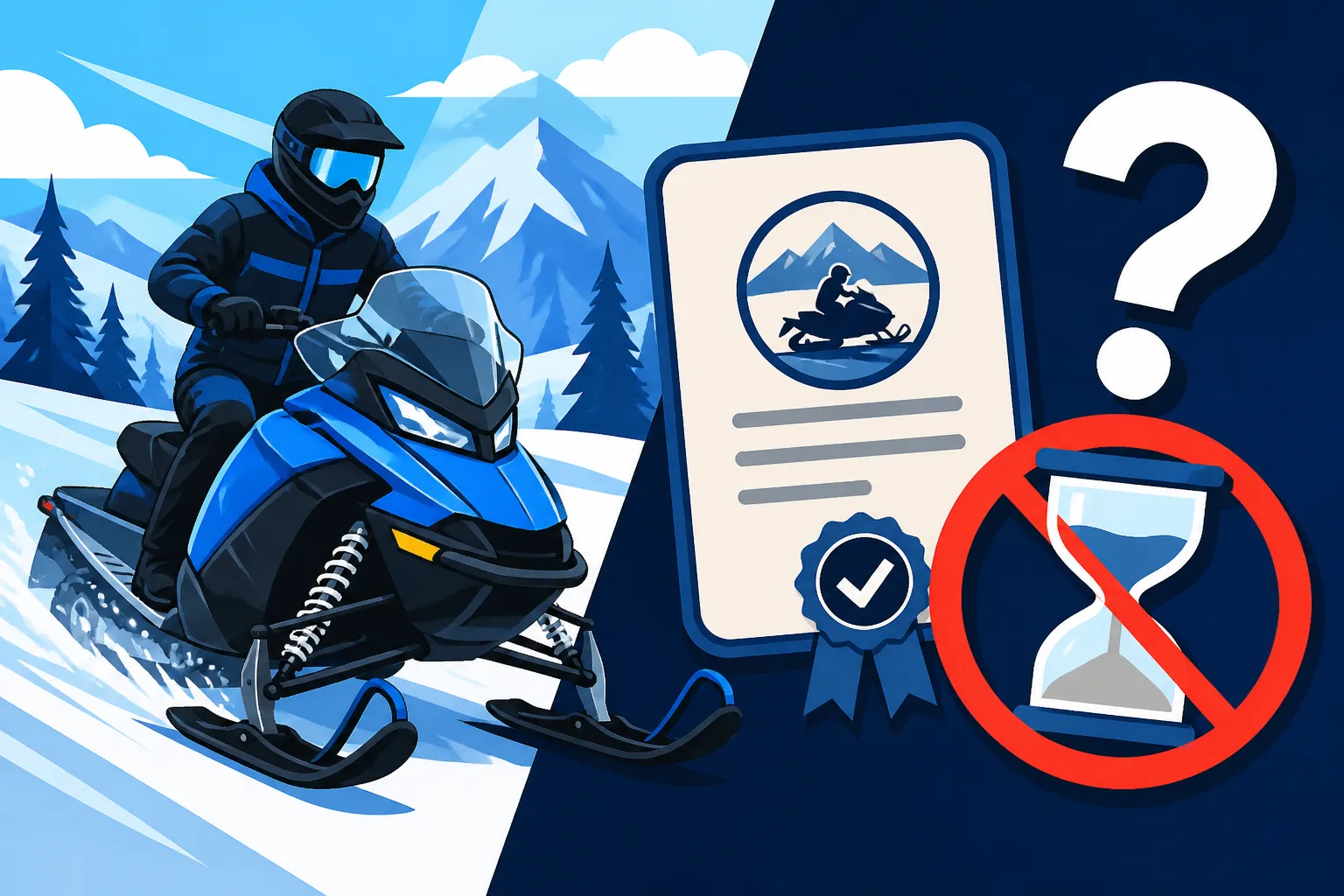
Colorado snowmobile safety certification generally does not expire, but that does not mean every riding requirement lasts forever. The key is to separate the course certificate from permits, age-related rules and other states’ requirements, then check that your proof is available before you ride.
Does a Colorado snowmobile safety certificate expire?
In general, a completed snowmobile safety course certificate does not have a routine renewal date. Riders who have earned a valid certificate usually do not need to retake the course simply because time has passed.
That is different from a permit or registration, which may need to be obtained or renewed for a particular riding season or machine. A certificate shows that you completed required safety education; it does not automatically authorize a specific ride or replace other paperwork.
If you are unsure whether your document is the certificate you need, check the issuing agency and the current requirements with Colorado Parks and Wildlife. A course completion record, a printed card and an online record may all serve as proof, but what a ranger or another state accepts can depend on the applicable rule and how the certificate was issued.
Certificate, permit and registration are different
These terms are easy to mix up, especially when one trip involves a snowmobile, an ATV or a UTV. They answer different questions:
| Document or requirement | What it generally shows | Does it replace a snowmobile safety certificate? |
|---|---|---|
| Snowmobile safety certificate | Completion of an approved safety course, when required | It is the certificate |
| Permit or registration | Permission or legal status for a machine or riding season | No |
| Driver’s license | Authorization to drive certain vehicles on public roads, where applicable | No |
| Proof of ownership | Who owns the machine | No |
| OHV safety course record | Completion of ATV or UTV safety education, when applicable | Not automatically |
A certificate does not make a closed route open, provide permission to ride on private property, or substitute for a required permit. Likewise, buying a permit does not necessarily satisfy a safety-course requirement.
For broader permit questions, see Colorado Non-Resident OHV Permit Explained and Colorado OHV Permit Reciprocity With Other States. Snowmobile and OHV rules are not always interchangeable, so confirm that information applies to the machine you plan to ride.
When should you check the certificate anyway?
Even if the certificate itself does not expire, it is worth checking your proof before a trip. You may have an old card with a damaged name or unreadable details, or you may not remember which course provider issued it. The certificate could also be missing from your current account or paperwork folder.
Check that:
- The certificate belongs to the rider who will be operating the snowmobile.
- The name and identifying details are legible and match the rider’s other documents where relevant.
- You can access the certificate or course record without relying on a phone connection at the trailhead.
- The course is accepted for the type of riding and location you have planned.
- Any current age or supervision rules are met separately.
If you cannot find the card, a missing card does not necessarily mean the course has to be taken again. First, contact the provider or agency associated with the course and ask whether it can verify completion or provide replacement proof. The steps depend on how and where the certificate was issued. Replacing a Lost Snowmobile Certification Card covers that problem in more detail.
What certification does and does not let you do
A safety certificate is evidence of training, not a universal riding pass. It does not, by itself, settle whether you are old enough to operate a machine in a particular situation, whether an adult must supervise, or whether the route is open to snowmobiles.
Those questions can change with the rider, machine and location. A young rider may face rules that do not apply to an adult, while a public trail, private property and a road section can have different requirements. Check the rules for the specific place you intend to ride rather than assuming a course certificate covers every circumstance.
Snowmobile training is not the same as ATV or UTV training
A common point of confusion is assuming that one safety course automatically applies to every motorized machine. Snowmobiles and off-highway vehicles are different categories, and the applicable requirements can differ. A snowmobile certificate should not be treated as proof of an ATV or UTV course unless the agency responsible for the requirement confirms that it is accepted.
Colorado’s rules for OHV safety education are not identical to its snowmobile rules. For an ATV or UTV trip, consult Why Colorado Requires No OHV Safety Certificate and Colorado OHV Rules for First-Time Visitors. Those topics can help clarify the distinction, but always verify the rule for the machine you will operate and the area you will visit.
The same caution applies when one person in a group plans to switch between machines. Do not assume that passing a snowmobile course settles any training or age requirement for an ATV or UTV. Check each machine category separately.
A certificate is not a permit or registration
A certificate generally remains evidence of course completion, while permits and registration address a different issue: whether the machine has the required authorization for the particular use or season.
Before setting out, make a short checklist:
- Identify the machine you will ride and whether it is a snowmobile, ATV or UTV.
- Check the current operating rules for the route and land manager.
- Confirm whether the machine needs a permit, registration or other documentation.
- Check whether the operator’s age triggers training, supervision or equipment requirements.
- Carry or be ready to access the required certificate and machine paperwork.
This is especially useful for visitors bringing a machine from another state. A registration from home does not necessarily answer every Colorado permit question, and a safety certificate does not automatically provide reciprocity. See Do Out-of-State Safety Cards Matter in Colorado? for the recognition issue, and check the current requirements for the particular activity rather than relying on a general assumption about out-of-state documents.
Age and supervision rules are separate checks
A rider’s certificate does not necessarily remove age-based restrictions. Depending on the activity and location, a younger operator may need adult supervision or may be restricted from certain routes or road sections.
Do not use an old certificate as the only check when a child or teenager will ride. Review the current rule for the rider’s age and the kind of machine involved. For ATV and UTV questions, Colorado Age Rules for Young OHV Riders may be a useful starting point, but it is not a substitute for checking snowmobile-specific requirements.
For a family trip, make sure every operator has the required proof and supervision plan. One adult’s certificate does not cover other riders, and a parent or supervisor should not assume that a child’s successful course automatically gives permission to operate in every setting.
How to verify your certificate before riding
The safest approach is to confirm two things separately: whether your course completion is still recognized, and what other requirements apply to the trip. The first is usually straightforward; the second can depend on the machine, rider and location.
Confirm who issued the course record
Look at the card, certificate or confirmation email for the issuing organization and course information. If the document is old or the provider is unclear, contact the agency or course provider that maintains the record. Ask whether they can confirm completion and what forms of proof are currently accepted.
If you took the course outside Colorado, do not assume that the card is invalid—or that every agency must accept it. Recognition can depend on the issuing state, course type and rule at issue. Check with Colorado Parks and Wildlife or the relevant authority before relying on it. The same principle applies when planning to ride outside Colorado: a Colorado certificate may be recognized elsewhere, but another state’s requirements can differ. Where Colorado Riders Need a Certificate Elsewhere discusses why riders should check destination rules.
Check the trip requirements independently
Before travel, identify the land manager or jurisdiction for the route and check its current information. A trail system may have seasonal closures, machine restrictions or permit conditions that have nothing to do with whether your safety certificate expires. If you are unsure who manages the area, confirm that before leaving rather than relying on an old map or a previous year’s plan.
For a Colorado trip involving an OHV rather than a snowmobile, determine whether the machine needs a Colorado permit and whether its home-state status matters. A plated vehicle, a registered machine and an unregistered recreational machine may be treated differently. Colorado OHV Permit Reciprocity With Other States can help frame the question, but the specific permit rule should be verified for your vehicle and destination.
Keep practical proof together. A phone screenshot can be convenient, but service may be unavailable in remote areas or the device battery may run low. Where possible, carry a physical copy or make sure the relevant record is saved for offline access. Keep it with the machine’s registration or permit documents, not buried in an email account you cannot open on the trail.
If the certificate is missing or hard to read
Start with the course provider or the agency that keeps the record. Give them enough information to locate it, such as the rider’s name at the time of the course and approximate course details. Avoid sending personal documents through an unverified contact channel; use the provider’s official contact information.
If an agency cannot locate the record, ask what it accepts as proof and what options are available. Do not assume that you must retake the class, but do not assume a verbal recollection will satisfy an enforcement check either. Get a clear answer before riding where the certificate is required.
Also check whether the problem is actually the certificate. If the missing document is a permit, registration card or ownership paper, the replacement process will be different. A safety-course provider generally cannot replace machine paperwork, and an OHV permit vendor may not be able to retrieve a snowmobile course record.
A simple pre-ride check
Use this quick sequence when planning a ride:
- Confirm the machine category: snowmobile, ATV or UTV.
- Locate the safety certificate and verify that it belongs to the operator.
- Check current rider age and supervision requirements.
- Confirm permits, registration and route access separately.
- Check out-of-state recognition if the course or machine comes from elsewhere.
- Save or carry the proof in a form you can access without reliable cell service.
The main takeaway is that a Colorado snowmobile safety certificate generally does not need periodic renewal just because it is old. But the certificate is only one part of being ready to ride. Verify that the proof is accepted, then check current permit, age, route and reciprocity requirements for the machine and location.
Disclaimer
This article is for general informational purposes only and does not constitute professional advice. Laws, prices and regulations vary by location and change over time. Consult a qualified professional for guidance on your specific situation.