Colorado Permits for a Plated Jeep
A license plate does not automatically give a Jeep permission to use every Colorado OHV trail. The answer depends on where you drive, where the Jeep is registered, and whether the route is open to ordinary highway vehicles or managed as an OHV route. Here’s how to sort out the permit question before you unload, turn off the pavement, or head for a trailhead.
When a plated Jeep needs a Colorado OHV permit
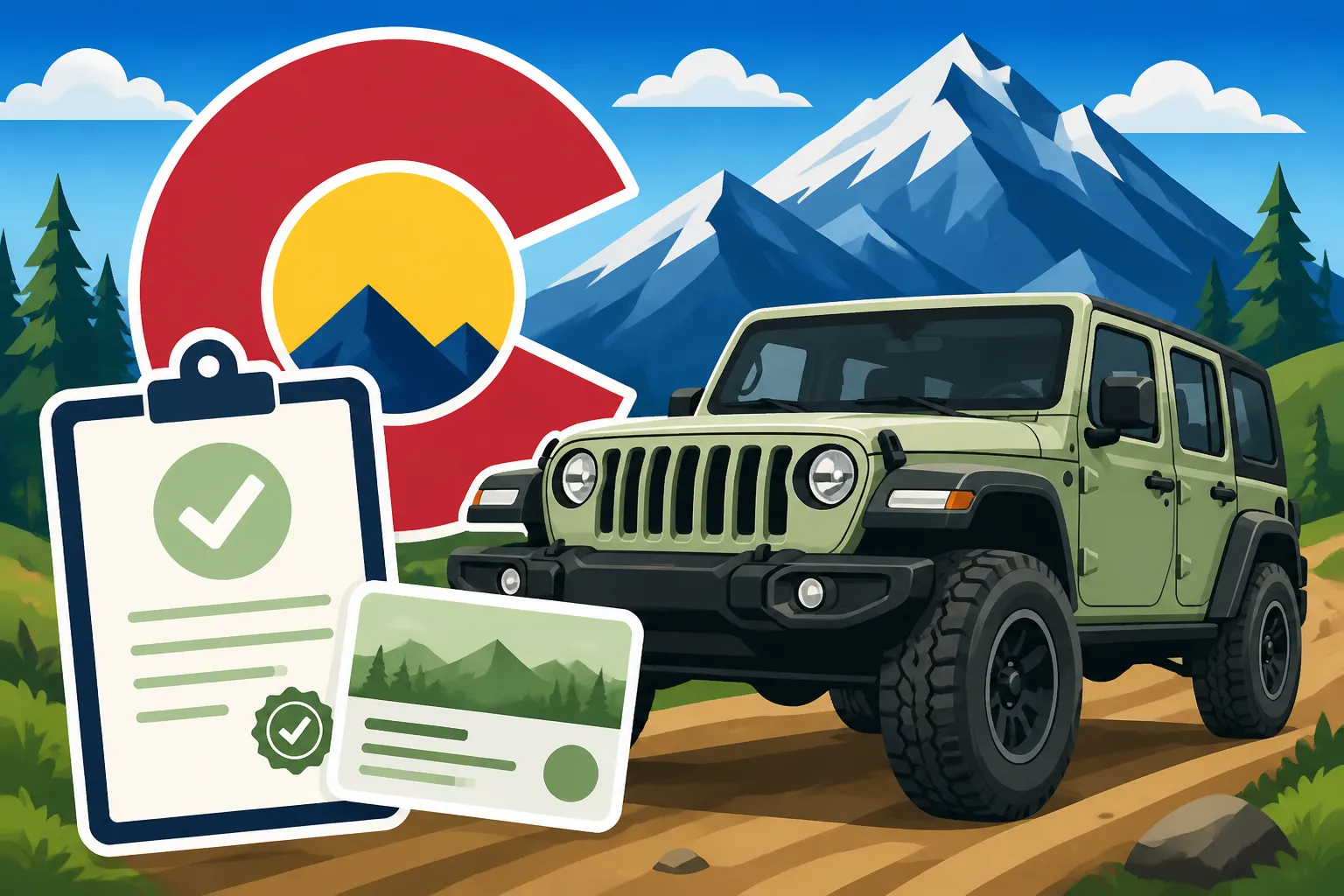
A plate and an OHV permit serve different purposes. The plate shows that the Jeep is registered for highway use. An OHV permit or registration addresses its use on routes and areas where Colorado requires OHV authorization. One does not automatically replace the other.
If you plan to take a plated Jeep onto a designated OHV trail or into an OHV riding area, check the permit requirement before setting out. Out-of-state registration does not, by itself, guarantee that your Jeep is covered for OHV use in Colorado. The vehicle may need a Colorado nonresident OHV permit even though it is street legal in its home state.
That does not mean every drive on a dirt or gravel road requires an OHV permit. A public road open to ordinary motor vehicles is different from a route designated for OHV use. A Jeep traveling on a public road under its regular registration is generally using its highway authorization; a Jeep entering a designated OHV area may be subject to the area’s permit rules. The surface alone—pavement, gravel, or dirt—does not settle the question.
The route’s legal designation matters. So does the land manager’s rule. A county road, a Forest Service road, a BLM route, and a signed OHV trail can have different access conditions, even when they connect to one another. Check the current route information and local restrictions rather than assuming that a street-legal vehicle can travel anywhere an ATV or UTV can.
| Where you plan to drive the Jeep | What to check |
|---|---|
| Public road open to ordinary highway vehicles | Confirm the road is open and that the Jeep meets its normal registration and equipment requirements |
| Designated OHV trail or riding area | Check whether a Colorado OHV permit or registration is required for your vehicle and residency status |
| Road that connects with an OHV trail | Confirm which sections are open to plated vehicles and whether permit rules change along the route |
| Private property | Get the owner’s permission and check whether any separate public-land permit rule applies to the trip |
The practical rule is simple: don’t treat the plate as a universal OHV pass. If your trip includes designated OHV routes, check the permit requirement for your specific Jeep and itinerary. For context on why a plate may not be enough, see Why Plated Vehicles Still Need a Colorado Permit? and Do Street-Legal Trucks Need a Colorado OHV Permit?.
Colorado plates and out-of-state plates
Your Jeep’s state of registration can change which permit or registration process applies. A Colorado-plated Jeep and an out-of-state-plated Jeep are not necessarily handled the same way for OHV use. Before buying anything, identify whether the vehicle is registered in Colorado or elsewhere, and whether the planned route is an OHV trail, an open riding area, or a public road.
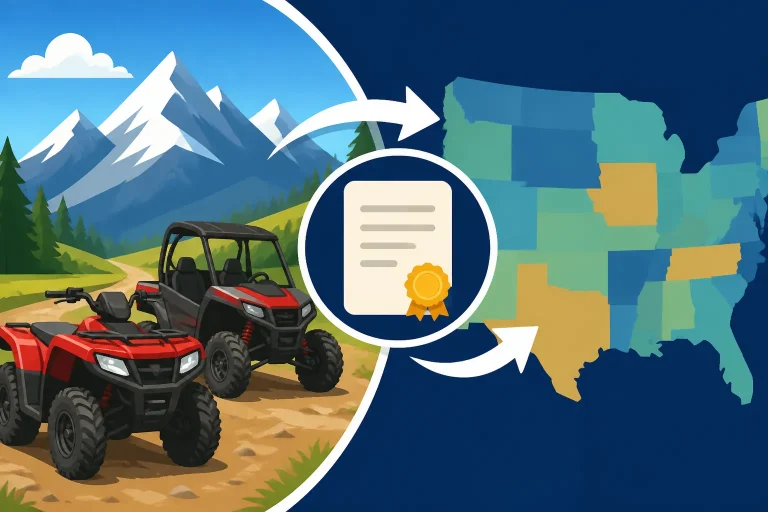
If the Jeep is registered outside Colorado, do not assume that a home-state plate, off-highway sticker, or registration automatically satisfies Colorado’s requirements. States do not always recognize each other’s OHV permissions, and road-use registration is not the same as permission to use a designated OHV route. Colorado’s rules for visitors are covered in Colorado Permits for Plated Street-Legal Vehicles and Colorado OHV Permit Reciprocity With Other States.
If the Jeep has Colorado registration, check the Colorado resident rules that apply to its intended use. Do not assume either that a plate makes the Jeep exempt from all OHV requirements or that every plated Colorado vehicle needs a separate permit for every road. The answer depends on the vehicle’s status and the kind of route being used. Colorado Resident OHV Registration Price explains the resident registration side, while Which Colorado Permit an Out-of-State Rider Buys is a useful starting point for a visitor.
A useful pre-trip check is to write down three details before contacting a permit vendor or land manager:
- The state where the Jeep is registered.
- Whether you will use a designated OHV trail or area, rather than only roads open to regular motor vehicles.
- Whether you will cross between routes managed by different agencies or local governments.
Those details make it easier to get a direct answer. “I have a plated Jeep” may not be enough information; the person answering also needs to know where you plan to drive it.
A permit does not make an illegal route legal
An OHV permit is not a road-use authorization and does not open a closed route. It also does not convert a road that bars your vehicle into one you may use. The Jeep still has to meet the route’s access rules, and you must follow closures, local ordinances, signs, and any restrictions on vehicle type or size.
This distinction matters on Colorado trips where a public road and a trail network meet. A route may be open to plated vehicles for one section, then become an OHV trail with separate conditions. In a mountain town, a county or municipal rule may limit where OHVs can travel even if a nearby trail is open. A plate does not override those local rules.
Before driving, confirm:
- The exact route or area is open to your type of vehicle.
- Whether the route is a public road, an OHV route, or a combination of both.
- Whether a Colorado permit or registration is required for the Jeep.
- Whether local restrictions apply, including town rules, seasonal closures, or vehicle-width limits.
- What equipment or operating rules apply to the route.
A map is useful, but it may not show a recent closure or a local rule. Check the current information from the relevant land manager or local authority, and pay attention to signs at the route entrance. When the route designation is unclear, ask before entering rather than relying on what other vehicles appear to be doing.
If your Jeep is plated in another state, the plate may allow normal highway travel without giving you OHV access. That distinction is especially important for visitors who have used the same vehicle on public roads at home and assume its highway registration settles the question everywhere. For more on visitor requirements, see Colorado Non-Resident OHV Permit Explained and Out-of-State Machines on Colorado Trails.
How to check and prepare before you go
The most reliable approach is to match the Jeep’s registration status to the route, then verify the current rule with the agency or vendor responsible for the permit. Do this before the trip, especially if you are traveling to a remote trailhead where an incorrect assumption could mean turning around.
- Choose the route, not just the destination. Write down the trail, road, or riding area you plan to use. If you will travel through several jurisdictions, list each section.
- Identify the vehicle’s registration state. Note whether the Jeep is Colorado-registered or registered elsewhere. Keep the registration information handy when asking about the permit.
- Check the route’s designation and access. Confirm whether it is open to plated highway vehicles, limited to OHVs, or subject to a seasonal or local restriction.
- Ask whether the Jeep needs a Colorado permit or registration. Describe the registration state and intended route. Do not ask only whether the Jeep is “street legal”; that may not answer the OHV permit question.
- Use an authorized purchase or registration channel. If a permit is required, follow the current instructions for obtaining it and confirm how it must be displayed or carried.
- Recheck shortly before departure. Weather, seasonal gates, maintenance, fire conditions, and local decisions can affect access after you first plan the trip.
Keep proof of the Jeep’s regular registration with you, along with any required OHV permit or registration documentation. Follow the current rules on whether the permit must be displayed on the vehicle or carried in another way. Do not rely on a receipt alone unless the applicable instructions say it is accepted while you wait for the permit or decal.
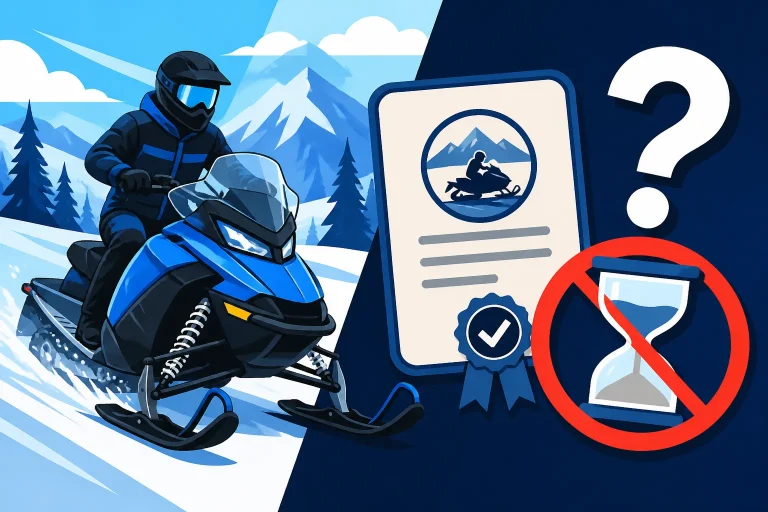
The permit’s price, validity period, purchase options, and display instructions can change. Confirm current details with Colorado Parks and Wildlife or the authorized permit provider rather than relying on an old receipt, an outdated sticker, or a friend’s experience. Colorado OHV Permit Price and Validity and Where to Put a Non-Resident Permit cover those practical questions.
A few common assumptions are worth avoiding:
- “It has a plate, so it can go on any trail.” A plate supports highway use; it does not cancel trail closures or replace any OHV permit requirement.
- “The road is dirt, so it must need an OHV permit.” Road surface alone does not establish the route’s legal status.
- “My home-state registration is enough.” Do not assume another state’s registration or permit is recognized for Colorado OHV use.
- “A permit means the route is open.” A permit does not override access restrictions, seasonal closures, or local ordinances.
- “Every part of the trip has the same rule.” Requirements can change when a route crosses between roads, trails, land managers, or jurisdictions.
The takeaway: a plated Jeep can still have a Colorado OHV permit requirement when it is used on designated OHV routes. First confirm where the route is open to your vehicle, then check the permit rules for the Jeep’s registration state. Treat the plate, the permit, and route access as separate questions, and verify all three before you leave.
Disclaimer
This article is for general informational purposes only and does not constitute professional advice. Laws, prices and regulations vary by location and change over time. Consult a qualified professional for guidance on your specific situation.