Family-Friendly Colorado OHV Trails
A family ride can go sideways quickly when a route is narrower, steeper, busier, or more exposed than the map suggested. This guide helps you choose Colorado OHV areas with options for mixed experience levels, plan around altitude and changing conditions, and set a comfortable pace for kids and newer riders.
What makes a Colorado OHV trail family-friendly
Look beyond the trail name
A trail area described as family-friendly does not mean every route in it is suitable for every family. One trail system can include mellow roads, narrow tracks, steep climbs, loose rock, and routes that demand confident machine handling. The useful question is not simply “Is this area good for families?” It is “Can we find a route here that fits our least experienced rider and the machine we brought?”
Check the route’s width rating, surface, grade, and difficulty before you go. A road marked for full-size vehicles may still have a rough, exposed section that feels intimidating to a first-time passenger. A route that looks easy on a screen can also become harder after rain, snowmelt, washouts, or heavy traffic. If your group includes children or new riders, plan a modest first outing rather than assuming you will cover a full day’s worth of trails.
Machine fit matters too. A route may be manageable on a narrow ATV but uncomfortable in a wider side-by-side, or the reverse. Before loading up, compare your vehicle’s width and turning needs with the route information. For more on choosing an appropriate route, see [Colorado Trails Suited to Beginners] and [Trails That Suit a 50-Inch Machine].
Match the ride to the youngest or least experienced person
Families often plan around the adult who has ridden before. It is usually wiser to plan around the person who is most likely to feel tired, cold, nervous, or overwhelmed first. That might be a child, a new rider, or an adult who has never spent several hours on a rough trail. A short loop with time to stop and look around is often a better first day than a long route chosen for its scenery alone.
Talk through the plan before anyone starts the engine. Explain that stopping is allowed, turning around is not a failure, and the group will regroup at agreed points. On a side-by-side ride, passengers can feel every rut and tilt, so check in with them instead of assuming quiet means comfortable. On ATVs, keep spacing generous and avoid pressuring a newer rider to follow a faster one through a difficult section.
A family-friendly outing also needs practical stopping places. A wide turnout, trailhead, or established staging area is a better place to take a break than a blind corner or narrow shelf. Build in time for water, food, bathroom stops, and clothing adjustments. The route is only one part of the day; the pace and the group’s ability to pause safely matter just as much.
Colorado riding areas to consider with a family
Grand Mesa for varied riding options
Grand Mesa can work well for families who want a high-country setting and are willing to choose routes carefully. The broader area offers different kinds of riding, so a group can look for an outing that suits its machine and experience rather than committing to one ambitious pass. Forest roads and less technical routes may appeal to newer riders, while more challenging trails can be left for another trip.
The high elevation changes the feel of a ride. Even on a sunny day, wind and clouds can make it chilly, and a route that seems short on a map can take longer when the group stops often or moves cautiously. Bring warm layers, water, and sun protection. If someone in the group is not accustomed to altitude, keep the first ride conservative and pay attention to headache, nausea, unusual fatigue, or dizziness.
Grand Mesa’s conditions and access can vary with season and weather. Check current closure notices and official route maps before setting out; do not assume a road is open just because it appears in an older map or a saved track. For planning ideas, see [Riding the Grand Mesa in Colorado] and [Grand Mesa Lakes Loop Riding].
Taylor Park for a base-camp style trip
Taylor Park can suit families who prefer to establish a base and choose a ride each day. The area around the Gunnison National Forest has a network of routes, which gives groups a chance to select a conservative outing rather than treating one long ride as the only option. That flexibility can be helpful when a child tires early, weather shifts, or a machine needs attention.
Do not confuse the number of routes with a guarantee that every route is beginner-friendly. Narrow trails, rough surfaces, elevation, and changing weather can make a route demanding. Before leaving camp or a staging area, agree on the destination, turnaround point, and a time to reassess. If one person is uncomfortable, choose the easier option or head back while the group is still having a good day.
A base-camp approach also makes it easier to carry extra food, warm clothing, and basic supplies in a support vehicle or at camp. Be thoughtful about where you park and stage, and keep access clear for other visitors. Explore [Taylor Park in the Gunnison National Forest] and [Taylor Park Reservoir Trail Access] when comparing the area with other Colorado riding destinations.
Rampart Range for a trip near Colorado Springs
Rampart Range Recreation Area is a well-known option for riders near Colorado Springs, but popularity brings a planning tradeoff: busy weekends can mean more traffic, dust, and encounters with other vehicles. Families may find it helpful to choose a quieter time when practical, start early, and pick an outing that leaves room to turn around without feeling rushed.
Expect changing surfaces and pay attention to route signs. A road that seems straightforward can still have loose gravel, rocks, washboard, or blind turns. Keep children close to the adult leading the ride, use a pace that allows everyone to respond to hazards, and leave enough distance to see through dust. If visibility drops, slow down and wait for it to settle rather than following another vehicle’s dust cloud.
Check local access information before the trip because closures, fire restrictions, and trail conditions can affect where you can ride. A saved route should never take precedence over signs or a posted closure. You can compare options through [Rampart Range Recreation Area Riding] and [Rampart Range Trail Ratings].
Rabbit Valley for families comfortable with desert conditions
Rabbit Valley, near Grand Junction and the Utah line, offers a very different experience from the high-country forests. The open desert setting can be appealing when mountain routes are cold or inaccessible, but it brings its own demands: sun exposure, limited shade, dust, and a need to carry enough water. The landscape may look open, yet the terrain and route difficulty can change quickly.
Families should plan conservatively, especially if children are riding in the heat or have little experience on loose or rocky surfaces. Take water breaks before anyone feels depleted, and do not count on finding shade or services along the route. Check weather and access conditions, bring a map, and identify a turnaround point before leaving the staging area. A shorter loop close to the start can be a better choice than extending the ride because the terrain initially seemed easy.
Desert routes can also be confusing where tracks branch or cross. Use official route information and follow signs rather than making a guess at a junction. For area-specific planning, see [Rabbit Valley Desert Trail Riding] and [Rabbit Valley Camping Near the Utah Line].
| Riding area | Family-planning strengths | Conditions to plan for | A sensible first-ride approach |
|---|---|---|---|
| Grand Mesa | Varied routes and a high-country setting | Elevation, wind, cold, and seasonal access changes | Choose a shorter, less technical route and check closures |
| Taylor Park | A base-camp feel with multiple route choices | Rough or narrow routes, altitude, and changing weather | Pick one conservative outing and set a clear turnaround point |
| Rampart Range | Convenient for riders near Colorado Springs | Weekend traffic, dust, and blind turns | Start early when possible and leave extra space between vehicles |
| Rabbit Valley | Desert scenery and a different seasonal feel | Heat, sun, dust, and limited shade | Carry ample water and keep the first route short |
How to choose a route and prepare before leaving
Read maps and signs as a set, not in isolation
Use current official route information to confirm where motorized travel is allowed and what kind of vehicle can use each route. A general recreation map may show an area without making every route’s restrictions clear. A Motor Vehicle Use Map, trail signs, and local closure notices each provide useful information; compare them rather than relying on a single app or a track shared by another rider.
Digital tools can make route planning easier, but they do not replace posted signs. Some families use onX Offroad to review route options and keep a digital map available, then cross-check access and restrictions against official maps and signs. Download maps for offline use before leaving areas with reliable service. For a more complete map-preparation routine, see [Reading a Colorado Motor Vehicle Use Map] and [Downloading a Motor Vehicle Use Map].
At each junction, pause long enough to confirm the route. Do not follow tire tracks just because they appear established; they could lead onto a closed or unauthorized route. If your group is uncertain, stop in a safe place and check the map. For a family trip, a few minutes spent confirming a turn is better than realizing much later that the group is on a route beyond its comfort level.
Check weather, seasonal access, and altitude
Colorado conditions can change significantly between a trailhead and a high pass. A warm morning in town does not guarantee a warm afternoon at elevation. Afternoon storms, cold wind, and lingering snow can affect both comfort and traction. Before departure, check the forecast for the riding area and look for current closure notices, not only a general forecast for the nearest town.
Seasonal access is another important part of the plan. Roads and trails may be closed for snow, mud, wildlife protection, maintenance, or fire danger. A route shown in an older guidebook may not be open during your planned trip. Review [When Colorado OHV Trails Open Each Summer] and [Colorado Trail Closures and Where They Are Posted] as part of your planning, then follow the signs you encounter on the ground.
Altitude can make ordinary exertion feel harder, especially for visitors coming from lower elevations. Take it easy on the first day, drink water regularly, and avoid turning a ride into a race. If anyone develops concerning symptoms, stop and assess rather than pushing onward to reach a planned destination. Families with younger children should be especially willing to shorten the ride when energy or comfort starts to fade.
Pack for delays, not just the planned ride
A short ride can take longer than expected because of a flat tire, a blocked route, a mechanical issue, or a child who needs a break. Pack drinking water, snacks, warm layers, sun protection, a basic first-aid kit, and a way to navigate without cell service. Carry tools and recovery gear suited to your machine, and make sure someone in the group knows how to use what is packed.
Before departure, tell someone who is not riding where you plan to go and when you expect to return. Keep the plan realistic and update that person if the route changes. Cell coverage can be unreliable in mountain areas, so do not make a phone signal part of your emergency plan. For more preparation ideas, read [What to Carry Over a High Pass] and [Cell Service on Colorado Mountain Trails].
Give each rider or passenger a clear role. One adult can lead, another can bring up the rear, and the group can agree to stop at safe junctions. If you are riding with multiple machines, establish a simple regrouping routine: wait at marked intersections, do not race to catch up, and make sure the last vehicle is accounted for before continuing.
Keeping children and new riders comfortable and safe
Choose equipment and supervision thoughtfully
A machine should fit the rider’s size, ability, and experience. A child who can reach the controls while stationary may still struggle to manage a machine over bumps or on a slope. Adults should supervise closely and set expectations before starting: stay on the route, keep a safe following distance, and stop when instructed. Do not assume that a child who rides confidently in an open area is ready for a narrow or steep trail.
Passengers need to be comfortable too. In a side-by-side, make sure everyone is seated correctly and using the available restraints as intended. Take breaks to check whether passengers are cold, frightened, or uncomfortable. A quiet child may be concentrating or may simply be reluctant to ask for a stop, so ask directly and make the answer easy to give.
Rules can vary according to the type of route, rider age, and machine. Review the applicable requirements before your trip rather than relying on what a friend remembers. Useful starting points include [Colorado Rules for Riders Aged 10 to 16] and [Colorado Helmet and Eye Protection Requirements in Colorado]. Follow posted requirements and use protective equipment appropriate for the ride.
Set a pace that leaves room for mistakes
New riders need time to process turns, changing surfaces, and the behavior of other vehicles. Keep the group slow enough that riders can see hazards and choose a response without pressure. Avoid crowding, passing in poor visibility, or asking a new rider to maintain an adult’s pace. If the group stretches out, regroup at safe, visible stopping places rather than urging someone to catch up.
Dust deserves special attention because it reduces visibility and can hide rocks, ruts, or an approaching vehicle. Leave a generous gap between machines and slow down when the view is obscured. On a narrow route, wait for a suitable place to pass instead of squeezing by. If another group approaches, pause where there is room and communicate calmly.
Make the ride feel manageable by breaking it into small sections. Instead of saying, “We have a long way to go,” describe the next planned stop and reassess there. A child or new rider may find a series of short goals less intimidating. If the route becomes uncomfortable, turning back is a sound decision—not a poor use of the day.
Practice low-impact riding and good trail etiquette
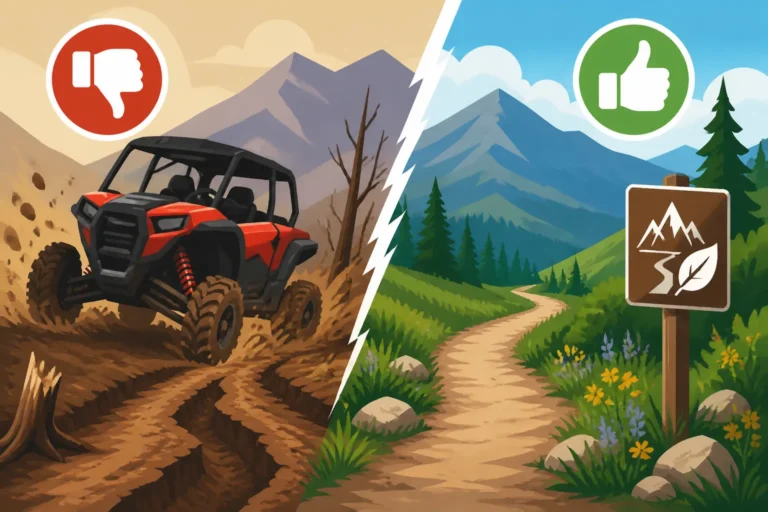
Family rides are a chance to model respect for the land and other visitors. Stay on designated routes, avoid cutting corners, and do not create new tracks to get around mud or an obstacle. Going off route can damage vegetation and soil, and in some places it can lead to closures or enforcement. Make sure every rider knows that the route line on a map is not a suggestion to improvise beyond marked access.
Keep noise and speed under control near homes, campgrounds, trailheads, and other riders. Yield where required, pass with care, and give hikers, cyclists, and horse users room. A friendly wave and a patient pause can make a shared route feel much less tense. In busy areas, avoid revving or accelerating hard simply to keep up with the machine ahead.
Pack out food wrappers, bottles, and broken parts. If you encounter a damaged sign, blocked route, or unsafe condition, note the location and report it through the appropriate land manager or local contact. For family-friendly guidance that extends beyond vehicle handling, see [Stay The Trail Ethics in Colorado] and [Colorado Trail Damage and Resource Protection].
A practical family ride plan
Use a simple pre-ride checklist
The evening before the trip, confirm the riding area, route access, forecast, and any current closures. Compare your machine’s width and capabilities with the route information. Download maps for offline use, agree on a conservative turnaround point, and let someone outside the group know the plan. If you are new to an area, choose a route with a clear return rather than a complicated network of branching trails.
In the morning, check tire condition, fuel, lights, brakes, and essential fasteners. Make sure everyone has suitable clothing, eye protection, and a helmet where required. Put water and snacks somewhere accessible without creating a loose-item hazard. Review the group’s stopping and regrouping plan before leaving the staging area.
At the end of the ride, check that everyone is accounted for and comfortable, then look over the machines for obvious damage or loose parts. If the day included a difficult section, talk about what made it challenging while the details are fresh. That conversation can help you choose a more suitable route next time, whether that means a shorter loop, a different area, or more practice close to camp.
Know when to change the plan
A good plan is useful only if the group is willing to adjust it. Turn around if weather worsens, a route is more difficult than expected, visibility is poor, a machine develops a problem, or a rider is no longer comfortable. Do not let a promised destination or the effort involved in reaching the trailhead convince you to continue into conditions that feel wrong.
Keep a backup option in mind before you start. That may be a shorter loop, a lower-elevation route, or a return to camp for lunch. It can also mean calling the ride early and spending the rest of the day exploring nearby without a machine. Families often remember the relaxed parts of a trip more fondly than the number of miles they covered.
The most reliable family-friendly trail is the one that fits the group on that particular day. A route that works for confident adults may not work for a tired child, a first-time rider, or a machine with limited clearance. Plan conservatively, follow current access information, and treat turning back as part of responsible riding.
Disclaimer
This article is for general informational purposes only and does not constitute professional advice. Laws, prices and regulations vary by location and change over time. Consult a qualified professional for guidance on your specific situation.