Do Colorado Passengers Under 18 Need a Helmet?
Colorado passengers under 18 need to wear a helmet when riding an ATV or UTV in Colorado. That rule is easy to overlook when a child rides in a side-by-side with a roll cage or arrives on a machine registered in another state. Here’s what to check before the ride, including helmet standards, passenger seating and how permits fit in.
The short answer: yes, passengers under 18 need a helmet
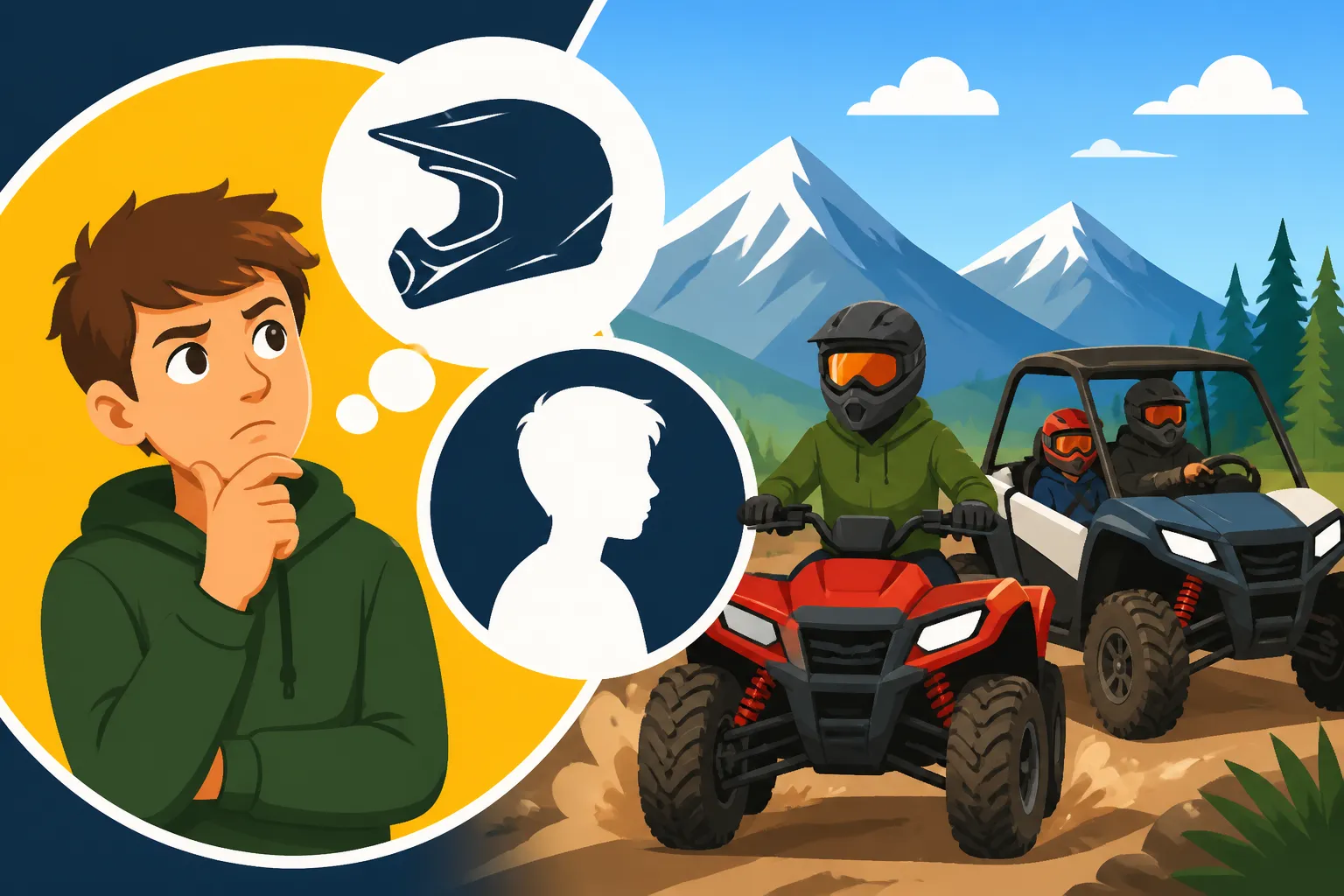
Colorado requires a person under 18 who operates or rides as a passenger on an off-highway vehicle to wear a protective helmet that meets U.S. Department of Transportation standards. The requirement applies to passengers, not just drivers. A child riding in a UTV therefore should not assume that the vehicle’s doors, roll cage or seat belt make a helmet unnecessary.
The rule concerns the rider’s age, not the vehicle’s owner or where it was registered. A helmet is still needed if a parent, rental operator or other adult owns the machine. Likewise, a registration, permit or pass does not replace required safety gear.
| Situation | What to plan for |
|---|---|
| Passenger under 18 on an ATV | Wear a DOT-compliant helmet and use only a seat intended for a passenger |
| Passenger under 18 in a UTV | Wear a DOT-compliant helmet and use the designated seat belt |
| Passenger 18 or older | The under-18 helmet requirement does not apply, but a helmet remains a sensible safety choice |
| Machine registered outside Colorado | Do not treat the home-state registration as an exemption from Colorado riding requirements |
| Ride on public land or an OHV route | Check the applicable permit and route rules as well as the helmet requirement |
For the broader age and riding rules, see Colorado Age Rules for Young OHV Riders. The helmet requirement is separate from rules about who may operate a machine, whether a young person may ride a particular route, and what permission or permit is needed.
Colorado’s OHV permit system and helmet requirements answer different questions. A permit or registration may be required for a machine or rider in a particular setting; a helmet is protective equipment worn by the person. State-to-state permit reciprocity does not make an under-18 passenger exempt from Colorado’s helmet rule. See Colorado OHV Permit Reciprocity With Other States and Out-of-State Machines on Colorado Trails if you are bringing a machine from elsewhere.
Choosing a helmet that meets the requirement
Look for a motorcycle-style helmet with a DOT certification label, and check that the label is attached to the helmet rather than relying only on a product description. Bicycle helmets, construction hard hats and soft caps are not substitutes for a DOT-compliant motorcycle helmet.
A helmet should fit the passenger who will wear it. A child’s helmet that is loose, rocks from side to side or slides over the eyes is not a good fit, even if its label indicates the right standard. When possible, have the child try it on while wearing any balaclava or thin head covering they plan to use. The helmet should sit level, feel snug without painful pressure points and stay in place when the child moves their head. Fasten the chin strap for the ride.
A child should not share an adult’s helmet simply because it is available. Adult helmets are often too large, and adding padding is not a reliable way to correct a poor fit. If you are buying online, confirm the sizing information and return policy before ordering. For example, when comparing options on Amazon, check the certification label and fit details rather than relying on a listing title or a general claim that a helmet is “protective.”
A helmet also needs to be in sound condition. Don’t use one with a cracked shell, damaged strap or signs of impact. A helmet can have internal damage that is hard to see after a significant hit, so replace it after an impact rather than assuming it is still protective. Follow the helmet maker’s care and replacement guidance; avoid modifying the shell or using cleaning products the maker does not recommend.
Helmets, goggles and other protective gear
A helmet protects the head, but it does not shield a passenger’s eyes from dust, grit, branches or wind. Goggles or other suitable eye protection can make a ride safer and more comfortable. Rules for eye protection may depend on the vehicle and its equipment, so check the current requirements for your ride rather than assuming the helmet covers every obligation. The related rules are covered in Eye Protection Rules for Passengers and Helmet and Eye Protection Requirements in Colorado.
For a UTV, the helmet is only one part of the passenger’s protection. Use the installed seat belt, keep arms and legs inside the vehicle, and use doors, nets or other occupant restraints as designed. A roll cage is not a substitute for a seat belt, and a seat belt is not a substitute for a helmet. For details on restraint use, see Seat Belts in a Side-by-Side.
Check that the passenger can ride safely
A legal helmet does not make every passenger or every seat suitable for a ride. Before leaving, confirm that the vehicle is built to carry a passenger and that the child can sit securely in the intended position. Follow the machine’s owner’s manual for passenger, seat and weight limits.
On an ATV
Many ATVs are designed for one rider. Do not carry a passenger on a machine that has no designated passenger seat, footrests and suitable handholds. A passenger who is perched behind the operator or cannot keep their feet on the footrests can shift the machine’s balance, particularly on uneven ground or during a turn.
If the ATV is designed to carry a passenger, check that the child can sit upright, hold on and keep their feet planted where the manufacturer intends. Do not let a passenger sit on a rack or cargo box. Those areas are not passenger seats. More on the risks and practical considerations appears in Carrying a Passenger on a Quad.
In a UTV
Use only an installed passenger seat and its restraint system. Check that the belt fits the child as intended and can be fastened securely. If the belt cannot be adjusted to hold the passenger properly, or the child is too small to sit securely in the seat, don’t assume that a booster or improvised cushion will solve the problem. Follow the vehicle maker’s guidance and do not use a passenger position that is unsuitable for the child.
A child’s helmet should fit with the UTV’s head restraint, seat and belt arrangement. Check that it does not prevent the child from sitting back properly or using the restraint as designed. Keep the helmet on for the whole ride, including short trips between a staging area and a trail.
Consider the route and the child’s ability
Route difficulty matters as much as equipment. A passenger may be uncomfortable or unable to brace safely on a rough, narrow or steep trail even when the vehicle has proper seating. Choose a route that matches the machine, the driver’s experience and the passenger’s ability to remain seated and follow instructions. Stop if the child is tired, cold, frightened or unable to keep a secure position.
Rules for younger riders can change with the setting. A passenger rule is not the same as permission for a child to drive, and road access can carry additional requirements. If the ride includes a road open to OHVs, check Colorado’s Age Ten Rule for Riding an Opened Road rather than relying on a general trail rule.
A pre-ride check for Colorado visitors
If you are visiting Colorado, make a separate check for the machine, the route and each passenger. A registration or permit from another state may not satisfy Colorado’s access requirements, and it does not waive the helmet rule. Confirm current permit and route details before setting out, especially if the trip includes public land, a trail system or an OHV-opened road.
Use this checklist before starting:
- Confirm the passenger’s age. Anyone under 18 riding as a passenger should have a DOT-compliant helmet.
- Check the helmet itself. Look for the DOT certification label, a secure strap and a fit that is snug and level.
- Verify the passenger seat. Use only a designated passenger position and follow the vehicle’s limits.
- Fasten the restraints. In a UTV, use the seat belt and any installed occupant restraints as intended.
- Review the route. Check current access restrictions, closures and any road-specific requirements.
- Check the permit separately. Determine what registration, permit or pass applies to the machine and where you plan to ride.
- Pack eye protection and weather layers. Dust, wind and changing mountain conditions can make a ride uncomfortable even when the helmet fits.
If a rental machine is involved, ask the rental provider what helmets and restraints are supplied, whether they have child sizes, and which routes the vehicle is allowed to use. Do not assume that a helmet included with a rental fits every passenger. If it does not fit, ask for a suitable alternative before riding.
The simplest rule to remember is this: if the passenger is under 18, plan on a DOT-compliant helmet, whether the ride is on an ATV or in a UTV. Then check seating, restraints, permits and route rules as separate parts of the same pre-ride decision.
Disclaimer
This article is for general informational purposes only and does not constitute professional advice. Laws, prices and regulations vary by location and change over time. Consult a qualified professional for guidance on your specific situation.