OHV Rules on a Family Ranch
A family ranch can feel like a private playground, but the rules change as soon as a ride leaves private ground or reaches a road open to public use. The key is to separate ranch-only riding from public-land access, then set clear expectations for permits, youth riders and work machines before anyone starts the engine.
Start by deciding where the machine will be ridden
For a Colorado ATV or UTV used only on private ranch land, the public-land OHV permit and registration rules may not apply in the same way they do for a ride on public land. But “it’s a ranch” is not, by itself, a complete answer. The important questions are where the machine will travel, who owns or controls that ground, and whether any part of the route is open to public use.
A machine that stays on private ranch ground with the owner’s permission is a different case from one that heads out onto a Forest Service road, a public trail, or a route that crosses neighboring property. Even a short public-land segment can change what the rider needs. Check current requirements with Colorado Parks and Wildlife before a trip that leaves the ranch. For the private-land starting point, see Do You Need a Permit on Private Colorado Land?
| Where the machine goes | What to check |
|---|---|
| Ranch ground used only with the owner’s permission | Whether the ride stays entirely on private land and whether any local restrictions apply |
| A public trail or other public land | The current Colorado OHV registration or permit requirement for the machine and rider |
| A road or route whose public status is unclear | Who controls the route, whether public access is allowed, and which road-use rules apply |
| Another person’s private property | The owner’s permission and the boundaries of the approved route |
| A route that crosses both ranch and public land | Requirements for each part of the trip, not just the ranch portion |
Property boundaries can be less obvious than they look. A ranch road may appear private but connect to a public route, pass through land with an easement, or be open to public traffic. Conversely, a signed gate or a road on a map does not necessarily tell you all the details about access. If a planned ride uses a road whose status is uncertain, confirm it with the land manager or local authority before treating it as private.
It also helps to separate three kinds of paperwork:
- Permission to ride: approval from the person or entity that controls the land.
- OHV registration or permit: a requirement that may apply when riding on public land.
- Title or proof of ownership: paperwork that identifies ownership but does not automatically authorize riding on a particular route.
A bill of sale or title does not give the owner permission to cross someone else’s property. And a permit that allows a machine to be used on public land does not turn a private ranch road into a public route. The distinction between registration and title is explained in Colorado OHV Title Versus CPW Registration.
If a family intends to keep machines on the ranch and never ride them on public land, review the details in Colorado OHV Registration for Machines Kept on Private Land. The answer may differ if a machine is later used on a public route, loaned to a visitor for a public-land trip, or moved to another property. Check the rule for the actual use rather than relying on how the machine is stored or what the family usually does with it.
Permission matters, even within the family
A ranch owner may allow certain relatives to ride but not guests, contractors or other visitors. Be clear about who has permission, which machines they can use, and where they can go. If the ranch is leased, jointly owned, managed by a business, or divided among family members, confirm who has authority to approve riding. A verbal invitation from one person may not settle access rights for the whole property.
For land outside the family’s control, get specific permission before riding. The article Written Permission Before Riding Private Land covers why it helps to clarify access in advance. Permission should identify the property or route, the people allowed to ride, and any limits such as gates, livestock areas, speed, or time of day.
Know when ranch riding turns into public-land riding
The most common surprise is a family ride that begins on the ranch but continues onto a public trail, road, or open riding area. A rider can’t rely on the private-land situation for the whole trip if the machine crosses onto land with different rules. Before leaving the ranch, check the route, the machine’s required permit or registration, and any restrictions that apply to the area.
Colorado’s requirements can depend on the machine and its use. A resident-owned OHV and a machine brought from another state may not follow identical paperwork rules. Do not assume that a plate, registration, or permit from another state automatically satisfies Colorado requirements. For an out-of-state machine, confirm the current rule with the state agency before heading onto public land. Colorado OHV Permit Reciprocity With Other States is a useful next step when the machine is registered elsewhere.
A public road is another separate issue. A ranch may have private roads, county roads, or routes with public access rights. A machine’s ability to travel on ranch property does not automatically make it legal to ride on a road open to public traffic. Nor does a public-land OHV permit automatically make an ATV or UTV street legal. If the planned route includes a road, first confirm the road’s status and the rules for that kind of road. Riding an OHV on the Road in Colorado explains why road use needs its own check.
Before a family ride that leaves the property, make a simple route plan:
- Mark the ranch boundary and the intended route.
- Identify any public land, public road, easement or neighboring property along it.
- Confirm written permission for private land outside the ranch.
- Check current permit or registration requirements for every public-land segment.
- Verify whether the road or trail is open to the machine and the rider.
- Carry required paperwork and make sure the rider knows where the route changes from private to public.
A map can help, but maps may not show every access agreement, seasonal closure or local restriction. Check the current land-manager information for the route and look for signs at access points. If the map and the signage seem inconsistent, don’t guess: stop and confirm before continuing.
Work use does not automatically answer the permit question
Ranch owners often use ATVs and UTVs to check fences, move tools, tend animals or reach remote parts of a property. Those practical tasks do not, by themselves, establish that a machine is exempt from every requirement. Colorado has rules and exemptions that may apply to particular kinds of agricultural or utility use, but the details matter. The machine, the operator, the purpose and the location can all affect the answer.
Before relying on a work-use exemption, confirm that the ranch’s activity and the machine fit the current rule. Do not assume that any ride becomes exempt because the rider is employed by the ranch or carries equipment. A recreational trip across public land remains a different use from a qualifying work task. See Agricultural Exemptions From Colorado OHV Rules and Ranch and Farm ATV Use for related distinctions.
Set ranch rules for riders, passengers and machines
Even when a ride stays entirely on private land, the family can reduce risk by setting rules that are easy to understand and consistent for everyone. Private property is not a reason to treat speed, passengers, maintenance or supervision casually. Ranch terrain may include slopes, loose gravel, blind corners, irrigation ditches, livestock, gates and equipment that is hard to see from a low seat.
A written ranch riding policy does not need to be complicated. It can state:
- Which riders may use each machine and who must give permission.
- Approved routes and areas that are off limits.
- Whether passengers are allowed, and on which machines.
- Required helmets, eye protection, seat belts and other protective gear.
- Speed expectations near buildings, livestock, workers and road crossings.
- Rules for riding after dark, in poor weather or when visibility is reduced.
- What to do after a crash, breakdown or near miss.
Make youth rules specific
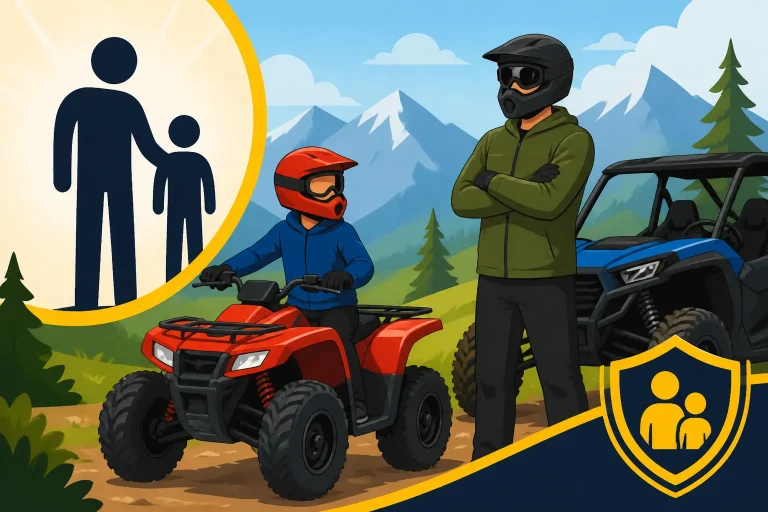
A child’s age alone is not enough to decide whether a machine is appropriate. Consider the child’s size, experience, judgment, ability to reach and operate the controls, and the terrain. Choose a machine the rider can control without stretching, leaning awkwardly or being overwhelmed by its weight and power. A younger rider may need a separate, suitable machine rather than a turn on an adult’s ATV.
Set supervision rules before the ride, not halfway up a trail. Decide which adult is responsible, how close that adult must stay, and what happens if the group separates. Make clear that a child should stop and wait rather than follow an unfamiliar route or attempt to catch up at speed. For additional Colorado-specific context, see Colorado Age Rules for Young OHV Riders and Who May Supervise a Young Colorado Rider.
Private ranch use and riding on public roads are not interchangeable situations. Age limits and supervision requirements may apply differently depending on where the machine is being operated. If the plan includes any public road or other public route, check the rules for that route before a young rider takes part. Don’t assume that permission from a parent or ranch owner overrides a rule that applies to the public route.
Match the machine to the task and the ground
A utility machine used for ranch work may carry tools or supplies, but loading it beyond its capacity can make it unstable. Follow the manufacturer’s limits for passengers and cargo, secure loads, and avoid letting a load block the driver’s view. Keep people out of cargo areas unless the machine is designed for passengers there.
Before riding, check tires, brakes, steering, lights and controls. On a UTV, use seat belts and keep the cab or safety features in working order. On an ATV, avoid carrying a passenger unless the machine is designed for one. These are practical safety rules, not substitutes for checking any legal requirement that applies to the location.
Ranch terrain can change quickly. A dry two-track may become muddy, rutted or slick after rain or irrigation. A familiar route can be unsafe when cattle are moved, a gate is left open, or equipment is working nearby. Close gates as directed, yield to livestock and ranch vehicles, and keep enough distance to stop safely. Avoid riding through crops, wetlands, streambanks or areas where tires could cause damage.
Build a simple plan for family and guest rides
A short pre-ride check prevents many avoidable problems. Confirm that riders know the route, their machine’s limits, and how to contact the group if they get separated. If guests are unfamiliar with the property, explain boundaries and hazards rather than assuming they will recognize a gate, ranch track or no-riding area.
Use a consistent routine:
- Confirm access. Make sure each rider has permission and knows the approved route.
- Check location and conditions. Look for livestock, workers, gates, weather changes and any route closures.
- Inspect the machine. Check controls, tires, brakes, fuel, protective equipment and cargo.
- Review rider roles. Identify the lead and sweep rider, agree on spacing, and set a regroup point.
- Carry useful essentials. Bring water, basic first aid supplies and a charged way to call for help where service is available.
- Reassess before leaving the ranch. If the ride will enter public land or a public road, stop and verify the route and paperwork requirements first.
Visitors should receive the same briefing as family members. A guest may know how to drive a UTV but not understand where the ranch ends, which gates should remain closed, or where a public route begins. Don’t lend a machine without explaining the approved route, passenger rules and emergency plan. For rides that involve public land, check whether the machine’s registration or permit status and the rider’s route are appropriate before handing over the keys.
Keep documents organized, but don’t confuse carrying paperwork with having permission. When public-land use requires a permit or registration, make sure the machine meets the requirement before it leaves the ranch. When a ride stays on private land, keep a clear record of the owner’s approval and any limits the family has set. For general background on how private-land use and registration interact, see Private Land Riding and Colorado Registration.
The safest approach is to treat the ranch as one part of the plan, not as a blanket exception. Confirm the property boundary, identify every road or trail on the route, and check current Colorado rules whenever the ride crosses onto public land. That simple distinction helps families enjoy ranch riding without mistaking private access for permission to ride everywhere.
Disclaimer
This article is for general informational purposes only and does not constitute professional advice. Laws, prices and regulations vary by location and change over time. Consult a qualified professional for guidance on your specific situation.