Hauling Game Out by OHV
Hauling game out by OHV can save a long pack-out, but a hunting license does not settle every question about where you may ride or what your machine can carry. In Colorado, plan around hunting rules, land access, OHV requirements, trail closures, and safe loading. Checking each before the hunt helps prevent a difficult recovery from turning into a citation or a rollover risk.
Check hunting and OHV rules before planning retrieval
Treat the hunt and the ride as two separate activities with rules that overlap. Your hunting license and harvest tag cover hunting requirements; they do not automatically give you permission to cross private land, ride a closed route, or use an OHV without the required registration or permit.
Confirm the rules for your species and hunting area
Colorado Parks and Wildlife regulations vary by species and hunting area. Before the trip, check the current rules for the animal you plan to hunt, including tagging, evidence-of-sex requirements, carcass handling, and any restrictions on transporting parts. Those requirements may affect how you field dress and divide the animal, as well as what needs to remain with each portion during transport.
Do not assume the requirements are the same for an elk, deer, or another species. Nor should you rely on an old tag, a past season’s regulations, or a hunting partner’s recollection. Use the current Colorado Parks and Wildlife regulations for your license and hunt area. If the animal is difficult to identify, the tag is damaged, or you are unsure how a carcass may be divided, contact the agency for guidance before removing parts.
Hunting access is another separate issue. Public land does not mean every route is open to motorized travel, and permission to hunt on private property does not necessarily grant permission to ride an OHV across it. Confirm both where you may hunt and where you may drive. Colorado Permits for Hunting Access explains why access and vehicle requirements need to be checked independently.
Verify your machine’s permit and the route’s status
For a Colorado-registered machine, check that its registration is current and that you understand where its decal and registration documents belong. Nonresidents should confirm which Colorado permit applies to their machine and the places they intend to ride. Requirements can depend on whether the vehicle is an OHV, a licensed vehicle, and whether the route is managed by a particular land agency. Colorado OHV Permits for Out-of-State Riders covers the nonresident side of that decision.
A plate is not a universal substitute for an OHV permit, and a permit does not make every road or trail legal to ride. If your machine is street-legal, check the rules for the particular public land and route rather than assuming its registration settles the issue. Do Licensed Vehicles Need a Colorado OHV Permit? and Colorado Permits for Plated Street-Legal Vehicles are useful starting points.
Before the hunt, look up current route maps, seasonal closures, and any local restrictions. A route shown on an old map, a trail open earlier in the season, or a track on a phone app may no longer be open. Check the responsible land manager’s current information, signs at the trailhead, and any posted closure orders. For broader context, see Colorado OHV Rules During Hunting Season and Colorado Permit Rules on Designated Trails.
Do not assume that retrieving an animal allows you to leave a designated route or ride around a closure. If an animal is down beyond a legal route, stop and check with the land manager or wildlife officials about lawful recovery options. The fact that the animal is already harvested does not automatically authorize cross-country travel.
| What to confirm | Why it matters | Practical check |
|---|---|---|
| Hunting license, tag, and species rules | Tagging, evidence requirements, and carcass transport rules may differ | Read the current regulations for the hunt area and species |
| OHV registration or permit | The hunting license does not replace vehicle requirements | Confirm what applies to your machine and riding location |
| Land access and route status | Hunting access does not necessarily include motorized access | Check permission, maps, signs, and current closures |
| Machine capacity | Game, riders, and gear all contribute to the load | Review the owner’s manual and rack or cargo-bed limits |
| Transport setup | A shifting load can affect steering, braking, and stability | Bring suitable bags, tie-downs, and tools before the hunt |
Load game safely without overloading the machine
A successful harvest can create a heavier, less balanced load than you expected. Estimate the complete load before leaving camp: riders, clothing, tools, fuel, water, recovery equipment, and the animal all count. Check the machine manufacturer’s capacity limits and any separate ratings for racks, cargo beds, and tie-down points. Do not use a general vehicle limit to assume that every rack or accessory can carry the same amount.
Keep weight low, centered, and secured
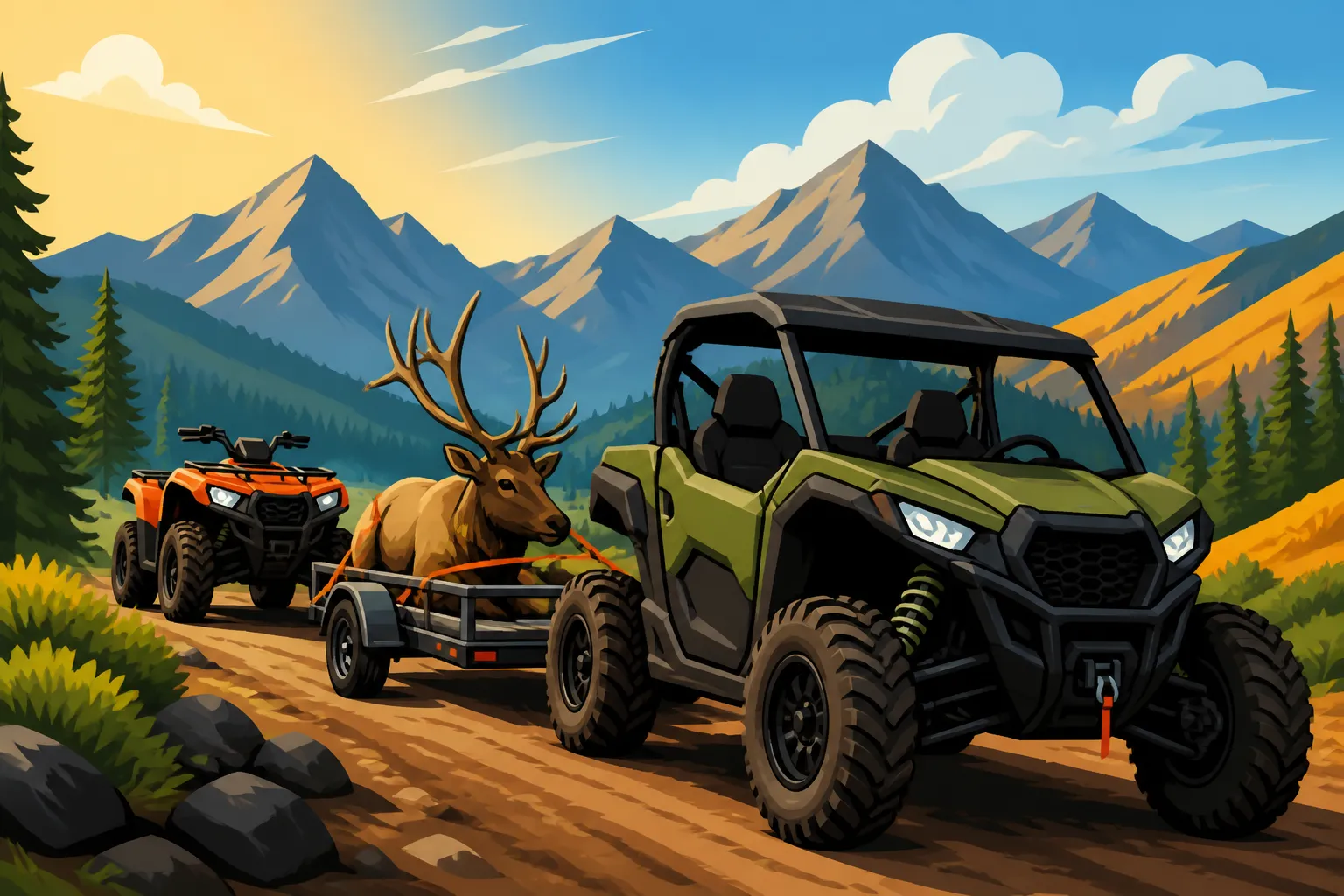
When possible, divide the carcass into manageable loads and keep the weight low and centered. A high or lopsided load raises the chance of tipping, especially on a side slope or uneven trail. On an ATV, heavy weight on one rack can make steering and balance harder. On a UTV, an off-center cargo-bed load can affect handling and braking. Respect the machine’s passenger limit, and do not carry a passenger in a space intended for cargo.
Use the machine’s designated cargo and tie-down points. Secure the load so it cannot slide forward, backward, or sideways when the vehicle brakes, climbs, or tilts. Keep straps away from moving parts, hot exhaust components, controls, and openings needed for cooling. Do not block lights or the operator’s view. Avoid letting a carcass or loose gear hang where it could catch on brush, a wheel, or the trail.
Use clean game bags or other suitable coverings to protect meat from dirt and contact with the machine. A cover should not trap heat around warm meat for longer than necessary. Follow safe meat-handling guidance for cooling and processing; riding slowly through a warm area does not replace proper care of the meat. If ordering game bags or tie-downs through Amazon, check the product’s material, dimensions, and stated load rating, and make sure the tie-downs are appropriate for your machine’s approved anchor points.
For a large animal, a single load may be impractical even when it appears to fit. Make more than one trip if that is the safer option and the route remains open. A full cargo bed or heavily loaded rack can change how quickly a machine accelerates, stops, and turns. Take a short test ride in a safe, level area before entering a steep or narrow route. If the machine feels unstable, unload and rearrange rather than trying to compensate with speed or aggressive steering.
Do not exceed the machine’s limits to avoid a second trip
Check the owner’s manual for limits that apply to the exact model and configuration. Accessories, added equipment, and different passenger arrangements can affect the amount of cargo the vehicle can carry. A rack’s rating may be lower than the machine’s overall payload capacity, and a tie-down point may have its own limit. If the manual or label is unclear, ask the manufacturer or a qualified dealer rather than guessing.
A trailer is not automatically a safer fix. It adds weight and can change braking, turning, and stability on rough terrain. Use one only if it is suitable for the machine and permitted on the route, and stay within the trailer and vehicle ratings. Never assume that a setup safe on a flat driveway will behave the same way on a rocky descent or narrow mountain road.
Before departing, check tire condition and pressure, brakes, steering, lights, and the fuel or battery range needed for the planned return. Make sure the operator can reach the controls freely and see the route. If the carcass prevents a clear view or interferes with safe operation, change the load or make another trip. Riding an OHV to an Elk Camp by OHV offers related planning context for using a machine during a hunt.
Plan the route, recovery, and transport after harvest
A safe game-hauling plan starts before the shot. Identify the legal route to and from the hunting area, note where a route becomes closed or restricted, and decide what you will do if the animal falls beyond reasonable vehicle access. A phone map is helpful, but it is not permission to ride a route. Carry the current map or route information you need, and be ready to turn around if signs or conditions show the route is closed.
Plan for an animal that cannot be loaded whole
Do not count on dragging a carcass behind an ATV or UTV. Dragging can damage meat, place an uncontrolled load behind the machine, and make the vehicle harder to stop or steer. It can also pull the machine sideways on a slope. If the animal is too large to carry within the machine’s limits, field dress or divide it as permitted by the current species-specific rules, then pack out manageable portions. Keep required tags and identifying evidence with the appropriate portions as the regulations direct.
If recovery would require riding off a trail, crossing land without permission, or passing a closure, do not improvise. Contact the land manager or Colorado Parks and Wildlife to ask what options are allowed. A lawful foot pack-out, another permitted route, or help from an authorized person may be necessary. Colorado Permit Exemptions on Private Land may help clarify the distinction between private-land riding and access to public routes, but confirm how the rules apply to your specific property and machine.
Prepare for breakdowns and changing conditions
A loaded machine can be difficult to recover if it becomes stuck or breaks down. Tell someone your planned route and return time, and carry water, basic tools, and suitable recovery gear. Know the machine’s recovery points and how to use them before you need them. Do not winch or pull a heavily loaded machine from an unstable edge, across a route used by other people, or from a location where the anchor could fail. Unload first when that makes recovery safer.
Leave enough fuel or battery range for a slower return with the load. Mud, steep grades, altitude, cold, and detours can increase the effort required. If the route becomes unsafe, wait for help or find a legal alternative rather than rushing to reach the trailhead. The animal is not worth a rollover or an injury.
At the trailhead or road crossing, secure the game and equipment before loading the machine onto a trailer. Keep the cargo contained during transport on public roads and follow the applicable rules for vehicle and trailer use. If you are not sure whether an OHV route remains open to your machine, stop and check instead of continuing because the animal is already on board.
Use a pre-ride checklist
Before hunting, take a few minutes to check the basics:
- Read current hunting regulations for the species, hunt area, tagging, and carcass transport.
- Confirm landowner permission and legal motorized access to the planned route.
- Verify the machine’s current registration or permit requirements and route eligibility.
- Check seasonal closures, signs, and current land-manager information.
- Review payload, rack, cargo-bed, and tie-down limits in the owner’s manual.
- Pack clean game bags, suitable straps, basic tools, and recovery equipment.
- Decide how you will handle a harvest that cannot be safely carried in one load.
- Tell someone your route and expected return, and keep a backup plan if the route closes.
The main rule is simple: keep hunting compliance, motorized access, and cargo safety as separate checks. A legal harvest does not make an otherwise closed route legal, and a machine that can move the load is not necessarily safe or within its ratings. For permit questions tied to private property, public land, or a particular machine, use the relevant rules and confirm details with the responsible agency before the trip.
Disclaimer
This article is for general informational purposes only and does not constitute professional advice. Laws, prices and regulations vary by location and change over time. Consult a qualified professional for guidance on your specific situation.