Colorado OHV Rules During Hunting Season
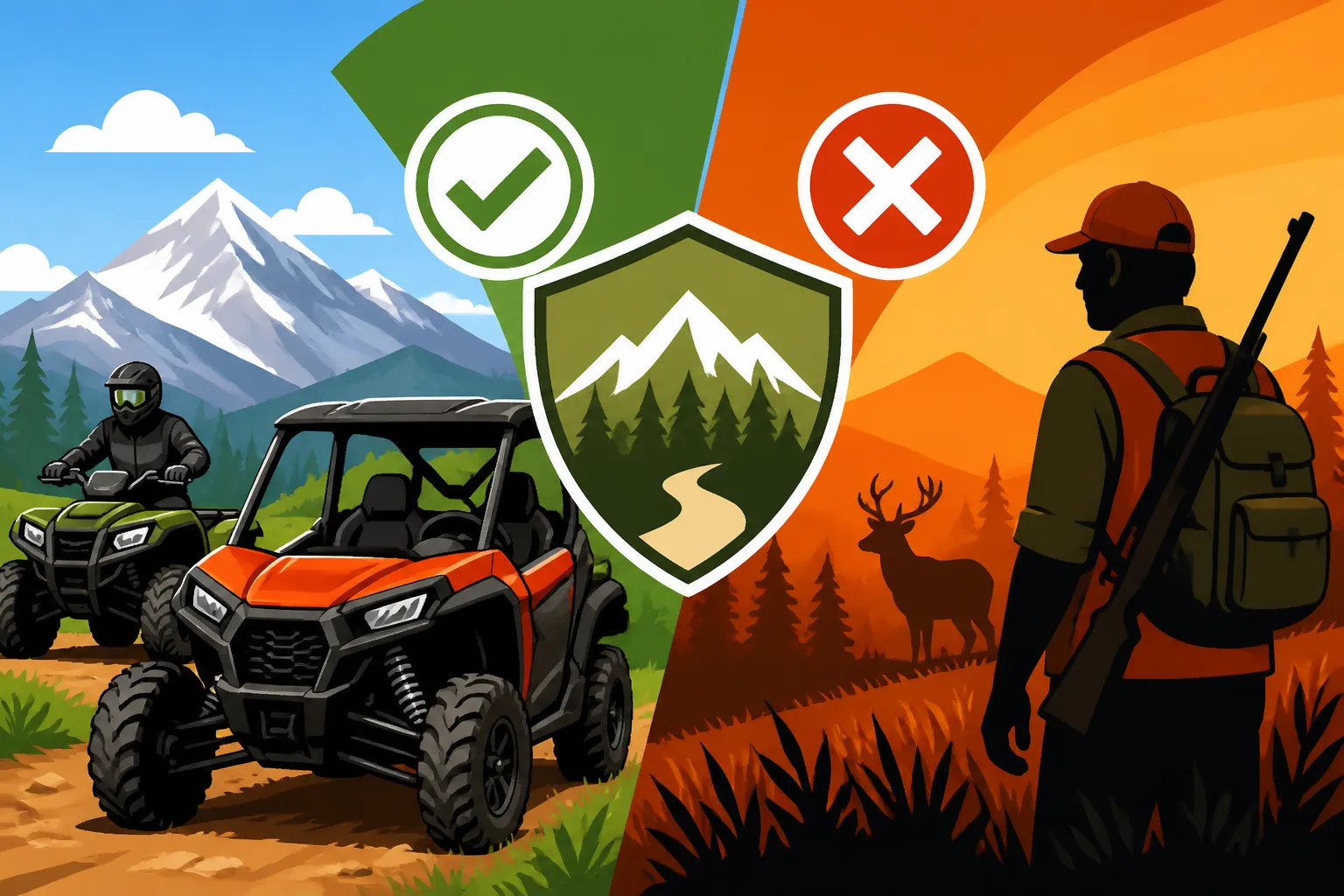
Hunting season adds people, gear, parked vehicles and wildlife activity to Colorado’s roads and trails. If you plan to ride an ATV or UTV during that time, a hunting license alone does not settle where you may go or what permit your machine needs. Check the vehicle rules, land access and current route closures before setting out.
Separate hunting authorization from OHV requirements
A hunting license and permission to hunt do not automatically authorize OHV use. The machine’s registration or permit requirements are a separate issue, and they depend on details such as where you plan to ride, whether the vehicle is registered or plated, and whether you are a Colorado resident or visitor.
For many off-highway vehicles used on public land, riders need the appropriate Colorado OHV registration or permit. The right option can differ for a Colorado owner and a nonresident visitor. A plate from another state does not necessarily replace Colorado’s OHV permit requirements, and a permit does not give you permission to ride on a closed route or enter land where you lack access. Confirm the current rules for your machine and destination with Colorado Parks and Wildlife before you travel.
If you are visiting, start with Which Colorado Permit an Out-of-State Rider Buys and Colorado OHV Permit Reciprocity With Other States. Colorado registration and nonresident permit requirements are not interchangeable in every situation. A street-legal vehicle may also be subject to different rules from an unplated OHV, so check the vehicle category rather than relying only on its appearance or where it is registered.
| Question | What to check before riding |
|---|---|
| Is the machine registered or permitted for this use? | Confirm the requirement for the vehicle, rider’s residency and land where it will operate. |
| Is the route open to motorized travel? | Check current agency maps, signs, seasonal dates and closure notices. |
| Do you have permission to cross or hunt on the land? | Verify access separately with the land manager or private landowner. |
| Are you also hunting? | Review the current hunting regulations for your species, unit, method and season. |
| Are you riding on a public road? | Check the road’s status and local rules; an OHV permit alone does not make a route legal. |
A permit is not a general pass for every public road, trail or piece of public land. Routes can have vehicle-width limits, seasonal closures or restrictions set by the agency that manages the area. Private land access also requires permission. For the permit side of the question, see Colorado Permit Rules on Public Land and Do You Need a Permit on Private Colorado Land?.
If a friend is taking you out on a ranch or other private property, ask what access the owner has granted and whether it includes riding the machine. Permission to hunt does not always mean permission to drive an ATV across the property, and access to one parcel does not automatically authorize travel across neighboring land. Riding a Friend’s Ranch Without a Permit can help clarify the distinction.
Confirm routes, land access and closures
Hunting season is not a blanket opening of roads or trails. A route must be open to your type of vehicle on the day you ride, and you must stay within its marked boundaries. A road shown on a map may have seasonal dates, be closed to motorized use, or allow only certain kinds of vehicles. Conditions and restrictions can also change after a closure notice is issued.
Check the map and closure information from the agency that manages your route. In national forests, a Motor Vehicle Use Map can show designated roads and trails, vehicle-use restrictions and seasonal dates. Read the map’s notes and dates, not just the colored route line. On other public land, check that area’s current visitor information and posted signs. If a sign at the entrance conflicts with an old downloaded map, do not assume the map is more current.
A useful pre-ride check is:
- Identify the land manager for every part of your planned route.
- Find the current motorized-use map or route information for that area.
- Check whether your machine’s width and type are allowed.
- Look for seasonal closures, fire restrictions and temporary notices.
- Confirm access for any private-road crossing or staging area.
- Save a map for offline use and note the route’s turnarounds.
Hunting access can involve a patchwork of public and private land. A route that reaches a trailhead or public parcel may cross private property along the way. Do not assume that a gate, track or existing tire marks indicate public access. Get clear permission before crossing private land, and follow any conditions the landowner sets.
If your ride includes a road section, check the road’s designation and local rules separately. OHVs are not automatically allowed on every public road, and being able to ride a route physically does not make it legal. Colorado Permit Rules on Designated Trails explains why a permit should not be treated as permission to use any motorized route.
Hunting activity does not override closures or resource-protection rules. Avoid driving off designated routes to reach a hunting spot, get around a closure or retrieve an animal unless the land manager specifically authorizes that use. Off-route travel can damage soil and vegetation, disturb wildlife and lead to enforcement. If you need vehicle access for a special circumstance, ask the land manager rather than assuming an exception applies.
Ride with hunters, wildlife and visibility in mind
During hunting season, a quiet trail can become a busy access route before dawn or near the end of the day. Hunters may be walking away from parked trucks, carrying equipment or watching for game rather than listening for an approaching engine. Slow down near trailheads, camps, road junctions and places where people are on foot. Stop if you cannot see far enough ahead to pass safely.
Make your approach predictable. Avoid sudden acceleration, aggressive revving or repeated passes through an area where hunters are set up. If you meet someone on foot, give them room and let them move to a safe place before proceeding. Do not assume that a person will hear you in time to step aside, especially if they are wearing hearing protection or are focused on wildlife.
Wildlife can also behave unpredictably when people and machines are nearby. Keep a controlled speed, stay on the route and give animals space. Never chase wildlife with an OHV or use a machine to push animals toward another person. If animals block the route, wait for a safe opportunity to pass without crowding them; if that is not possible, turn around.
Visibility matters in changing light, dust and wooded terrain. Use the vehicle’s required lighting and keep it in good working condition. Wear visible clothing, especially when you will be outside the machine, but do not treat bright clothing as a substitute for following hunting regulations. If you are hunting as well as riding, check the current Colorado hunting rules for the clothing requirements that apply to your activity and season. Those requirements are for hunters in the circumstances specified by regulation; they should not be assumed to be the same for every OHV rider.
A high-visibility vest or outer layer can make a rider easier to see when stopped beside a route, but it does not grant permission to ride or hunt. Carry a light source if you may return near dusk, and avoid starting a route that you cannot reasonably complete before dark. Weather, dust and poor visibility can make a slow, cautious return safer than pressing on to meet a schedule.
If you are riding with a hunting party, agree on a plan before leaving the staging area. Decide where the machine will be parked, whether it will remain on the designated route, how the group will communicate, and what to do if someone is delayed. Do not leave a machine where it blocks a gate, narrows a trail or prevents another vehicle from passing. Keep firearms secured and follow all rules for transporting them; never handle or discharge a firearm from an OHV.
Plan the ride around the hunt
A hunting trip can make a ride harder to plan because the group may be carrying more equipment, traveling before daylight or trying to reach a specific location. Build in time for slower travel, map checks and a change of plan. An ATV or UTV is not a guarantee of access to a remote hunting area, and it should not be used to cross a closure just because the walking route is inconvenient.
Before leaving, discuss the purpose of the machine. Is it being used to get to a permitted staging area, carry camp supplies, or travel between locations where motorized use is allowed? Keep the use within the route authorization. Hunting access and motorized access may have different boundaries, and an approved hunting location may not be reachable by OHV.
Plan fuel and recovery needs around the whole route, not only the distance shown on a map. Mountain roads can take longer than expected, and a route may not have a convenient place to turn around. Carry basic repair and recovery equipment suited to the machine, but do not use a winch or recovery line to drag a disabled vehicle through vegetation or beyond the route. If you are unsure whether a route is suitable for your machine, choose a more conservative option.
Tell someone who is not on the ride where you intend to travel and when you expect to return. Share the route and a backup plan, particularly if the area has limited cell coverage. Keep an offline map available and know how to identify the road or trail number on signs. A device with downloaded maps is useful, but it does not replace posted closures or a current agency map. Reading a Colorado Motor Vehicle Use Map and Downloading a Motor Vehicle Use Map offer practical help with map preparation.
If you are transporting an animal or equipment, secure the load so it cannot shift, fall onto the route or interfere with the machine’s controls. Keep the vehicle within its passenger and cargo limits. A heavy or uneven load can affect braking and handling, especially on a rough descent. For a hunting party using multiple machines, maintain enough space between vehicles to control dust and avoid crowding people on foot.
Before the trip, confirm that all riders understand the route plan and the rules that apply to them. This is especially important when visitors are using a Colorado machine, a Colorado resident is bringing an out-of-state vehicle, or the group includes riders who may assume that one permit covers every machine. Check each machine’s status rather than treating the group as one vehicle. You can review the relevant distinctions in Colorado Permits for a Second Machine.
Finally, keep a backup destination in mind. If a route is closed, a gate is locked or a landowner has not granted access, turn around and choose a legal alternative. A hunting plan may need to change, but riding beyond a boundary can create safety, access and enforcement problems for everyone who uses the area.
Disclaimer
This article is for general informational purposes only and does not constitute professional advice. Laws, prices and regulations vary by location and change over time. Consult a qualified professional for guidance on your specific situation.