Colorado Resident OHV Registration Price
Colorado resident OHV registration has a recurring cost, but the amount shown at checkout can depend on the registration year and how you buy it. The key is to check the current Colorado fee before paying and keep registration separate from title, tax, and trail expenses. Here’s what the price covers, what may be added, and how to confirm the right total.
What the Colorado resident OHV registration price covers
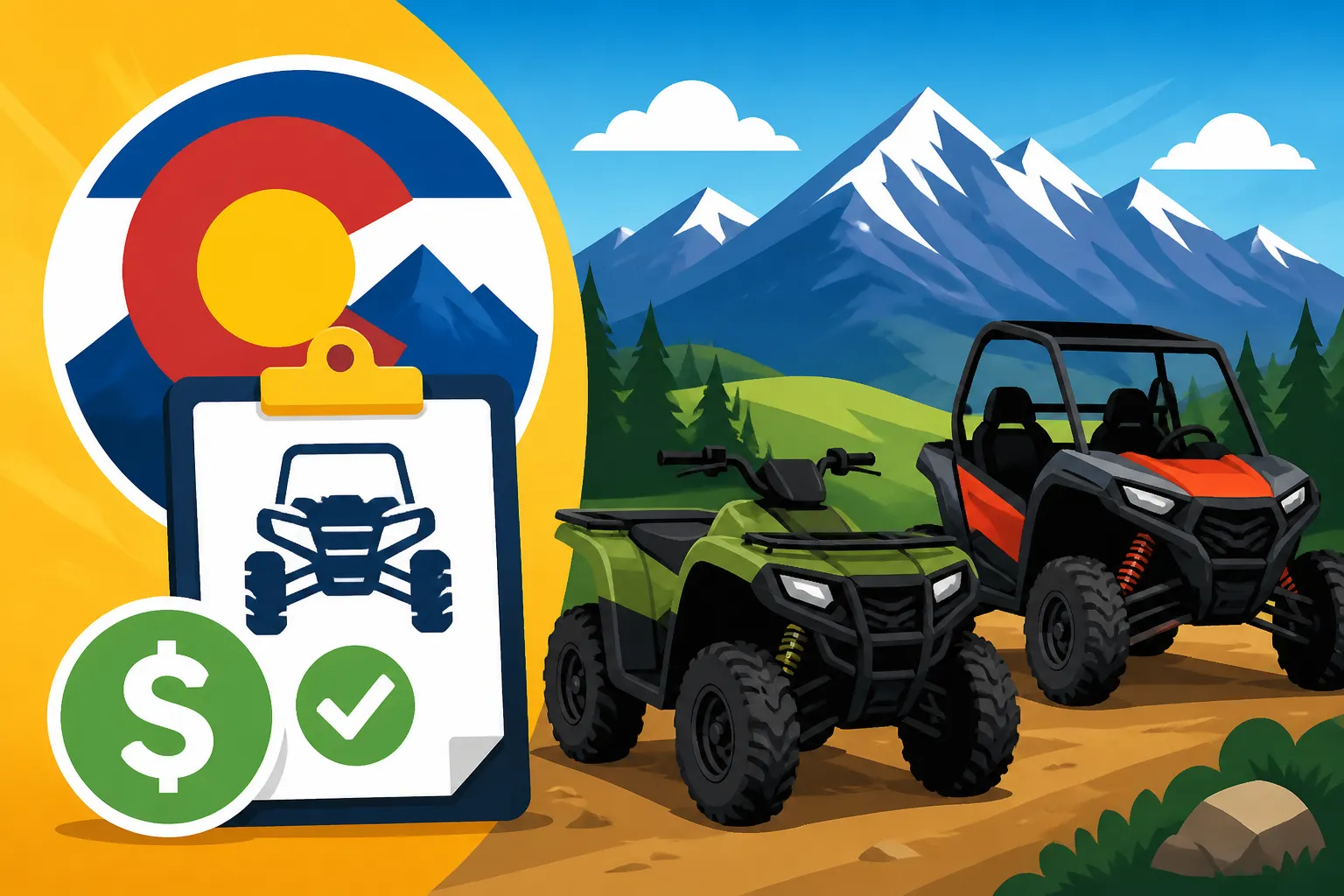
Colorado residents generally register an off-highway vehicle through Colorado Parks and Wildlife when it will be used in situations that require registration. The registration cost is for the required OHV registration, not a road license plate or a vehicle title. The decal and registration document serve a different purpose from title paperwork.
The amount can change, so use the current Colorado Parks and Wildlife fee information or the amount displayed through its registration system when you are ready to buy. Older receipts, forum posts, and prior-season articles may show a figure that no longer applies. For an overview of the process and the distinction between resident registration and other permit types, see Colorado Parks and Wildlife OHV Registration Explained.
A resident registration is generally tied to a specific machine. If you own multiple ATVs, dirt bikes, or side-by-sides, check the registration requirements for each one rather than assuming a single payment covers the whole household. The type of vehicle and where you plan to ride can also affect which registration or permit category applies.
Colorado’s OHV registration year runs from April through March, rather than following the calendar year. That matters when comparing prices or deciding when to renew: a registration purchased later in the season may still be subject to the same registration-year end date. See Colorado’s OHV Registration Year Runs April to March for how the annual period affects a purchase.
| Cost or document | What it is for | Included in the resident OHV registration price? |
|---|---|---|
| OHV registration | Required registration for qualifying use of the machine | This is the main registration charge; confirm the current amount at purchase |
| Title | Ownership record for a machine, when titling applies | No; title processing is separate |
| Sales or use tax | Tax that may apply to a purchase or transfer | No; it is a separate transaction issue |
| Dealer or payment processing charges | Charges that may appear through a seller or payment channel | Not necessarily; review the itemized total |
| Insurance | Coverage selected or required for a particular use | No; arrange it separately if needed |
| Trail, parking, or recreation costs | Access or services at a particular riding location | No; requirements vary by site |
The simplest way to avoid mixing up costs is to treat registration as one line in the machine’s ownership and riding budget. It does not replace a title, settle tax due from a sale, provide insurance, or guarantee access to every trail or recreation area.
What can change the amount you pay
The current fee is the starting point, but the total charged can differ from the basic registration amount. The purchase channel, the registration year, and any applicable transaction charges can affect what appears at checkout. Check the itemized amount before submitting payment, especially if you are registering several machines or buying through a vendor.
Purchase channel and transaction charges
Residents may be able to handle registration through Colorado Parks and Wildlife channels or an authorized sales agent. A vendor may show charges in addition to the registration itself, so compare the itemized total rather than relying on a remembered figure or a general statement about the fee. If you use an online system, review the final screen before paying; if you use an agent, ask which line is the state registration and whether a separate service charge applies.
For renewal steps and the online option, see Colorado OHV Registration Renewal Online. If you are buying for the first time, What Colorado OHV Registration Costs offers a broader look at the cost categories to check.
Timing within the registration year
A purchase date can affect how long you have before the current registration year ends. Do not assume that buying late in the season automatically gives you a full year from that day. Confirm the validity dates shown during purchase and note when the next renewal will be due. The official transaction record is more useful than a generic estimate because it reflects the registration period being issued.
This also matters if you are buying a used machine shortly before the registration year changes. Ask the seller what paperwork is current, then verify whether you need to transfer, renew, or obtain a new registration for the machine. A seller’s old decal or receipt does not by itself establish what you need to do next. Colorado OHV Registration After a Private Sale explains the paperwork questions that commonly come up after a private purchase.
Resident registration versus a nonresident permit
A Colorado resident registering a qualifying machine should not assume that a nonresident permit is the same product or has the same fee. The state has different pathways for residents and visitors, and the appropriate one depends on residency, machine status, and intended use. If you recently moved to Colorado, or you keep a machine registered elsewhere, confirm which category applies before paying.
Likewise, an out-of-state registration or plate does not automatically answer every Colorado OHV permit question. Reciprocity and local access rules can be more specific than a simple resident-versus-visitor distinction. Check Colorado OHV Permit Reciprocity With Other States if another state’s registration or permit is part of your situation.
What the registration price does not cover
A common source of surprise is treating “registration cost” as the full cost of getting an ATV or UTV ready to own and ride. Several separate expenses may arise around the same time, but they are not necessarily part of the resident OHV registration payment.
Title and ownership paperwork
A title records ownership; an OHV registration addresses registration for qualifying use. One does not automatically replace the other. Whether a machine needs a Colorado title depends on the circumstances and paperwork, so check the title rules separately rather than adding an assumed title charge to the registration amount.
If you are unsure which document you need, start with Do You Need Both a Title and a Registration in Colorado?. For title-specific questions, Titling an Off-Highway Vehicle in Colorado explains the separate process.
Sales and use tax
A purchase or transfer can raise tax questions that are distinct from the OHV registration fee. The tax treatment may depend on where and how the machine was bought, the transaction details, and applicable state or local rules. A registration receipt does not prove that sales or use tax has been paid, and paying tax does not take the place of registration.
If you bought from a dealer, ask which taxes and paperwork the dealer is handling and request an itemized record. For a private purchase or an out-of-state transaction, verify the applicable tax obligations with the appropriate official source. Do not rely on the registration checkout total to settle a tax question.
Insurance and riding expenses
Registration does not mean the machine is insured. Insurance needs depend on how the ATV or UTV is used and on the owner’s circumstances; a lender or other party may also have separate requirements. Check the policy terms directly if you need coverage, and do not assume a home, auto, or recreational policy covers every kind of OHV use. Insuring an ATV in Colorado covers the insurance question separately.
You may also need to budget for fuel, hauling, maintenance, parking, or access costs at a particular riding area. Some locations have their own entry or recreation rules. Confirm those requirements for the place you intend to ride; state registration alone does not establish that every route is open to your machine.
How to confirm the current price and pay the right amount
Because fees and checkout charges can change, the most dependable answer is the amount displayed by Colorado Parks and Wildlife or an authorized registration channel at the time you purchase. Use this checklist to avoid paying for the wrong category or overlooking a separate cost.
- Confirm that you are using the resident registration category. Check the state’s current instructions if your residency is recent, your machine is registered in another state, or you are registering a machine for someone else.
- Identify the machine and its paperwork. Have the vehicle information and ownership documents available. If the VIN is hard to locate or read, resolve that before starting an application rather than guessing.
- Check the current registration-year dates. Confirm the validity period shown for the registration you are buying, especially if the season is close to its end.
- Review the full checkout or receipt. Separate the registration charge from any vendor, payment, title, tax, or other line item. Ask the seller or agent to explain anything unclear before paying.
- Save the proof of registration. Keep the receipt and registration document in a place you can retrieve them, and follow current instructions for displaying the decal. For replacement or placement questions, see Where the Colorado OHV Sticker Goes.
- Set a renewal reminder. Do not assume the registration renews automatically. Check the renewal process and dates for the next registration year.
If you are buying a new or used machine, ask the seller to distinguish the price of the machine from registration, title work, taxes, and dealer charges. An itemized quote makes it easier to compare offers and spot duplicated charges. For private sales, confirm what paperwork will transfer and what you must complete yourself; an existing registration should not be treated as a substitute for checking the buyer’s obligations.
The practical answer to “What is the Colorado resident OHV registration price?” is to check the current official fee before purchasing, then verify the itemized total and registration dates. Use the registration amount as one specific cost, not as an estimate for all paperwork or riding expenses. That approach is more reliable than budgeting from an old price and makes it clearer which additional charges, if any, apply to your situation.
Disclaimer
This article is for general informational purposes only and does not constitute professional advice. Laws, prices and regulations vary by location and change over time. Consult a qualified professional for guidance on your specific situation.