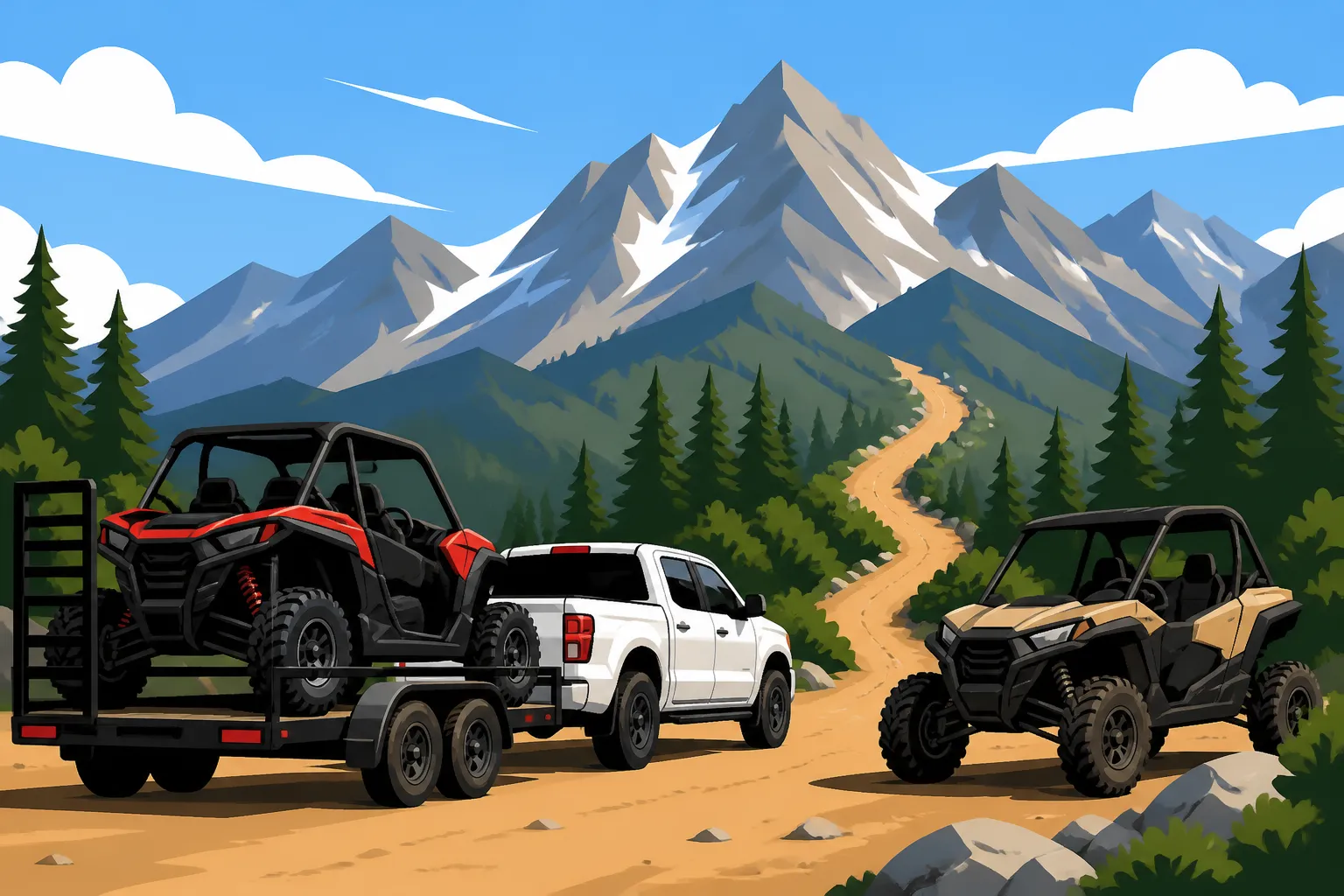
Colorado Trailhead Parking and Staging
A trail ride can go sideways before the machine leaves the trailer: the lot is full, the turnaround is too tight, or the spot you planned to use is not a legal staging area. This guide explains how to choose and use Colorado ATV and UTV trailhead parking, prepare for limited space, and avoid common problems at busy mountain and desert access points.
Plan your Colorado trailhead parking before leaving home
Confirm the legal access point and parking rules
A trailhead shown on a map is not automatically a place where you can park a truck, leave a trailer, unload machines, or camp overnight. Access may be limited to a signed parking area, and nearby pullouts or gates may be private, reserved for maintenance, or unsafe for staging. Before you set out, check the managing agency’s current information and posted signs at the access point.
This matters especially in Colorado, where routes can pass through a mix of public and private land. A forest road may lead to a trail network, but that does not mean every wide spot beside it is public parking. Check the relevant Motor Vehicle Use Map, local land-manager notices, and any closure orders. For a broader planning framework, see [Reading a Colorado Motor Vehicle Use Map] and [Where Colorado Closure Orders Are Posted].
Pay attention to more than whether the route is open. Look for restrictions on trailer parking, overnight use, vehicle length, staging, or access during seasonal closures. If the trailhead has a designated lot, use it rather than creating a new parking area on vegetation or widening an informal pullout. When signs are unclear, do not assume that a convenient space is permitted.
Match your parking plan to your route
Colorado trailheads vary dramatically. A developed staging area may have a defined entrance, marked spaces, and room to turn around. A remote access point might have only a small gravel turnout, with no room for a long truck-and-trailer combination. A route that looks easy to reach on a phone map may become narrow, steep, muddy, or rutted near the parking area.
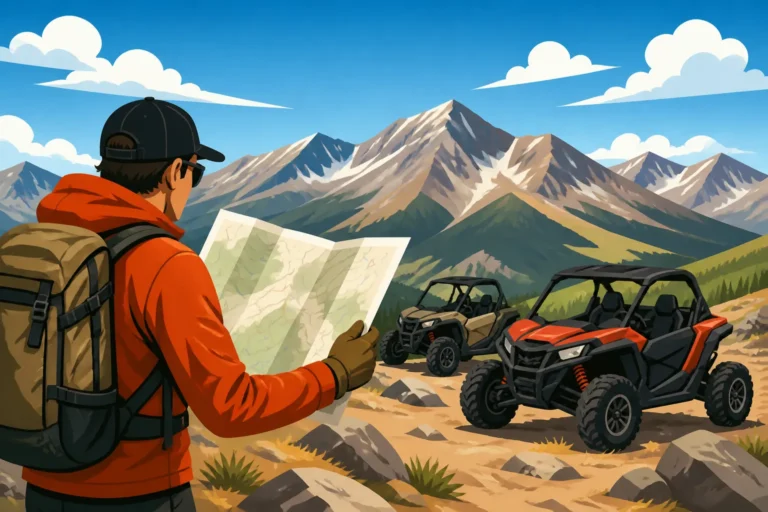
Use a map to check the approach as well as the riding route. Tools such as onX Offroad can help you review route context and locate potential access points, but don’t treat a digital map as permission to park anywhere or as a replacement for current agency information. Compare the map with posted restrictions and prepare a backup staging option that is actually allowed.
Think through the whole parking sequence: entering, positioning the tow vehicle, unloading, securing the trailer, and leaving without blocking anyone. If your group is heading toward a popular area such as Taylor Park or the Alpine Loop, decide in advance where you will stage and what you’ll do if the first choice is full. Guides to [Colorado Trailhead Parking That Fits a Toy Hauler] and [Where to Stage a Trailer for the Alpine Loop] can help you think through specific trip logistics.
Choose a parking setup that fits your machine and trailer
Check space for the whole rig, not just the ATV or UTV
A parking space that fits a pickup may not fit the pickup, trailer, and turning room needed to maneuver safely. Measure or estimate your full combination, including any hitch-mounted equipment, before choosing a trailhead. A long trailer can make a tight entrance or sloped turnout difficult even if the lot appears mostly empty.
If you are hauling a side-by-side, consider the width of the trailer and the space needed to open ramps and unload. On a busy morning, you may not be able to reposition repeatedly while other riders wait behind you. A simple pre-trip check—knowing your trailer length, the tow vehicle’s turning radius, and whether the trailer has a spare tire—can prevent a stressful arrival.
When you are unsure whether a particular access area can handle your setup, look for official descriptions or contact the land manager or local visitor information service before traveling. Do not rely only on photographs or a satellite view; imagery may be old, and snow, construction, temporary closures, or parked vehicles can change how much room is available.
Decide whether to keep the trailer attached
Leaving the trailer attached can be the simplest option when the lot has a suitable pull-through space and you can park without blocking the road or other users. It also avoids the need to maneuver a trailer into a separate space and makes departure easier if the weather turns. But a trailer can take up several ordinary parking spaces, and some small lots simply cannot accommodate a full rig.
Unhitching can help when there is a designated trailer area or a large, level space where the trailer can be secured. It is not a good solution if you would have to leave the trailer in an unauthorized turnout, block an access road, or place it where other vehicles need to turn. Check the surface before disconnecting: a slope, loose gravel, or soft ground can make it difficult to stabilize the trailer safely.
Whichever approach you use, keep access routes open. Avoid blocking gates, road shoulders, emergency turnarounds, drainage features, or spaces marked for agency vehicles. If other groups are arriving, coordinate calmly rather than trying to claim extra room with cones, ramps, or a second vehicle.
| Parking situation | What to consider | Safer approach |
|---|---|---|
| Small, informal turnout | Limited turning space and unclear boundaries | Verify it is an authorized parking area; have a backup |
| Marked staging lot | Posted rules, designated spaces, and traffic flow | Park within marked areas and keep lanes clear |
| Long truck and trailer | Combined length and maneuvering room | Confirm the approach and lot can accommodate the full rig |
| Busy weekend access point | Congestion and limited unloading space | Arrive with a plan, unload efficiently, and avoid saving spaces |
| Overnight parking question | Local rules may differ from daytime use | Check posted signs and land-manager guidance before staying |
Stage and unload without creating congestion
Use a predictable unloading routine
A clear routine helps everyone unload faster and reduces the chance of someone backing into a machine, ramp, or pedestrian. Before reaching the lot, have one person confirm where the group will park and another ready to guide the vehicle if the space is tight. Use a spotter where needed, and make sure the driver can see and hear them.
Once parked, unload only in a place where the ramps are stable and there is enough room to work. Set the parking brake, use appropriate wheel chocks when conditions call for them, and keep people clear of the path between the trailer and the ground. Avoid unloading into a travel lane or onto a blind bend where passing vehicles cannot see the activity.
Keep the staging area tidy. Put ramps away when they are not in use, secure loose straps, and store gear so it does not spill into neighboring spaces. Riders often arrive focused on the trail and forget that helmets, fuel containers, coolers, and tools can quickly take over a small lot. A compact, repeatable setup makes the process smoother for your group and everyone else.
Respect other users and leave room for emergency access
Trailheads are shared spaces. You may be parking alongside hikers, cyclists, horse trailers, campers, agency staff, or other OHV groups. Avoid occupying more room than your rig needs, and do not use an empty space as a staging bay if another vehicle could reasonably park there. If you need time to unload, work efficiently and move the tow vehicle once the machines and gear are safely clear.
Keep fire lanes, gates, signs, and road entrances unobstructed. Do not park where a vehicle would have to drive around you and into oncoming traffic, or where an emergency vehicle could be prevented from turning around. A tempting roadside patch can be especially risky on a mountain road, where sightlines are short and passing room is limited.
Be considerate about noise and dust, too. Starting several machines at once, revving engines while waiting, or driving repeatedly through the lot can bother nearby residents and visitors. Keep machines at low speed in staging areas and follow posted instructions. For guidance on minimizing trail impacts more broadly, read [Stay The Trail Ethics in Colorado].
Prepare for weather, elevation, and changing trailhead conditions
Allow for mountain access and seasonal closures
Colorado trailhead access can change with snow, mud, fire danger, road maintenance, and seasonal gates. A parking area that was accessible on a prior visit may be difficult or unavailable on a later trip. Check for access updates before driving a long distance, especially when your plan depends on a remote trailhead or a high-country route.
Do not assume a road is open simply because it appears on a navigation app. A gate may be closed, or the road may be open to some users but not to vehicles towing trailers. Where a seasonal restriction applies, parking outside the gate does not necessarily make it acceptable to continue riding. Check the route’s official status and respect closure signs. [When Colorado OHV Trails Open Each Summer] and [Colorado Trail Conditions Reports] are useful planning topics to review before a trip.
Build extra time into your travel day. A slow approach, a queue at a narrow entrance, or a full lot can push your ride later than expected. That matters on mountain routes, where afternoon storms, cold temperatures, and changing visibility can affect the return trip. If conditions make the access road unsafe for your tow vehicle or trailer, turn around rather than forcing the rig through.
Pack for a delayed start or an unexpected overnight wait
Even a well-planned parking arrival can involve a delay. Bring drinking water, warm layers, food, and basic first-aid supplies in the tow vehicle, not only on the machines. In high-elevation areas, sun exposure and dehydration can catch people off guard while they are unloading or waiting for a group to assemble.
Keep essential items easy to reach: keys, registration or permit documents, a phone, a paper map, and any emergency communication device you use. Cell service can be limited at remote access points, so do not assume you can call for help or look up a replacement route once you arrive. [Cell Service on Colorado Mountain Trails] and [What to Carry Over a High Pass] cover related preparation considerations.
If your group arrives and finds the planned parking area full, do not improvise by blocking a road or leaving a trailer in a questionable spot. Use the backup location you identified, or choose a different ride. That can be disappointing after a long drive, but it is much better than creating a hazard or discovering later that the vehicle was parked where it was not allowed.
Handle common trailhead parking problems calmly
What to do when the lot is full
A full lot is frustrating, particularly when everyone is ready to ride and the tow vehicle has been on the road for hours. Resist the urge to squeeze into a space that blocks another rig, park across a marked area, or unload on the road shoulder. Crowding can restrict emergency access and make it harder for every group to leave safely.
Instead, pause in a safe, legal place away from the entrance while the driver checks the backup plan. If another authorized staging area is available, use it. If not, consider a lower-elevation route or a different riding area with suitable parking. Before moving, check whether the alternative route is open and appropriate for your machine and experience level.
For popular destinations, arriving earlier can help, but it is not a guarantee. Weekends, holidays, and peak riding periods can bring more vehicles than the lot can handle. Your plan should work even if the first choice is unavailable: know what you will do, who will make the decision, and how the group will stay together.
Avoid disputes, damage, and unsafe departures
If someone has parked awkwardly or appears to be using more space than necessary, do not escalate the situation by moving their property or blocking their vehicle. Speak politely if it is safe to do so, or ask a land manager or official for help when the issue involves a posted restriction or an actual hazard. A tense exchange can distract drivers in a crowded lot and make a manageable problem worse.
Before leaving, walk around the tow vehicle and trailer. Check that ramps, straps, tools, and loose gear are secured, and make sure nothing has been left behind. Look for soft shoulders, sharp rocks, and uneven ground before pulling out; a trailer tire can be damaged by an obstacle that was easy to miss during arrival. Keep the group together and avoid backing into the road without a clear view.
On the return, be patient if other riders are loading. Leave enough room for them to work, and do not drive through an active unloading area. A few extra minutes in the lot are worth it when they help prevent a collision, damaged equipment, or a conflict that follows everyone onto the trail.
A practical pre-trip parking checklist
Use this checklist before you leave and again when you reach the access point:
- Confirm the trail and access road are open for your planned trip.
- Check official information for parking, staging, overnight, and trailer restrictions.
- Identify an authorized backup parking area in case the first lot is full.
- Compare the lot and approach with the full length and width of your tow vehicle and trailer.
- Decide whether to park with the trailer attached or use a designated trailer area.
- Assign a driver and spotter if the entrance or parking maneuver is tight.
- Unload only in a stable, permitted area that does not block traffic or other users.
- Keep gates, turnarounds, emergency access, and marked spaces clear.
- Secure ramps, straps, tools, keys, and personal belongings before riding.
- Recheck signs and conditions when you return, especially if weather or traffic has changed.
Good Colorado trailhead parking is mostly about preparation and courtesy. Confirm that the access point is appropriate for your entire rig, follow posted rules, unload without blocking others, and have a backup plan for a full or closed lot. Those small decisions make the start and finish of a ride safer for your group and easier for everyone sharing the trailhead.
Disclaimer
This article is for general informational purposes only and does not constitute professional advice. Laws, prices and regulations vary by location and change over time. Consult a qualified professional for guidance on your specific situation.