Dispersed Camping Near a Trailhead
Arriving at a Colorado trailhead with a trailer, tired riders, and no clear place to camp is a frustrating way to start a trip. Dispersed camping can put you close to the riding, but nearby-looking land is not automatically legal to camp on or drive across. This guide explains how to check access, choose a practical site, and plan an overnight stay without creating problems for yourself or other riders.
Start With the Land, Not the Map Pin
Check who manages the ground around the trailhead
A trailhead pin tells you where a route begins; it does not tell you who manages the surrounding land or whether camping is allowed. Near a Colorado riding area, boundaries can shift between National Forest, Bureau of Land Management land, state land, private property, and town or county areas. A clearing beside a forest road may look like an established campsite while sitting on private land or outside the area where dispersed camping is permitted.
Start by identifying the land manager for the actual spot where you want to camp. Then check that agency’s current rules, local notices, and any posted signs at the access point. Rules can differ between nearby parcels, and a temporary closure or fire restriction may affect an area that was open on a previous visit. The same check applies to your route from camp to the trail: public access on one road does not mean every connecting road is open to motorized travel.
Use a map to understand the layout, but don’t treat a map app as permission. onX Offroad can help you visualize routes and land boundaries while planning, but confirm important details with official maps, agency notices, and signs on the ground. For background on the rules that can apply, see [Dispersed Camping Rules on Colorado Forest Land] and [Colorado Open OHV Areas on BLM Land].
Confirm that camping and motorized access are both allowed
Camping access and OHV access are separate questions. You may be allowed to camp in an area but not ride directly from your site to the trailhead. Or a route may be open to vehicles while overnight camping is restricted nearby. A legal camp does not create a legal shortcut across a closed road, private parcel, or non-motorized trail.
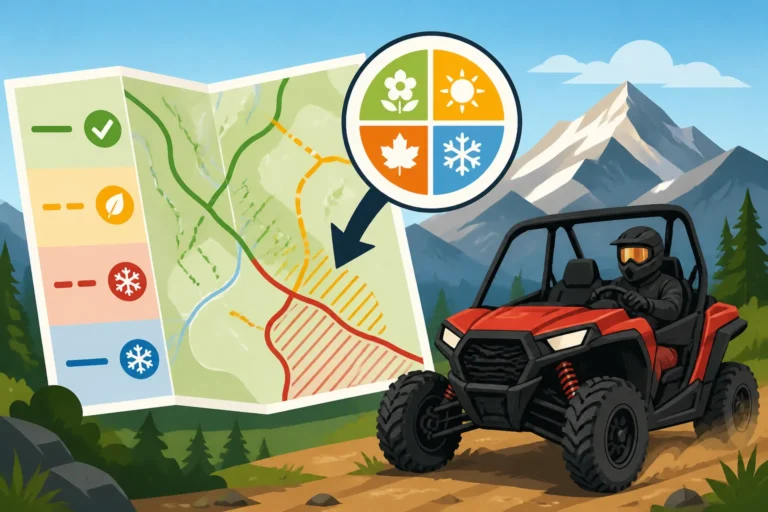
Check the specific roads and trails you plan to use. A Motor Vehicle Use Map, often called an MVUM, shows designated motorized routes for the area it covers and may include seasonal dates or vehicle restrictions. It can help you distinguish a road open to motorized use from a trail that is walking, bicycle, or horse access only. Read the map legend and seasonal notes instead of relying only on a colored line in an app. [Reading a Colorado Motor Vehicle Use Map] explains what to look for.
Before leaving home, make a short list of the campsite area, legal access roads, riding routes, and nearby alternatives. Save the relevant maps offline and keep a backup route in case the road is gated, muddy, closed for fire danger, or unsuitable for your trailer. That preparation is especially useful around high-country areas such as Taylor Park, the Grand Mesa, or the San Juan Mountains, where road conditions and seasonal access can change quickly.
Find a Site That Works for Camp and Riding
Look for established, durable camping spots
When dispersed camping is allowed, an existing site is usually a better choice than making a new one. Look for a previously used area with a clear vehicle pullout and durable ground, rather than spreading vehicles across grass, wetlands, stream edges, or fragile high-elevation vegetation. In some places, the permitted camping area is limited to marked sites or designated zones, so check local instructions before assuming any open-looking patch is available.
A site that seems roomy when you arrive can become awkward once you unload a trailer, park the tow vehicle, set up sleeping gear, and leave space for other campers to pass. Before committing, walk the area and check for soft ground, drainage channels, hanging branches, loose rocks, and a safe way to turn around. Avoid blocking a road, gate, trail entrance, or another established site. If the site requires driving around vegetation or widening a pullout to fit your rig, choose another one.
A little patience can save a long, stressful reversal with a trailer in the dark. If the first few sites are occupied, don’t assume you can create a new one beside the road. Have a backup camping area identified before you arrive, and be prepared to use it if the preferred spot is full or unsuitable. More campsite-planning ideas are covered in [Camping Beside Colorado OHV Trails].
Match the campsite to your vehicle and group
A tent camper and a truck towing a wide trailer have very different needs. A narrow spur that works for a pickup may not have room for a tow vehicle to turn around, and a steep or rutted approach can be a poor choice after rain. Think about the complete setup—not just the ATV or UTV—including trailer length, ground clearance, turning space, and whether your group can park without blocking access.
If you’re bringing several machines, agree on where each vehicle will go before unloading. Keep the road clear and avoid making the site bigger by driving over nearby plants or spreading out into a second clearing. For families or groups arriving separately, share a precise meeting point and a backup location; cell service may disappear before everyone reaches the area.
Choose a camp that makes the next morning manageable, too. You’ll want to check gear, secure food and rubbish, and load machines without rushing or disturbing nearby campers. If you have to move the trailer early to reach the riding route, consider whether that adds unnecessary driving or creates a bottleneck at a narrow access point. The closest camp is not always the easiest one.
Plan for a Self-Sufficient Overnight
Bring what you need without assuming there are services nearby
Dispersed sites generally do not offer the conveniences of a developed campground. Don’t count on potable water, a toilet, rubbish collection, a picnic table, or a reliable place to buy fuel at the last minute. Pack drinking water and food for the full stay, plus a way to store rubbish securely until you can dispose of it properly. If you’re carrying a portable toilet, plan how you’ll use and pack it out in accordance with the area’s rules.
Fuel planning should cover both the riding day and the return to a reliable refill point. A machine can use more fuel than expected when it is working hard on a long climb, carrying passengers, or crawling over rough ground. Keep enough reserve for route changes and delays, and don’t rely on a fuel stop being open or available near a remote trail. See [Fuel Planning for a Colorado Trail Day] for more trip-planning considerations.
Pack for changing mountain conditions even when the forecast looks pleasant at home. A sunny afternoon can turn cold, wet, or windy, and higher elevations can feel very different from the nearest town. Include warm layers, rain protection, lighting, first-aid supplies, and a way to communicate or navigate if your phone loses service. [Cell Service on Colorado Mountain Trails] can help you think through the limits of relying on a phone alone.
Prepare for fire restrictions, waste, and quiet hours
Fire rules can change with conditions and may differ by land manager or location. Check current restrictions before you travel, then follow posted instructions at the site. Don’t assume a metal fire ring means a fire is allowed, and don’t leave a fire unattended. If restrictions prohibit fires, plan meals and warmth without one. A small stove may also be subject to rules, so verify what is permitted rather than guessing.
Pack out rubbish, food scraps, and anything else you brought in. Food left around camp can attract wildlife, and loose rubbish can blow into nearby vegetation or waterways. Keep wash water and waste away from streams and other water sources, and follow the site-specific guidance for human waste. If a campsite is already littered or damaged, don’t add to the problem; choose a cleaner established site and report serious damage through the appropriate land manager when practical.
Noise matters in a place where sound can carry a long way. Keep generators, music, and machine warm-ups considerate, especially early in the morning or late at night. A group may be excited to get rolling at dawn, but starting every machine beside another camper’s tent is a quick way to sour the experience. The principles in [Stay The Trail Ethics in Colorado] are useful well beyond the riding route itself.
Choose Routes That Connect Camp to the Trail
Verify each road, trail, and seasonal restriction
Before you leave camp, confirm that your intended route is open to your machine type and width. Some routes are restricted to particular vehicle classes, and a full-size side-by-side may not fit on a narrower trail intended for smaller machines. Seasonal closures can also apply to a road that appears on a map. Check official maps and closure notices close to your trip, then pay attention to signs and gates when you arrive.
A route shown in a navigation app is a planning clue, not a guarantee that it is open or legal today. onX Offroad can be helpful for comparing possible routes and keeping a planned ride visible offline, but use it alongside official land-manager information. If the app, sign, and agency map appear to conflict, don’t push forward and hope the sign doesn’t apply. Stop, reassess, and use a route you can verify.
Build a conservative itinerary with room for delays. A short-looking road can take longer when it is narrow, rough, busy, or affected by weather. Tell someone where you intend to ride and when you expect to return. For route planning, [Colorado Trail Closures and Where They Are Posted] and [Colorado Trailhead Parking and Staging] offer useful related guidance.
Keep the campsite and the riding route separate in your planning
Don’t assume that riding straight out of camp is permitted just because the trail is nearby. You may need to tow your machine to a legal staging area, use a designated access road, or travel a longer route to reach an open trail. Keep any machine movement within routes authorized for that vehicle, and avoid cutting across meadows, stream corridors, or private ground to save a few minutes.
A practical plan accounts for where the trailer will stay while you ride. Make sure it is parked in a place where it doesn’t block other visitors, interfere with a gate, or create a hazard on a narrow road. If your campsite is remote, consider whether you can safely return there if weather changes or a machine develops a problem. Don’t count on being able to take every route back in darkness or poor visibility.
Use this quick comparison when choosing between possible campsites:
| What to check | Better choice | Caution sign |
|---|---|---|
| Land status | Camping is allowed by the land manager | Boundary or ownership is unclear |
| Access | Road is open to your vehicle and trailer | Gate, closure notice, or uncertain route |
| Site condition | Established, durable ground with room to park | New clearing would be needed |
| Trail connection | Verified legal route to staging or riding area | Plan depends on crossing closed or private land |
| Weather and terrain | Firm access with a safe turnaround | Mud, steep ruts, or no room to reverse |
| Camp impact | Space to contain vehicles, rubbish, and noise | Site is crowded or close to sensitive ground |
Leave the Site Ready for the Next Visitor
Pack out your impact and avoid expanding the campsite
Before you leave, walk the campsite and check around the vehicle, sleeping area, and any place where food was prepared. Pick up small rubbish that can be easy to miss, including ties, wrappers, and broken bits of gear. Make sure no food or waste is left behind, and remove anything you brought in rather than trying to hide it under rocks or brush.
Drive only on established access areas and avoid widening the site to make departure easier. Wet ground can be especially vulnerable: tires can cut ruts that remain long after a campsite looks empty. If the exit is soft or your vehicle is at risk of getting stuck, pause and consider a safer route rather than spinning tires or pushing through vegetation. If conditions make the site unusable, move to a legal alternative instead of damaging the ground further.
A tidy departure is also a courtesy to the next group. Put vehicles away from the road before loading, keep the loading area compact, and avoid leaving a trailer or machine where other visitors need to pass. Taking a few minutes to check the site can prevent a small piece of litter or a widened track from becoming someone else’s cleanup job.
Have a backup plan for closures and crowded areas
Colorado riding areas can be busy, and the first campsite you hoped to use may be occupied. A road may also be closed for seasonal conditions, a fire restriction, maintenance, or resource protection. Arrive with more than one legal camping option and enough supplies to reach an alternative without depending on a nearby store or campsite host. If a closure is posted, respect it; driving around a gate can create safety, access, and land-management problems.
If you’re planning around a popular area, consider staging farther away and towing your machines to the trailhead rather than insisting on camping beside it. That may mean a little extra setup, but it can be safer than trying to wedge a large rig into a crowded roadside pullout. It also reduces pressure on fragile spots directly beside a trail or road.
When conditions are uncertain, check notices again before you leave and be flexible about the ride. A shorter outing from a suitable camp is better than forcing an unsafe drive or riding a route you cannot confirm is open. For broader trip planning and camping considerations, [Colorado Trailhead Parking and Staging] and [Camping Beside Colorado OHV Trails] are useful companion topics.
Disclaimer
This article is for general informational purposes only and does not constitute professional advice. Laws, prices and regulations vary by location and change over time. Consult a qualified professional for guidance on your specific situation.